



Stèles
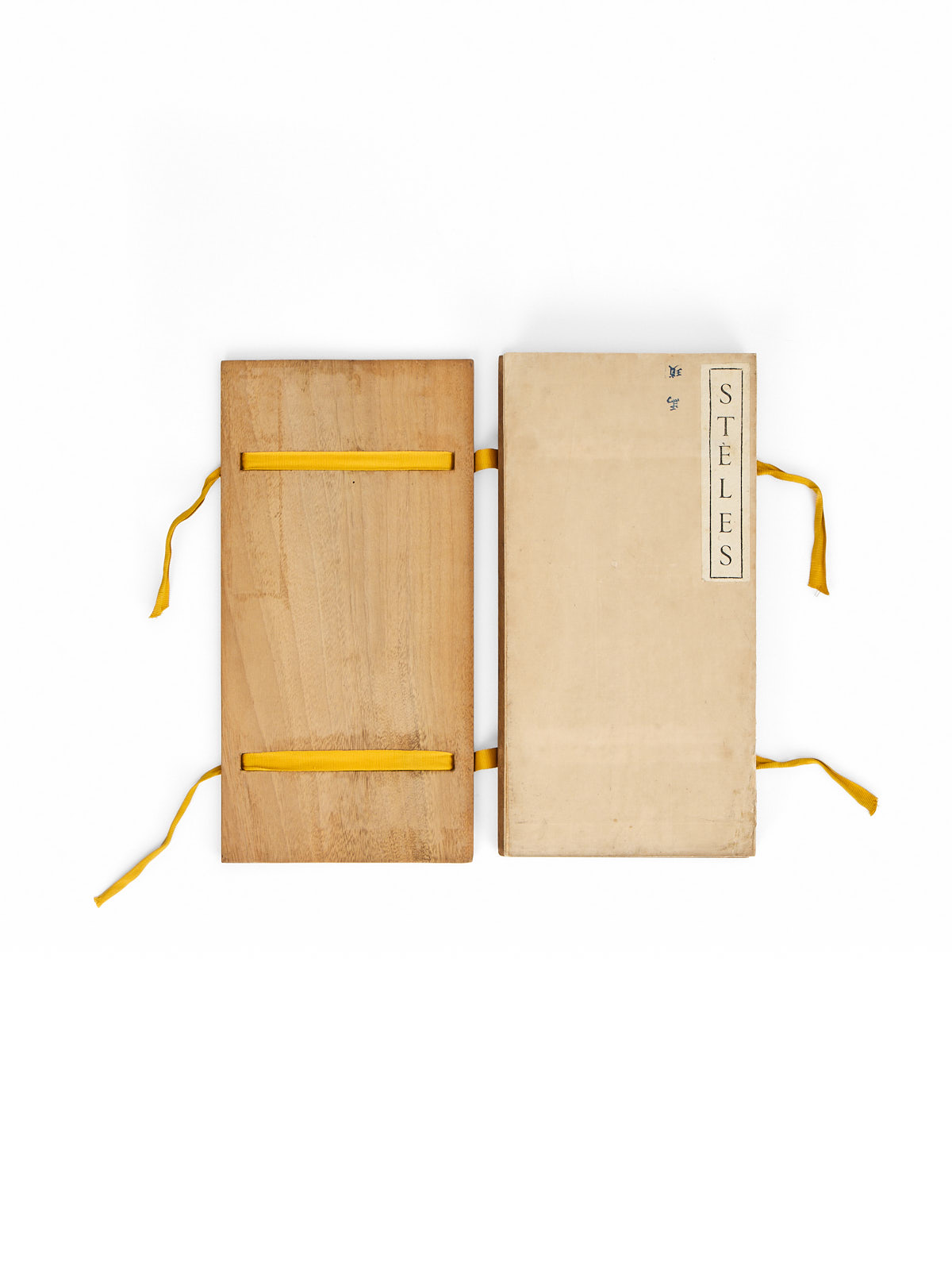
This copy is the one Segalen carried from China to his future French publisher, Georges Crès. Segalen presented him with a telling inscription, echoing their future collaboration, in copy no. 65.
Signed presentation inscription: “à George (sic) Crès, Maître éditeur aux Pays Barbares d'Occident des futures bibliophilies Coréennes – Victor Segalen, Paris, Sept. [19]13.”
This print run of 81 copies corresponds to the sacred number (9 x 9) of the paving stones on the third terrace of the Temple of Heaven in Beijing. Segalen intended these copies for his close friends and for figures he wished to honor; we have to date located 24 of them, including those of Claudel (to whom Stèles is dedicated), Bons d’Anty, Bourges, Chavannes, Clifford Barney, Debussy, Farrère, Gaultier, Gide, Gilbert de Voisins, Gourmont, Jaloux, Jessé-Curély, Lartigue, Loti, Monfreid, Dr Poupelain, Pouvourville, Dr Robin, Saint-Pol-Roux and Yvonne Segalen, the latter later giving one to André Malraux and another to Antoine de Saint-Exupéry.
Victor Segalen arrived in Paris via the Trans-Siberian Railway on 22 July 1913 and left again for China on 17 October of that year. He met Georges Crès in September, through Remy de Gourmont: “For the first time I leave a publisher’s office not furious, but enthusiastic. In a word, everything I could want — he would even accept a volume on nail clippings if I insisted on it. He considers me one of the ‘great men’ to come, and above all does not haggle over friendly arrangements.” (Letter to Yvonne, who had remained in China, September 1913). Crès, a passionate bibliophile delighted by the volume Segalen showed him, then proposed that the poet direct a “Korean” series, conceived in the spirit of Chinese bibliophily, of which Stèles would be the first title. Only three volumes would ultimately appear in it: Stèles by Segalen (for the second edition), Connaissance de l’Est by Paul Claudel, and Mardrus’s Histoire d’Aladin et de la lampe magique.
Georges Crès was born with a passion for books: he began as a bookseller’s clerk at thirteen, at the Augustin Challamel bookshop, and spent seventeen years learning the trade as a complete autodidact. In 1908, wishing to offer a broad readership of limited means well-printed, well-made editions of major works, he created the series “Les Maîtres du livre” with Van Bever, pioneering an affordable deluxe format that proved highly successful. He founded the publishing house Crès & Cie in 1913, then reorganized it in 1918 as Éditions G. Crès et Cie. He also founded, at the instigation of the French Ministry of Foreign Affairs, the first French bookshop in Zurich in July 1916, “Les Éditions françaises,” and later one in Bern, intended as instruments of cultural propaganda.
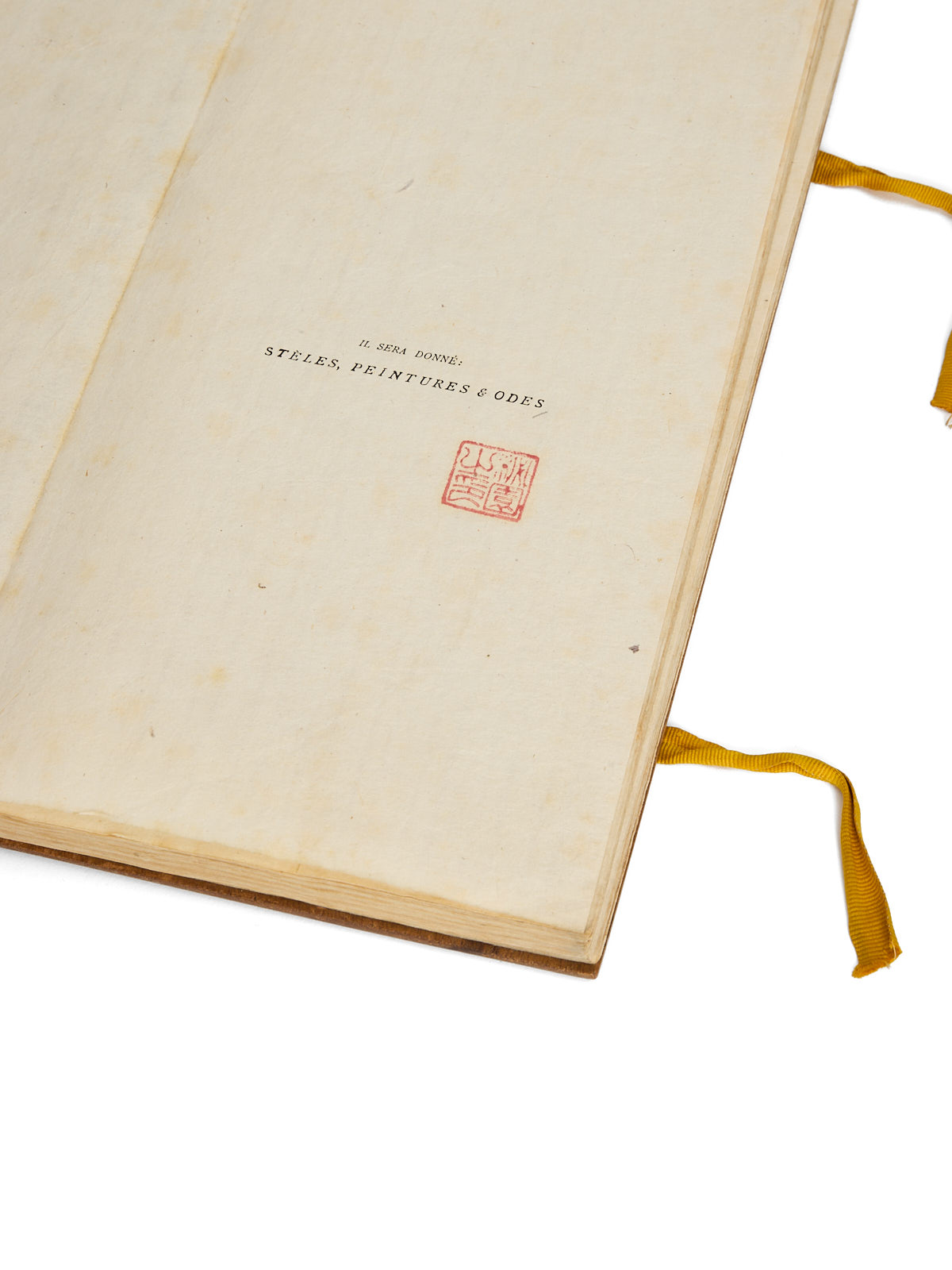
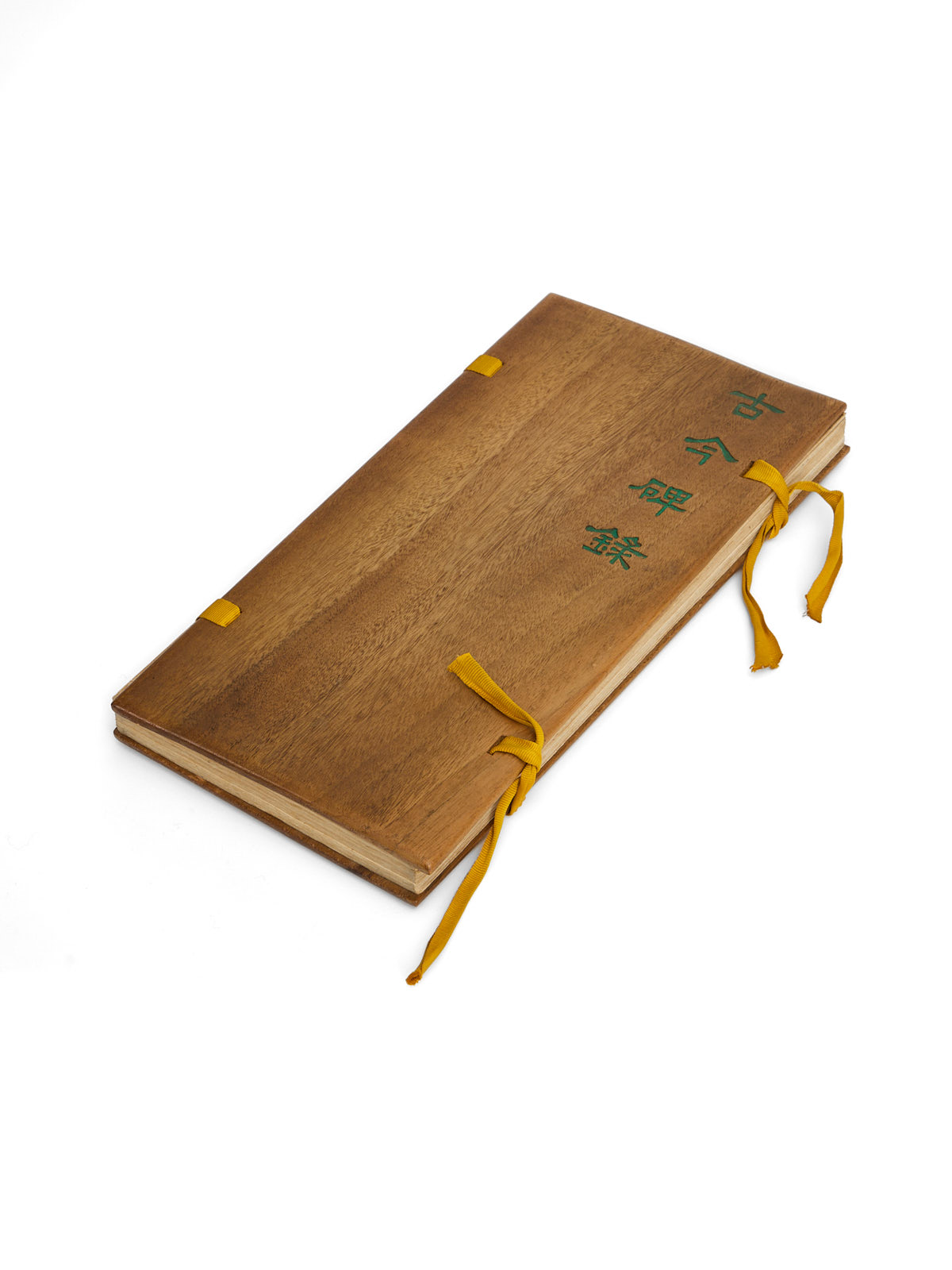
This copy bears, as it should, all three seals (some copies have only two), at the opening and close of the volume: three vermilion seals applied by hand. The first reproduces the title 古今碑錄, which Segalen translated as “Collection of ancient and everyday stelae”; the second, 秘園之印, reads “seal of Mi Yuan,” “Mi Yuan” (“Mysterious Garden”) being the literary name Segalen reserved for intimate friends; the third, taken from the epigraph of the first stele in the collection, 無朝心宣年, reads “Intimate proclamation of the Wu-chao era,” “Wu-chao” meaning literally “without dynasty.”
The proofs, corrected between May and June 1912, testify to the great care Segalen brought to this edition, a major literary work of the twentieth century.
The French edition Crès issued a year later was expanded with sixteen new poems and an afterword by the author, “Justification de l’édition,” and reached a wider audience with a numbered edition of 640 copies, still respecting Segalen’s strict specifications for paper and folding, which continued to make Stèles a truly spectacular book-object. On the same model, Crès published Peintures by Segalen in 1916.
In 1862, the Bishop of Beijing, Louis-Gabriel Delaplace, acquired a hand press for printing documents needed for his apostolic ministry. A press already existed there, dating from the former Jesuit Mission in Beijing, which had produced a few devotional works from woodblocks, suitable only for printing Chinese characters engraved on wood.
The need for a true printing press with movable type was all the more pressing since neither Beijing nor Tianjin possessed one. Bishop Delaplace requested and obtained from Paris two lay brothers to work exclusively on the press. Brother Auguste Maes, as soon as he learned of his appointment, trained at the Chamerol printing house in Paris before arriving in Beijing on 14 March 1878. Under his energetic direction for nearly fifty years, the press grew, acquiring new machines and eventually employing about fifty workers. Maes ran the workshop until June 1932, succeeded by the priest Aymard-Bernard Duvigneau, who directed the Lazarist press for several more decades.
Stèles was born of the shock Segalen experienced during his first expedition to China with Auguste Gilbert de Voisins. The collection gathers nearly 150 prose poems, each with an epigraph in classical calligraphy. In a letter to his traveling companion, Segalen explained his intent: “This edition, with its Chinese characters engraved on wood, will I believe constitute a bibliophilic novelty, for it is not a European booklet decorated in Chinese style, but an attempt at printing and composition in which Chinese bibliophily plays a role equal to that of European book conventions.”
Segalen thus borrowed from Chinese tradition the accordion fold and the specific binding of print albums, made of two camphor-wood boards held by silk cords. The paper had been chosen by the couple together; Yvonne Segalen later recalled to her daughter: “This Korean paper really did come from Korea. We had bought the first sheets in Beijing to line the lattice of a classic Chinese house for the winter, and your father was struck by the beauty of this paper” (Victor Segalen, Correspondance, Paris, Fayard, 2004, I, p. 1263). The page format was inspired by the proportions of stelae, those stone monuments erected in the Chinese countryside, along roads, in temple courtyards and before tombs — monolithic surfaces praising the virtues of the deceased, recording events, or proclaiming edicts and pious resolutions. The result was a wholly unique work, its layout not only subtle but of incomparable authority: one of the landmark works of early twentieth-century poetry, “a new literary genre” as the author intended. A long poetic ode unfolding on a single accordion-folded sheet, printed on one side only: the stele has no reverse.
The exhibition En français dans le texte (Paris, 1990, no. 340) put it well: “while writing his first stele, on 24 September 1910, Segalen began composing the remarkable preliminary text, arranging matters ‘so that every word would be doubled and resonate deeply.’ He thus composed a highly lucid ars poetica and, through the phrase ‘day of knowledge deep within oneself,’ joined the family of poets for whom poetry is a means of knowledge and an attempt to force open the doors of the world.” Stèles has since become one of the major collections of twentieth-century poetry, standing apart from dominant movements such as Surrealism, in the same Orientalist vein as poets like Saint-John Perse (Anabase, Amitié du Prince), Claudel (Connaissance de l’Est) and Henri Michaux (Un barbare en Asie).
A fine copy, retaining its two original wooden boards and cords, intact.