

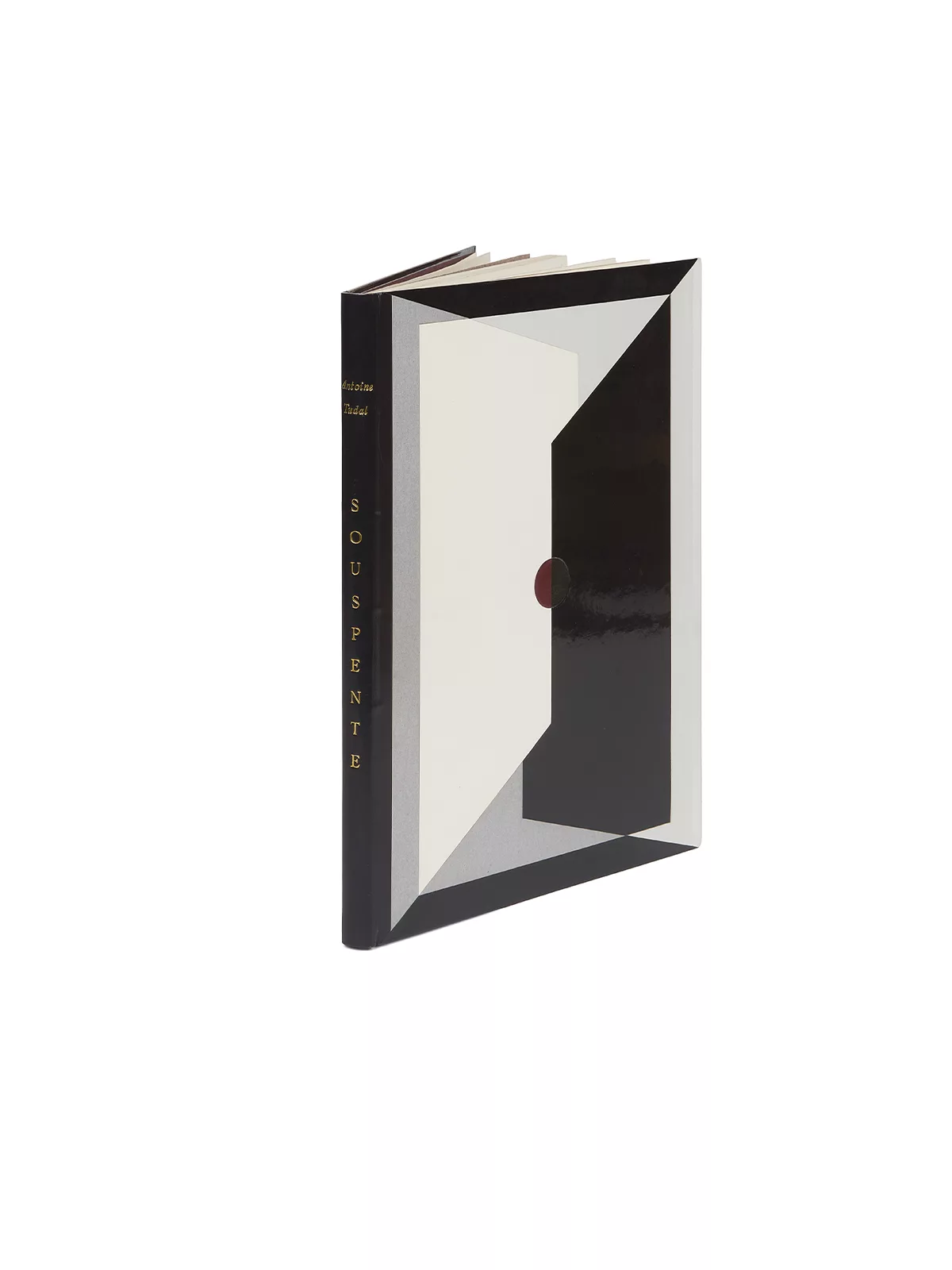
One of 125 copies on Rives BFK laid paper (no. 51).
Original lithograph by Georges Braque as frontispiece, printed by Mourlot.
Preface by Pierre Reverdy.
Born in 1931, the son of the painter Olek Teslar and stepson of Nicolas de Staël, who lived with his mother — herself a painter — Jeannine Guillou, whom he had met in Morocco, Antoine Tudal liked to recall the remarkable and moving circumstances that led him, at the age of thirteen, to attract the attention of Pierre Reverdy through the quality of his poems. Reverdy, a friend of the Cubists, published them shortly afterward under the title Souspente, writing a personal preface and persuading Braque to adorn the cover of the collection with an original lithograph.
“I was thirteen. I had already put together a collection, more precisely some fifty poems. I was living with Nicolas de Staël, who was living with my mother. We had come to settle in Paris clandestinely, with my mother and my little sister, who was the daughter of Nicolas de Staël and my mother. And, through a curious set of circumstances, she gave the poems to someone who typed them up. The next day, they had been read by the actress named Jandeline, the wife of Jean Mercure, who was a great theater director — Jandeline, an actress who performed under the direction of… Jandeline passed them on to a friend of hers named Nadine Robinson (the wife of the painter Cassandre), who was a friend of Pierre Reverdy, who passed them on to Braque. So, within forty-eight hours, Braque and Reverdy had come across what I had written. And Reverdy absolutely insisted on meeting me. One must remember that it was wartime, there was a curfew, Germans were everywhere. But one day, Reverdy turned up at the house with large shopping nets full of provisions. It was extraordinary: there was foie gras, a chicken, wine, champagne. He was accompanied by two or three lady friends. We spent the day together, a day completely outside of time. For the occasion, I was pulled out of my garret and told: ‘There’s a great poet who wants to see you, so wash up!’ He shook my hand and, in the voice you just heard, said to me: ‘Hello, colleague.’ Then came Braque. At that point Reverdy said to him: ‘You’re going to make him a lithograph, aren’t you?’ After a brief moment of surprise, Braque said: ‘Well, of course, it must be published.’ A few months later, Braque told me: ‘I saw Gaston Gallimard, who absolutely wants to publish you.’ It should be said that there was an illustration by Braque at stake, and that Reverdy had already promised to write a preface. But the poet added: ‘He’s too old for you, you mustn’t go to Gallimard.’ So he told me: ‘I turned down Gaston Gallimard and found you a young publisher who is twenty-three, and who will be perfect, since you are fourteen. You’ll be able to have a long life together.’ This young man of twenty-three was named Robert Godet. He was a wild young man who absolutely wanted to publish me. He had already published two or three interesting things. So we set off on the venture. The plan was to produce a deluxe edition with a lithograph by Braque (who had made his lithograph including the title of the book within it: the particular spelling of the title is therefore due to Braque. Since the title was incorporated by the Cubist painter into his lithograph, the spelling remained). We were to produce a hundred deluxe copies that would sell at a high price, and then an ordinary edition so that the texts could be distributed more widely. What actually happened is that this young Robert Godet did indeed publish the hundred deluxe copies, a rather beautiful book, which of course can no longer be found. We split them: he brought us fifty, he kept the other fifty. On his side he sold his in a week, and then he left for Tibet, in a cart, and we didn’t see him again for fifteen years.”