

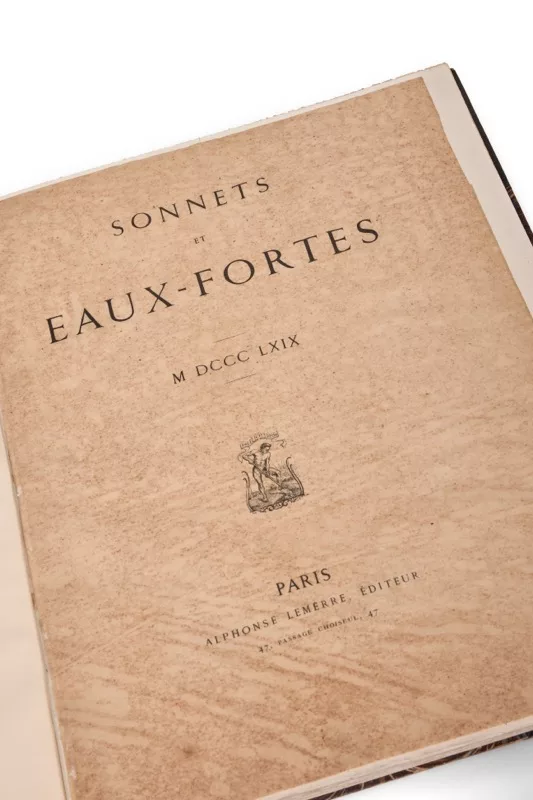
Sonnets et eaux-fortes
One of 12 copies on China paper.
It was Philippe Burty who first conceived the idea of pairing poems and illustrations in anthology form, inviting painters to draw directly on the copper plate to illustrate sonnets by contemporary poets — many of them then at the very outset of their literary careers.
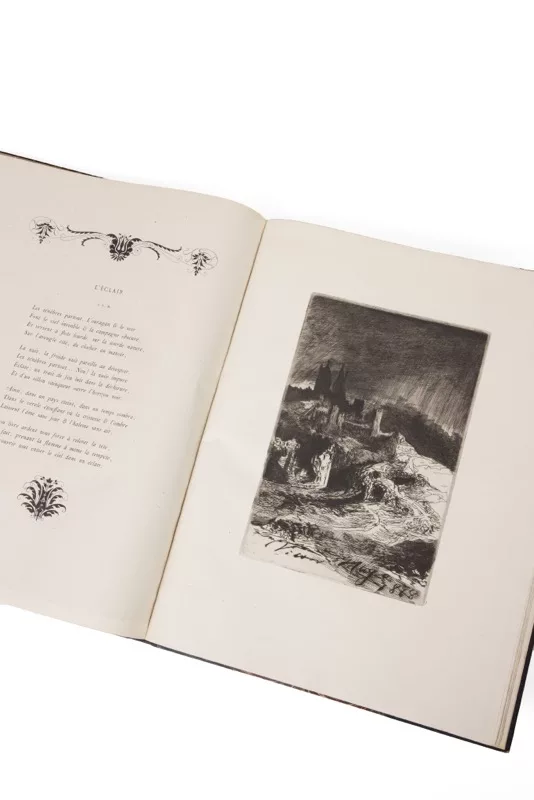
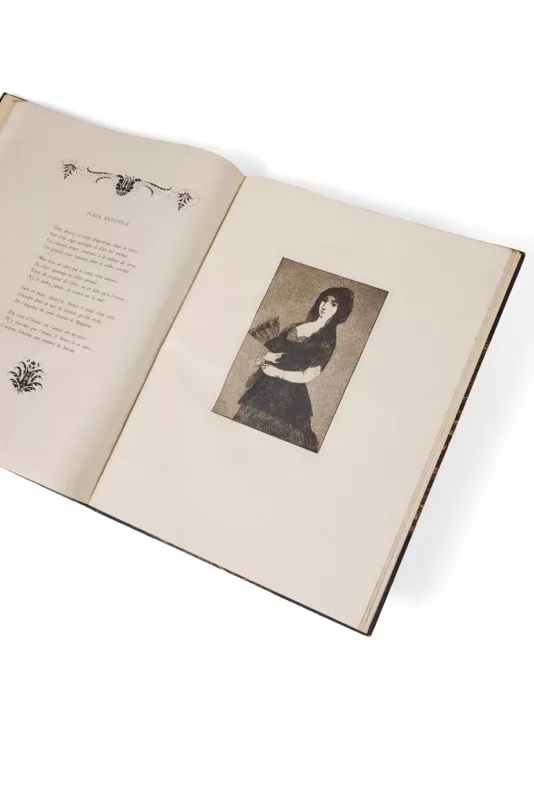
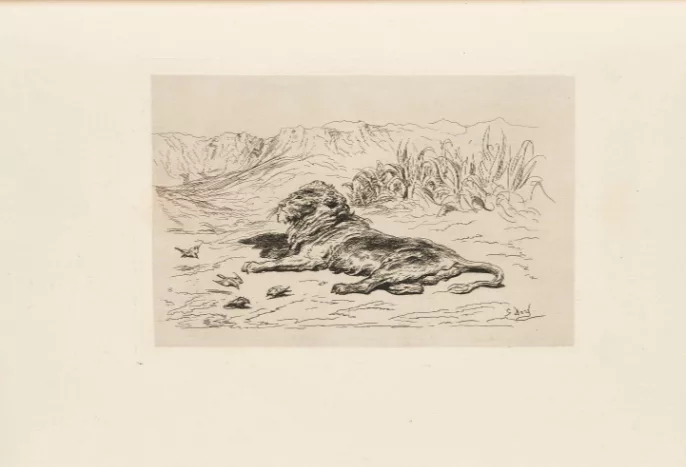
Forty-one original etchings were produced in this way, in reaction against reproductive engraving, bringing painter-engravers face to face with their contemporaries for the first time — with the exception of Victor Hugo, who “changed sides” and supplied his own drawing, engraved by Courtry to illustrate “L’Éclair” by his friend Paul Meurice. The collection thus brings together forty-two sonnets, arranged alphabetically by author, each accompanied by an etching. History has particularly remembered Manet’s admirable etching illustrating a sonnet by Armand Renaud, “Fleur exotique.” Among the poets are Banville, Glatigny, Gautier, Heredia, Leconte de Lisle, Sainte-Beuve, Verlaine and Anatole France; among the artists, Camille Corot, Édouard Manet, Gustave Doré, Johan-Barthold Jongkind, Jean-François Millet, Félix Bracquemond, Célestin Nanteuil, Seymour Haden and Léopold Flameng, among others.
The decorative elements of the text were woodcut by Prunaire, Manet’s engraver friend; the plates were destroyed once the print run was completed, a decision that scandalized Millet: “Between ourselves, I find this destruction of plates as brutal and barbarous as can be. I am not skilled enough in commercial matters to understand what purpose it serves, but I gather that if Rembrandt and Ostade had each made one of these plates, they would be destroyed.”
The work can indeed be considered the first illustrated anthology, and the second livre de peintre after Delacroix’s illustrated Faust of 1828, with Charles Cros’s Le Fleuve (1874), illustrated with eight etchings by Manet, forming the third.
We have been able to trace three of the four copies on parchment (the Burty and later Béraldi copy, bound by Marius Michel; the Esmérian copy, also bound by Marius Michel; and a copy without provenance, bound by Auguste Petit), and only two of the copies on China paper (the Descamps-Scrive and Sicklès copies, both bound by Marius Michel).
Very few copies therefore survive in strictly contemporary bindings: the Petit parchment copy, and this China-paper copy by Carayon. The others are slightly later, probably bound at the turn of the century. “Many copies have been destroyed to satisfy print collectors who removed the engravings by Corot, Manet, Millet and others from this book in order to complete their print collections of these artists” (Carteret).
A fine copy, of great rarity.
Rauch, no. 5; The Artist and the Book, no. 64; Carteret, III, 564 (hors commerce copies are “of great rarity”).