

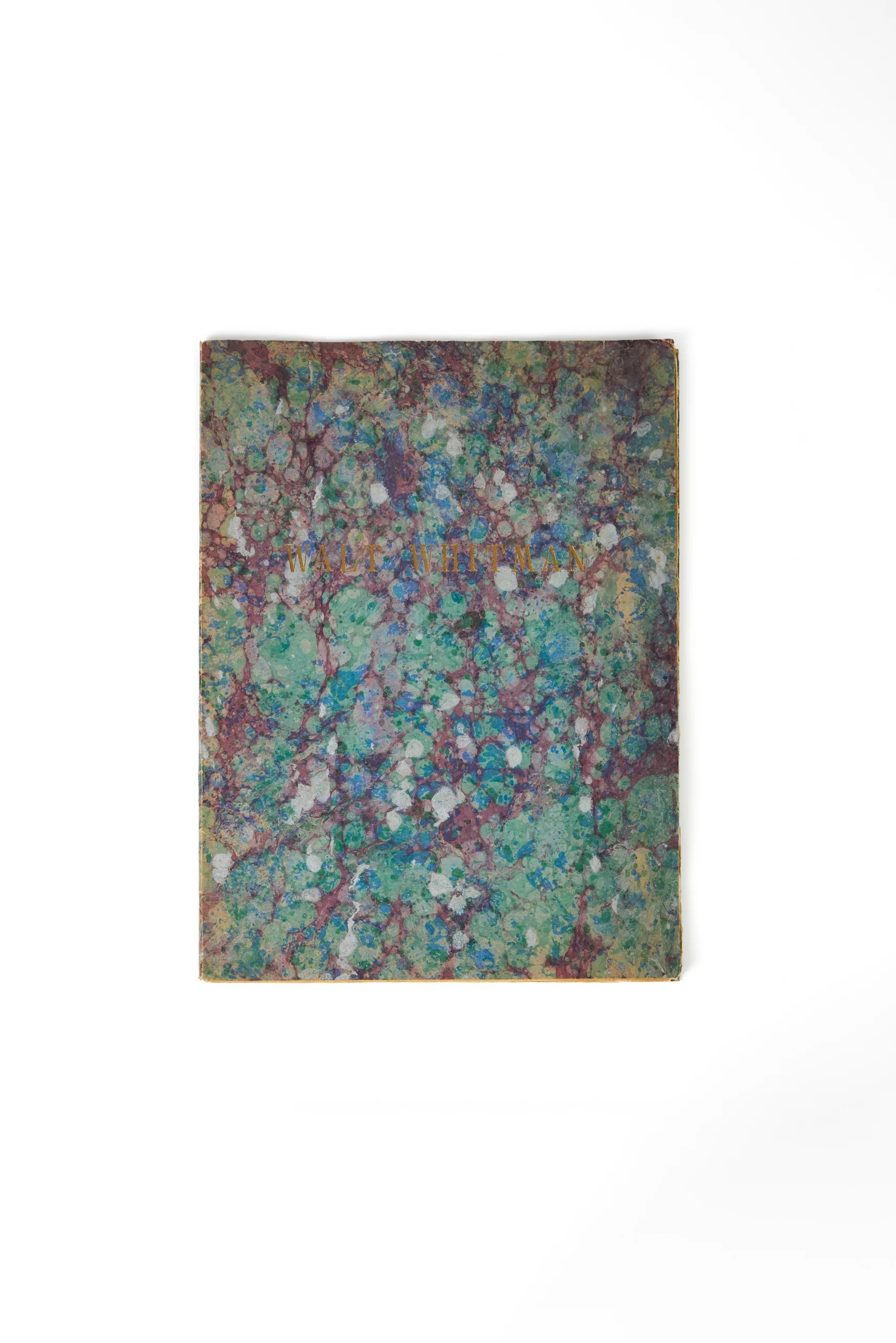
Six poèmes de Walt Whitman
One of 14 réimposé copies on old Japan paper (no. 2), after a single copy containing the drawings. Justified and signed by the publisher and the illustrator, with a presentation inscription from Aristide Gonon: “À Monsieur Eugenio Lopez Zudela. Hommage de cet essai de typographie. A. J. Gonon.”
The first translations of complete poems by Whitman are owed to Jules Laforgue, published in the symbolist review La Vogue in 1886. Whitman had given his consent to a complete translation, which never materialized, as Laforgue died in 1887.
In 1909, a complete translation appeared, the work not of a poet but of Léon Bazalgette, who chose to erase all the sexual ambiguities of Whitman’s poetry, for instance systematically feminizing the beloved interlocutor. It was in response to this highly partial reading that the collective translation project took shape, published in 1918 with a preface by Valery Larbaud, gathering an anthology of texts translated by André Gide, Valery Larbaud, Léon Fabulet and Francis Vielé-Griffin, alongside Laforgue’s own versions.
The same Léon Bazalgette provides these poems here, illustrated by Jean Lurçat in what was his first book: the collection contains “Une femme m’attend”; “Le corps d’un homme aux enchères”; “J’ai traversé naguère une ville populeuse”; “Combien de temps fûmes-nous entravés, nous deux”; “Vingt-huit jeunes hommes se baignent près du rivage”; “Chant pour toutes les mers, tous les navires.”