

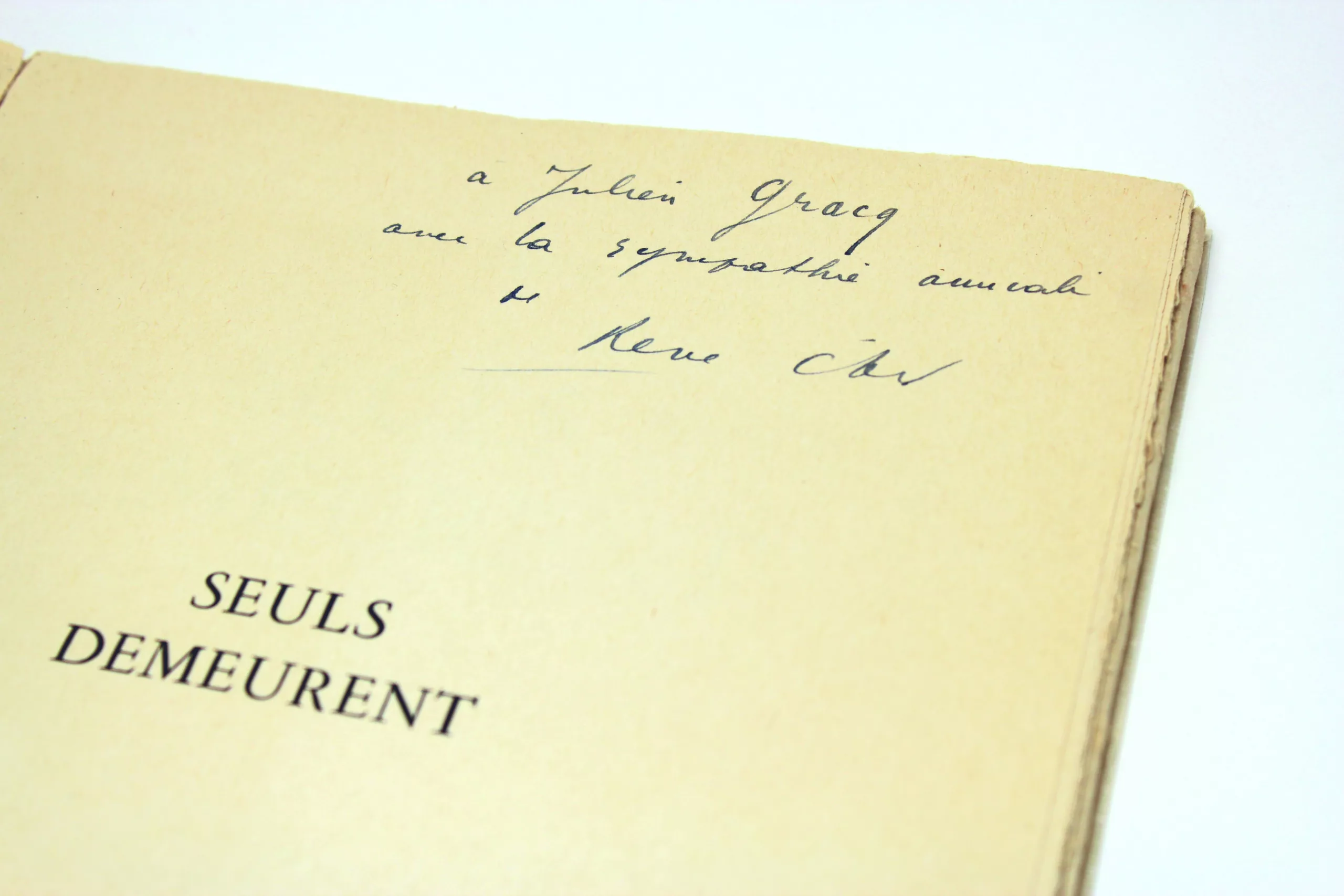
Seuls demeurent
One of 1,000 copies on Chataignier paper (the only paper after the 13 copies on pur-fil).
A precious copy from the library of Julien Gracq, with signed presentation inscription: “à Julien Gracq, avec la sympathie amicale de René Char.”
The first of Char’s books sent to Julien Gracq, in response to Un beau ténébreux, published almost the same day in February 1945 and sent to the poet by the novelist.
Few exchanges survive between the two men: six letters from Char to Gracq are held at the Bibliothèque Doucet (Ms 5101643, pre-empted at a 2008 sale — entirely unpublished), in which Char confides “how close your work is to me, I might say constant […] In this arduous journey through the poetry books of our time, the miracle of Liberté Grande occurs [published the year after Seuls demeurent].”
The earliest of these letters is dated 17 July 1946, and Gracq owned only three other inscribed books by Char: this Seuls demeurent (1945), Commune présence (1964), Faire du chemin avec (1976) and Chants de la Balandrane (1977). Two further titles, currently untraced, appear to have been sent by René Char to Julien Gracq: Les Feuillets d’Hypnos in 1946 and Lettera Amorosa in 1952.
Our copy is almost certainly the witness of the very first contact between the two men, or at least their first exchange. The novelist and the poet each published a book at the start of 1945: Un beau ténébreux was completed in print on 23 February, and Seuls demeurent on the 24th! It is difficult to know who made the first move, but it seems likely that Julien Gracq, who had until then published only Le Château d’Argol (1936), took the initiative by sending a copy of Un beau ténébreux, inscribed: “À René Char en très grande sympathie. Julien Gracq” (Sotheby’s, December 2014, lot 150). Char, in return, appears to have sent him this copy, which marks his return to poetry after having pledged not to publish anything of the kind during the war.
When Les Feuillets d’Hypnos appeared the following year, Char wrote to Gracq on 15 July, initiating their correspondence (the first of Char’s letters to Gracq is dated 17 July): “[…] This one [Les Feuillets d’Hypnos] struck me as very fine, and the least praise I can give it is that it does not trouble me, as Seuls demeurent did, in the sense that it casts a shadow over almost everything published since the war, dimming it. I tell myself that this comes — even if it is unpleasant for you to hear, I don’t know: I don’t think this is the kind of response you wish for your book — from the conviction you hold, almost alone in all the literature touching on the Resistance, that there is not much in common between the world of will and that of poetry.” (in Dans l’atelier du poète, Gallimard, Quarto, 1996, p. 454).
These two texts, Hypnos and Seuls demeurent, would remain Julien Gracq’s favorite collections. This is confirmed repeatedly in the correspondence held at Doucet, and in the other known letter from Gracq to Char (dated 13 February 1952): “Thank you for your Lettera amorosa. I place it alongside Les Feuillets d’hypnos and Seuls demeurent among your texts most dear to me […].”
A major work by the poet, here in a literary provenance of the highest desirability.
Publisher’s wraparound band preserved.