

Seuls demeurent
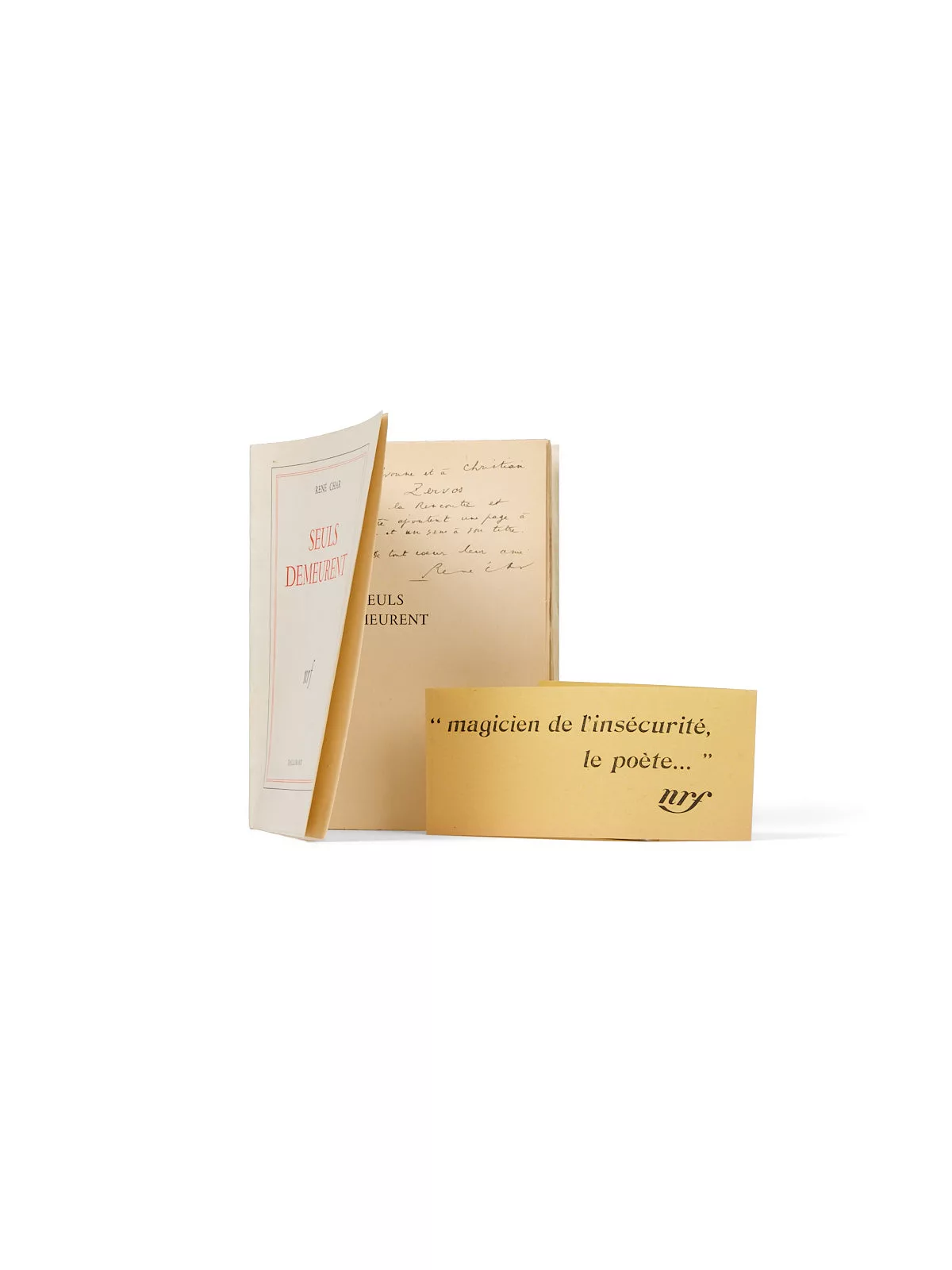
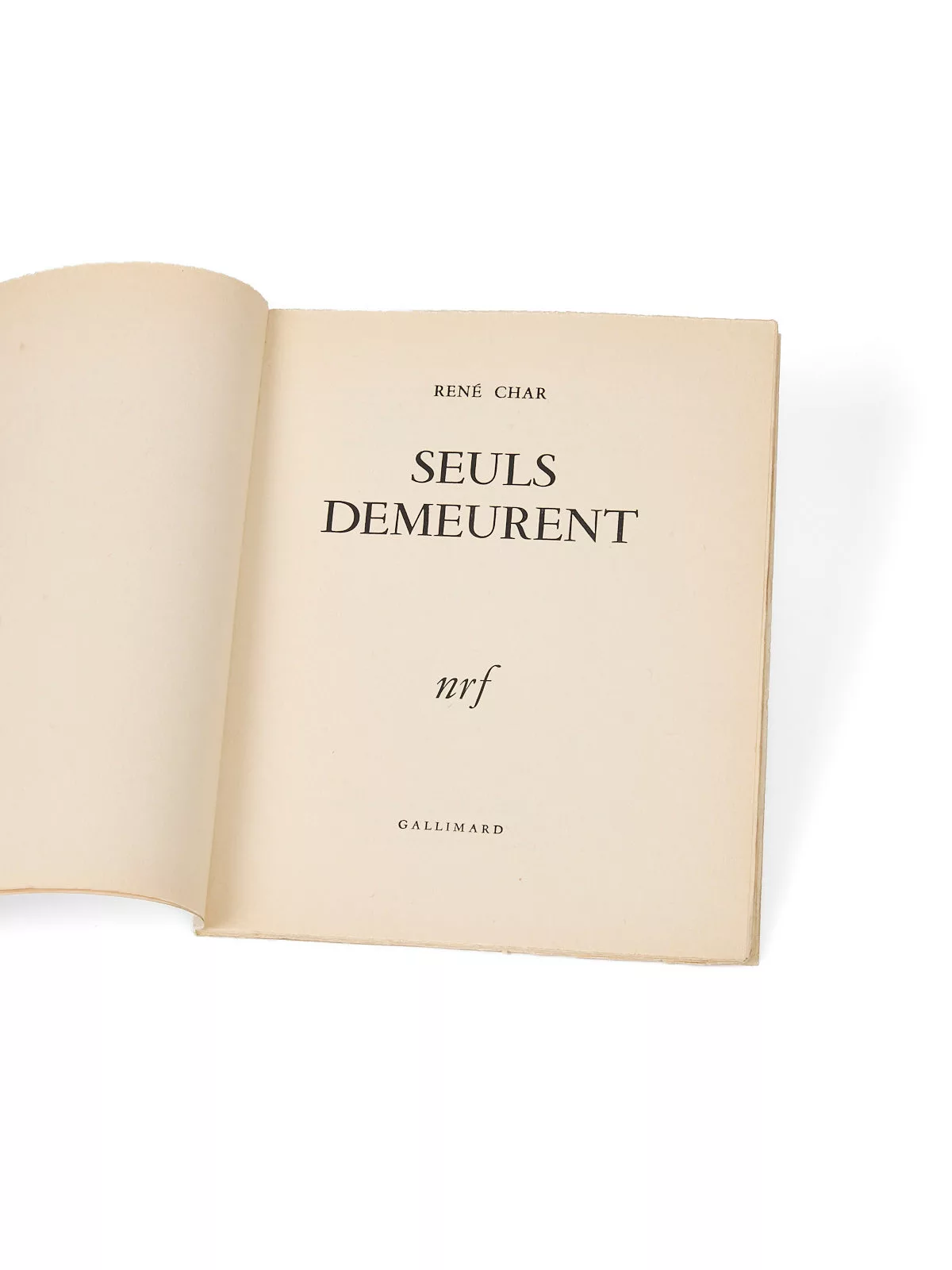
One of 1,000 copies on châtaignier paper (no. 387).
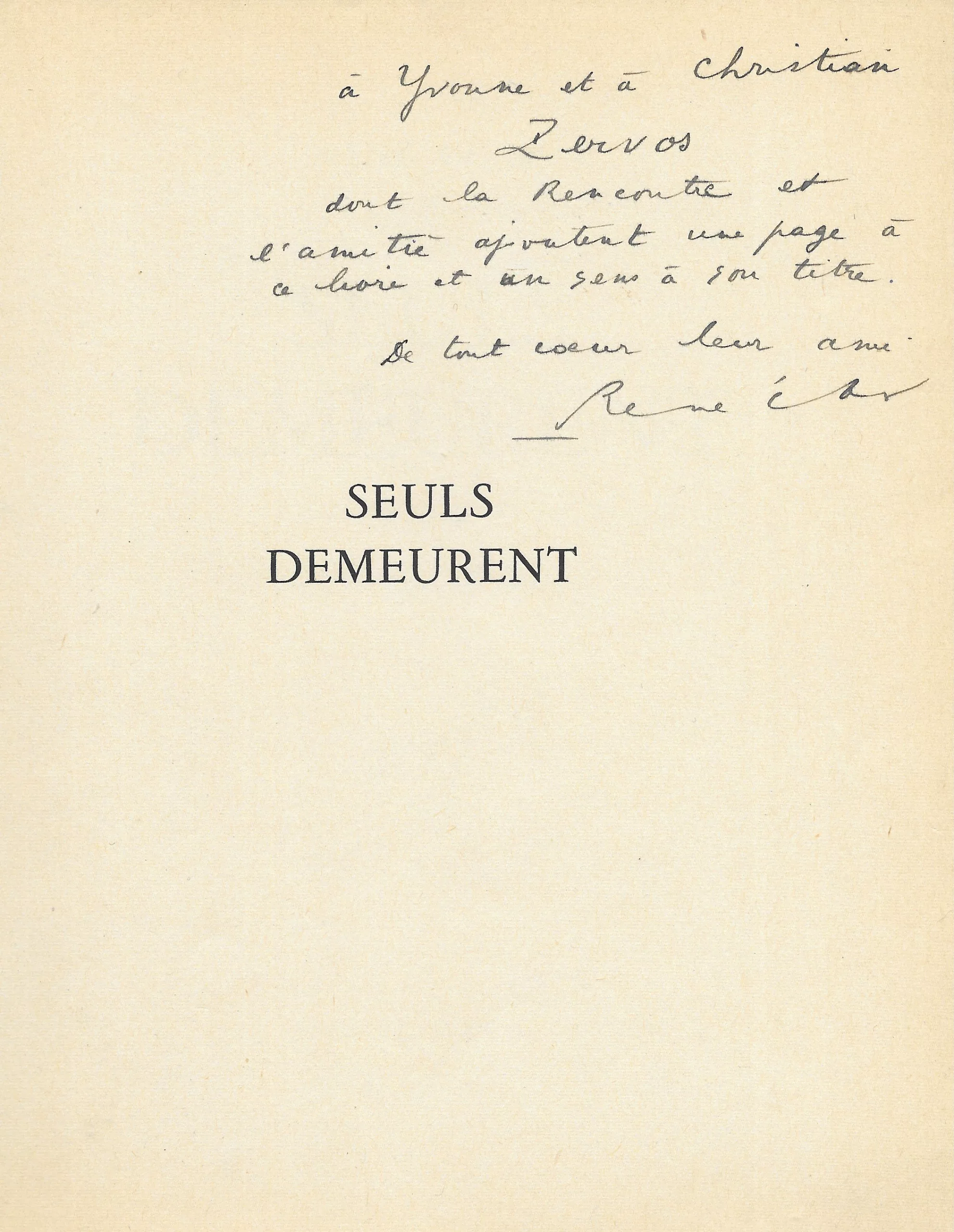
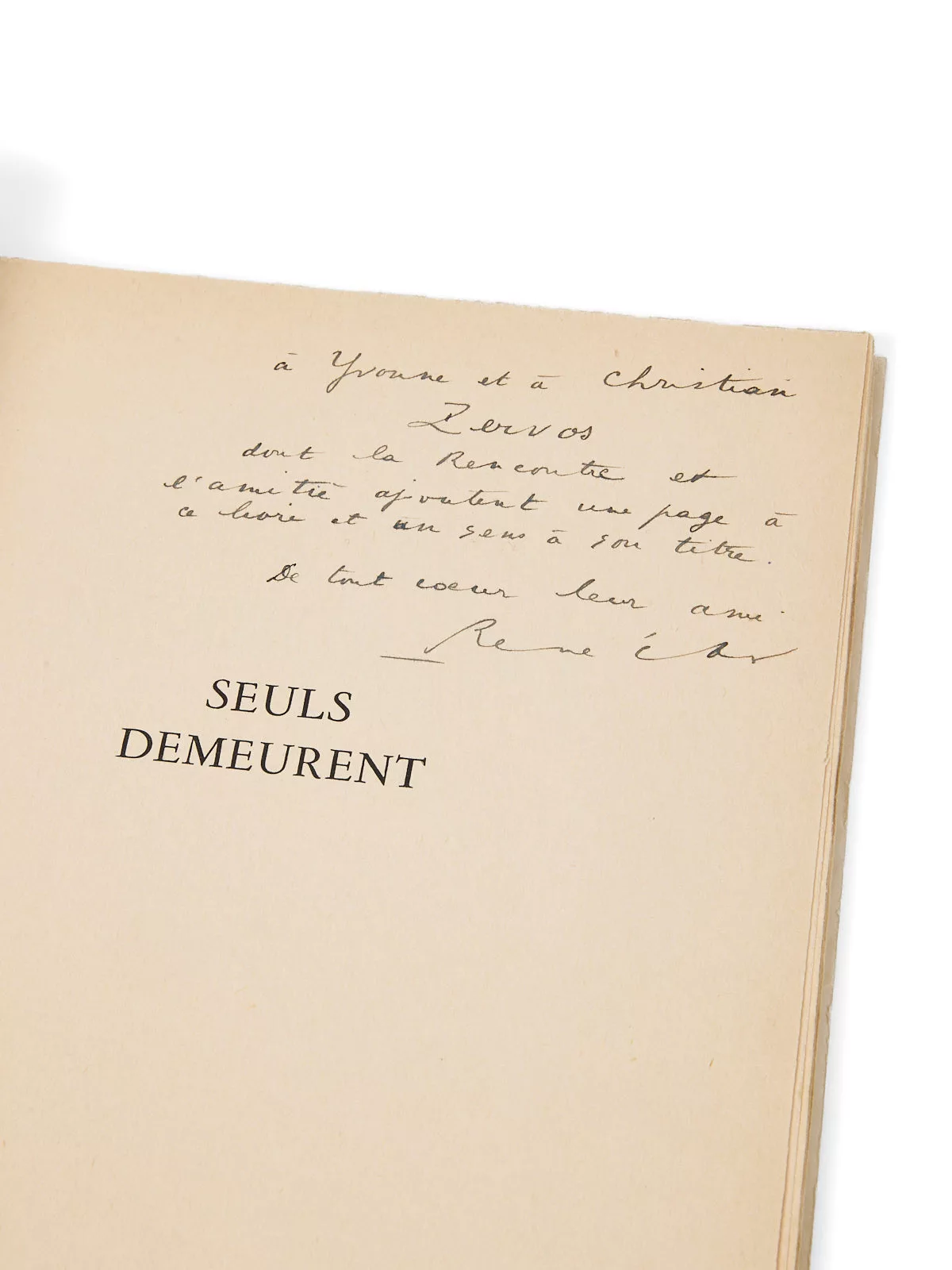
Signed presentation inscription: “à Yvonne et à Christian Zervos, dont la Rencontre et l'amitié ajoutent une page à ce livre et un sens à son titre. De tout cœur leur ami. René Char.”
René Char probably met Yvonne and Christian Zervos through Paul Éluard, at a time when the Surrealists were writing for Zervos’s Cahiers d’art. Their first documented connection dates to 1933, when the gallerist-publisher secured a drypoint from Kandinsky (whom he had helped emigrate to France) to illustrate the deluxe issue of Le Marteau sans maître. Char himself did not actually contribute to the Cahiers d’art until 1937, with “Dehors la nuit est gouvernée.” The war then separated them.
Yvonne and Christian Zervos — stripped in 1941 by the Vichy regime of the French nationality he had acquired in 1927 — took refuge at the farmhouse of La Goulotte, near Vézelay, while placing their Paris apartment at 40 rue du Bac, where they had lived since 1938, at the disposal of Paul and Nusch Éluard: numerous clandestine tracts were printed in its basement. Char, for his part, did not leave Provence, except for a trip to North Africa in the summer of 1944 in preparation for the landing in Provence.
Char was reunited with the Zervos after the Liberation: even before his demobilization, he became a regular guest at rue du Bac, which the Zervos reoccupied in February 1945. It was at this moment that Seuls demeurent appeared: the inscription on the copy he gave them bears the mark of this new beginning and of the enduring friendship that followed. The next year, Char invited the Zervos to Céreste, before the couple settled at Le Thor, near L’Isle-sur-la-Sorgue, where they prepared a major exhibition at the Palais des Papes in Avignon, for which Jean Vilar, at Char’s request, proposed three theatrical productions: the birth of the Avignon Festival.
“From the late 1940s to the 1960s, Char stayed regularly at La Goulotte, whose calm and countryside, well suited to walking, he appreciated, as his correspondence sent from Vézelay shows. On 16 May 1948, he took care to note the place and date at the foot of two poems he had just written there: ‘Un oiseau…’ and ‘Pénombre’ [later published in Fureur et mystère]. After selling his family property Les Névons (at L’Isle-sur-Sorgue), Char no longer had a house of his own and spent subsequent summers with Yvonne Zervos, either in the Eure or at Vézelay” (Christian Limousin, La Maison Zervos à Vézelay, 2019). It was at La Goulotte that Char wrote the poem “L’une et l’autre,” which he sent to PAB for a tiny edition, produced in September 1957. The Zervos would be among the first guests Char welcomed when, in 1960, he bought Les Busclats to make it his new and final Provençal home.