

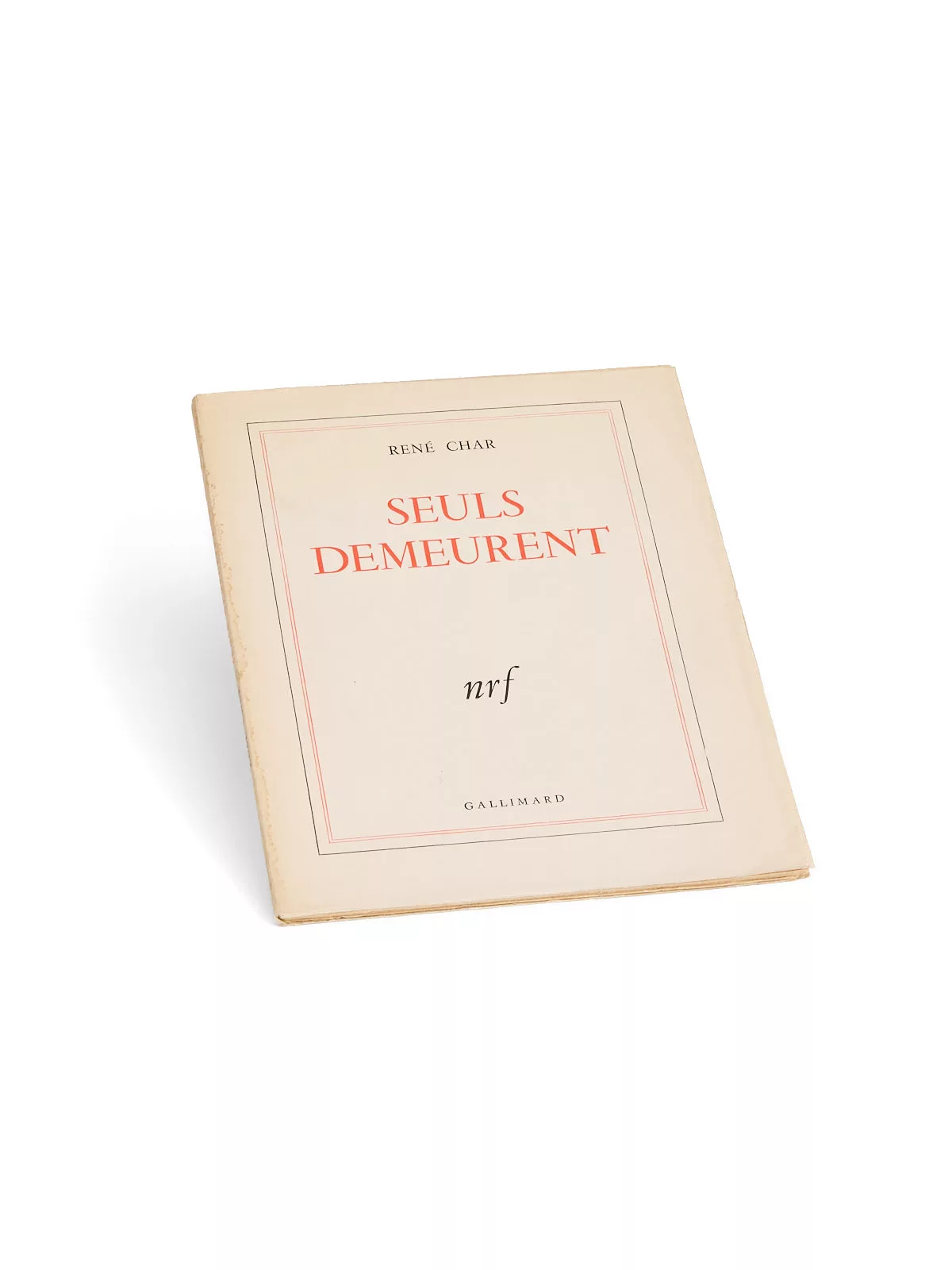
Seuls demeurent
One of 1,000 copies on châtaignier paper (no. 504).
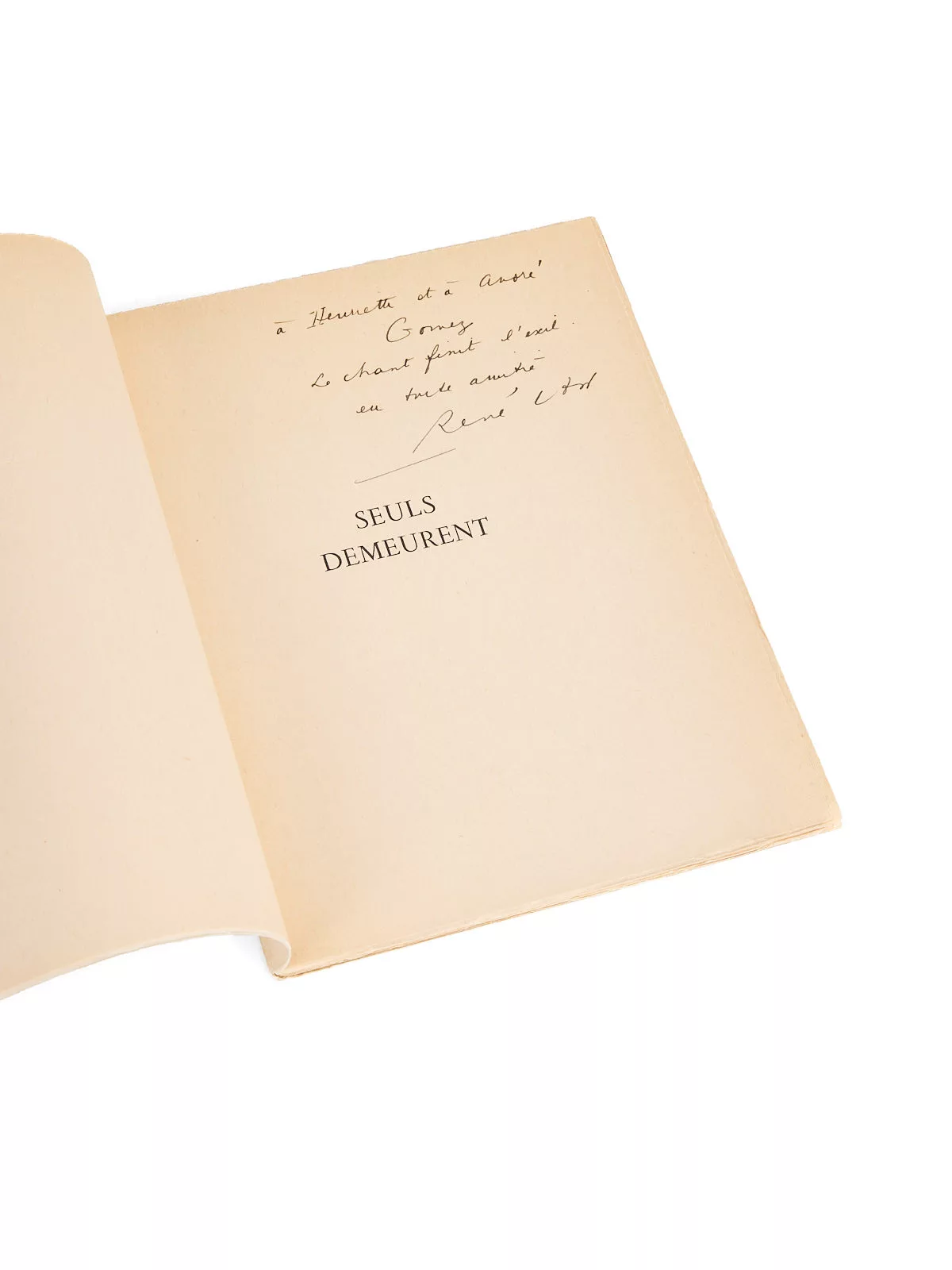
Presentation copy inscribed by Char to Henriette and André Gomès: “À Henriette et André Gomez [sic, for Gomès]. Le chant finit l'exil. En toute amitié, René Char.”
A fine copy with an attractive provenance.
Born in Montmartre, Henriette Gomès began her career as an assistant to Pierre Loeb, whose gallery, then located at 2 rue des Beaux-Arts in Paris, was an essential meeting place and exhibition venue for pre-war artists. There, in 1937, she met her future husband André, then a journalist and radio technician, whom she married a year later. With Loeb’s support, she opened her own gallery, the Galerie Henriette, on avenue Matignon, inaugurated with an exhibition devoted to Georges Rouault.
Over the following two years, she exhibited Cézanne, Gromaire, Brauner, Vieira da Silva, Arpad Szenes, Pierre Charbonnier and Hartung. But the war put an end to her activity: being Jewish, she was forced to leave Paris in May 1940 and took refuge in La Rochelle, separated from her mobilized husband. Her gallery was confiscated, and the couple found themselves in Nîmes before taking refuge in Marseille in 1941, where they joined the writers and artists gathered around André Breton at the Villa Air-Bel, rented by Varian Fry’s American Committee for the Relief of Intellectuals. It was André Gomès who photographed Marcel Duchamp in a famous picture, standing at the bow of an ocean liner about to set sail, arm raised in farewell. The couple themselves remained in France: involved in the Resistance, they had several dealings with the maquis of the Basses-Alpes, as René Char — known as Captain Alexandre — would later recall on several occasions.
After the Liberation, Henriette and her husband found a small space at 6 rue du Cirque in Paris, which they restored, while André Gomès continued his career as a professional photographer. Other letters from Char to the Gomès couple, whom he called his “dear lambs,” bear witness to this period.
The friends were reunited at the Liberation, and René Char was finally able to have Seuls demeurent published and offer them this “song that ends exile,” as the fine dedication states — an exile that reflected the years of Occupation and the wartime engagement they had all shared in the Resistance.
Char had considered publishing Seuls demeurent as early as April 1941, but this prospect faded as the maquis was being organized: “I do not wish to publish in a journal the poems I am sending you. The collection from which they are drawn, on which I am working despite adversity, could be titled Seuls demeurent. But I repeat that they will remain unpublished for a long time, as long as nothing occurs to entirely reverse the unspeakable situation in which we are plunged” (note to Francis Curel, 1941). Seuls demeurent was completed in the spring of 1943, but when the poet sent his publishing contract to Gallimard, he expressed the wish that the collection not appear “until the situation of our country is definitively resolved.”
The collection is composed of three parts: “L’Avant-monde,” a group of prose poems written between 1938 and 1943, to which Char added a final poem in 1945, “La Liberté,” which he had sent to José Corti in August 1942; “Le Visage nuptial,” a set of five love poems in verse dating from summer 1938 and the beginning of the war; and finally “Partage formel,” a series of aphorisms written in 1941 and 1942 on the role of the poet. The collection was published in February 1945, in an extremely limited deluxe-paper printing: only 13 copies on pur fil paper (3 hors commerce, lettered A, B and C, followed by 10 numbered in roman numerals), followed by 1,000 copies on châtaignier paper.
These first printings are now rare.