



Seul, à travers l’Atlantique
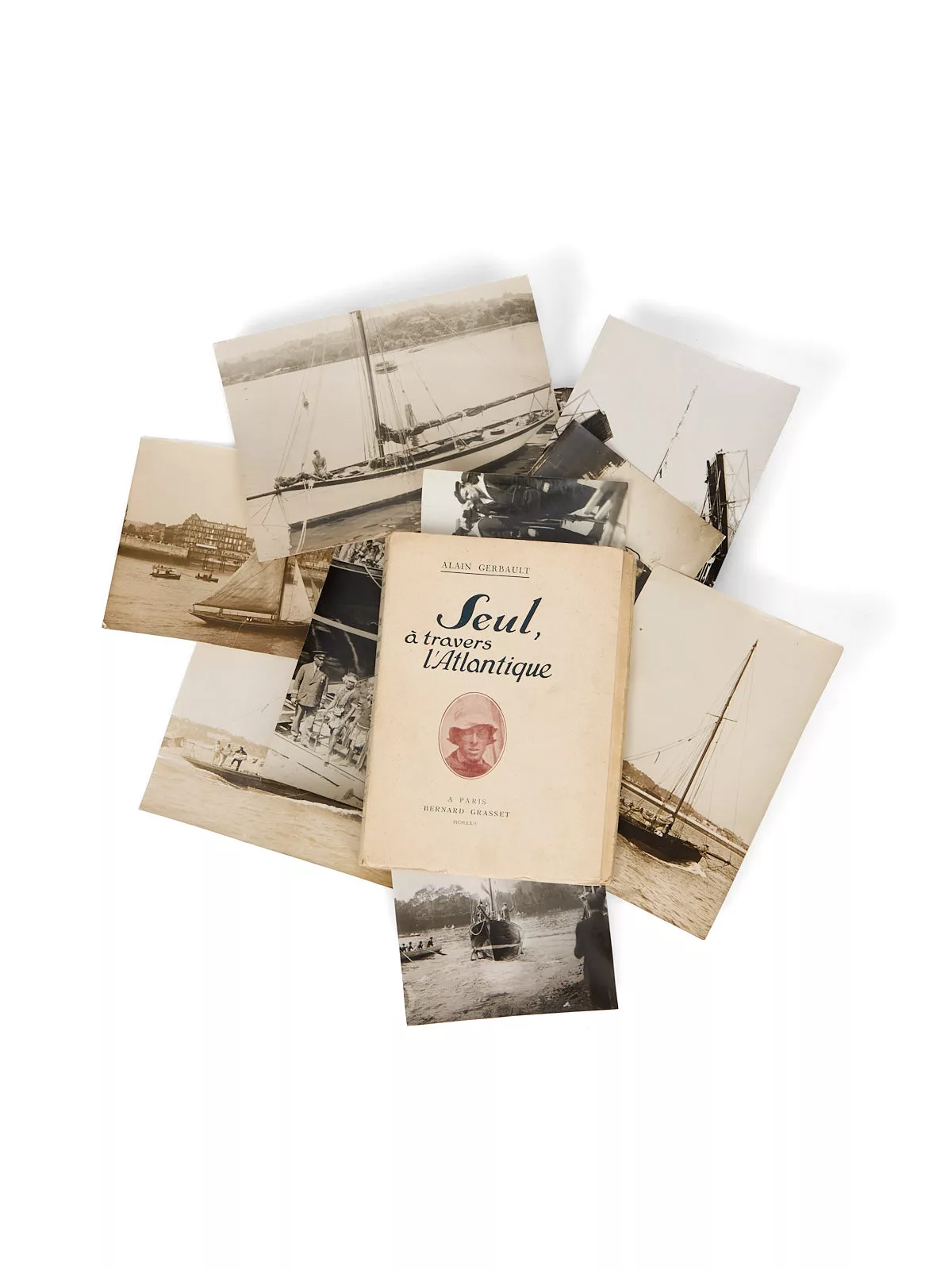
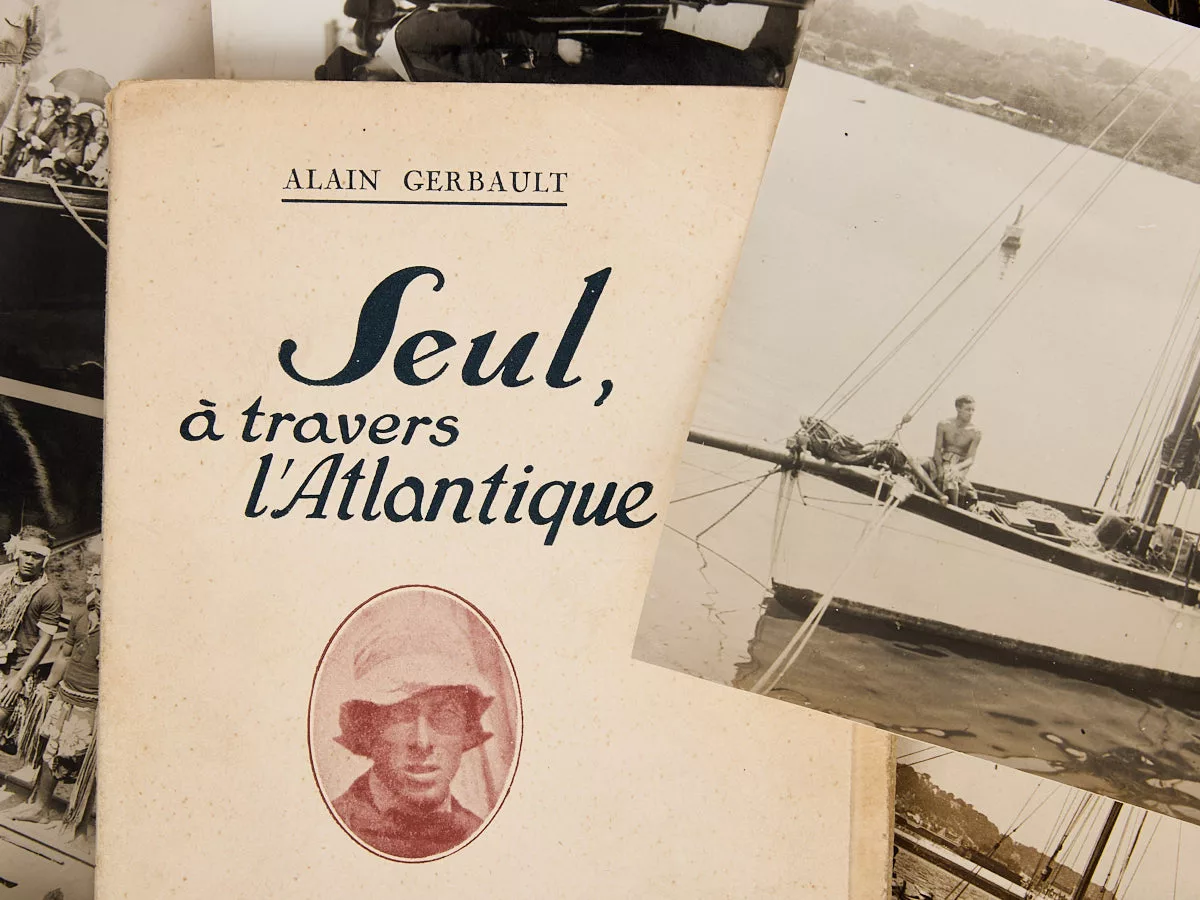
One of the first 15 copies on Japanese paper (no. 10).
Accompanied by a set of original prints: the Firecrest departing from Cannes in 1923, the Firecrest arriving at Le Havre in 1929, docked at Cherbourg before its — dramatic — transport in 1930; then the launch of the Alain Gerbault in 1932, with various views of Gerbault in Cannes, or sailing along the coasts or rivers of France.
In 1907, Jack London, his wife Charmian and a crew of amateurs set sail from San Francisco aboard the Snark, a 17-meter sailboat built for the occasion. Their destination: Sydney. A sailor at heart, the novelist reached Hawaii, visited Polynesia, then set course for the most remote islands of Melanesia before reaching Australia. From this Pacific crossing came The House of Pride and Other Tales of Hawaii, South Sea Tales, and, above all, Martin Eden.
These accounts fascinated and haunted Alain Gerbault, who, after the First World War, never ceased to nurture a plan for solo adventure. An outstanding fighter pilot during the war, he earned two citations: “A first-rate pilot, of remarkable boldness and spirit. On 17 March (1917), during a reconnaissance mission, attacked alone and far behind enemy lines a patrol of three aircraft, shot one down, and returned after a close fight with his opponents, his aircraft hit by more than 20 bullets. A truly remarkable fighter pilot, always a volunteer for every mission, and a fine example to his younger comrades.” He was assigned to the École nationale des ponts et chaussées from March 1919, but had little enthusiasm for a career as an engineer. He took part in numerous tennis tournaments, a sport he had played since childhood. French schoolboy tennis champion in 1913, he won the Dinard tennis tournament three times. In 1921 he reached the doubles final at Roland-Garros and at the World Championships with Pierre Albarran, with whom he also partnered at bridge. In 1922 he was a finalist at the Monte-Carlo tennis tournament.
But the dream of adventure proved stronger, and in 1921 he decided to change his life and pursue it. He sought to acquire a racing sailboat and traveled to Cowes, England, where he found the Firecrest (named after the small bird, the firecrest, or “roitelet à triple bandeau”), built for racing in 1892. She was a 12-meter yacht whose rigging was entirely unsuited to solo sailing. No matter. He brought her back to Cannes, where he mixed with the young sailor Ella Maillart, and trained throughout 1922 in the Mediterranean before setting off alone, anonymously and without publicity, on 25 April 1923 from Cannes; after three weeks he reached Gibraltar. Setting off again on 6 June, he achieved the first solo east-to-west crossing of the Atlantic under sail, reaching New York in 101 days, on 14 September 1923 — a remarkable sporting feat given the sailing conditions of the time.
He decided to continue his voyage and reached the Pacific on 11 June 1925, returning triumphantly to the port of Le Havre on 27 July 1929. He thus became the first sailor to cross the Atlantic solo under sail from east to west, an exploit recounted in this Seul, à travers l’Atlantique, as well as the first Frenchman to complete a solo circumnavigation of the world under sail, which he recounted in L’Évangile du soleil (Fasquelle, 1932), a vehement denunciation of the harm inflicted by Western civilization on indigenous peoples. He summed up his view bluntly: “There is a race that screws and another that gets screwed, but what I think is too vulgar, and only a Céline could write it!”