

Buoyed by the success of the films Dr. No (1962) and From Russia with Love (1963), James Bond had made his entry into France, where Plon launched a dedicated series in February 1964. But Fleming had died prematurely, leaving no substantial body of unpublished work — he had published only twelve James Bond novels in his lifetime — and the 007 vein was quickly exhausted.
Paul Paoli, who had just launched Plon’s “Nuit blanche” series to compete with Gallimard’s “Série noire,” urged his friend Gérard de Villiers — a Sciences-Po graduate and investigative journalist with a passion for foreign affairs — to invent a recurring character for a spy series. This opened the way for the arrival of His Most Serene Highness Malko Linge.
The series never stopped: “he wrote almost four novels a year for nearly half a century — a literary and commercial feat, sometimes with four releases a year, unmatched in the espionage thriller genre,” notes Nicolas Gary in an article devoted to SAS (“SAS: 60 ans d’espionnage et de géopolitique,” in Actualitté, March 18, 2025, online). Only the novels of Georges Simenon can rival such a relentless output.
Published from 1965 (SAS à Istanbul) until the author’s death in 2013 (La Vengeance du Kremlin), the series comprises 200 titles — including 159 proper SAS adventures, investigations (and conquests, next to which 007 looks like a choirboy) — featuring the Austrian prince as he travels the world on missions for the CIA. The volumes were translated into some twenty languages and sold more than 150 million copies worldwide: an undeniable success that forms part of the popular heritage of French publishing in the second half of the twentieth century.
Before writing a new SAS, the author would systematically travel to investigate the country where the action would take place, living there long enough to capture the spirit of the place as well as the spirit of the times. The result is a series of novels remarkable for their geographic and socio-cultural precision, generally opening with an unforgettable sequence — a device later adopted wholesale by cinema, most notably the James Bond films, whose opening sequences have often become anthology pieces plunging the viewer straight into the action. De Villiers’s incipits follow the same logic. Several titles, beginning with SAS à Istanbul, are emblematic of their era, displaying a recognized flair and expertise on geopolitical matters, notably L’Ange de Montevideo (1973), Le Complot du Caire (1981), Mission à Moscou (1990), Les Tueurs de Bruxelles (1992), Bin Laden: la traque (2002) and Le Trésor de Saddam (2006): “I need a strong story, involving politics, violence. I do applied geopolitics, so to speak. […] I never write anything implausible,” explained Gérard de Villiers (interview with Yves Couprie, 7 March 2005).
In 2013, a few months before his death, the New York Times devoted a long, admiring article to him, titled “The Spy Novelist Who Knows Too Much,” retracing this extraordinary saga. To illustrate the ambiguous status of the French Ian Fleming at home, the New York daily quoted Hubert Védrine, former minister of foreign affairs: “The French elite claims not to read him, but they all do.” Védrine was among the writer’s devoted readers, having read nearly all of his novels, and told the New York Times that before traveling to a country he would always consult the corresponding SAS title, a way of gauging how the French intelligence services viewed it (Le Monde, January 1, 2013).
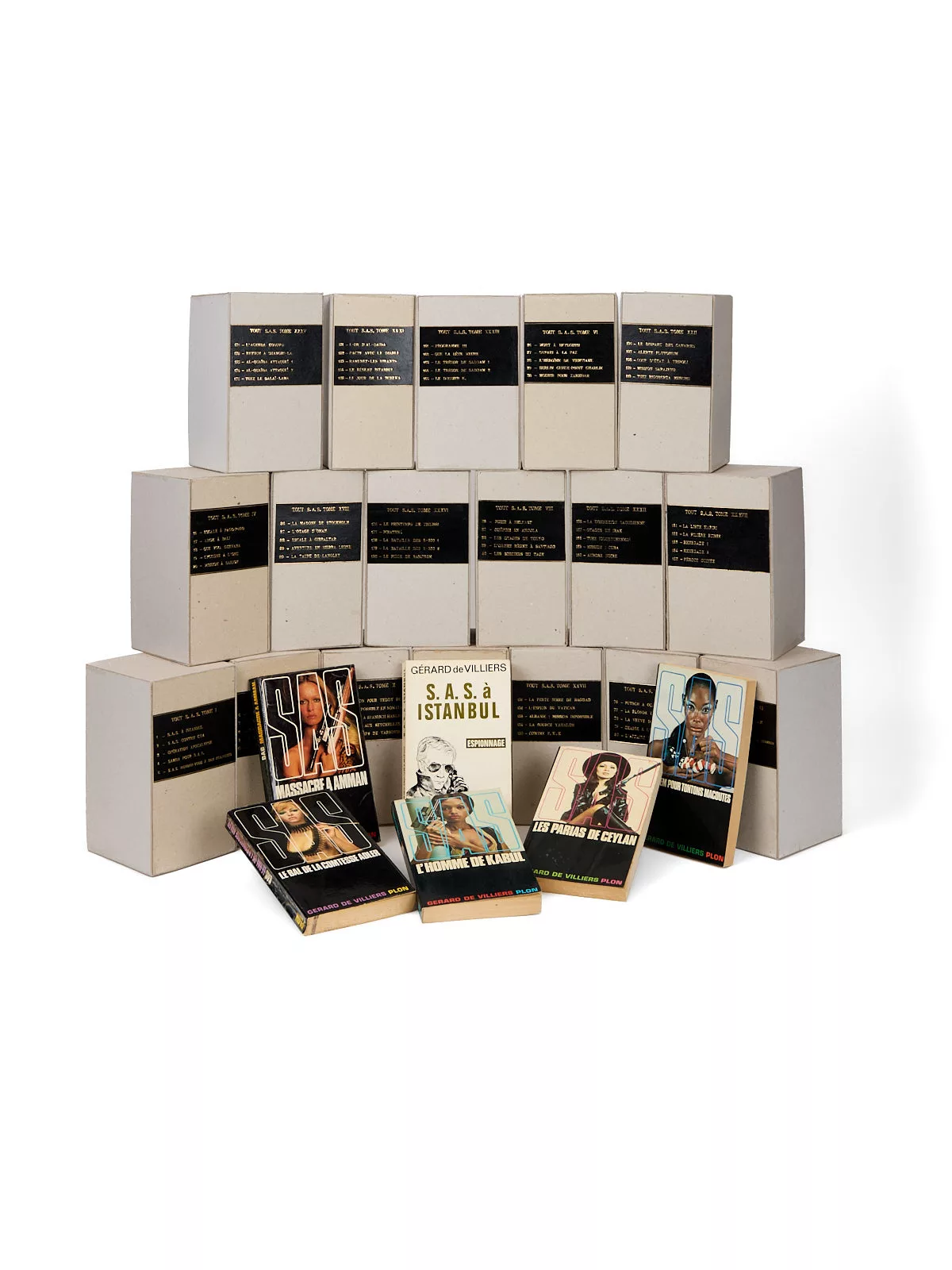
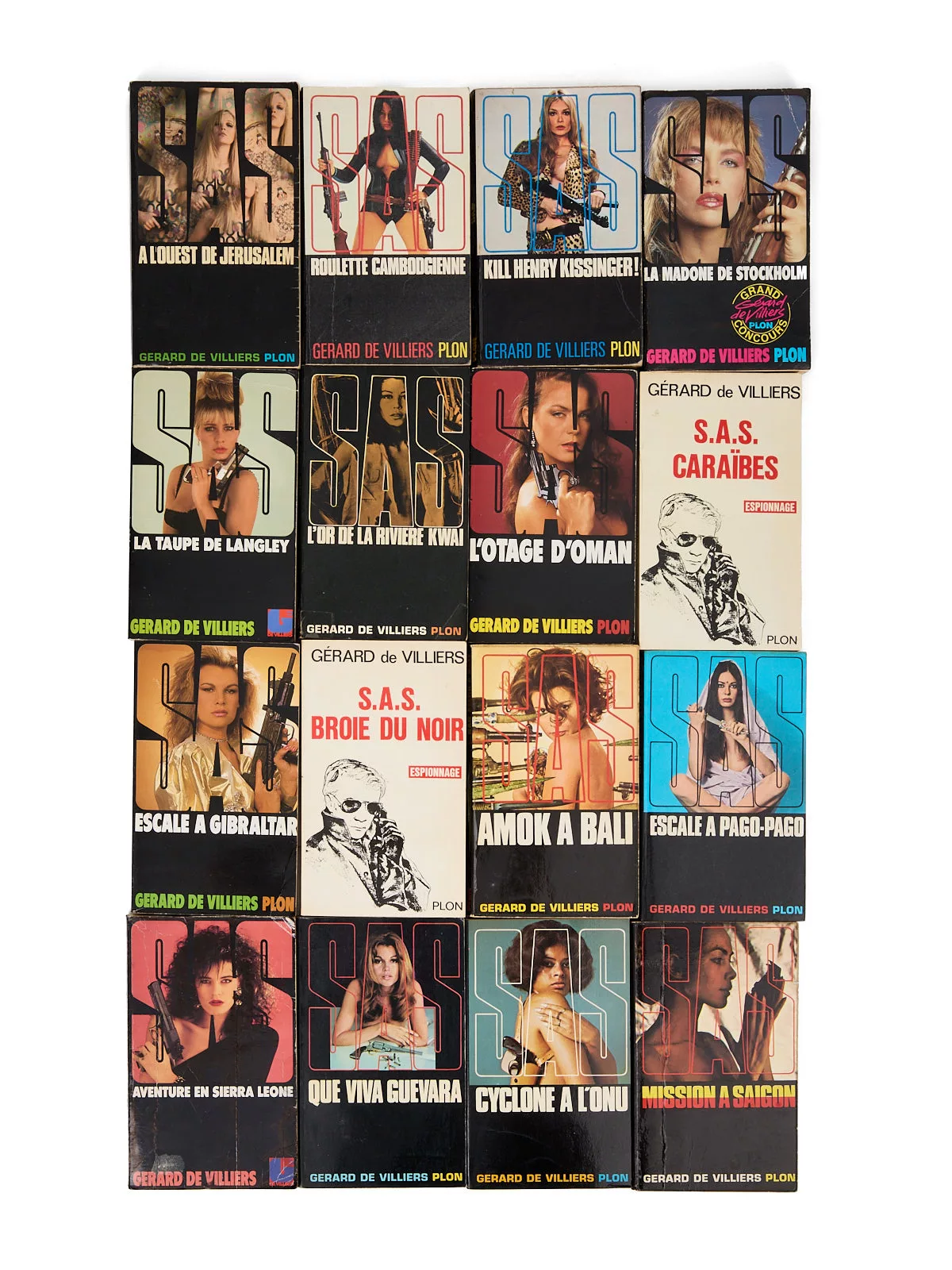
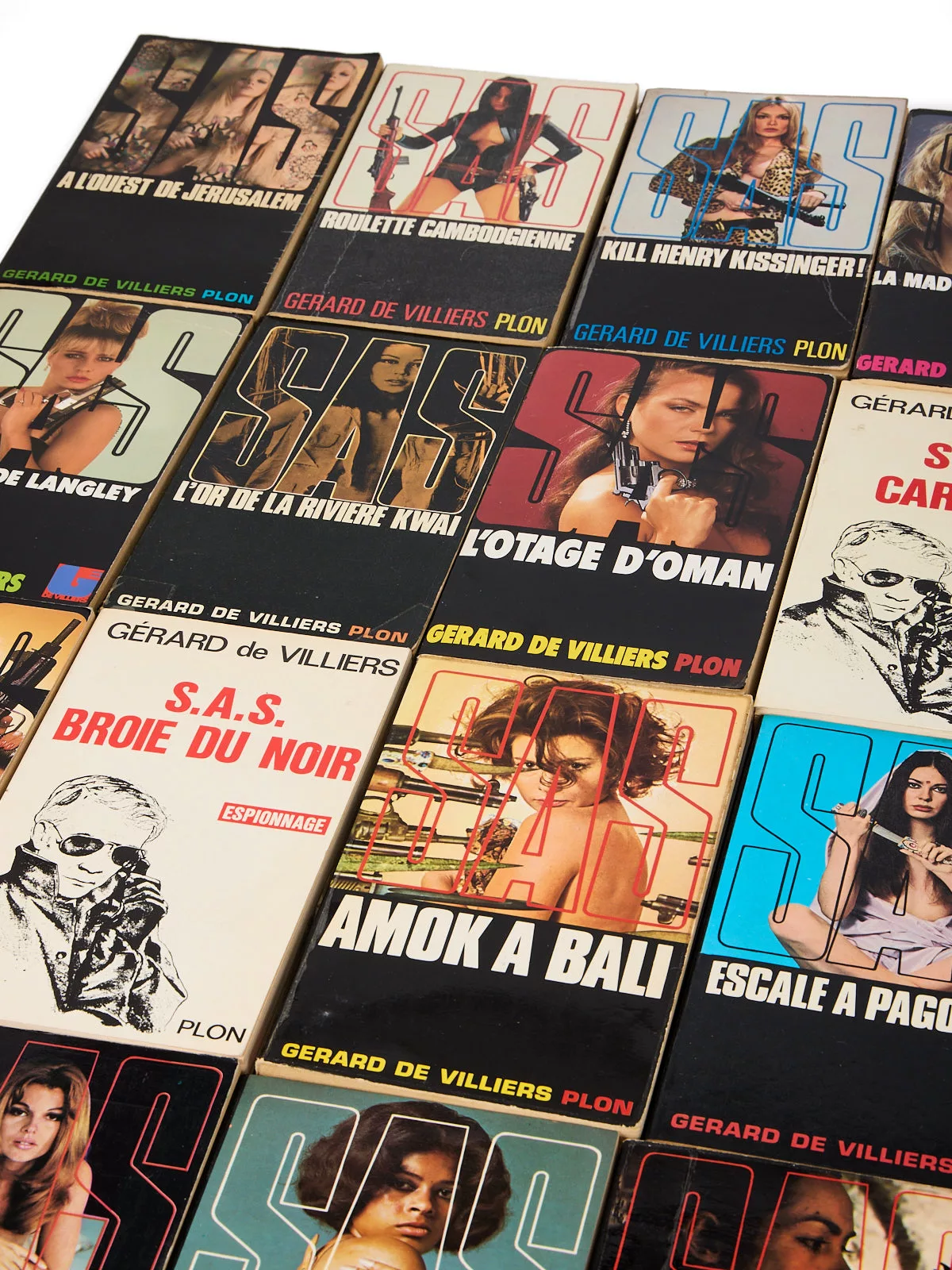
This series is notoriously difficult to assemble in full: certain volumes from the 1960s and 1970s, printed in relatively small numbers, are particularly rare, not to mention the first eight titles, issued with a white background and a portrait of Malko, before the subsequent editions adorned with young women in more or less suggestive attire, always armed.
The majority of the titles in our set are in their original editions, occasionally later printings, but always in the first states of these covers.
The set has been gathered and protected in slipcases, with title-pieces.