

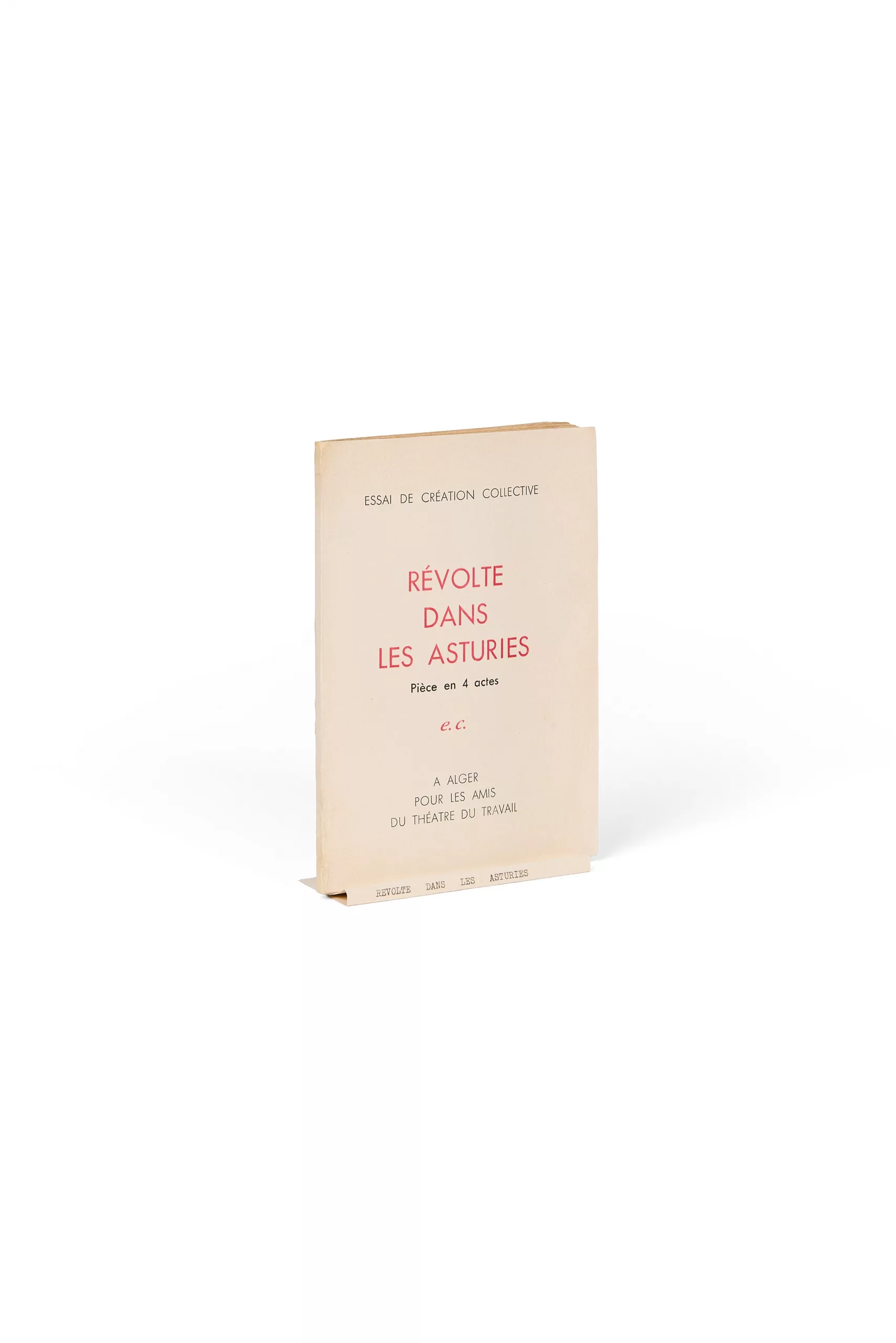
Révolte dans les Asturies
Theater was always Camus’s great passion. In 1935, when the Communist cell of Mustapha founded the Théâtre du Travail, Camus offered to become its director. Within a few months the troupe staged Le Temps du mépris, Les Bas-fonds, Prométhée enchaîné and La Femme silencieuse. Révolte dans les Asturies would have a more chaotic, but decisive, fate. Its subject — a miners’ uprising crushed by the Spanish government in 1934 — inspired Camus and his friends: two teachers from the Lycée d’Alger, Bourgeois and Poignant, and Jeanne Sicard, who were its principal authors. “As for the title, it was endlessly debated. We hesitated for a long time between La Neige and La Vie brève. We finally settled on Révolte dans les Asturies out of sheer exhaustion” (Jeanne-Paule Sicard, letter to Francine Camus). But the mayor of Algiers, Augustin Rozis, elected in 1935, banned the performance; he had already sent Daladier a telegram refusing to welcome Spanish Republican refugees to his city. The tone was set.
To cover the expenses incurred, the group decided to have the play published, and Camus turned to a young publisher just starting out, a former schoolmate, Edmond Charlot. Encouraged by Jean Grenier, Charlot had just founded his publishing house. He had as yet neither premises nor money, but reached an agreement with a small printer and published this collective work “for the friends of the Théâtre du Travail,” signing it with his initials, e.c.
500 copies of Révolte dans les Asturies were printed in May 1936.
Quickly sold out, this first edition encouraged the young Edmond Charlot to establish his business. Camus, for his part, had already begun writing some of the essays for L’Envers et l’Endroit and a few lines of the stories that would become Noces, which Charlot would publish in 1937 and 1939 respectively.
A copy from the library of Max-Pol Fouchet: the two men met very early, in Algiers. After leaving the Lycée Hoche in 1930, Fouchet and Camus moved in the same circles within the Jeunesses socialistes. Demanding, rebellious young men thirsting for the absolute and for justice, they witnessed daily the outrageous spectacle of Arabs held in contempt; they found their reason for living and fighting in books, which they consumed avidly. In Algiers, “a city poor in intellectual structures,” two passionate teenagers, by some miracle, demanded “the right to love without measure” (Fouchet, Un jour, je m’en souviens…).
One of Camus’s earliest texts, “Beriha ou le rêveur,” was published in Sud around 1932, and Fouchet wrote a review of it, to which Camus responded in a spirit of friendship. Camus was then secretary of the Algerian section of the Mouvement Amsterdam-Pleyel, and together with Louis Bénisti, Jean de Maisonseul, Claude de Fréminville, Max-Pol Fouchet and Louis Miquel, they formed a group of young men drawn to literature, the sun and — young women. The two men fell out over this last point: Max-Pol Fouchet was involved with, and even engaged to, Simone Hié, a young starlet from a good Algiers family, unfortunately addicted to drugs. But in 1933 Camus took her from him, married her, and the following year dedicated to her “Le livre de Mélusine,” the only short story he ever wrote. The Camus-Hié marriage ended in divorce fairly quickly, and Camus met another femme fatale, Christiane Galindo. But the damage was done, and Fouchet and Camus remained estranged for several years.
Nevertheless, as this copy attests, Fouchet always followed the path of his former friend. They were reconciled after the war, and the two men exchanged inscribed copies of their books.
On 13 January 1960, nine days after the death of Albert Camus, Lectures pour tous opened, exceptionally, with the grave and moved face of Max-Pol Fouchet, whose commentary usually closed the broadcast. Against a black background, his voice choked with emotion, Fouchet began his thirteen-minute tribute to Camus: “‘I know that something in this world has meaning, and that is man, for he is the only one who seeks to have it.’ The writer who left us these words, as you know, has died: it is Albert Camus […] Everyone has their memories of Camus; I have mine, and it seems to me that I can see him this evening, before me, at a time when he was not yet Albert Camus, but was preparing to become him. It was around 1932; we were young, and we used to walk along the paths overlooking the bay of Algiers. There was one path Camus loved in particular, the path of La Bouzaréah.”
Max-Pol Fouchet always kept his copy of Révolte dans les Asturies from that period, adding to it a small label affixed to the blank back cover of the volume — as though he needed, from time to time, to return to it, and never to lose sight of it.
The wrapper, damaged by Fouchet’s many moves, has been very skillfully restored.