

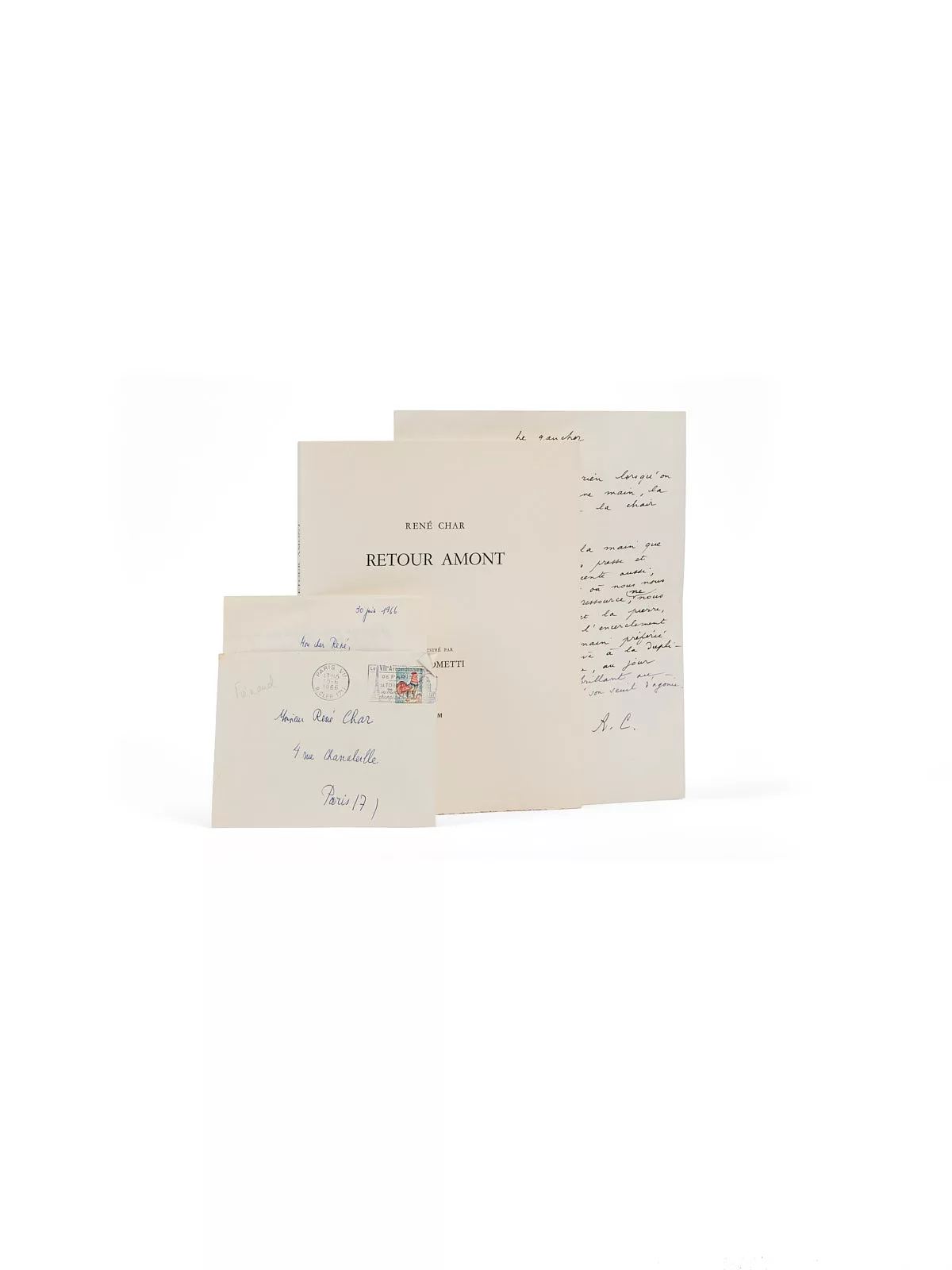
Retour amont
Four aquatints by Alberto Giacometti.
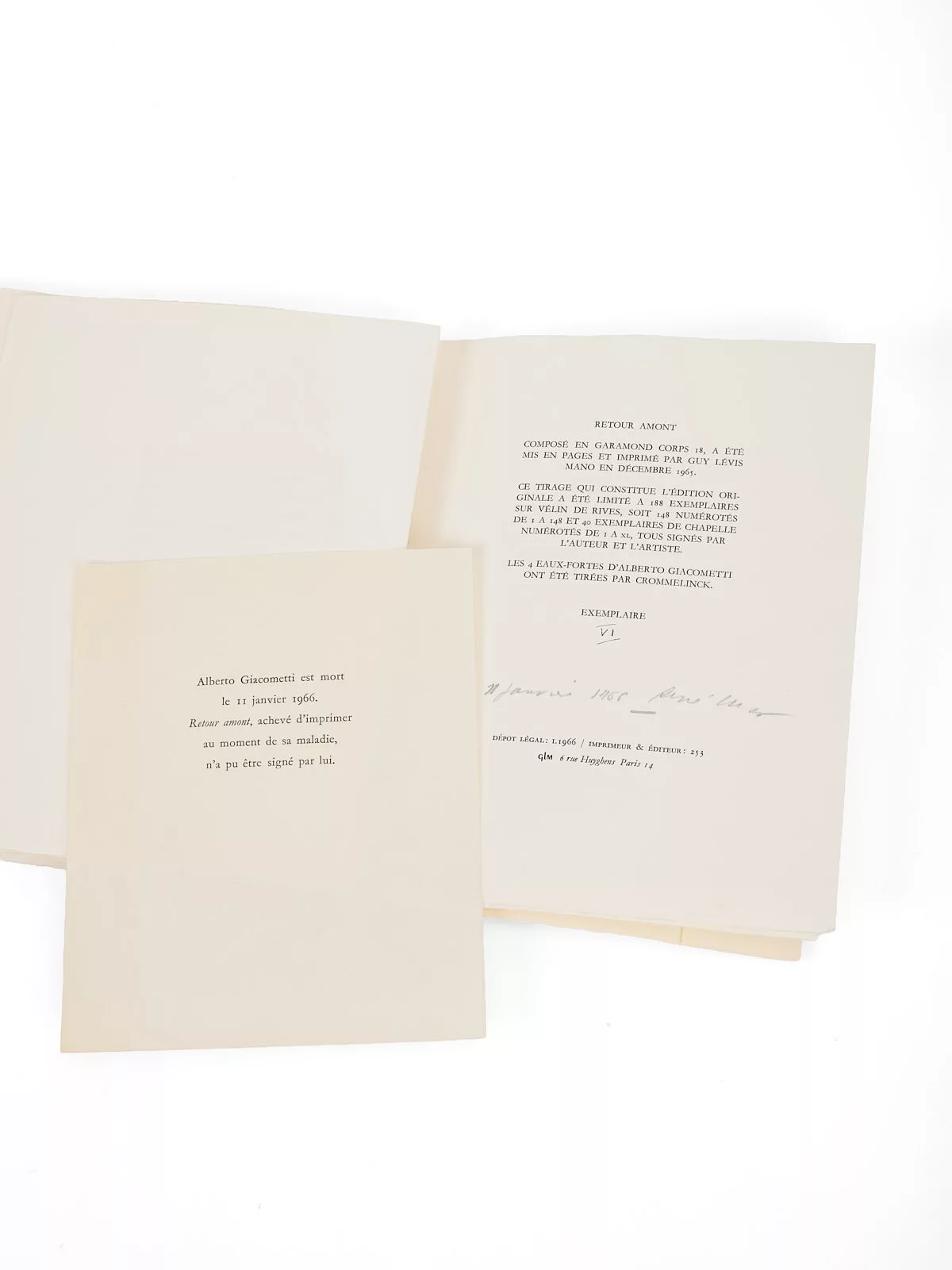
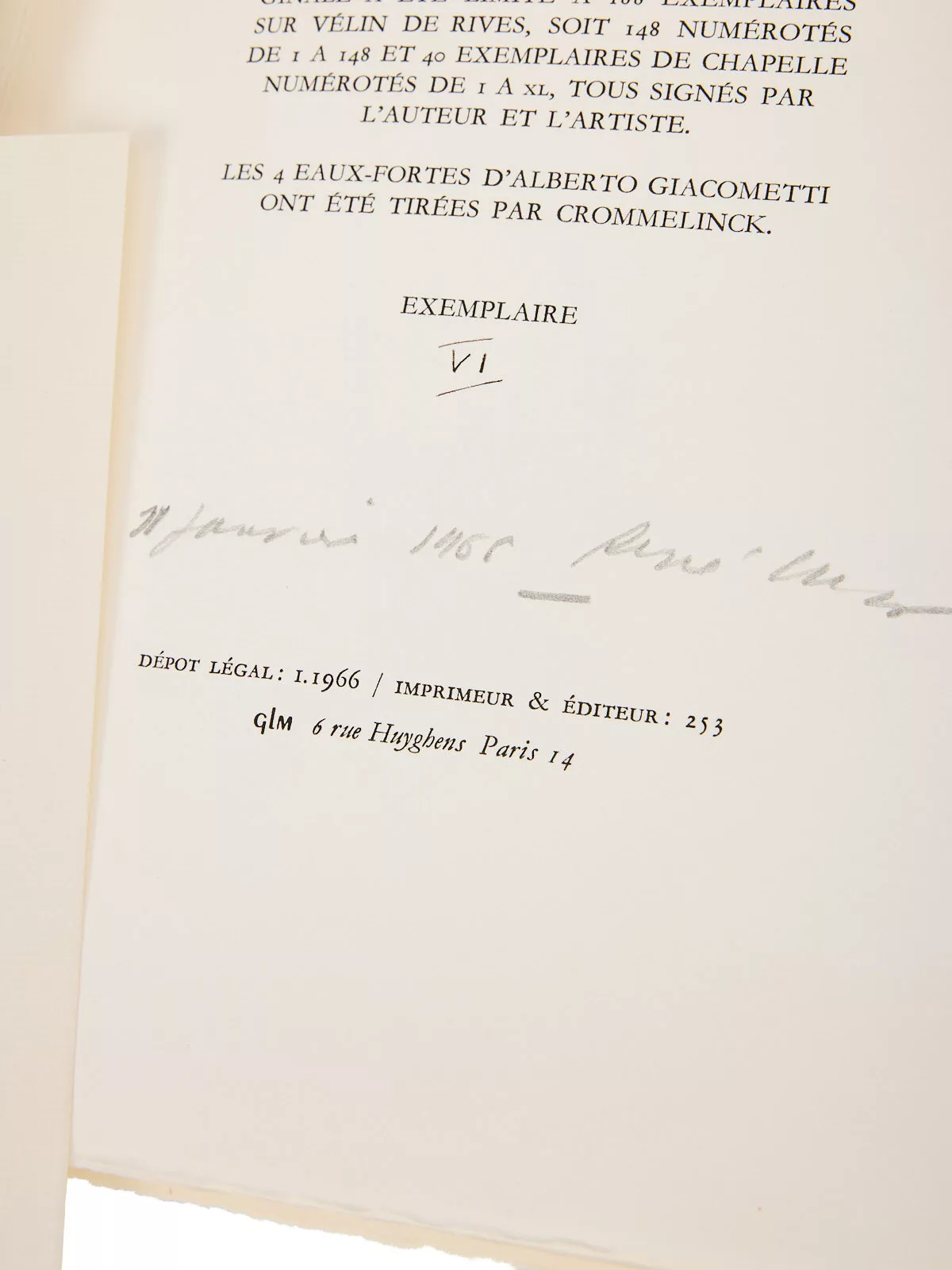
Limited to 188 copies on vélin de Rives.
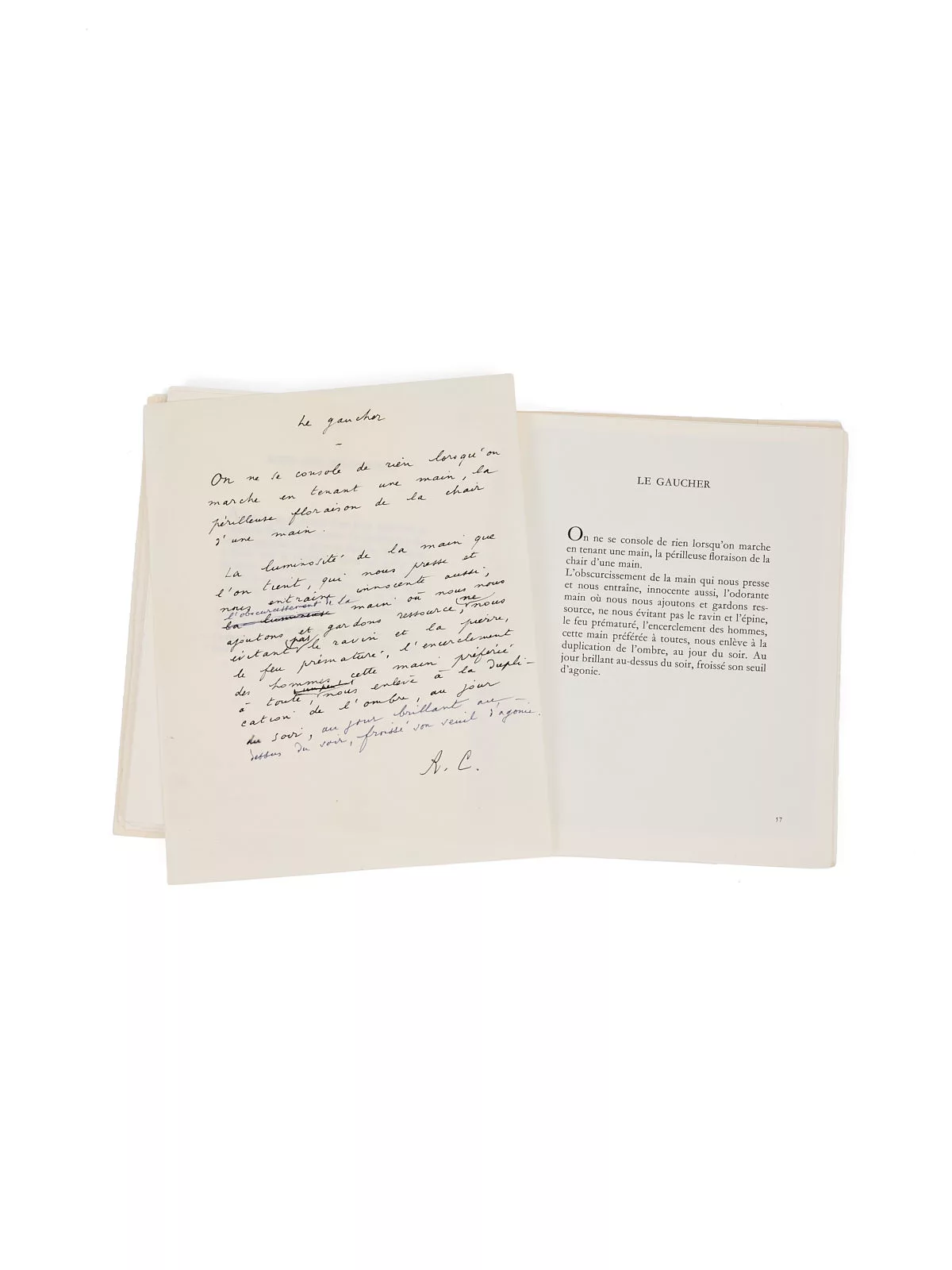
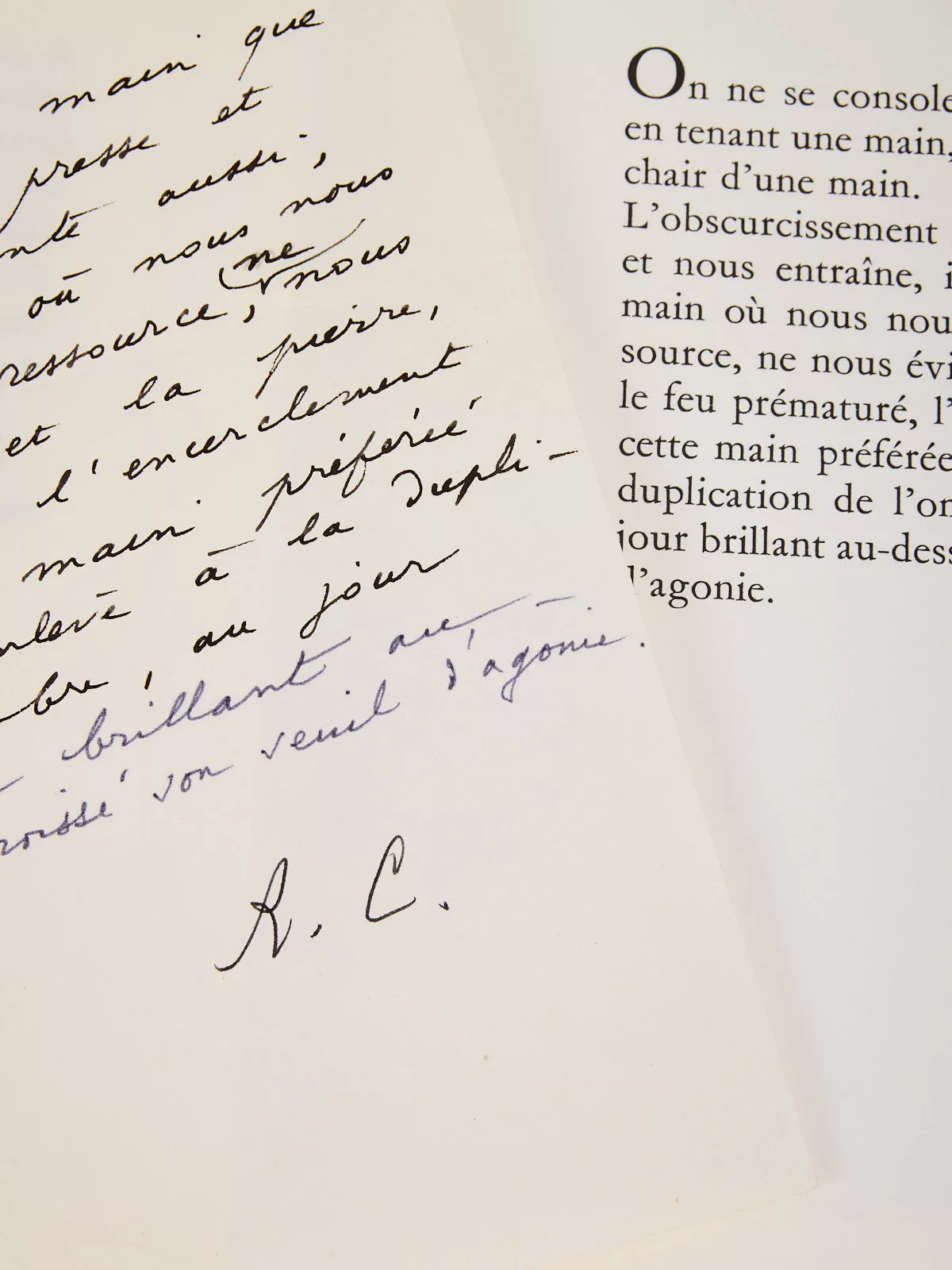
René Char's personal copy, in which he preserved the autograph manuscript of the poem “Le Gaucher” (16 lines in black ink), with previously unpublished variants.
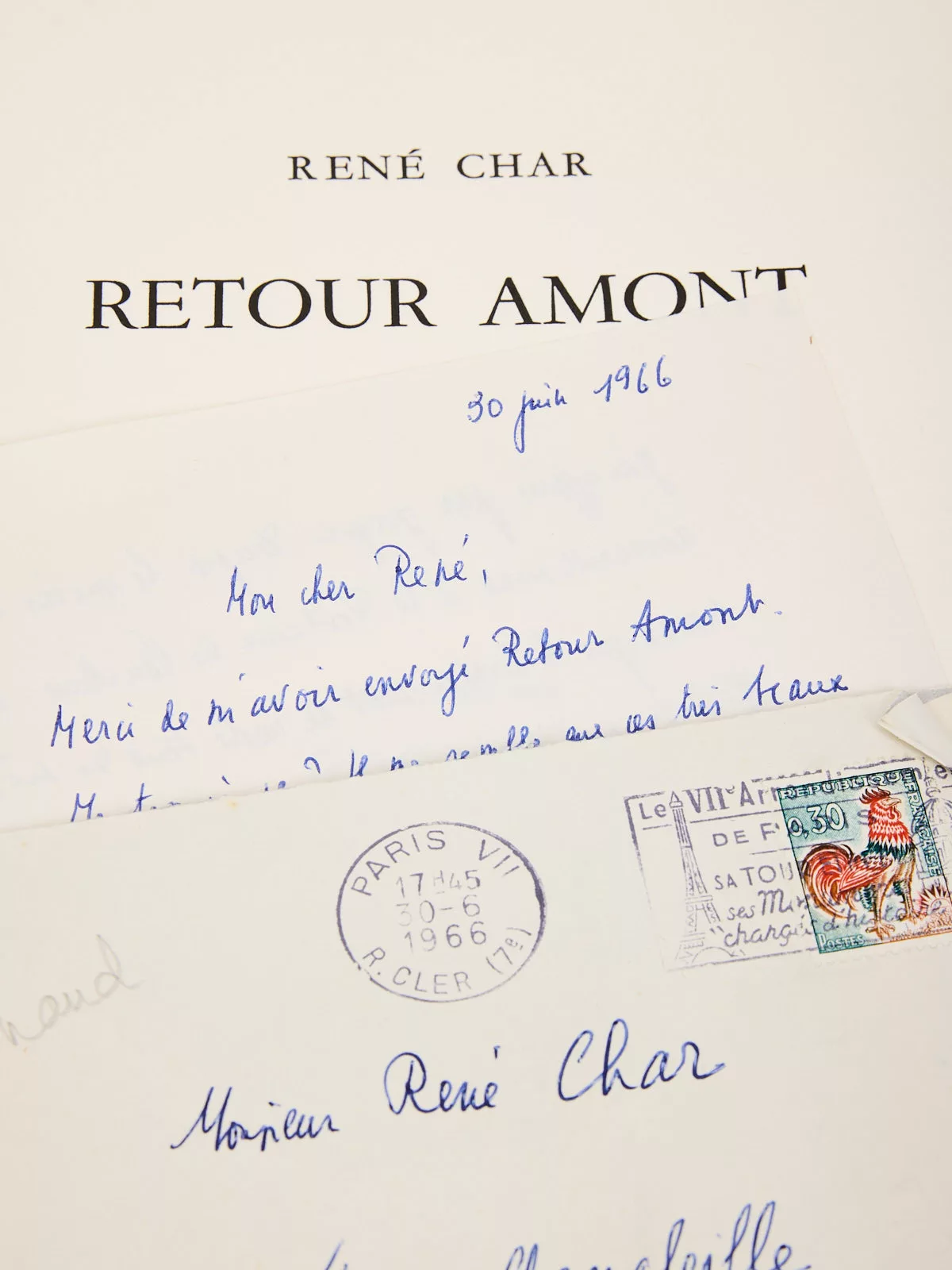
One of XL hors commerce copies (no. VI), in which Char preserved an autograph letter from André Frénaud, the latter acknowledging receipt of the volume from René Char.
Retour amont contains some of Char’s finest poems of the 1960s, many of which appeared — before or after this edition — in the limited printings published by PAB: Chérir Thouzon, Aux portes d’Aerea, Le Gaucher, Dansons aux baronnies, Lied de figuier, Faim rouge, and others.
All written at Les Busclats, they are set against the landscapes and mountains of the Vaucluse.
Giacometti’s etchings, printed by Crommelinck in negative, were the last the artist composed. Shortly before leaving for the hospital in Chur, from which he would not return, Giacometti wrote to Char that he was sending him “the four etchings (…) These four images have fixed themselves in my mind, drawn in white on a dark ground (it is the ground that is bitten with acid, not the lines). I don’t know if the result is good, I have no objective judgment in this case, but I cannot not send them to you. If they don’t suit you, I will do something else, but I would rather have etchings that for me have a relationship with the poems than etchings that are merely parallel, as is usually done. These would be arranged in a certain sequence. Before the title (frontispiece), the mountain (the etching with the fewest lines I have ever made), then in the book: I — men on horseback at a gallop (going somewhere for some massacre). II — the man among the rocks. III — at the end, the man on the precipice looking into the void, with the great emptiness of the landscape. I am adding a variant of the man among the rocks, black on gray, which I prefer as an etching but which works less well before a poem than white on black” (letter to René Char, 26 September 1965). A chronic bronchitis that turned into pneumonia proved fatal to his heart: he died a month later, on 11 January, and was buried on the 15th in the cemetery of Borgonovo, his native village in the Bregaglia valley, some hundred kilometers from Chur, near Saint-Moritz.
He was unable to sign the book, nor any proof of the etchings, whose printing had just been completed. A loose leaf, inserted in the copies, announces his death and explains the absence of his signature.
René Char dated his own copy here 11 January 1966, the very day of his friend’s death, as attested by a few other surviving copies.
René Char’s personal copy, in which the poet preserved the corrected autograph manuscript of “Le Gaucher,” a poem from the collection. Written in black ink on a single leaf and signed with the initials “R. C.,” it shows several deletions, substitutions and additions, some in blue ink. Comparison with the printed text allows one to follow the poem’s development, notably the replacement of “La luminosité de la main” with “L’obscurcissement de la main,” the image ultimately retained in the edition. The final sentence, revised in blue ink, also corresponds to the published text. This manuscript thus offers direct testimony to the poet’s work on one of the major poems of the collection, devoted to the hand of the beloved and evoking the ambivalence of love’s attachment, at once refuge and constraint.
A very fine copy.