

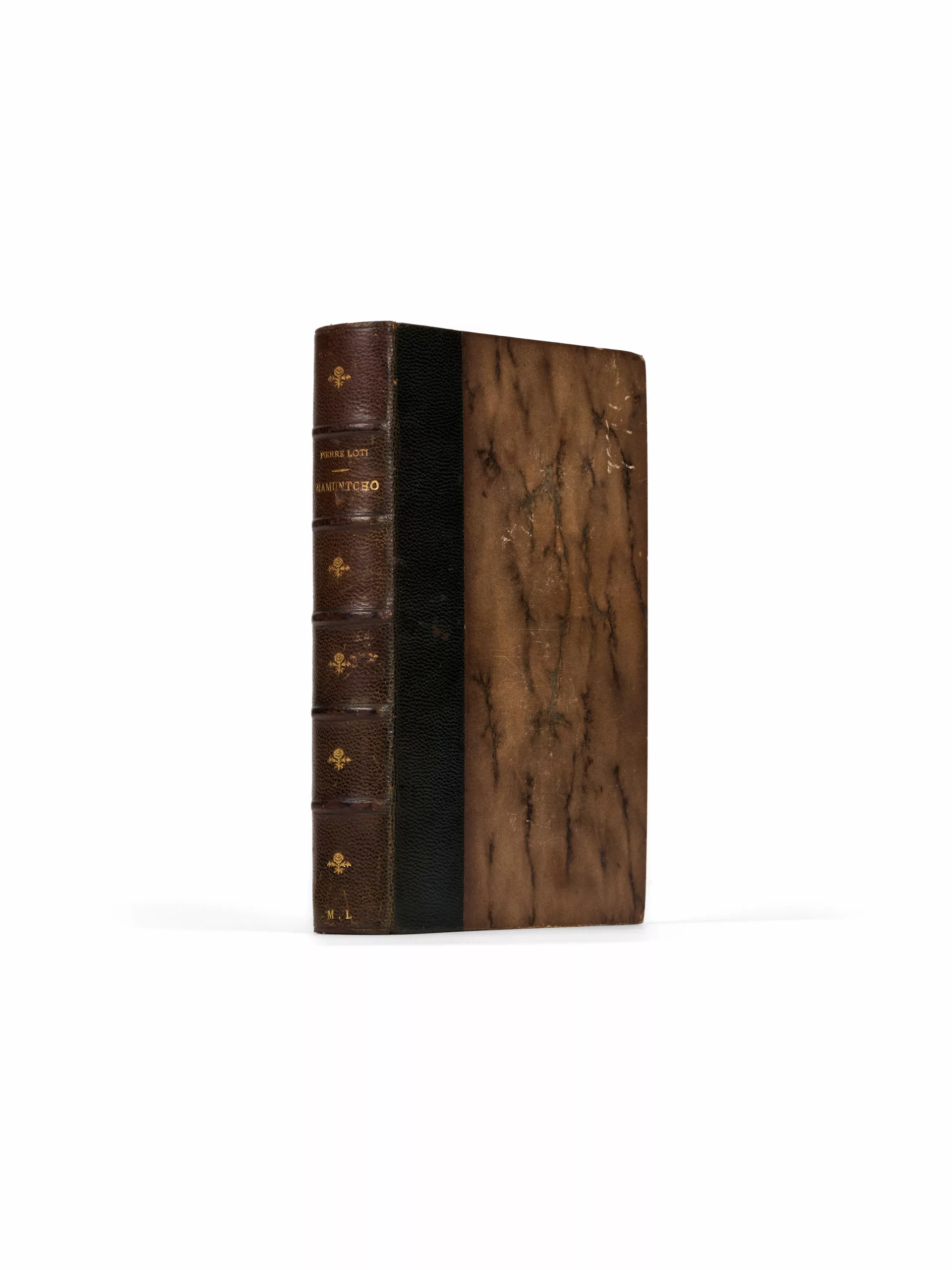
Ramuntcho
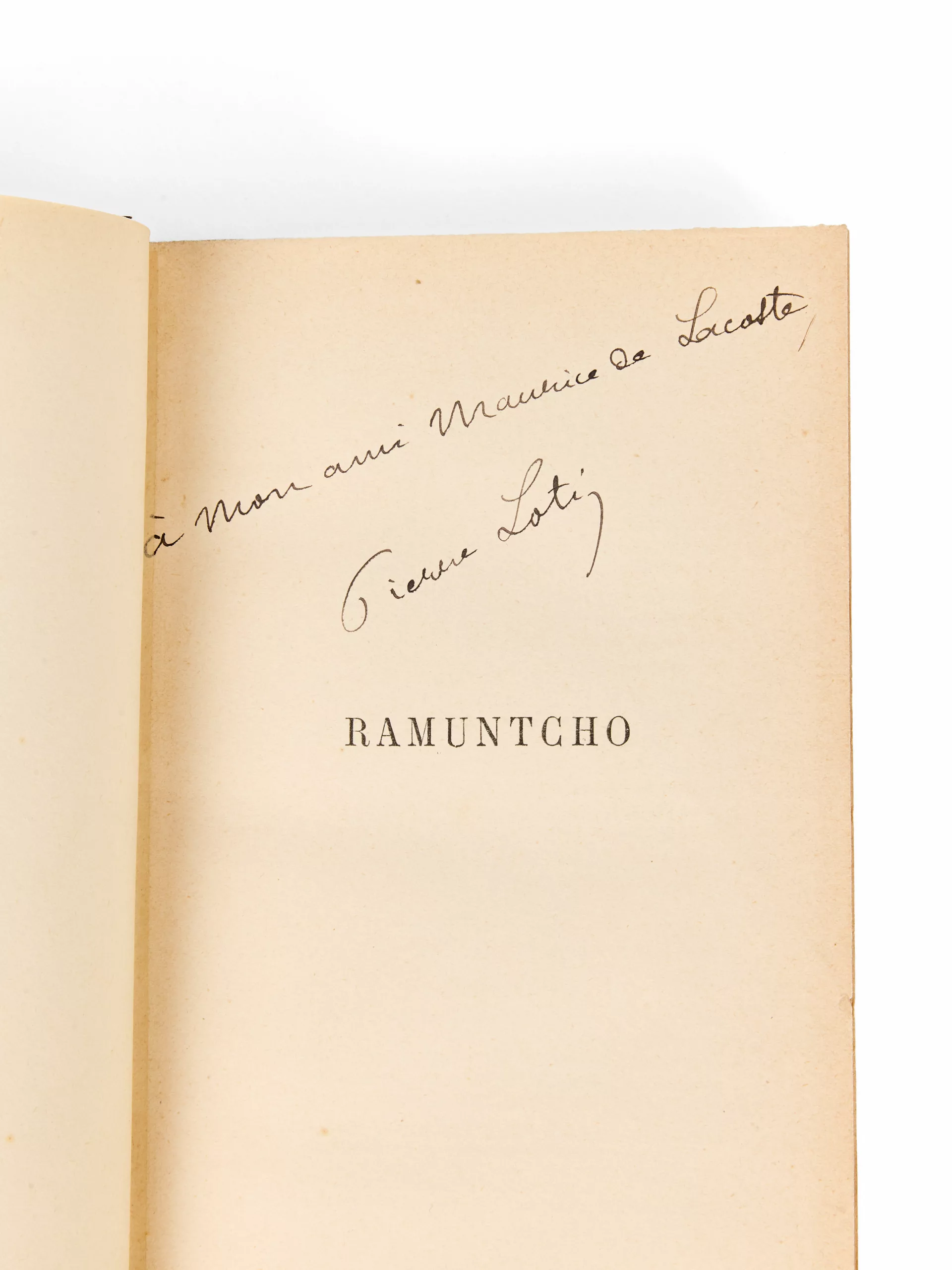
Presentation copy inscribed by Pierre Loti to Maurice de Lacoste: “à mon ami Maurice de Lacoste, Pierre Loti.”
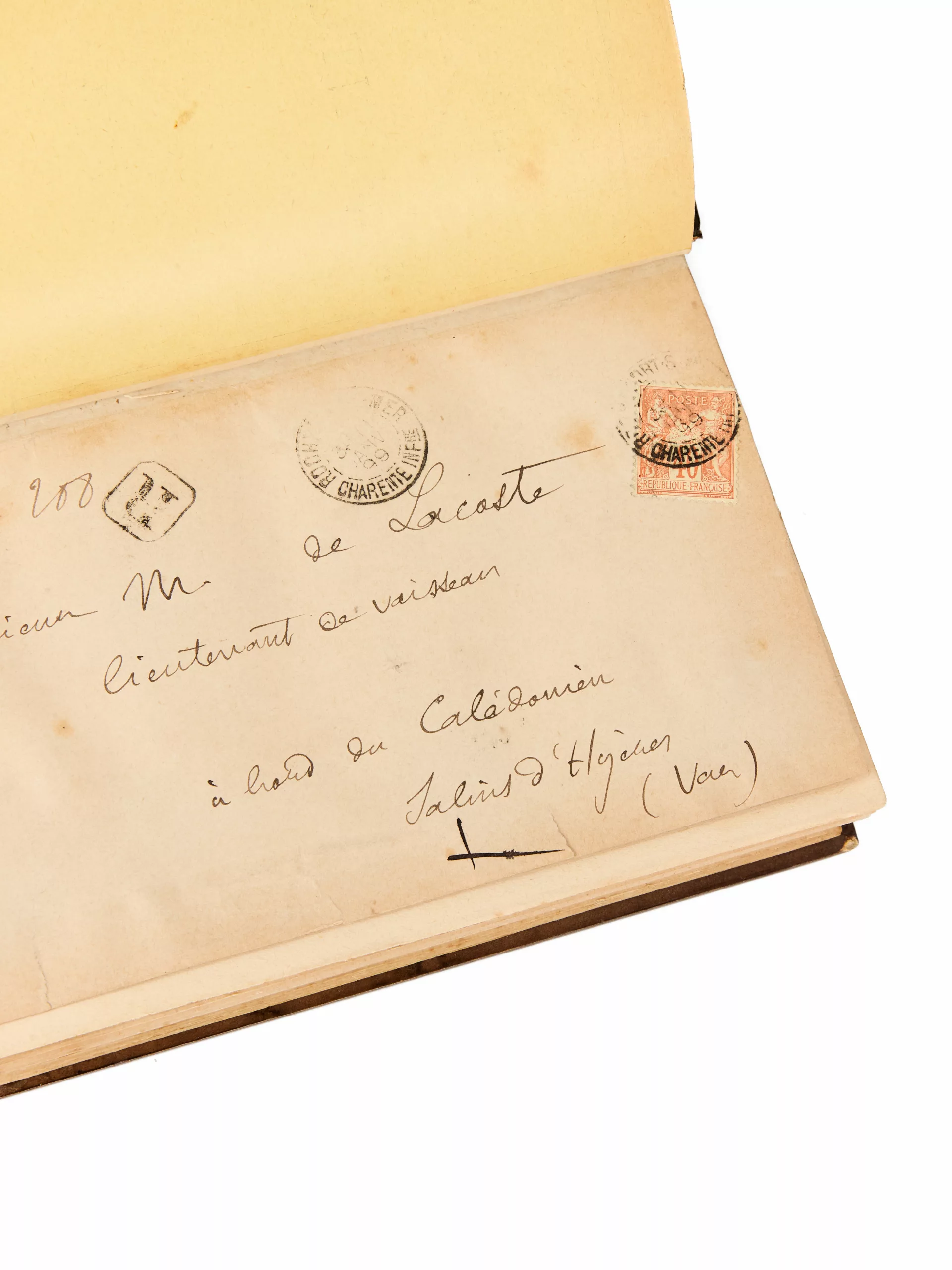
Mounted at front: 1 envelope addressed to Maurice de Lacoste, lieutenant de vaisseau, aboard the Calédonien / Salins d'Hyères (Var).
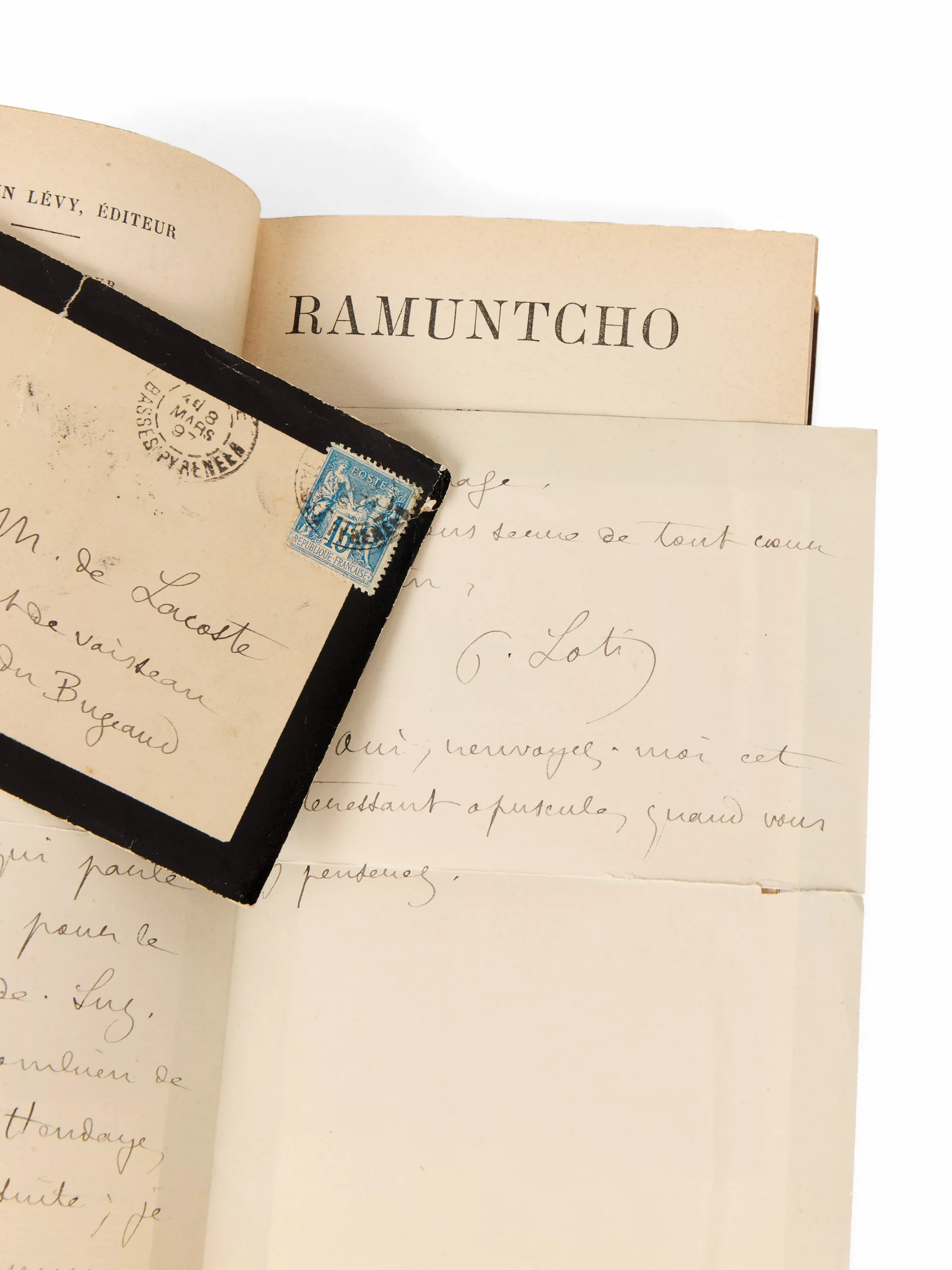
Preserved with the copy: 1 autograph letter signed (on mourning paper) addressed to the same, with its envelope preserved, dated 8 March 1897:
“My dear friend, I already knew you were on the Bugeaud, for I had gone a few days ago to Rochefort and, less forgetful than you might think, I had immediately sent to the Prefecture to ask whether by chance you were there. You will certainly receive Ramuntcho, the book. As for Ramuntcho, the real one, he is a pretty and sturdy baby of nearly two years old, who speaks Basque and is for the moment living at St Jean-de-Luz. I do not know how long I shall stay at Hendaye, nor what I shall do afterward; I am without plans, as without courage. I shake your hand with all my heart. P. Loti. Yes, send me that interesting little book, whenever you think of it.”
An ideal presentation copy, to his junior from the École Navale and friend, Maurice de Lacoste. Loti sent him, aboard the ship Calédonien anchored at the Salins d’Hyères, this copy of his major novel of the “Basque cycle,” begun after his postings aboard the Bidassoa. Ramuntcho transposes, into a Basque Country still perceived as an “elsewhere,” the coming of age of a young pelota player turned smuggler, his love for Gracieuse, and then the trial of separation and the clash with an unbending Catholicism that culminates in a failed attempt to abduct her from the convent.
First serialized in La Revue de Paris (15 December 1896 – 15 February 1897), the text appeared the same year from Calmann-Lévy. Departing from a strict travel journal, Loti favors “objective” fiction and the staging of interior landscapes, drawn from his stays at Hendaye and Saint-Jean-de-Luz, which fixed the fin-de-siècle Basque imagination for decades.
The accompanying letter precisely situates the author at the moment of the book’s publication in volume form, just after the serial installments ended in February. And it entrusts to its recipient an essential point, in which Loti specifies the fictional and “real” genesis of the hero, between the novel fresh off the press and the Basque child from whom he borrowed the name: Pierre Loti’s own son. It should be recalled that “Ramuntcho” is not merely a fictional hero. In the Basque Country, Loti maintained — apart from his official life — a lasting relationship with Juana Josefa Cruz Gainza, known as Crucita. To be near her, he rented at Hendaye the house Bachar-Etchea, known as “the solitary house,” which Crucita never inhabited, since as soon as their liaison and their “contract” ended, he took her to Rochefort and settled her in a house in the outskirts of the town. She bore him four unacknowledged sons, all born in the Basque Country. The first, Raymond, born during the night of 29–30 June 1895, is commonly known as “Ramuntcho” and has often been considered the direct inspiration for the title and the character of the novel. This parallel filiation, long kept silent, is here confirmed by a Loti confiding, in friendship and secrecy, in his friend Maurice de Lacoste.
Born in Metz in 1864, Lacoste entered the naval academy in 1882 — fifteen years after Loti. A first-class midshipman in October 1885, he was first posted to the Far East naval division. It was during these early voyages that he met Pierre Loti, who had been sailing those seas since the same year aboard the Mytho, one of eleven official transport ships of the naval forces in the Far East. It was on this ship, during a month-long crossing, that Loti wrote part of the manuscript of Pêcheur d’Islande.
Lacoste was promoted to ensign in October 1887, serving aboard numerous French Navy vessels. Promoted to lieutenant in October 1893, he was successively assigned to several battleships and then cruisers, the spearheads of the Navy and the most powerful warships of the time. He was later assigned to the central directorate of naval artillery, then became a frigate captain before being assigned to the general staff in 1909. Their friendship remained unblemished and lasted until Loti’s death in 1923.