

Raboliot
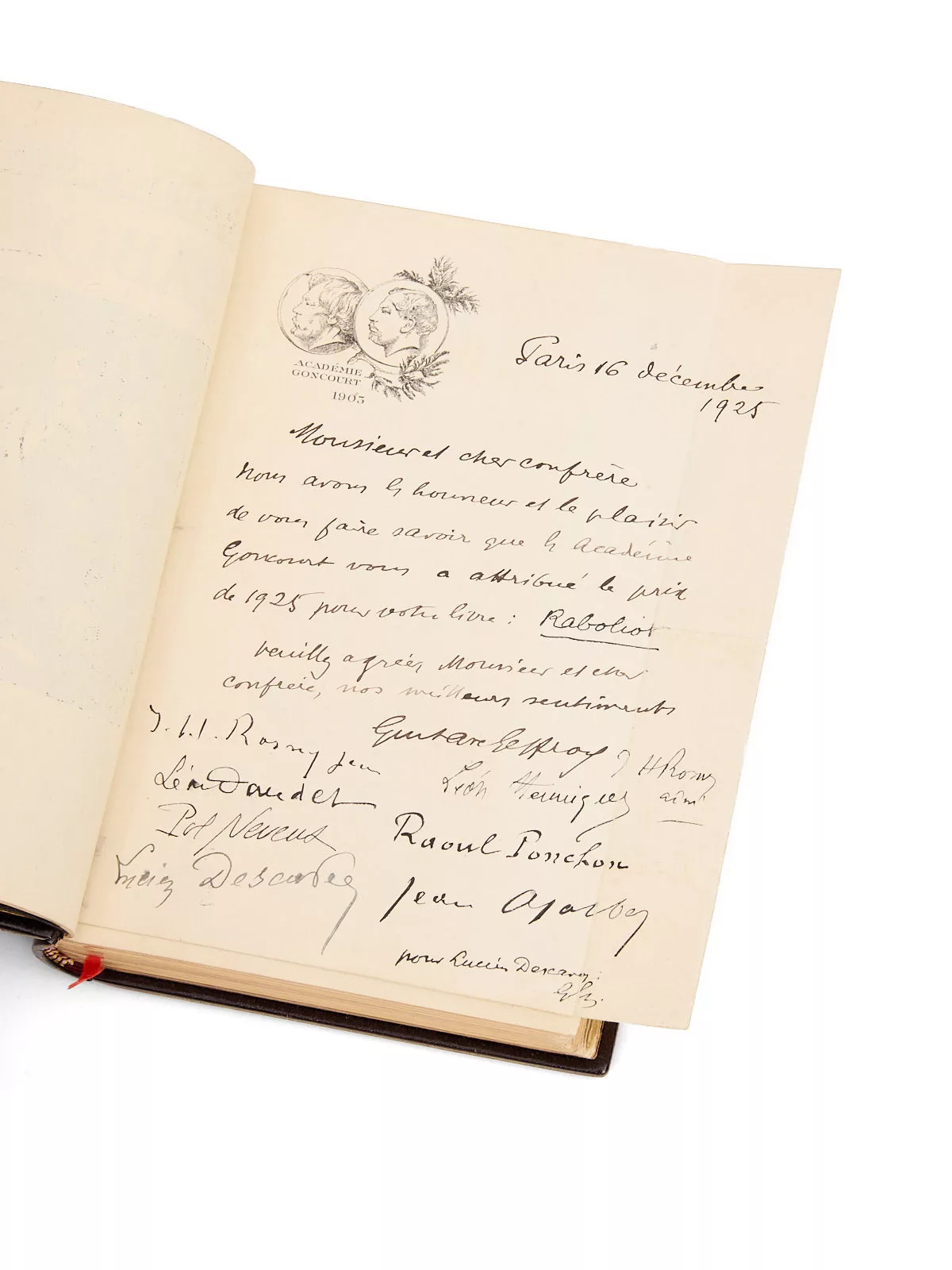
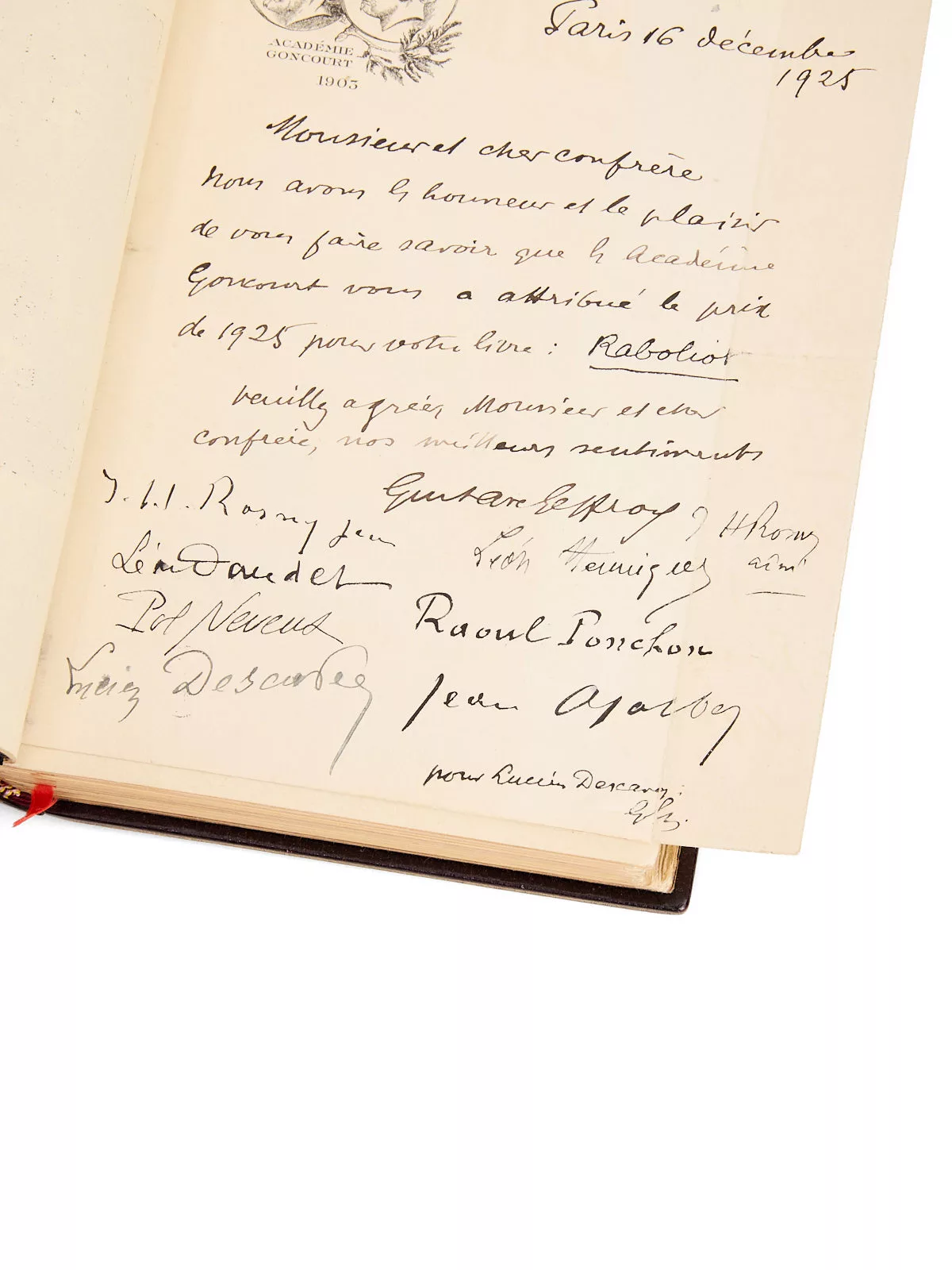
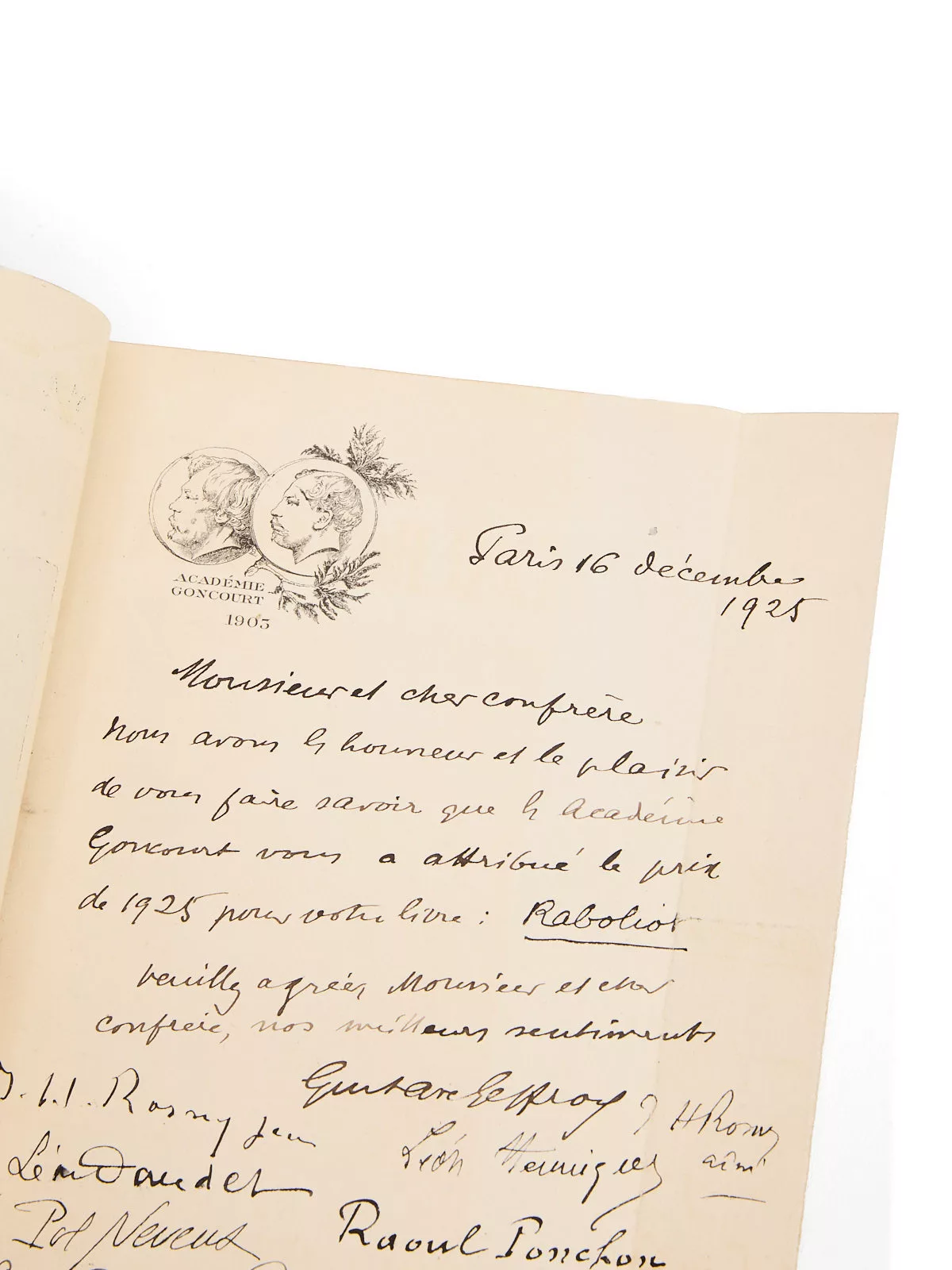
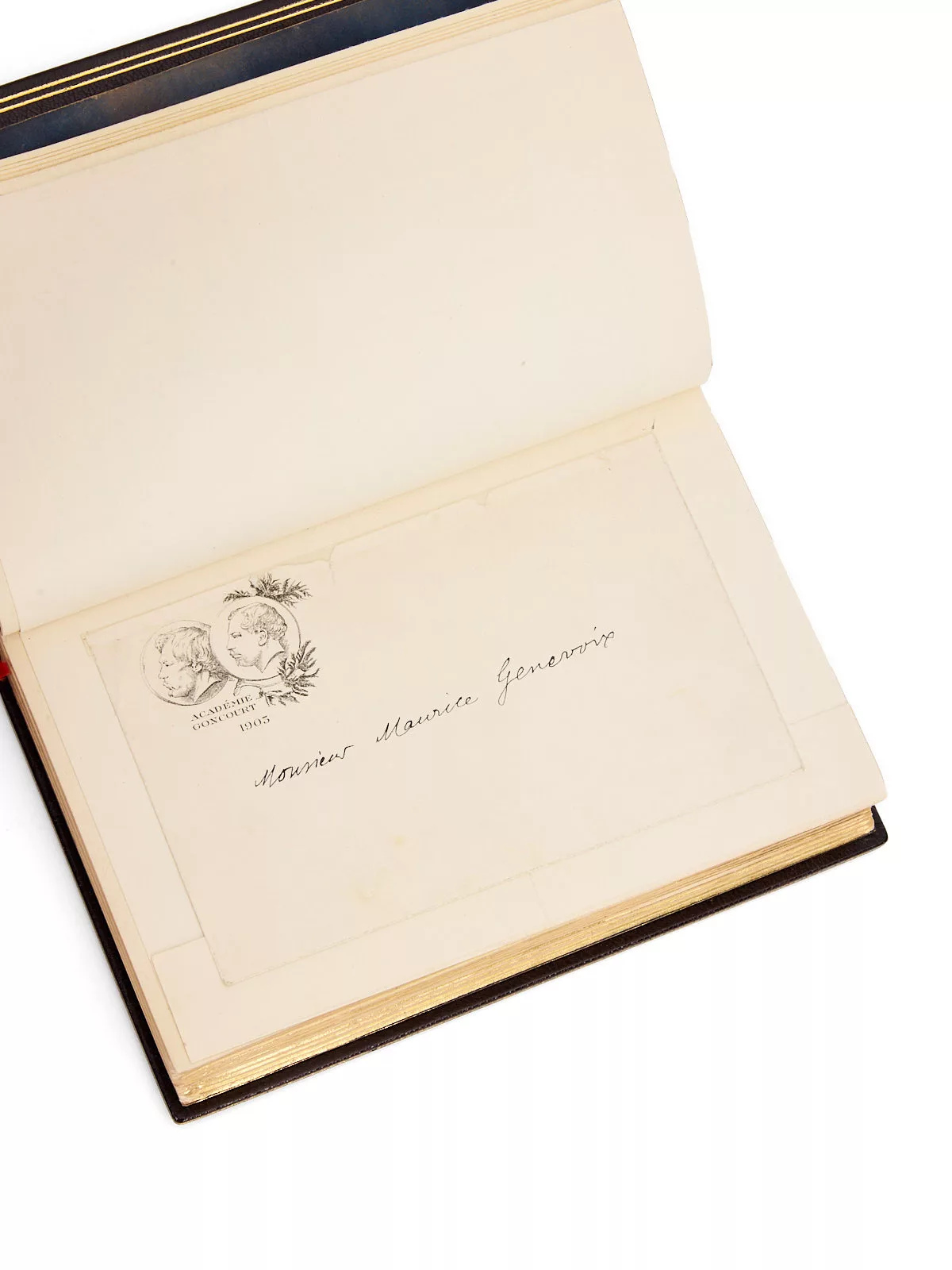
A moving and historic copy, containing the original notification informing Genevoix that he had won the prize.
This volume was included in the exhibition “Maurice Genevoix” held at the Bibliothèque historique de la Ville de Paris (December 12, 1990 – February 12, 1991, no. 200 of the catalogue).
Bound in at front:
“Monsieur et cher confrère,
Nous avons l’honneur et le plaisir de vous faire savoir que l’Académie Goncourt vous a attribué le prix de 1925 pour votre livre : Raboliot.
Veuillez agréer Monsieur et cher confrère, nos meilleurs sentiments.
Gustave Geffroy, J. H. Rosny aîné, J. H. Rosny jeune, Léon Hennique, Raoul Ponchon, Léon Daudet, Pol Neveux, Jean Ajalbert et Lucien Descaves [proxy signed by Geffroy].”
On December 16, 1925, the ten members — reduced to eight that day by the death of Élémir Bourges and the absence of Lucien Descaves, who voted by correspondence — met for the twenty-third time.
Among the competing candidates were Henri Pourrat and no fewer than five authors published by Gallimard: Drieu La Rochelle, Jouve, Beucler, Deberly and Bloch. Against this formidable field, Raboliot emerged on the second ballot, then contended with Jouve’s Paulina 1880 (three votes each), finally winning on the fifth ballot with five votes.
Sous Verdun, in 1916, had nearly won the prize, before Barbusse’s Le Feu and Adrien Bertrand’s L’Appel du sol, for various reasons, overtook it. Rémi des Rauches, in 1922, was also shortlisted. A year before Raboliot was published, a decisive meeting took place with Lucien Descaves, a leading figure of the Académie Goncourt: “Genevoix, I must clear my conscience. We have long wished to award you our prize. By ‘we’ I mean a majority. Unfortunately for you, there is a veto. Rosny aîné, our president, for reasons that are none of our business, harbors such resentment against the Fischer brothers that he has sworn to himself: never, as long as he lives, will the Goncourt prize go to an author of the house whose literary directors they then are… — Then I must give up hope. — Why on earth? — Because I am bound to that house by a fifteen-year contract. — So what? — There are still nine years to run. — And then what?, Descaves repeated. I guarantee you that if your next novel is as good as your Rémi des Rauches, you will have no shortage of publishers willing to risk a lawsuit. I have told you what I wanted to tell you. Draw your own conclusions.” (in Trente mille jours, p. 224).
It was Bernard Grasset, through Louis Brun, who took that risk, after months of battles, lawyers’ letters and formal notices, between February and July 1925 — culminating in a lawsuit, largely won: a dispensation was granted to Genevoix for three works outside the house of Flammarion. Raboliot, whose manuscript had been completed since January 23, 1925, was thus published by Grasset, with whom the contract was signed that summer.
The book, printing completed on September 29, appeared in October and was an immediate success. Buoyed by this alignment of circumstances, Louis Brun, who had taken Genevoix under his wing, gave him a few instructions and, on the morning of December 16, advised him to have lunch not far from the Place Gaillon, at Emil’s, almost opposite Drouant. The day before, he had agreed to an interview with the famous critic Frédéric Lefèvre for his column “Une heure avec” in Les Nouvelles littéraires. “A sign. Almost a consecration already,” he sensed. On December 16, Genevoix settled in with his uncle and aunt for a waiting lunch whose minutes felt like hours. Finally, at 1 p.m., when his victory was announced, it was Louis Brun, trailed by a crowd, who broke the good news. A journalist from Le Figaro was the first to gather his impressions: “It was there, in the company of a few friends, that we ourselves brought him the good news, handing him the official letter signed by the ‘nine,’ announcing his success. Immediately his fine, intelligent face lit up, and great joy shone in his eyes: ‘Please be sure to convey my deep gratitude to all the members of the jury, to those who voted for me as to the others, and in particular to Messrs. Descaves, Geffroy and Hennique, who have always encouraged my efforts.’”
Genevoix thus gave Bernard Grasset his third prizewinner — after the 1911–1912 double success with Alphonse de Châteaubriant’s Monsieur des Lourdines and André Savignon’s Les Filles de la pluie. Fifteen further Goncourt-winning titles would follow at Grasset (Peyré, Charles-Roux, Laurent, Chessex, Maillet, Bodard, Fernandez, Host, Vautrin, Combescot, Maalouf, Rambaud, Quignard and Weyergans). And this December 16 was a fine day for the publisher of the Rue des Saints-Pères: the Prix Femina, on the same day, crowned Joseph Delteil for his Jeanne d’Arc. Orléans, that year, was thus doubly honored in the literary prizes!
Since 1919, Maurice Genevoix had returned to live nearby, at Châteauneuf-sur-Loire, where he had grown up. But after Rémi des Rauches, published in 1922, which portrayed the Loire through the figure of a cooper, Genevoix wanted to cross the river: to the south lay the Sologne, which he had been exploring since his return to the region. As soon as he came back from the front, during his convalescence, he began walking again, tramping through the forests, listening to the local people, observing nature. Several stays are documented at the heart of the region, in Brinon-sur-Sauldre, Nouan-le-Fuzelier and Lamotte-Beuvron, where he steeped himself in local customs, stories and speech. He resolved to say more of it: “I wanted to do for the Sologne what I had done three years earlier for the Val de Loire: to evoke it, to render it in my own way, my lifelong attachment to it since childhood, my gratitude for all it meant to me.”
It was at Brinon that his uncle had acquired a hunting ground after the war; it was there, yielding perhaps to the same pull toward nature, that Maurice Genevoix decided to settle in the summer of 1924: “One evening, I put my bicycle on my shoulder, took the little train that would carry me to Brinon. I arrived at dusk, jumped into the saddle, and got off after six kilometers in front of the house of the gamekeeper Trémeau” (in Trente mille jours, p. 200). It was there, facing the Étang des Clouzioux (which becomes the Étang de la Sauvagère in the novel), that his ideas took shape: “The Sologne is eminently rich in game. The hero of my future novel, a true son of this hunting land, could only be a hunter: not an occasional hunter, some Sunday marksman, but a hunter by instinct, a free man, indifferent to social constraints, who answers only to his own nature, to the calls that drive and compel him — in other words, precisely: a poacher.”
Brinon is the native village of “the most famous, the shrewdest, the most skilled, the most sensational poacher of the region: Alphonse Depardieu,” known as Carré, with whom Genevoix obtained an “audience” in the autumn, as the certainty of the novel and its cast of characters began to take shape. A meeting was arranged, at Brinon. A meeting that never happened: suspicious, the poacher did not show up. No matter; Genevoix, determined to shape this universal poacher by merging several real people, created “his” poacher: Pierre Fouques, known as Raboliot.
Maurice Genevoix would later recount, precisely, in Jeux de glaces (1961), this failed meeting with Carré-Depardieu, who “was not the last to claim, perhaps even to believe, that he had served as my model. And I truly owe much to this man who did not come, one autumn day in 1924, to the back room of the rustic inn where I waited for him in vain” (p. 90). He also explains there the nickname of his hero: the name Raboliot — designating a young rabbit still in its nest, in the “rabolière” — came to him from Sologne hunters: quick, cunning, free.
From Brinon-sur-Sauldre, Genevoix drew a great deal, as from an ideal epicenter: the commune is simply the one occupying — even today — the largest territorial area in its département: it covers 11,600 hectares and is crisscrossed by some 340 km of rural paths! In 2025, only 132 communes in France cover more than 100 km2.
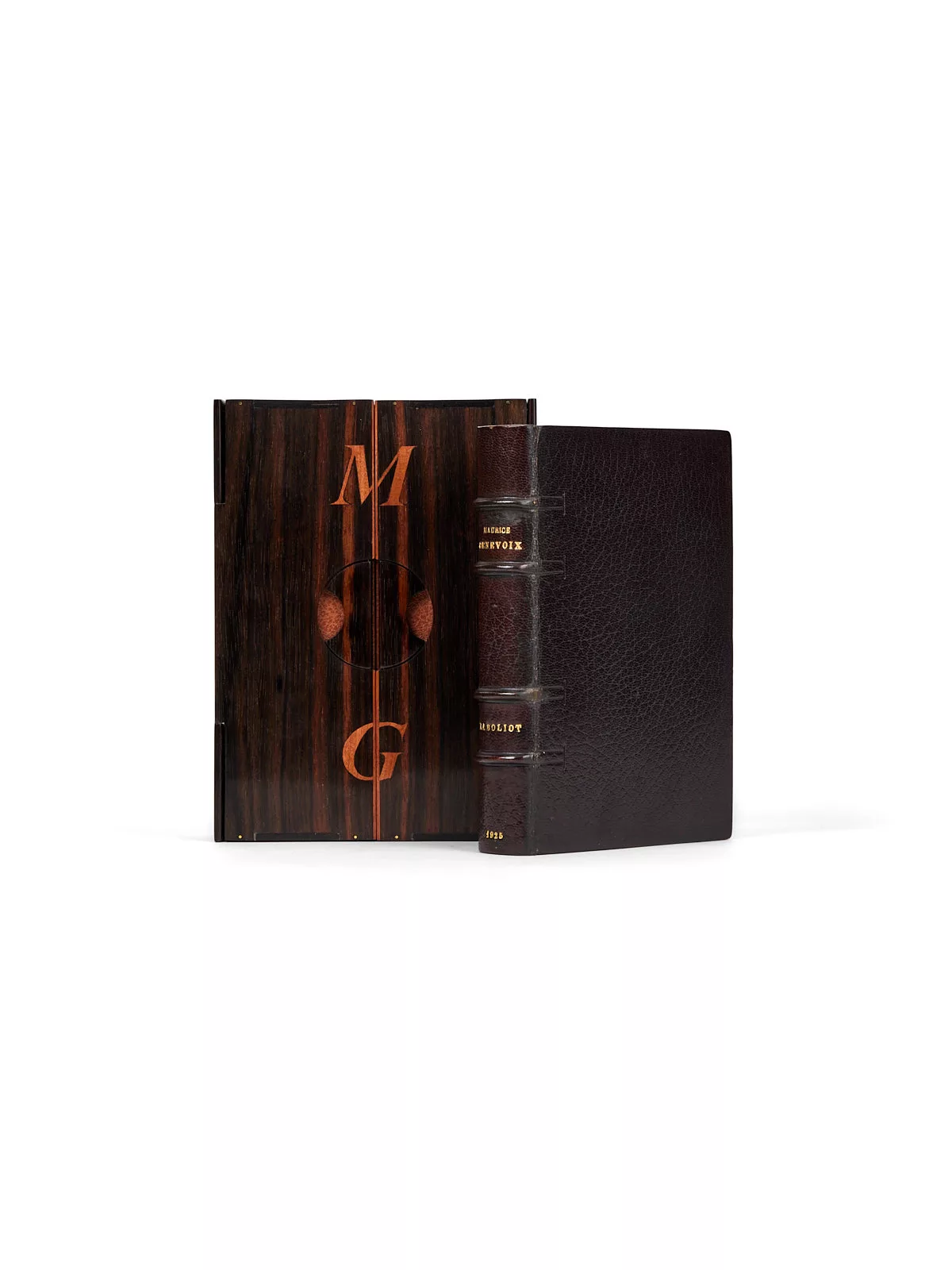
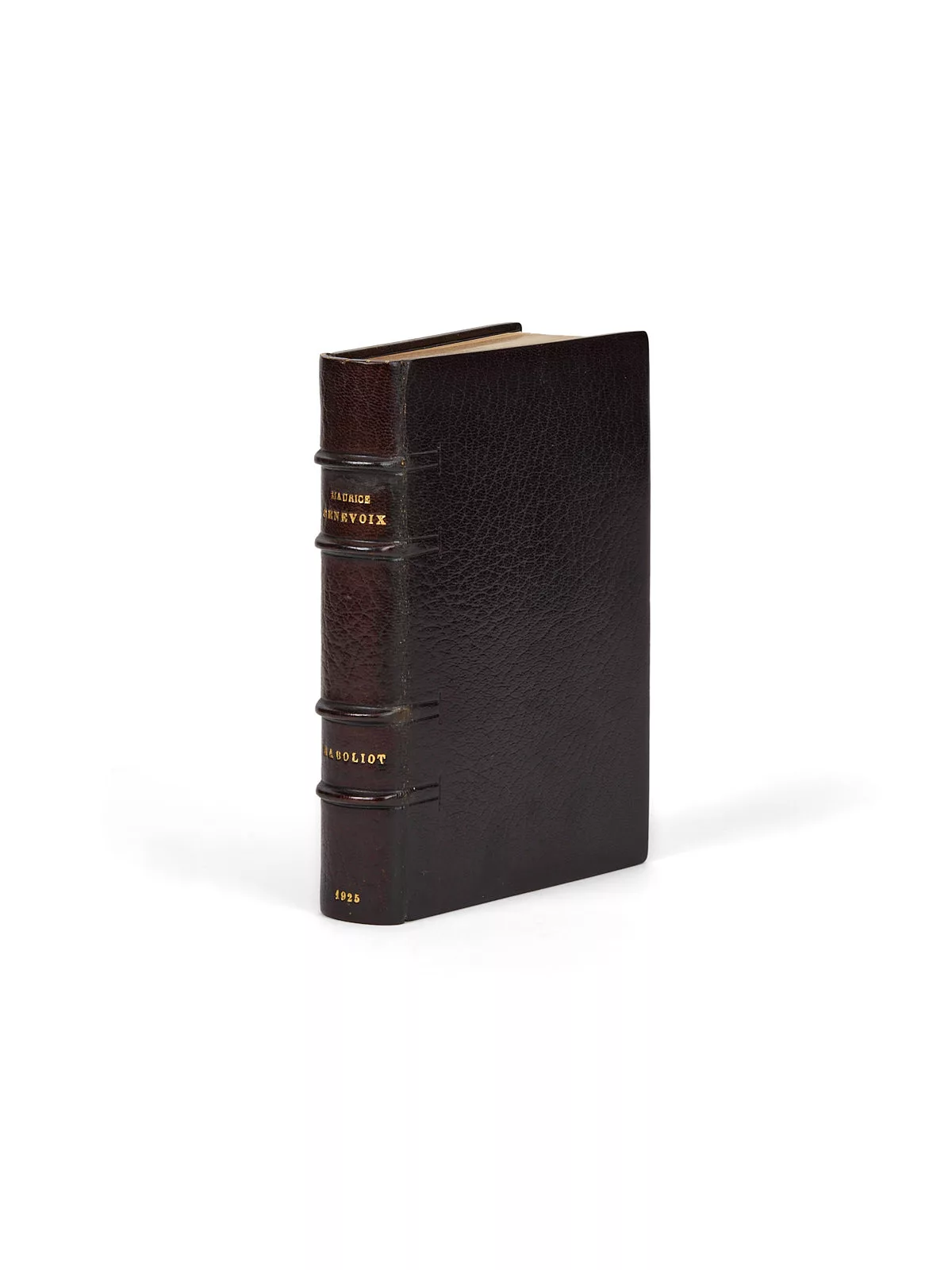
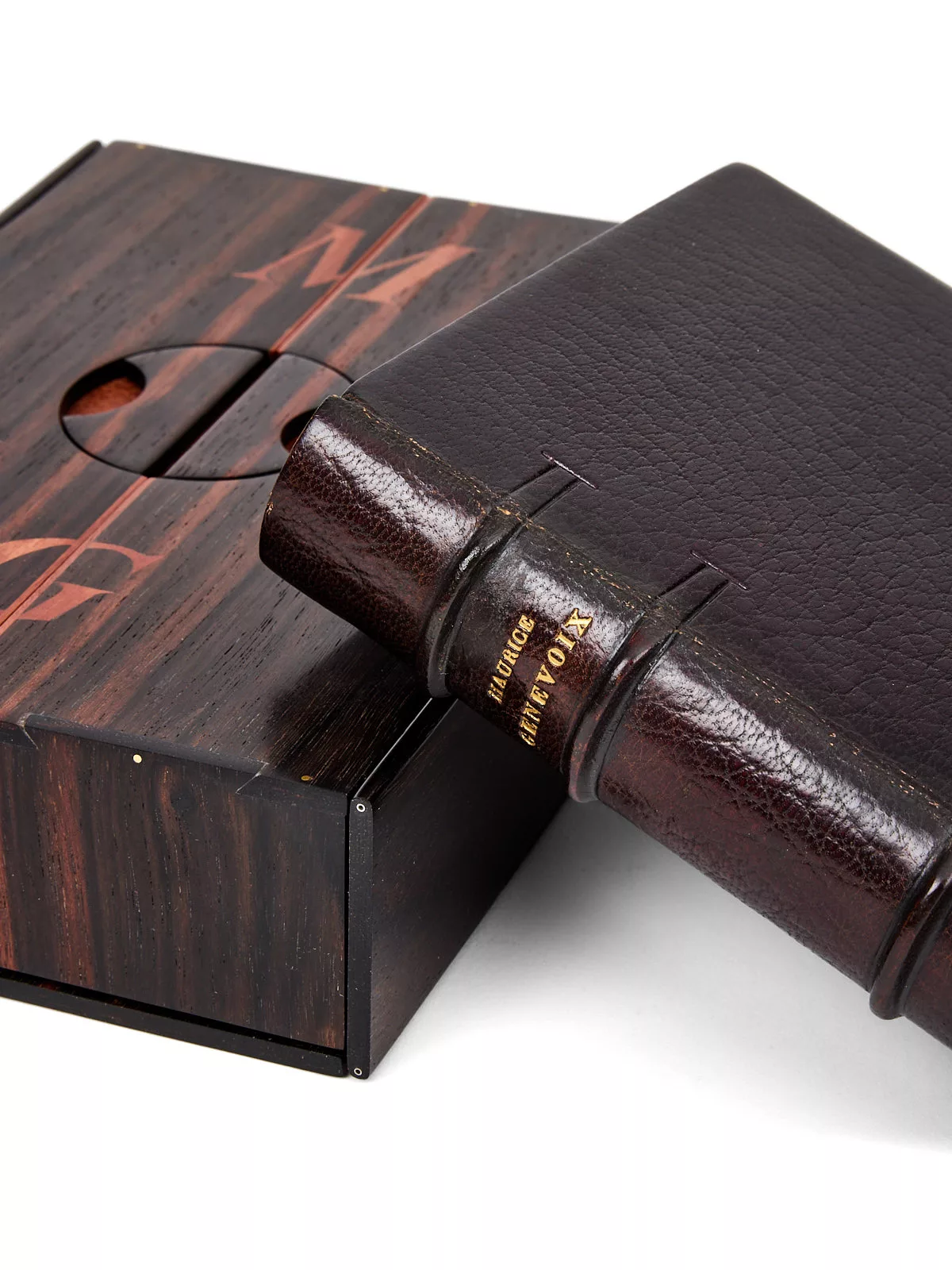
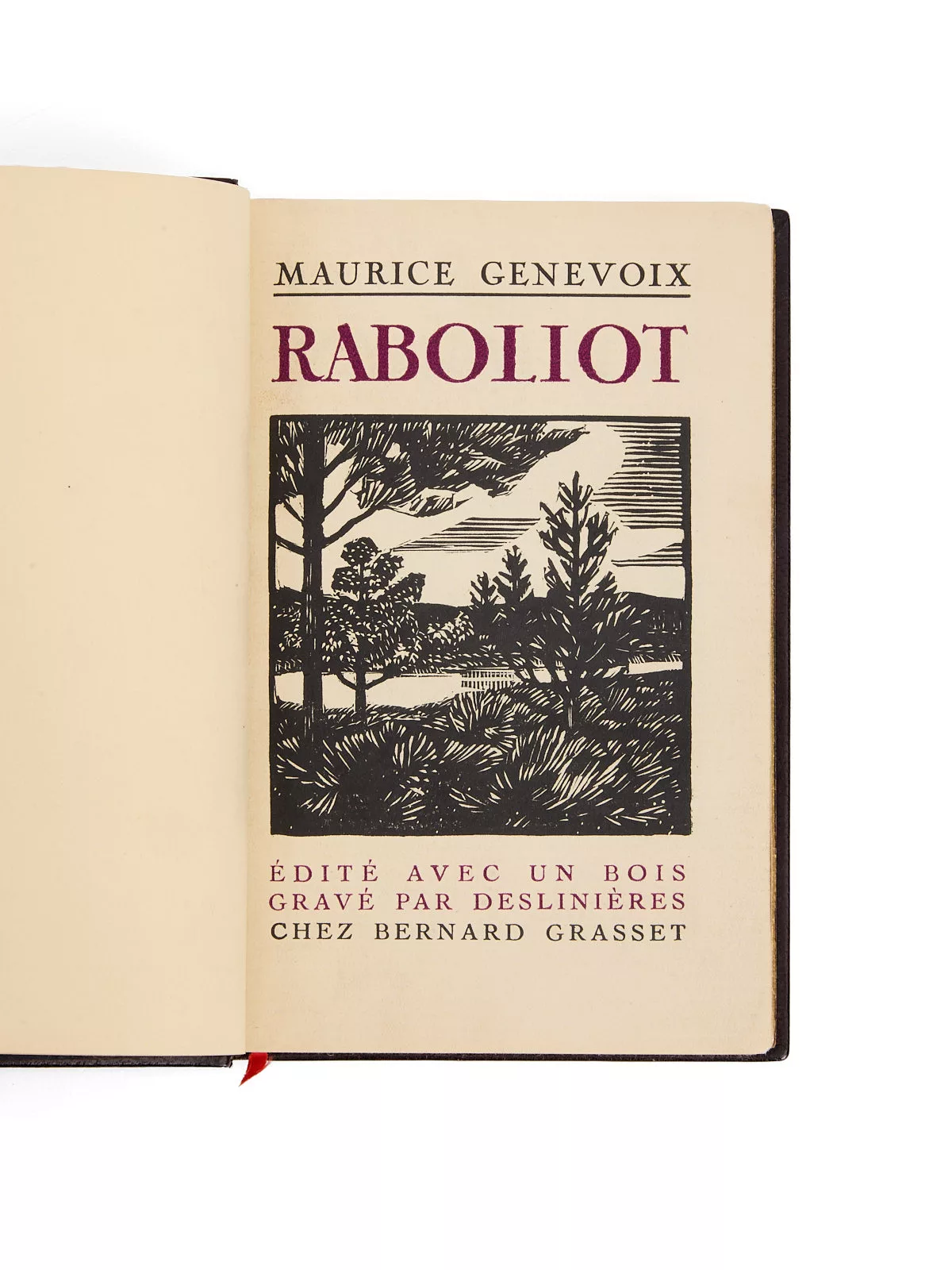
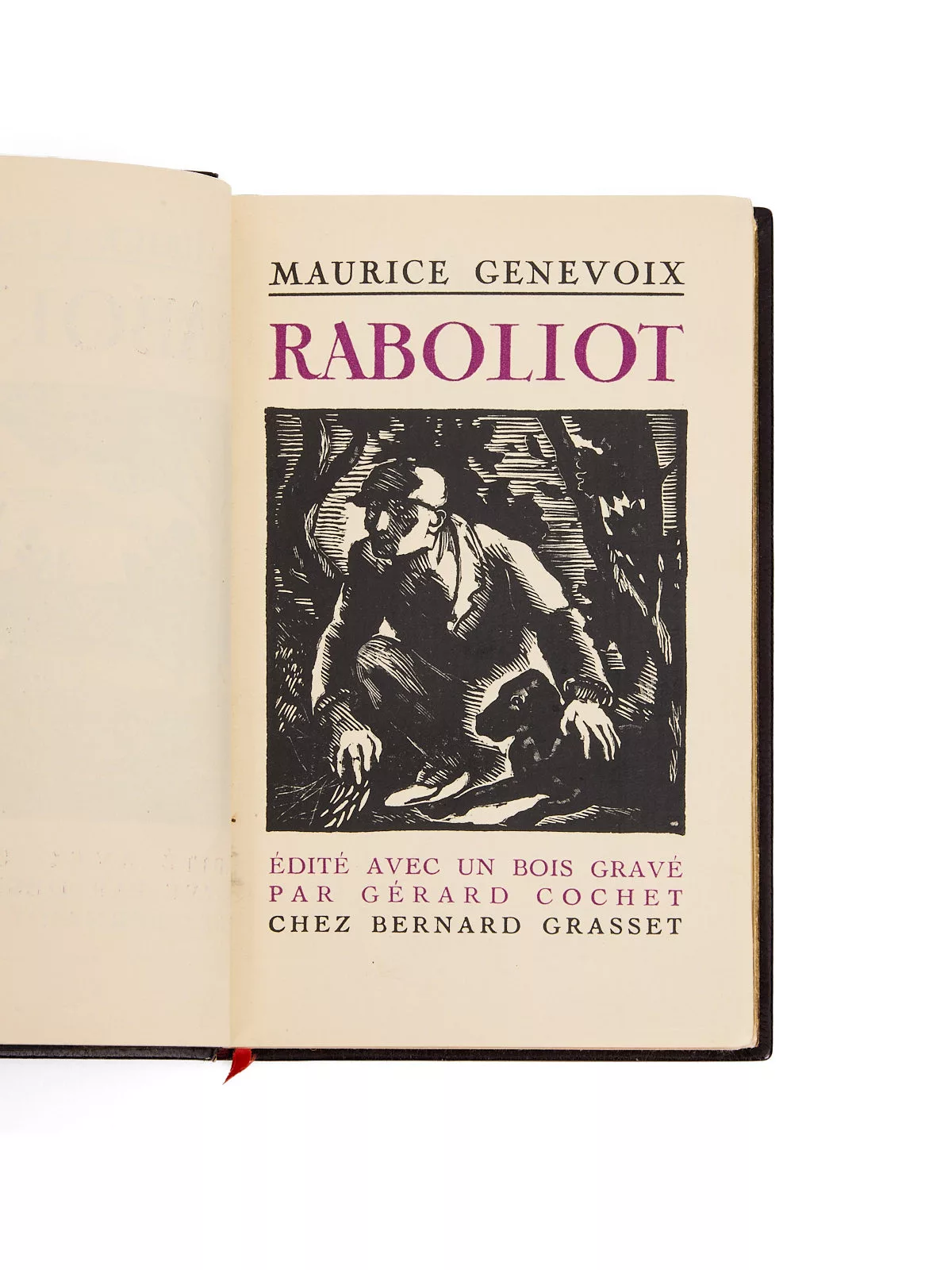
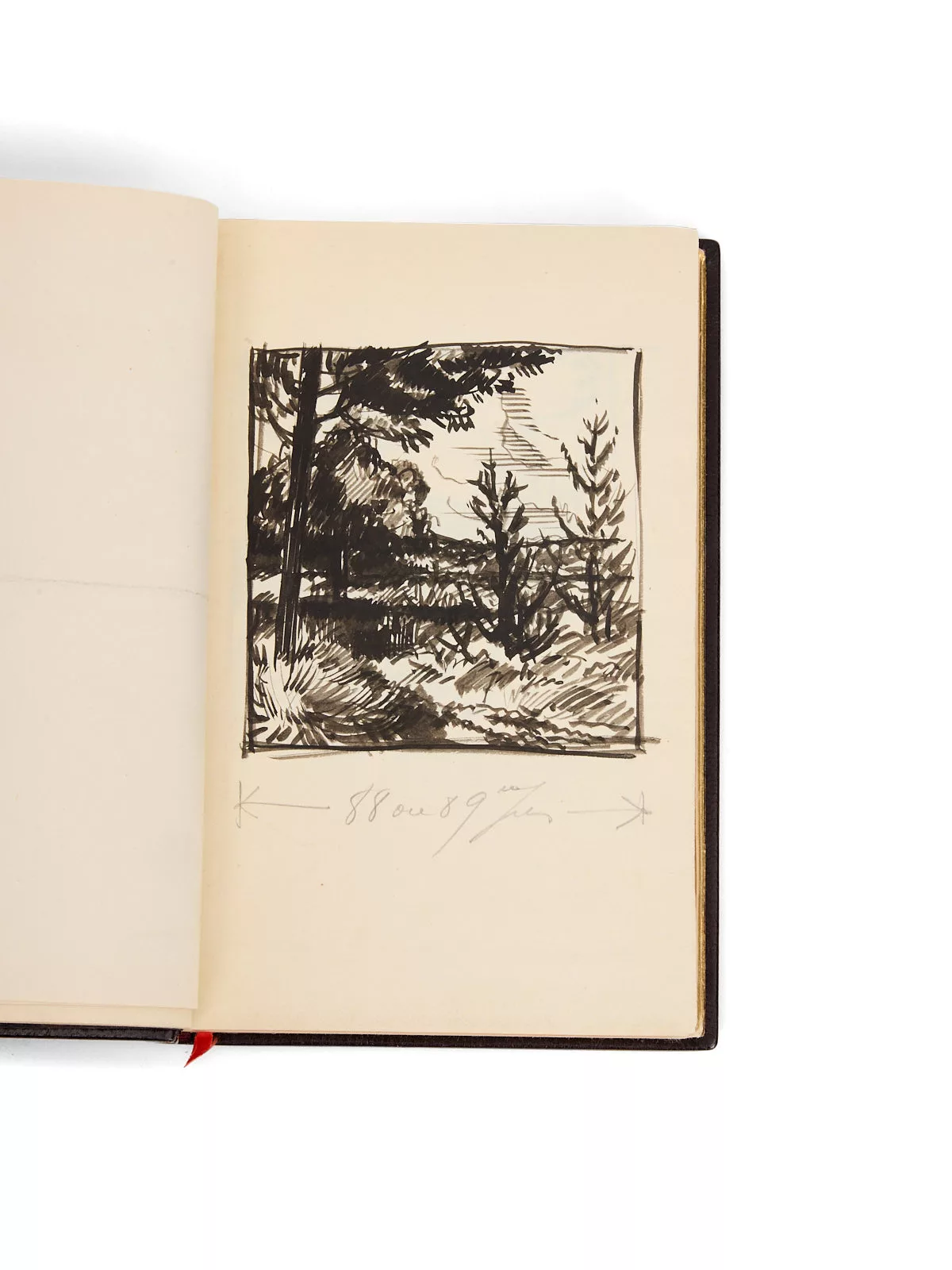
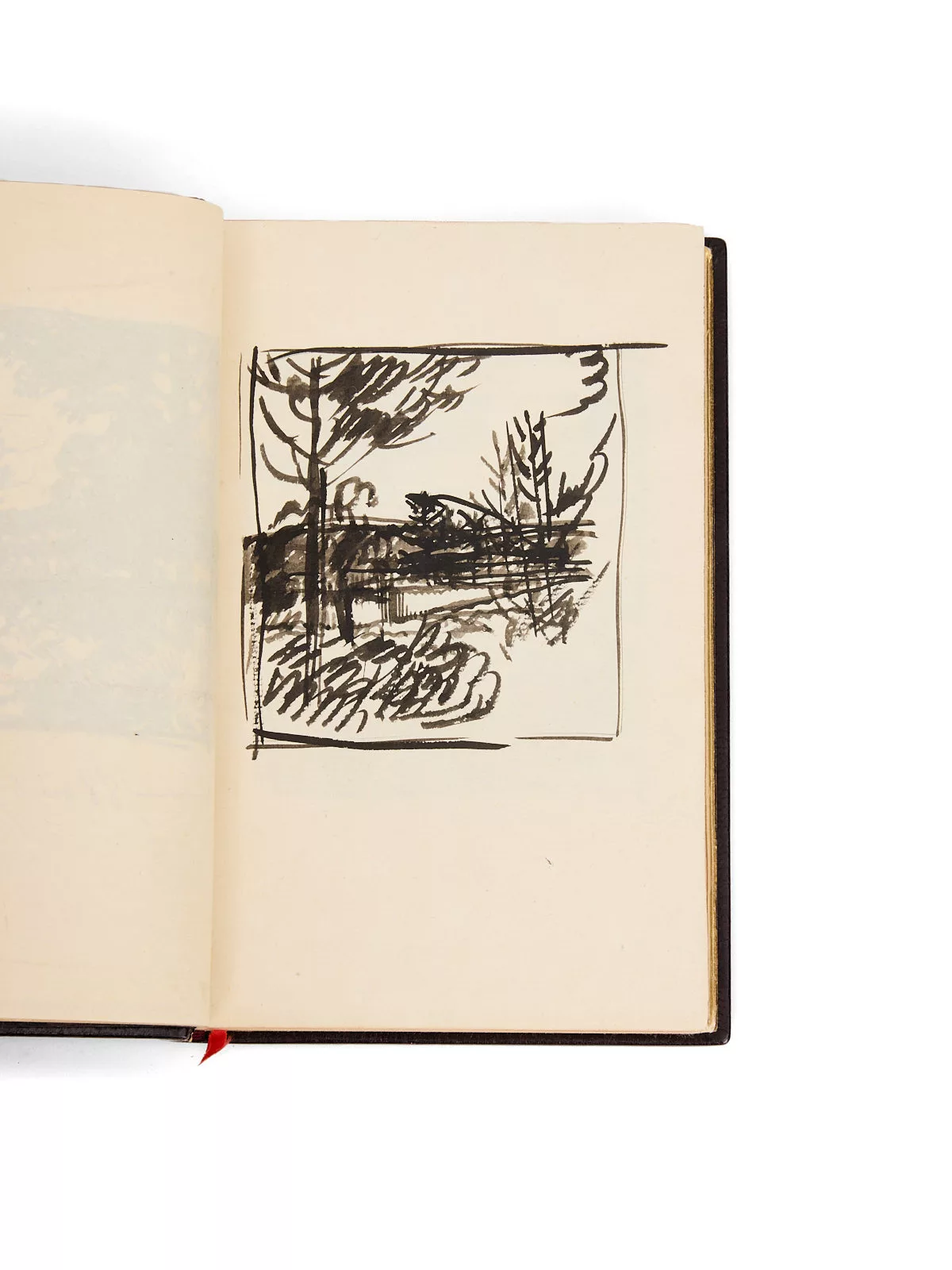
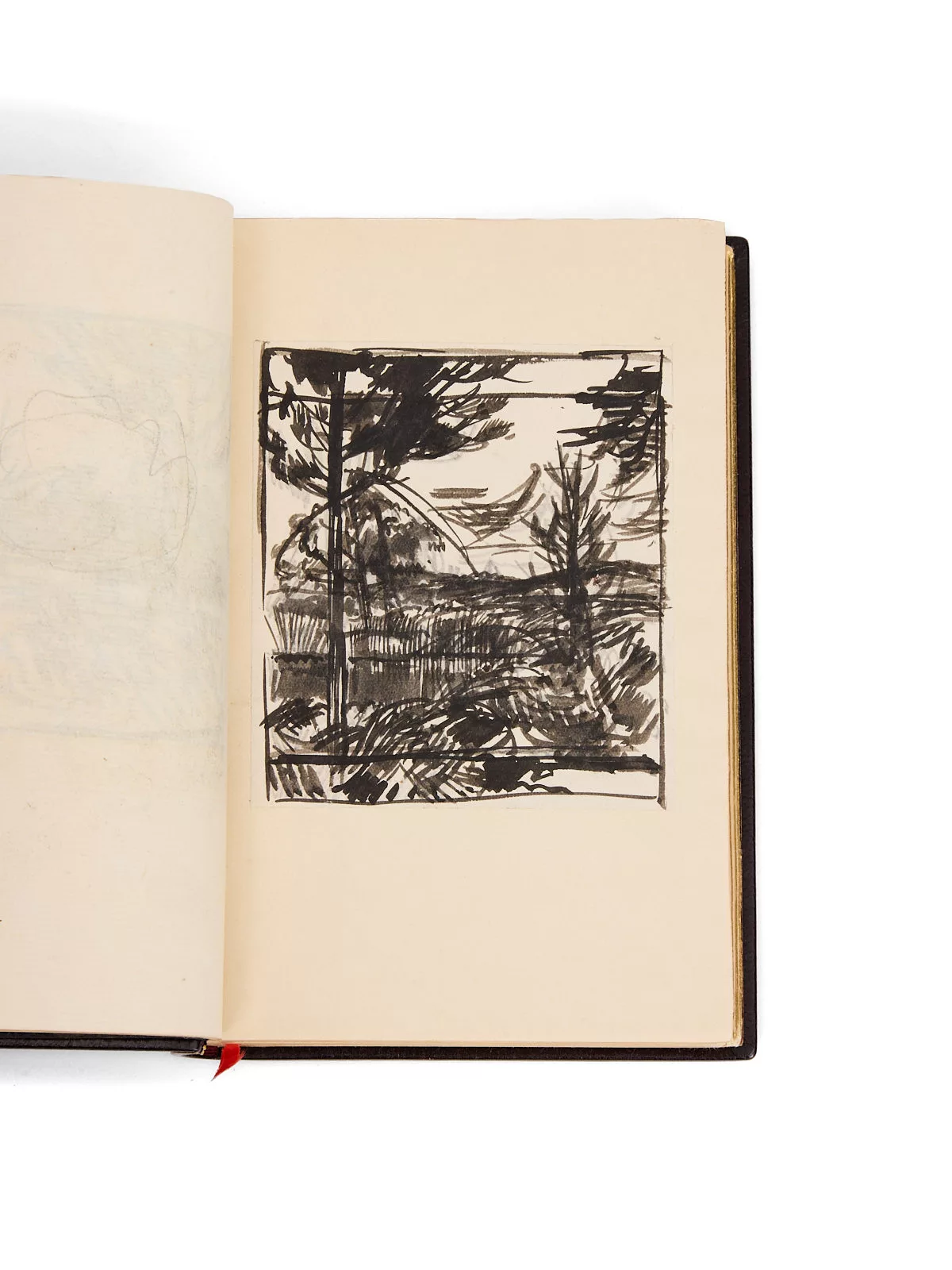
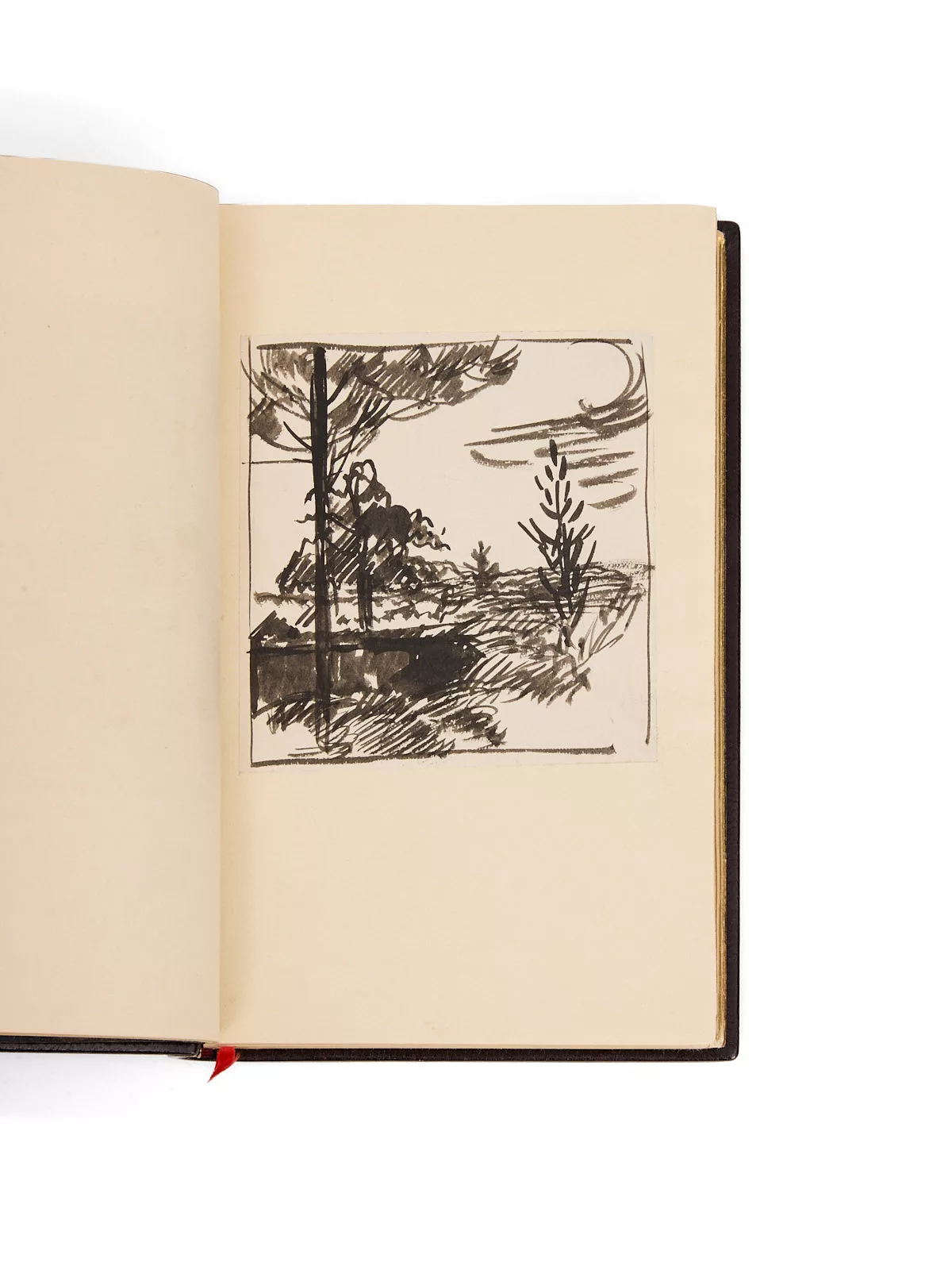
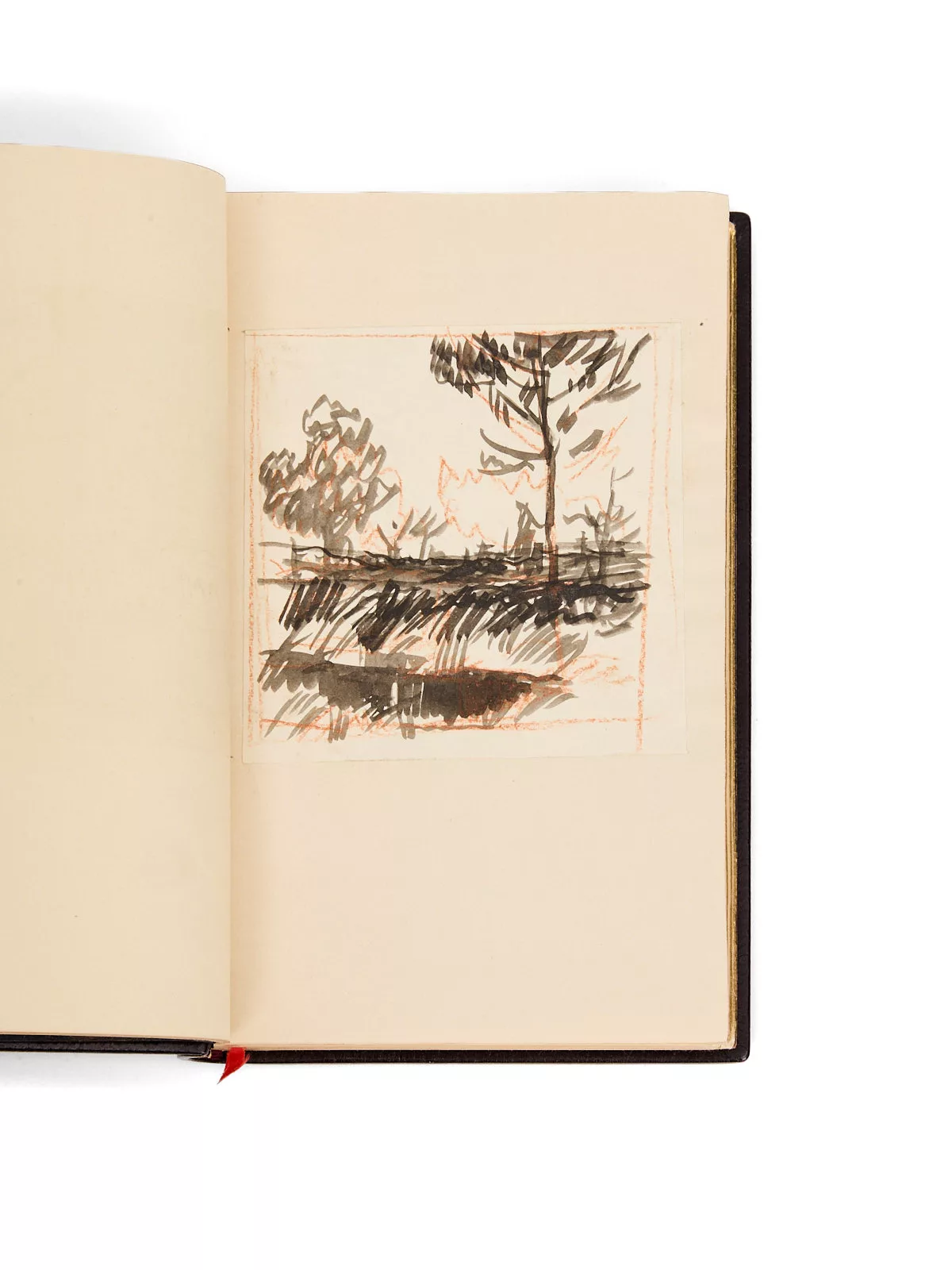
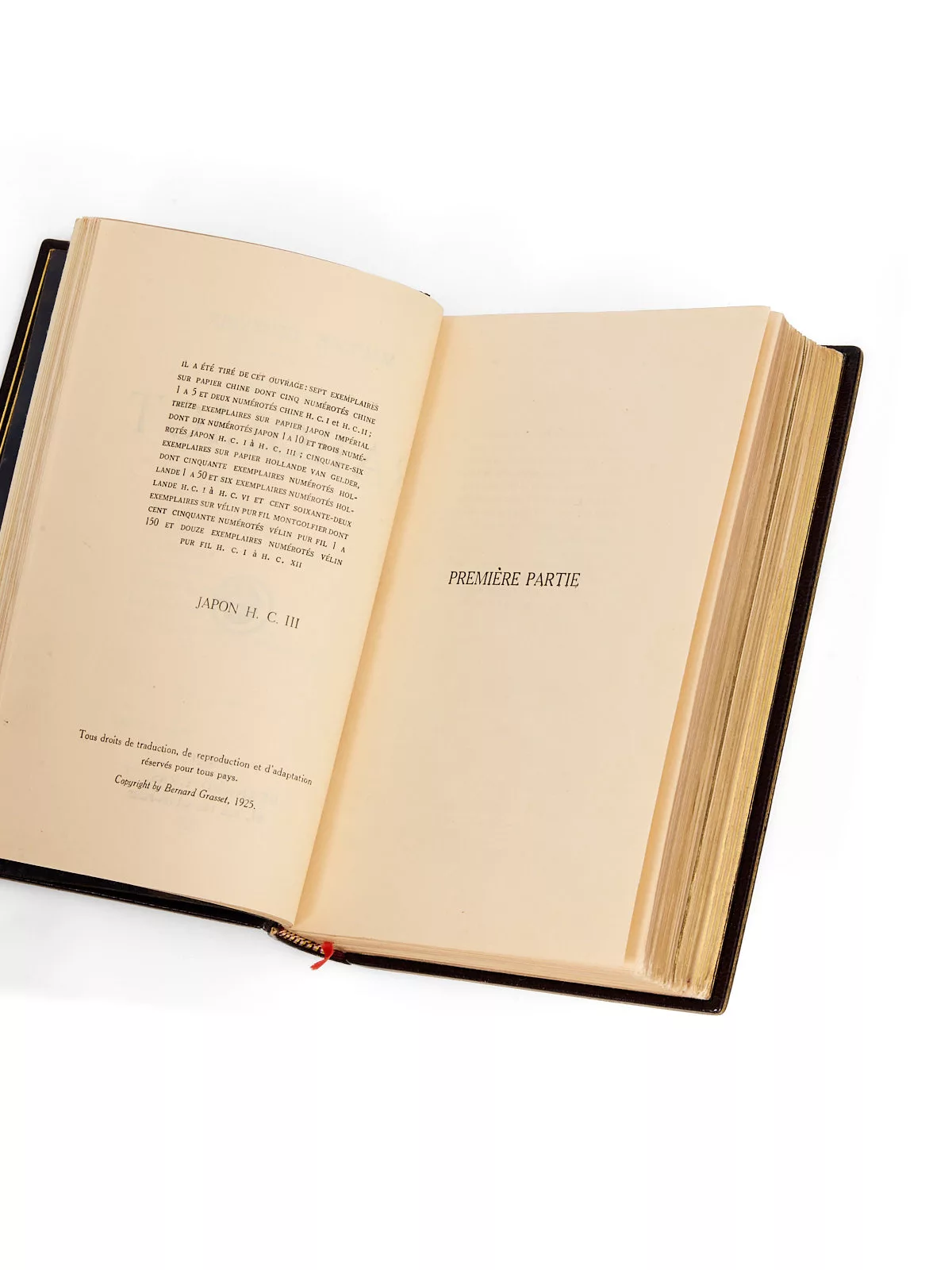
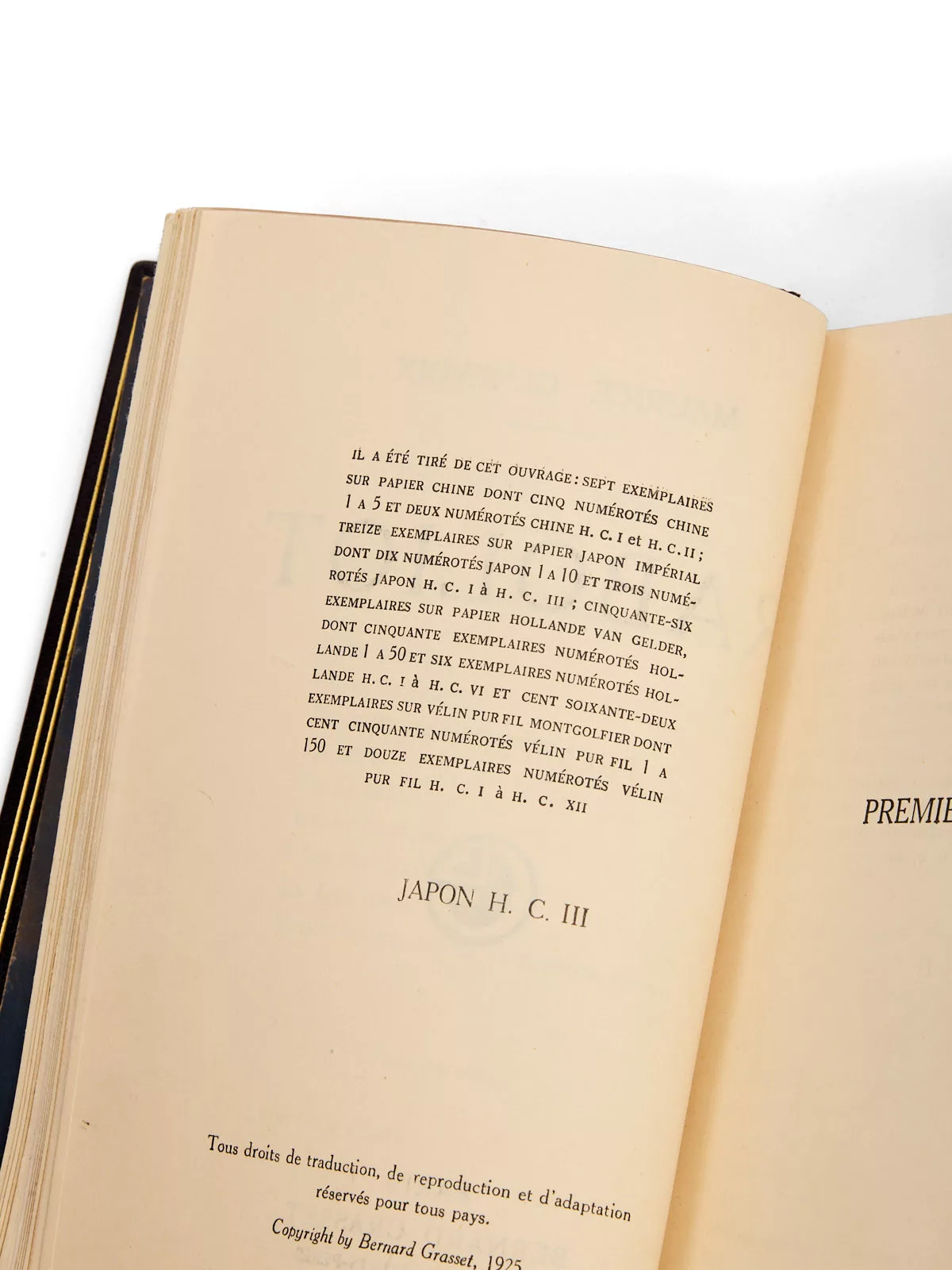
This precious copy on Japanese paper was entrusted by Maurice Genevoix to Grégoire Guimpel-Levitzky (1885–1969), along with André Deslignères’s original preparatory drawings for the edition’s cover. A second cover, illustrated with a woodcut by Gérard Cochet, was added only to copies printed on deluxe paper. It is present here.
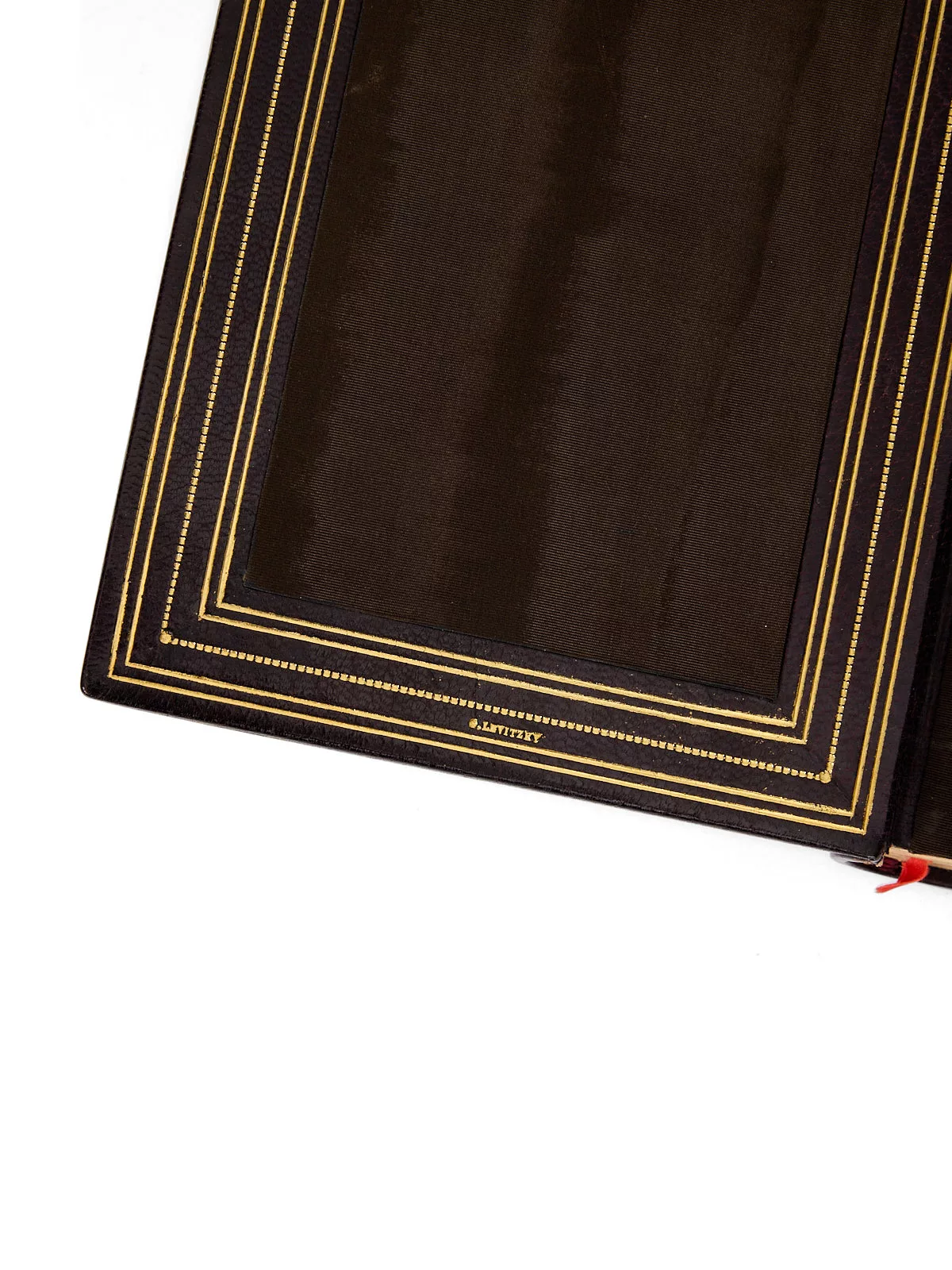
Of Ukrainian origin, born in Odessa where he trained in bookbinding, Grégoire Levitzky was forced into exile in 1905, fleeing the violent repression of the Russian revolution and the massacres carried out in Odessa. He first worked as a craftsman for the binder Hippolyte Prouté, before soon opening his own workshop on the Rue de l’Odéon, from 1910. He first made a name for himself with “boards in decorated and illuminated vellum” (Julien Flety, Dictionnaire des relieurs français, p. 113), before becoming a skilled practitioner in the treatment of morocco, whether in Jansenist style or with decoration.
It is not impossible that it was Louis Brun, an eminent bibliophile, who advised Genevoix to turn to Levitzky to have the copy bound. In the author’s library, this is the only book to have received such precious treatment; at most he entrusted a local binder, Carrey, with his other deluxe-paper copies for his personal library.
This copy of Raboliot never left Genevoix; he kept it at Les Vernelles, close at hand, in his study overlooking the Loire and the Sologne.
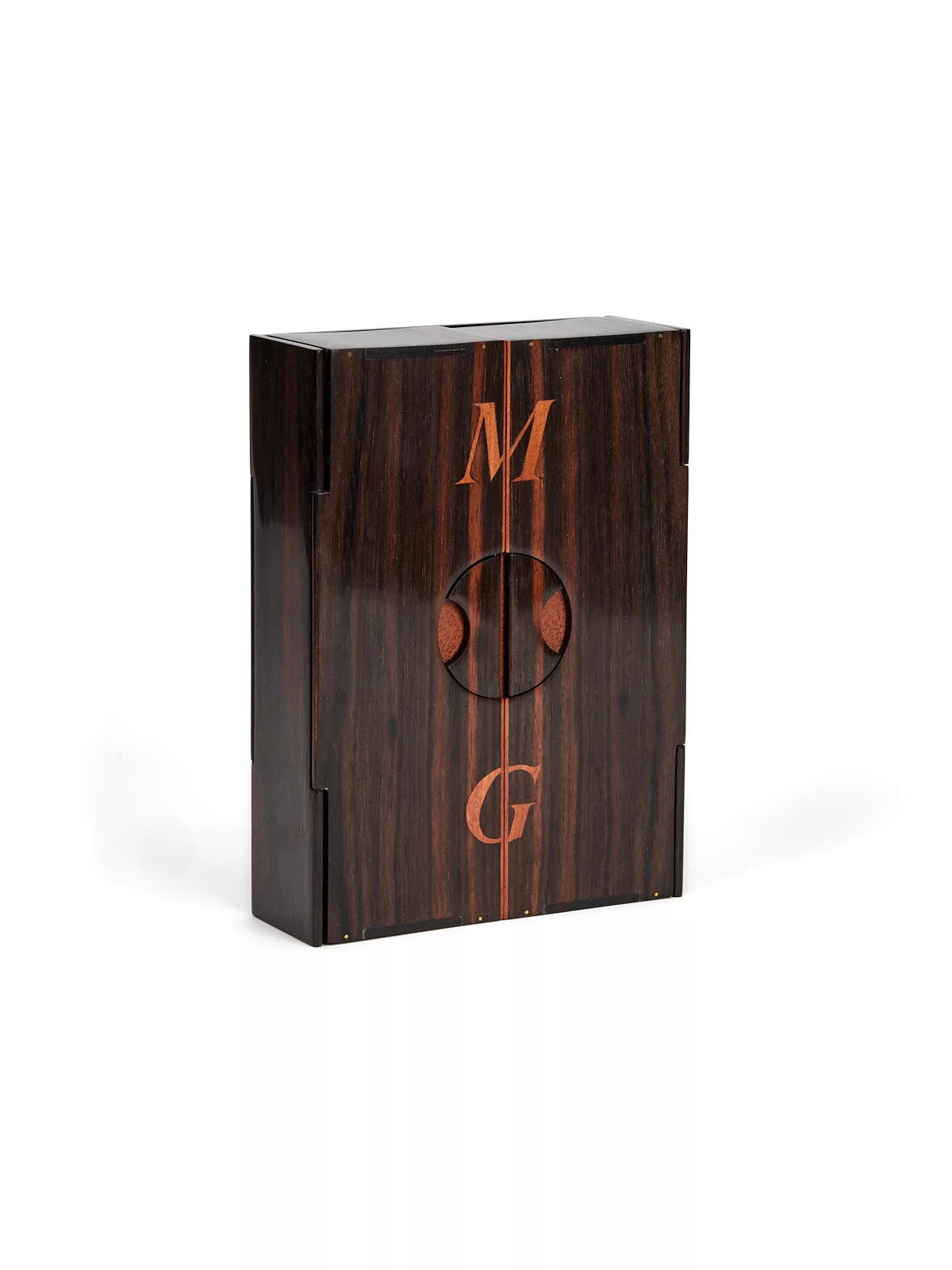
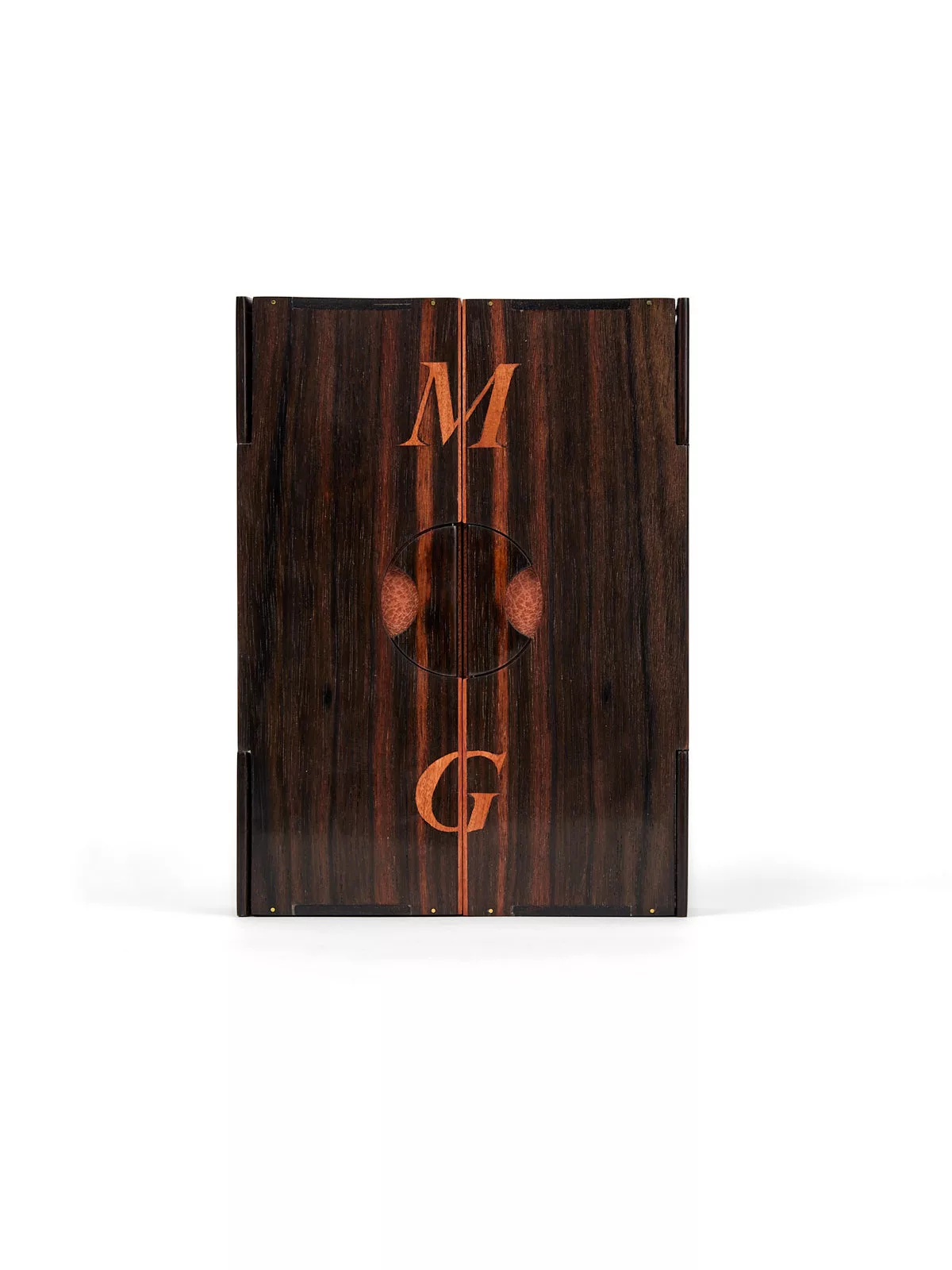
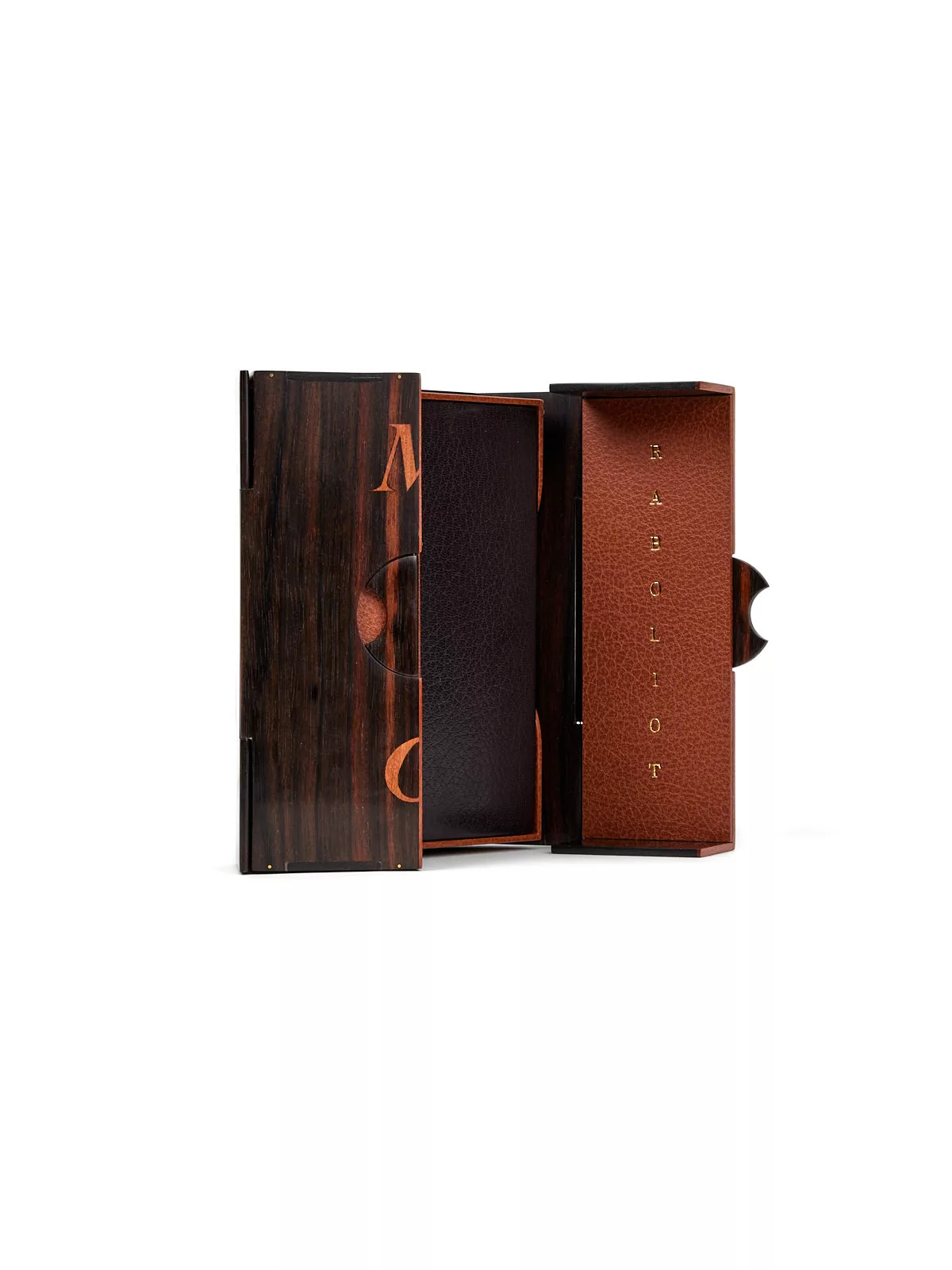
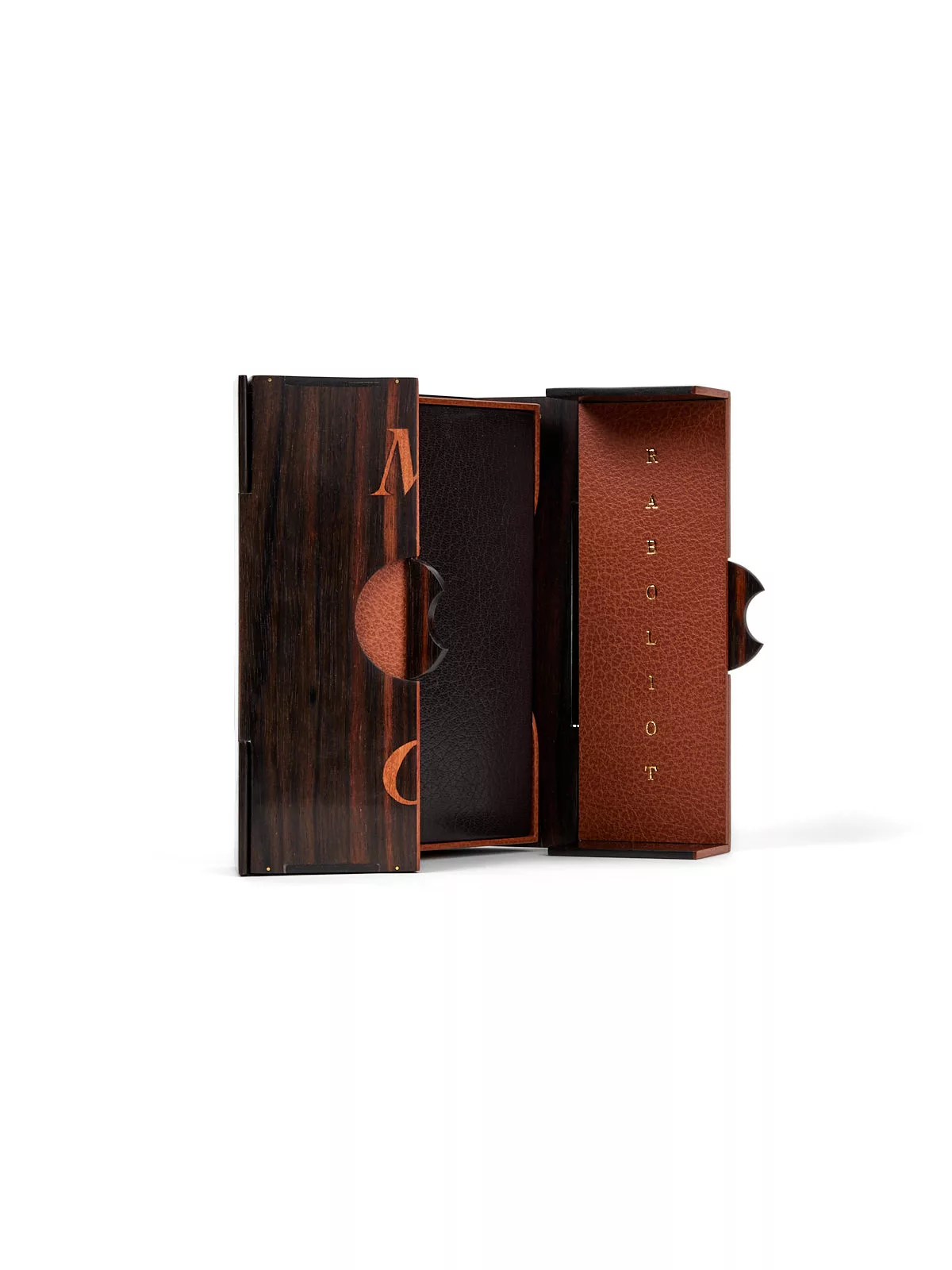
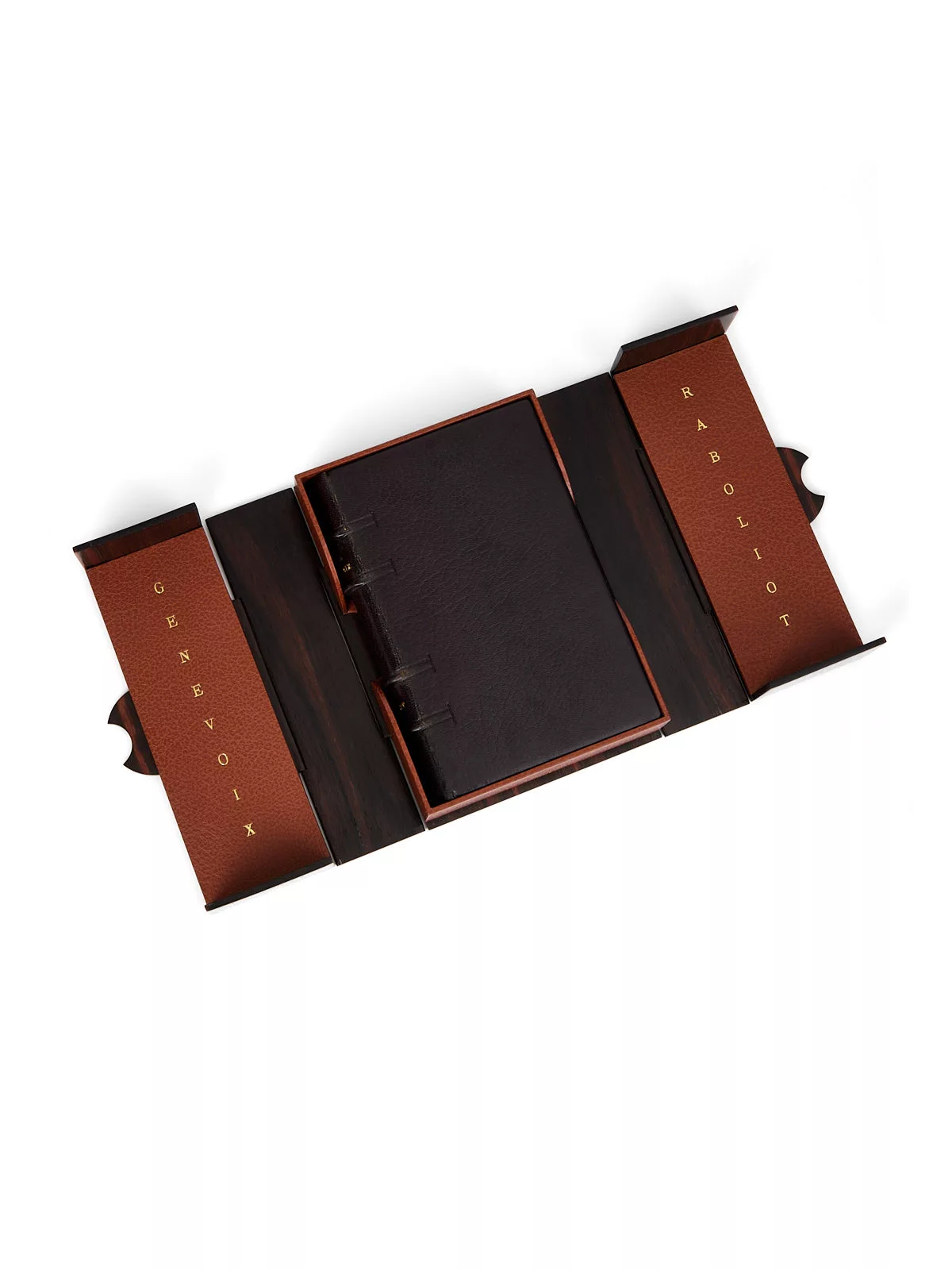
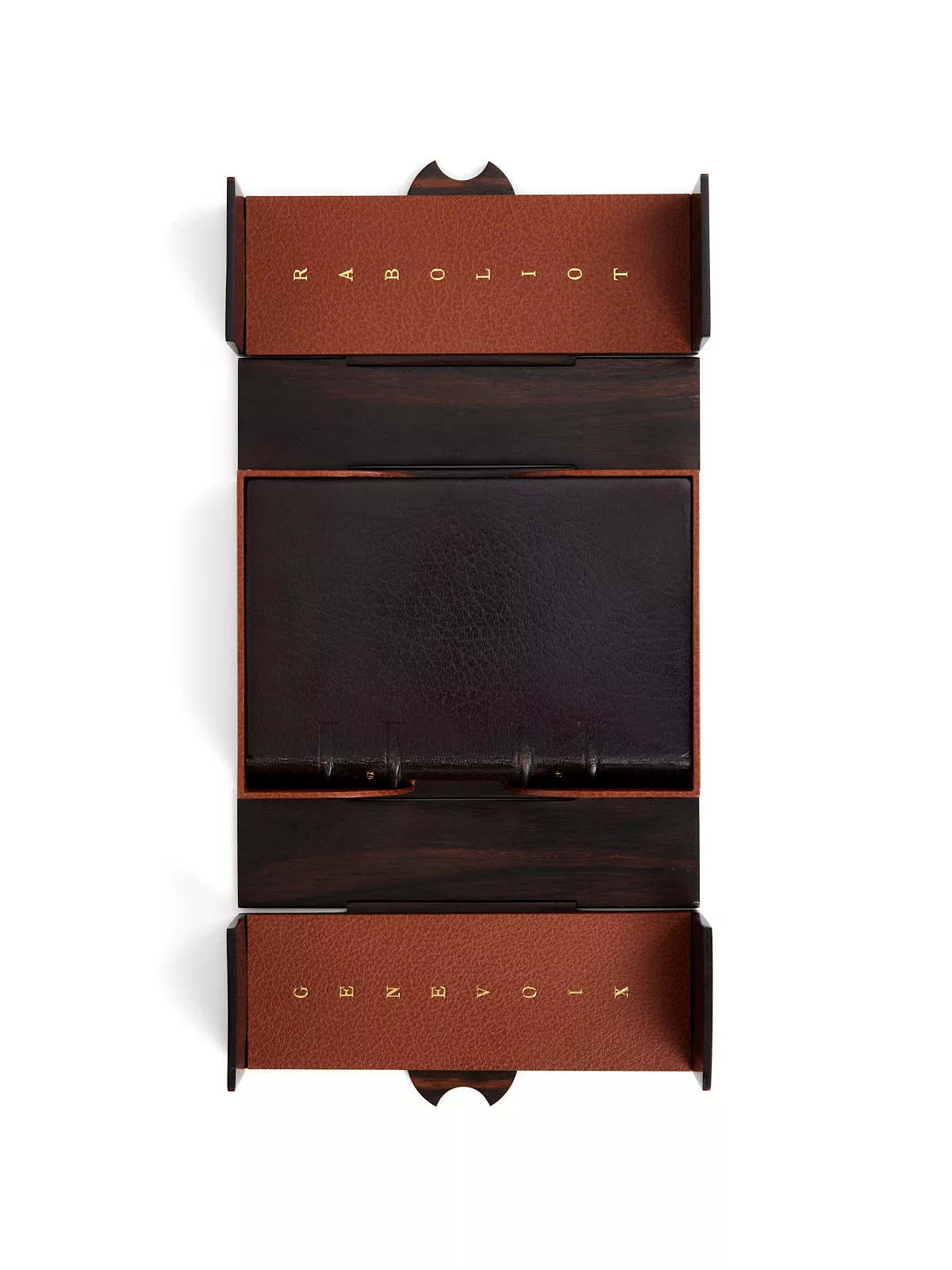
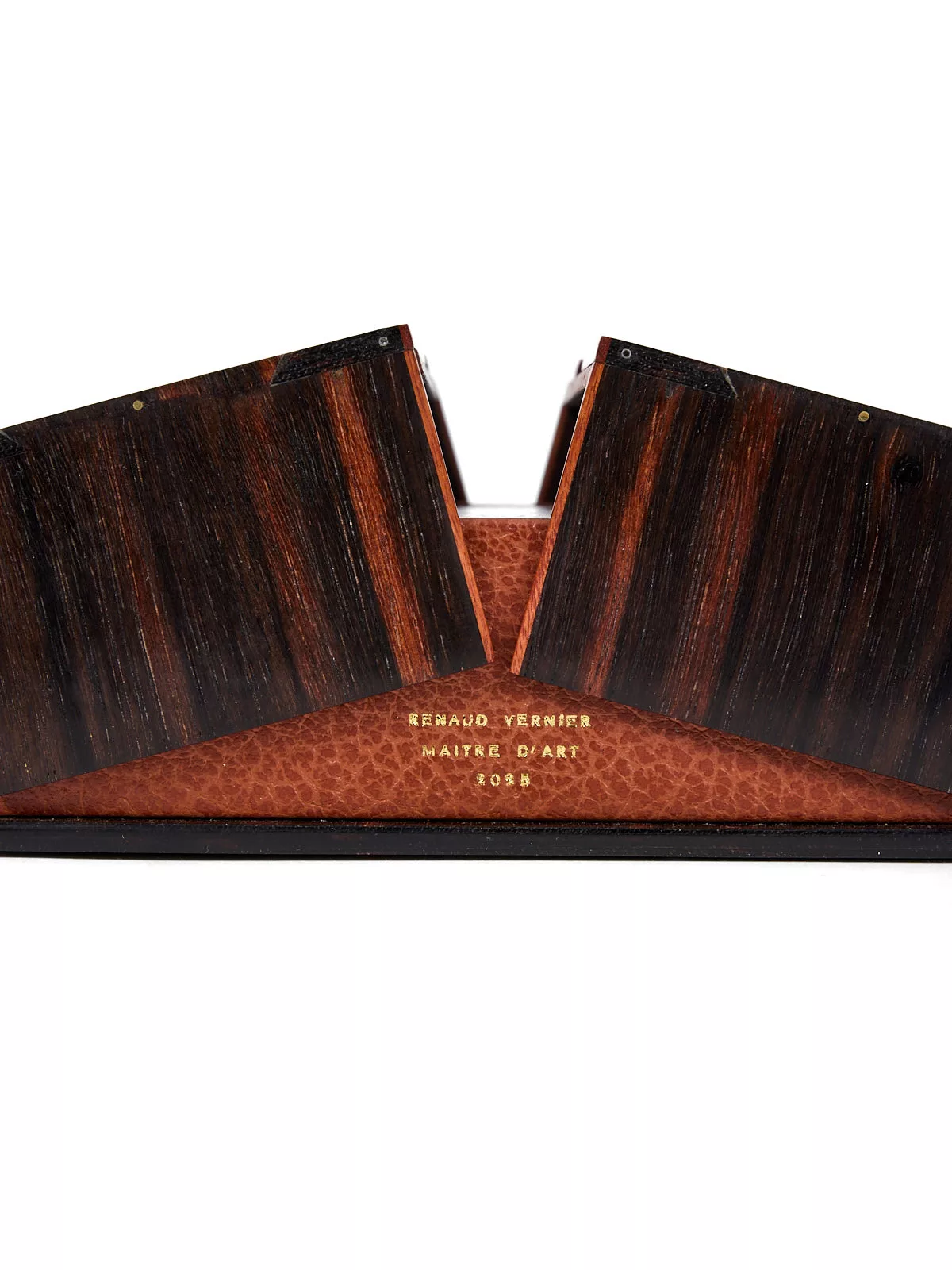
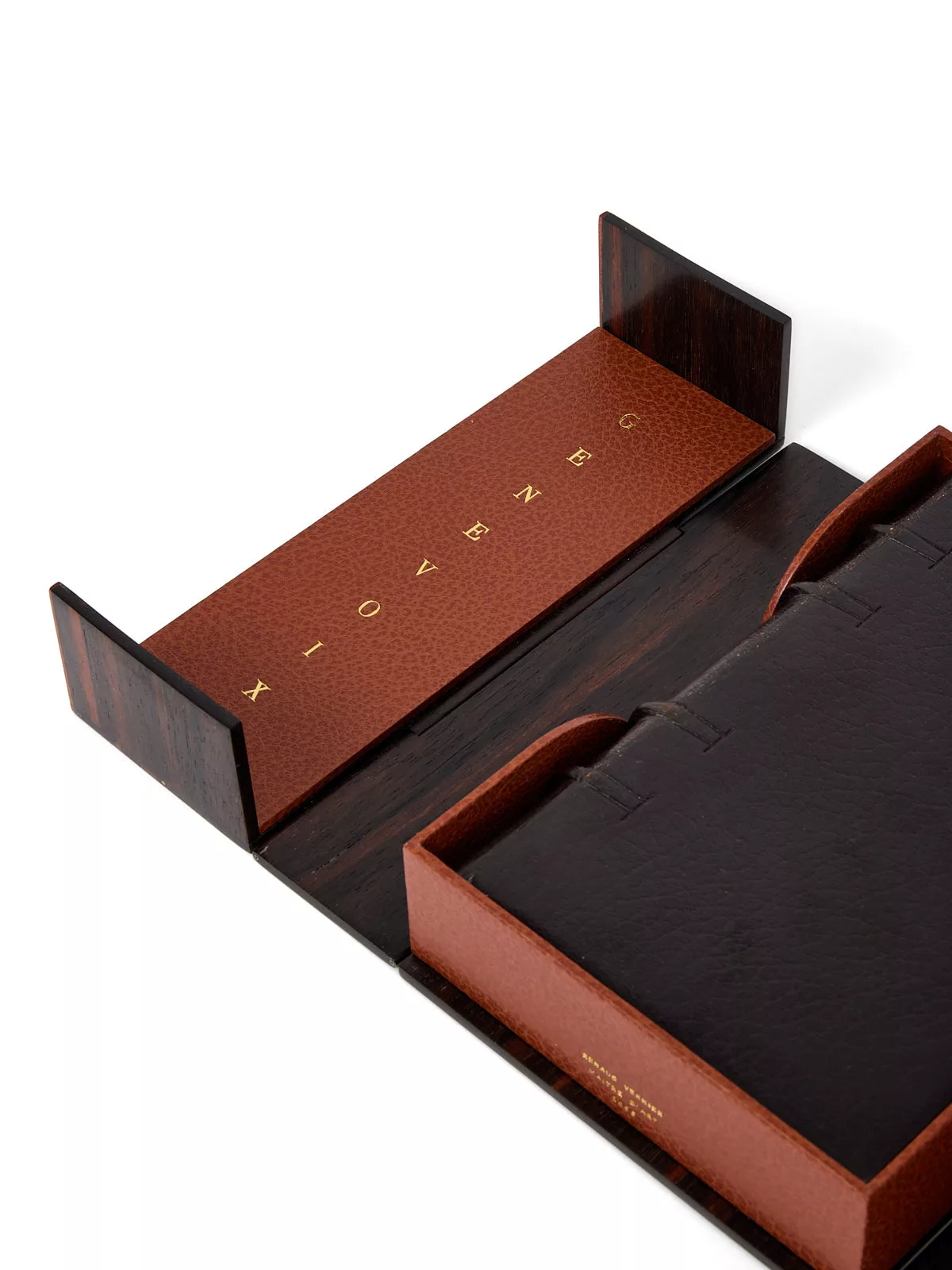
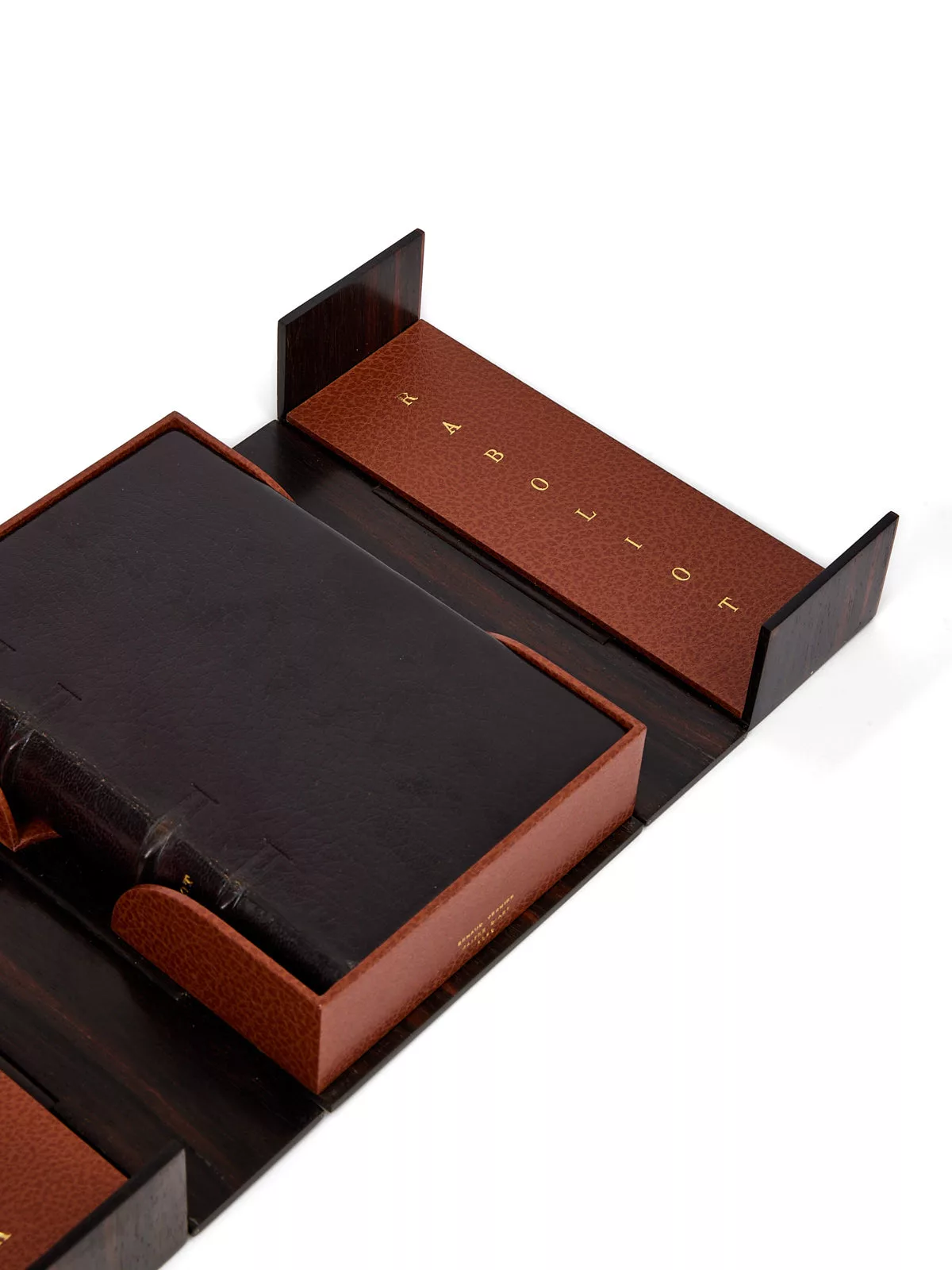
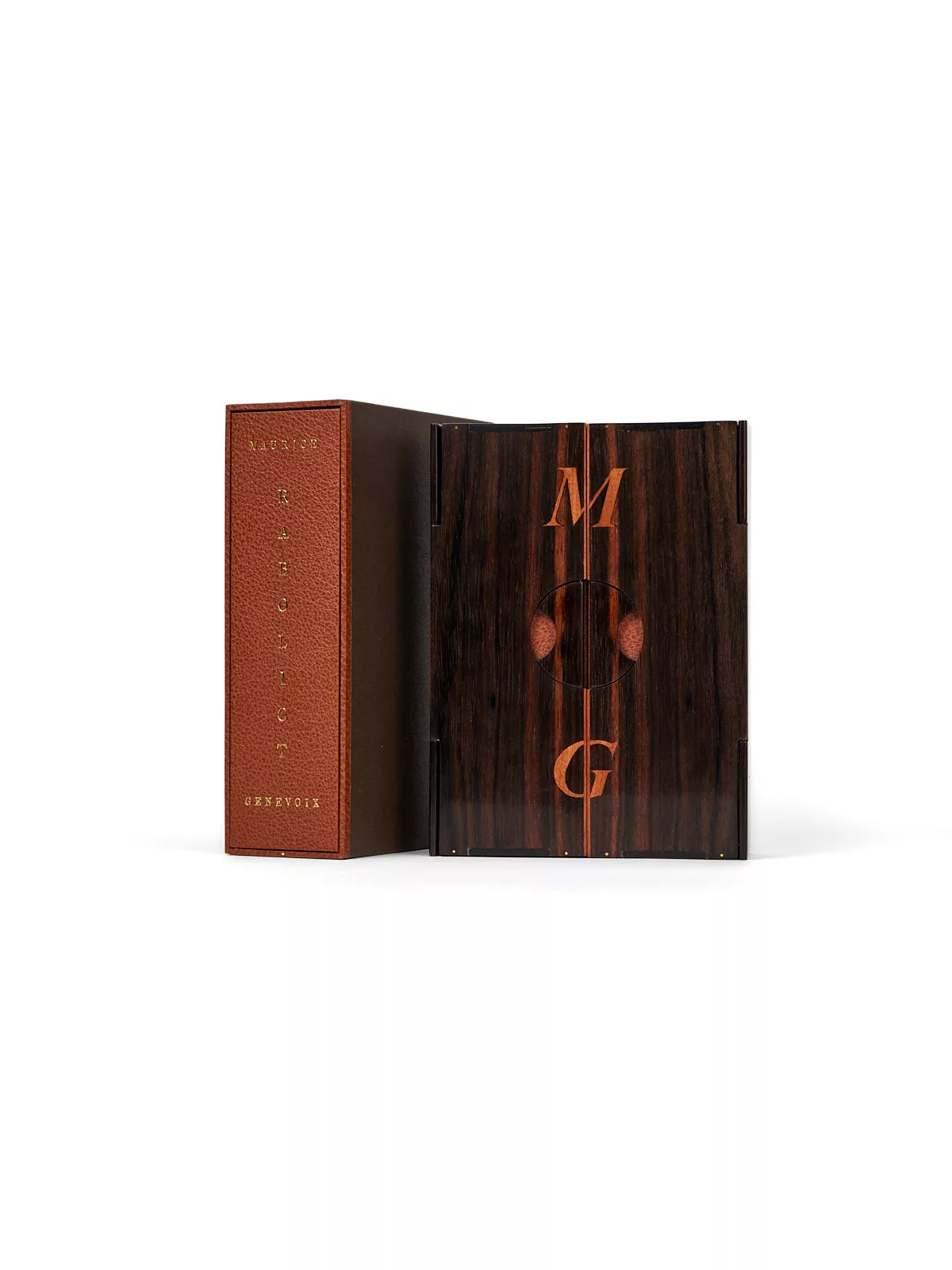
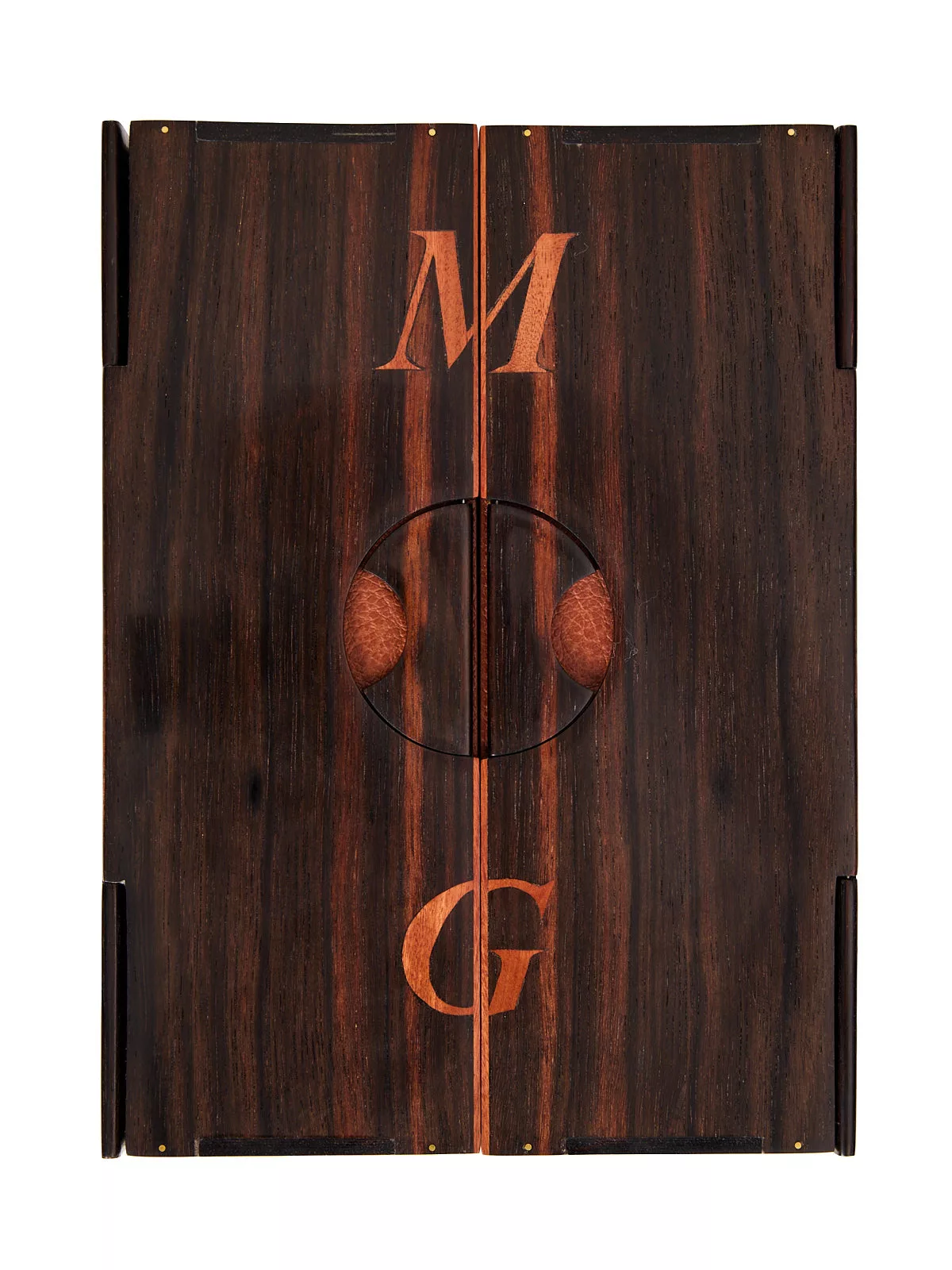
The copy is now preserved in a precious ebony case signed by the master craftsman Renaud Vernier.
An exceptional item.