

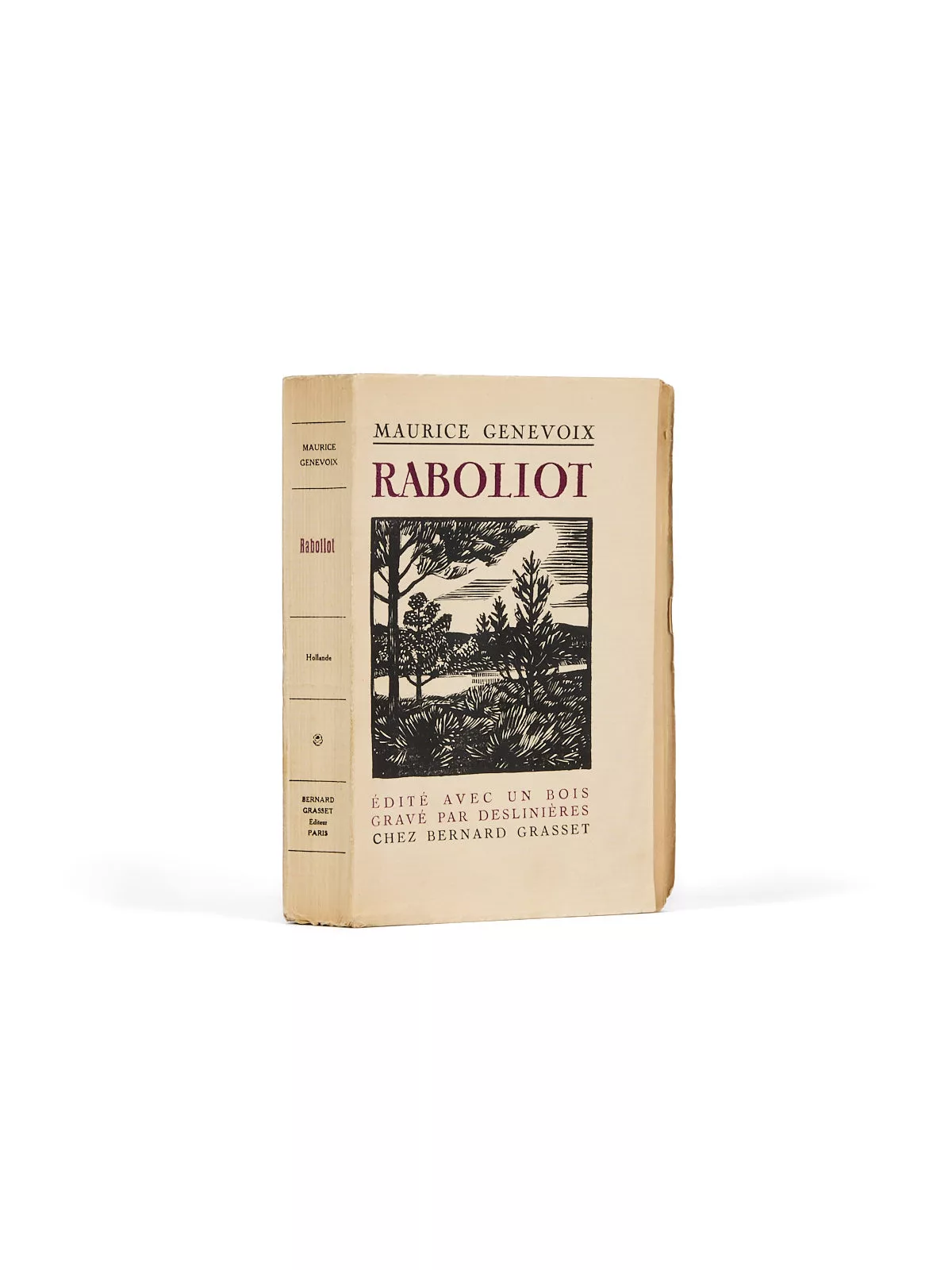
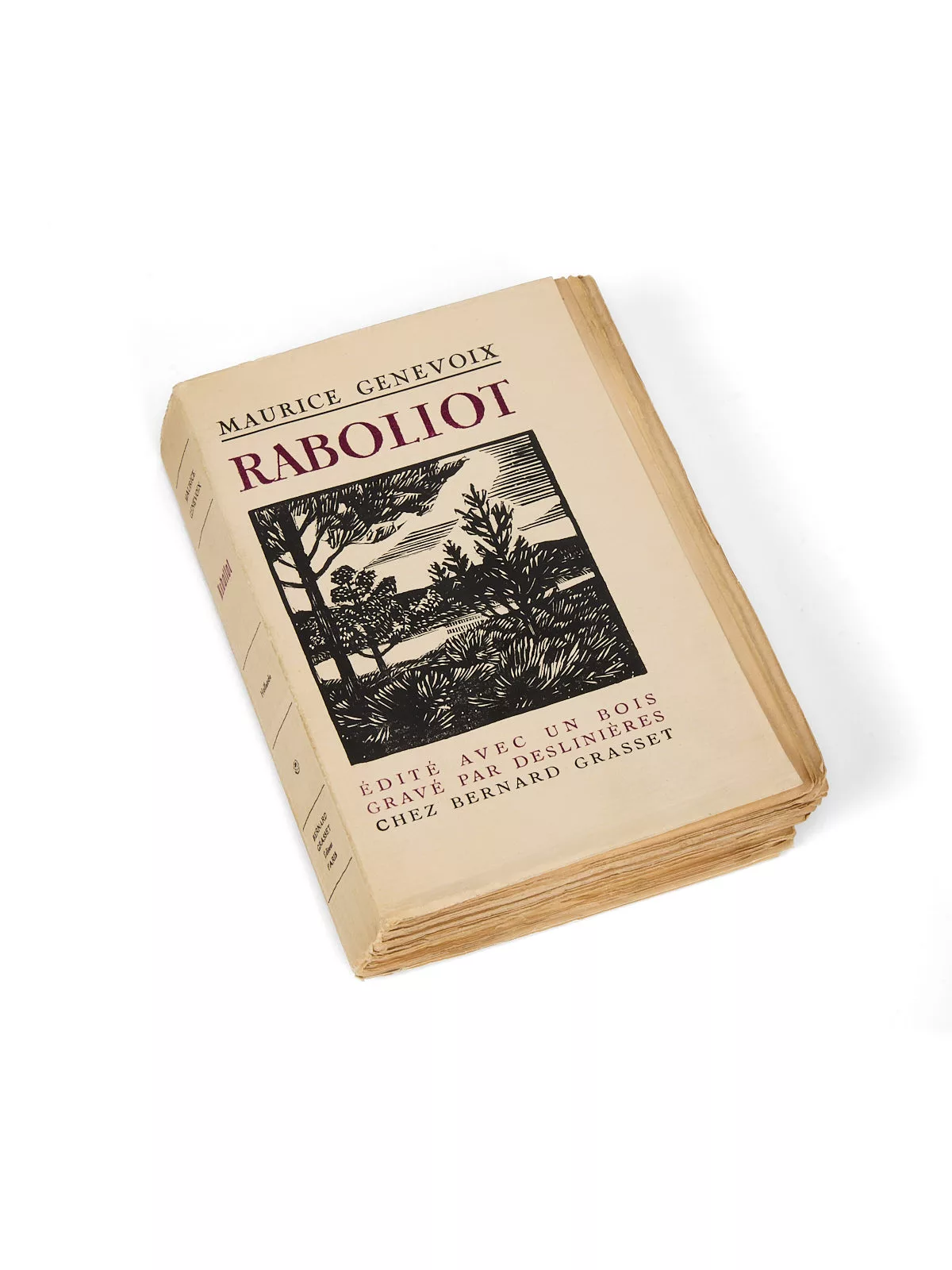
Raboliot
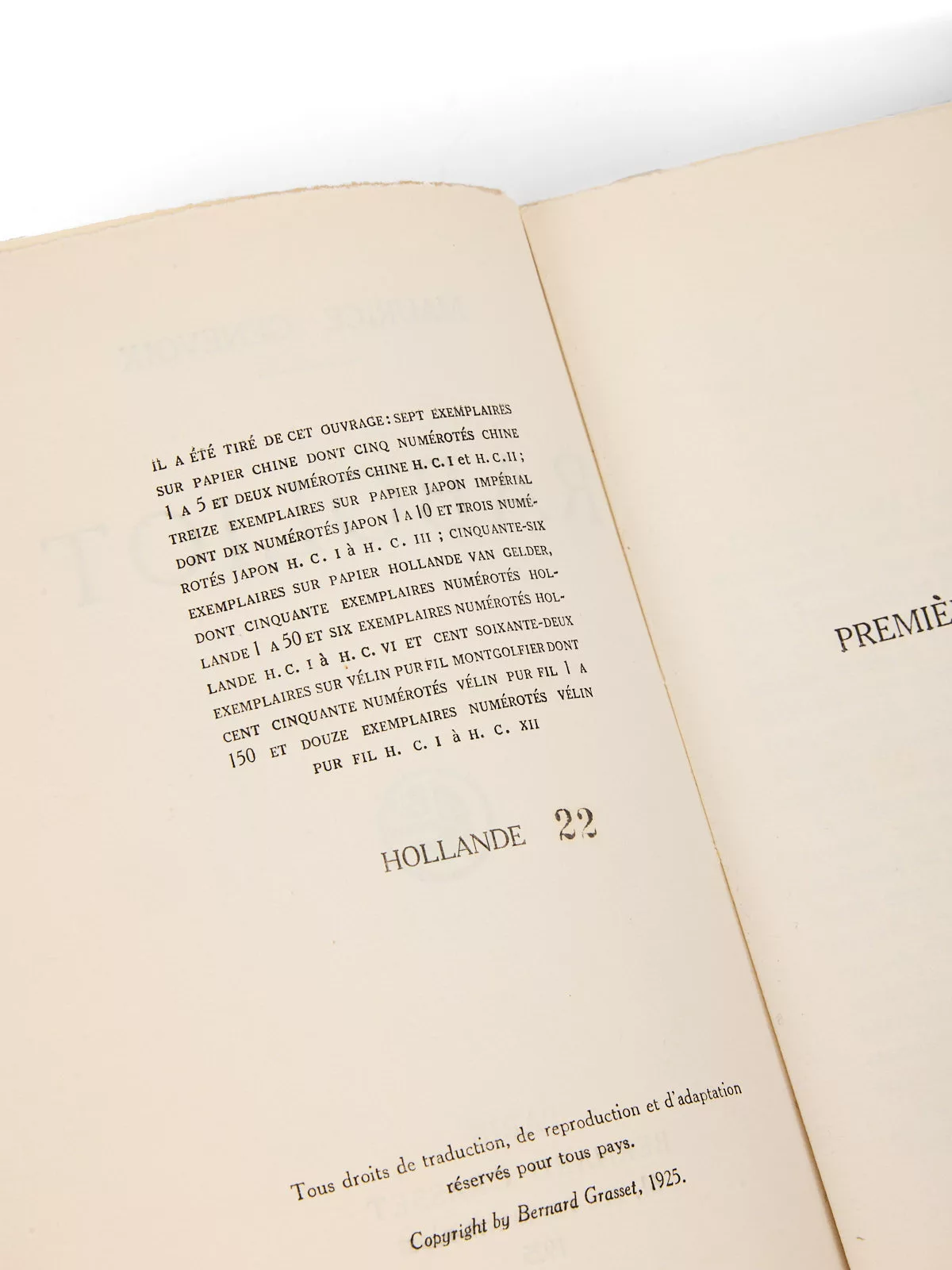
One of 56 copies on Holland paper (no. 22).
In his own library, Maurice Genevoix kept, for Raboliot, one copy of each paper of the first edition: one of 7 on China paper, one of 13 on Japanese paper, one of 56 on Holland paper, one of 162 on pur fil paper, and a press copy on alfa paper. For all but the ordinary printing, two covers were printed, one illustrated with a woodcut by Gérard Cochet, the other by André Deslignères.
Since 1919, at the end of the war which had so deeply scarred him, Maurice Genevoix had returned to live in Châteauneuf-sur-Loire, where he had grown up. But after Rémi des Rauches, published in 1922, which depicted the Loire through the eyes of a cooper, Genevoix wanted to cross the river: to the south lay the Sologne, which he had been exploring since his return to the region. As soon as he came back from the front, still convalescing, he began walking again, roaming the forests, listening to the local people and observing nature. Several stays are documented at the heart of the region, at Brinon-sur-Sauldre, Nouan-le-Fuzelier and Lamotte-Beuvron, where he absorbed the customs, the stories and the local speech. He made it his purpose to say more: “I wanted to do for the Sologne what I had done three years earlier for the Loire Valley: to evoke it, to render it in my own way, expressing my attachment since childhood and my gratitude for all it had meant to me.”
It was at Brinon that his uncle had acquired a hunting ground after the war; it was there that Maurice Genevoix decided to settle, in the summer of 1924: “One evening I slung my bicycle over my shoulder, took the little local train that would carry me to Brinon. I arrived at dusk, jumped on the saddle, and got off after six kilometers in front of the house of the gamekeeper Trémeau” (in Trente mille jours, p. 200). Facing the Étang des Clouzioux (which becomes the Étang de la Sauvagère in the novel), his ideas took shape: “The Sologne is a land teeming with game. The hero of my future novel, a true son of this hunting country, could only be a hunter — not an occasional hunter, some ordinary Sunday shooter, but a hunter by instinct, a free man, indifferent to social constraints, who answers only to his own nature and to the calls that summon and compel him: in other words, a poacher.”
Brinon happens to be the birthplace of the man known as “the most famous, the cleverest, the most skillful, the most sensational poacher of the region: Alphonse Depardieu,” called Carré, with whom Genevoix arranged a meeting. It came to nothing: suspicious, the poacher never showed up. No matter; determined to shape this universal poacher by fusing several very real characters, Genevoix created “his” poacher: Pierre Fouques, known as Raboliot.
Maurice Genevoix would later recount, in Jeux de glaces (1961), this failed encounter with Carré-Depardieu, who “was not the last to claim, and perhaps even to believe, that he had served as my model. And truly I owe a great deal to that man who never came, one autumn day in 1924, to the back room of the rustic inn where I waited for him in vain” (p. 90). Genevoix also explains there the nickname of his hero: the name Raboliot — denoting a young rabbit still in its burrow, the “rabolière” — came from the hunters of the Sologne: quick, cunning, free. From Brinon-sur-Sauldre, Genevoix drew a great deal, as though from an ideal epicenter: the commune is simply the largest in the department by territorial area, even today — it covers 11,600 hectares and is crossed by some 340 kilometers of rural paths! In 2025, only 132 communes in France cover more than 100 km².
Provenance: the library of Maurice Genevoix, with bookplate; the “Prix Goncourt” library of Gérard Pouguet, with bookplate.