



Portrait photographique de Saint-Exupéry
In May 1943, after lengthy efforts and the intervention of friends, Saint-Exupéry was reinstated in the military. The Little Prince was still being printed, not yet released, when he joined the Allied forces in Algiers for his first missions. But at high altitude Saint-Exupéry consumed too much oxygen and, disoriented, botched a landing in July. He was then grounded, no longer authorized to fly missions — the risk was judged too great.
His friend and captain of squadron 2/33, René Gavoille, had already been posted to Sardinia, and Saint-Exupéry wanted nothing more than to join him. The two men had met at the Orconte air base in the Marne, where Gavoille — “one of the finest fellows I know” — had been his instructor before becoming his friend.
That same summer, John Phillips, born in Algeria to a Welsh father and an American mother, arrived in Algiers. A photographer and journalist for Life, he had covered the Aéropostale routes in Latin America before the war and admired Saint-Exupéry’s work, which he had discovered in New York. He sought him out at once and learned that Saint-Exupéry was no longer deemed fit for high-altitude missions. Phillips relentlessly lobbied for his reinstatement, going as far as Allied headquarters in Naples to press the case with the command. Saint-Exupéry was already grateful: “I will give you a text if you manage to have me reinstated in my group” (in Œuvres complètes, La Pléiade, notes and variants).
American General Eaker, commander of the Mediterranean Allied Air Force, granted the authorization in spring 1944: Saint-Exupéry would be allowed to pilot an unarmed aircraft for a limited number of reconnaissance missions over France — five were planned, nine were flown — within Gavoille’s group 2/33 in Sardinia, where he immediately flew Phillips in for a photo assignment.
Phillips’s persistence — which he would later regret — sealed the friendship between the two men.
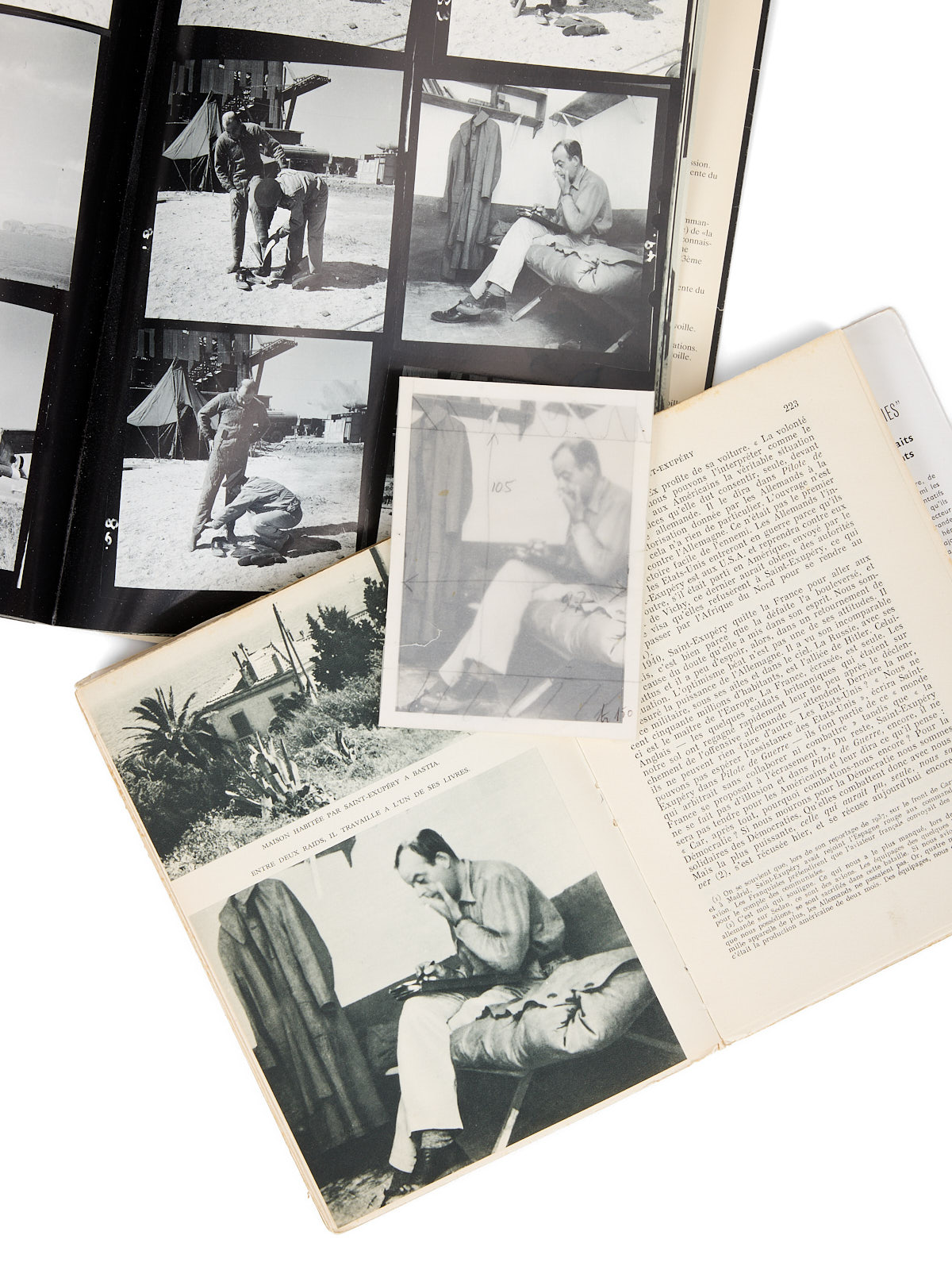
On May 10, they arrived together in Alghero, Sardinia, aboard a B-26. From that day until May 30, 1944, John Phillips documented the squadron: 14 contact sheets totaling 165 images, about twenty of them of Saint-Exupéry. This photo essay was not published until 1989, in Les Derniers jours de Saint-Exupéry, thanks to Charles-Henri Favrod, following an exhibition devoted to John Phillips in April 1989 at the Musée de l’Elysée in Lausanne, which Favrod directed.
Phillips had to leave the base on May 30. He and Saint-Exupéry spent the preceding night together — the night Saint-Exupéry wrote his Lettre à un américain, expressing his pessimism about the future in a kind of disillusioned testament.
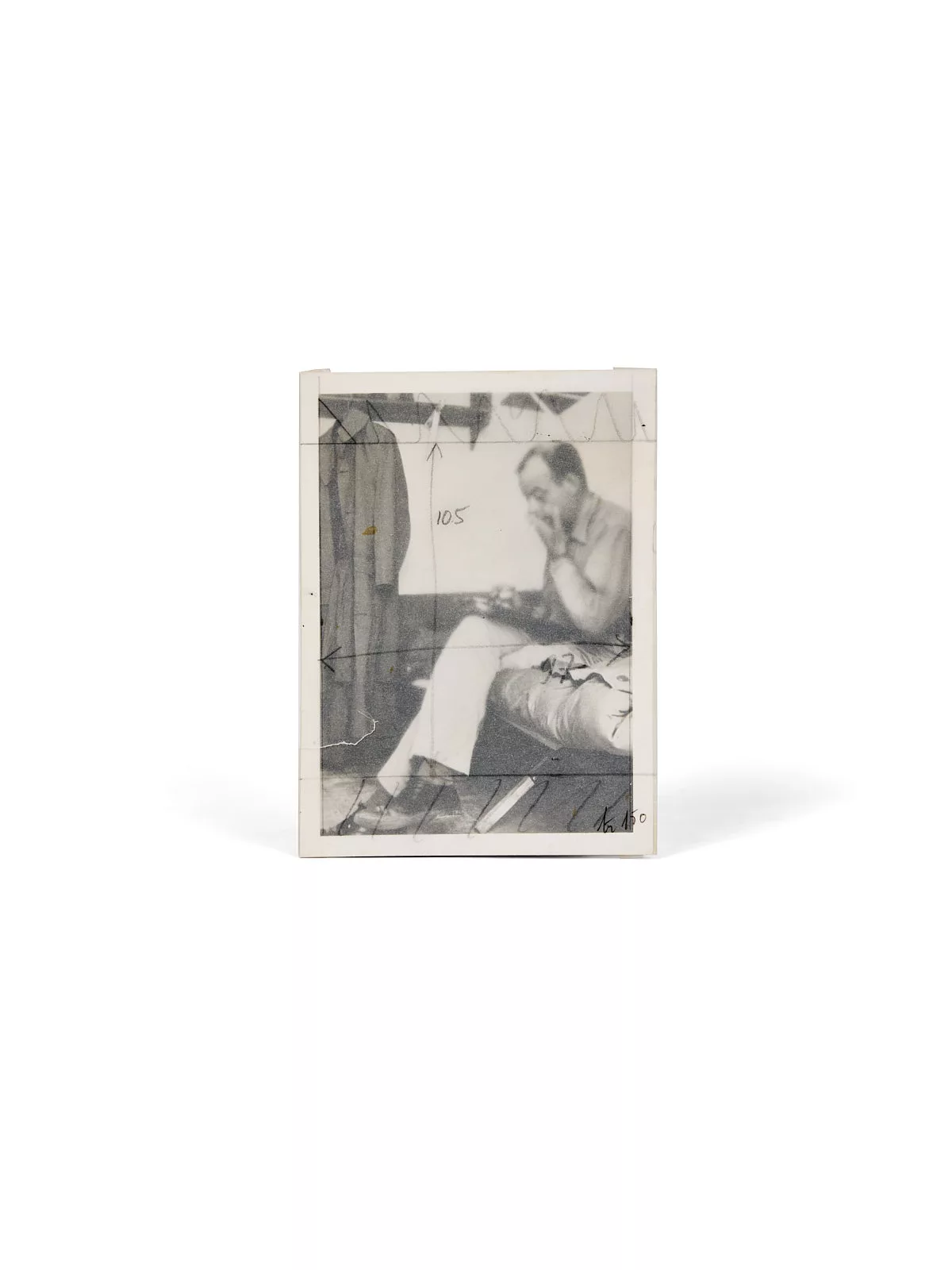
At dawn, he gave the manuscript — a first draft of six leaves, written in one sitting — to John Phillips as he departed, so that he might have it published. The photograph offered here shows him writing this text, in which he expressed his feelings toward the Americans, to whom he owed so much. Saint-Exupéry and group 2/33 left Sardinia in mid-July for the Borgo base in Corsica. It was there, on 24 July 1944, that René Gavoille’s son Christian was baptized, with Saint-Exupéry as godfather. A week later, he took off at dawn on 31 July 1944. That day, Gavoille knew something Saint-Exupéry did not: it was to be his last flight in a P-38 Lightning. Commander Gavoille had devised a plan to safeguard the future of the already legendary Antoine de Saint-Exupéry, by then part of the family circle: he intended to tell him of the imminent plans for the landing in Provence, classified information that would have grounded him for good. But the disclosure never took place: Saint-Exupéry never returned from his mission.
The Life journalist, devastated by the news, published neither the Lettre à un américain nor his photo essay. “The disappearance was a terrible shock to John Phillips, who put all the images away. Forty years later, I worked hard to persuade him to bring them back for a book and a traveling exhibition, which even returned to the Alghero airfield, where it had all begun in the elation of finally regaining the controls, and to Bastia, where the adventure came to its tragic end.” (Ch.-Henri Favrod, Le Temps, May 11, 2001).
As for the text — Saint-Exupéry’s last piece of writing — it was not published until 1959, in a limited edition issued in Liège by Pierre Aeberts, at his Éditions Dynamo, in 51 copies. La Pléiade (OC, II, notes) mistakenly states that its first publication was only in 1973, in the journal Air France toujours (no. 1, first quarter 1973), before being reprinted in 1981 in no. 96 of the journal Icare. The six leaves of the original manuscript were ultimately given by John Phillips to the Bibliothèque Nationale de France in 1984, where they are now part of the Saint-Exupéry collection of Nadia Boulanger.
The photograph — the only one taken early from the assignment — was first published, on loan from John Phillips, in Marcel Migeo’s first biography of Saint-Exupéry, issued by Flammarion in 1958. The photograph appears on p. 223, uncredited, with a caption that was probably deliberately vague: “Between two raids, he works on one of his books.” It subsequently appeared in several other tribute books devoted to the writer-aviator, and has since become one of the most famous portraits of Antoine de Saint-Exupéry.
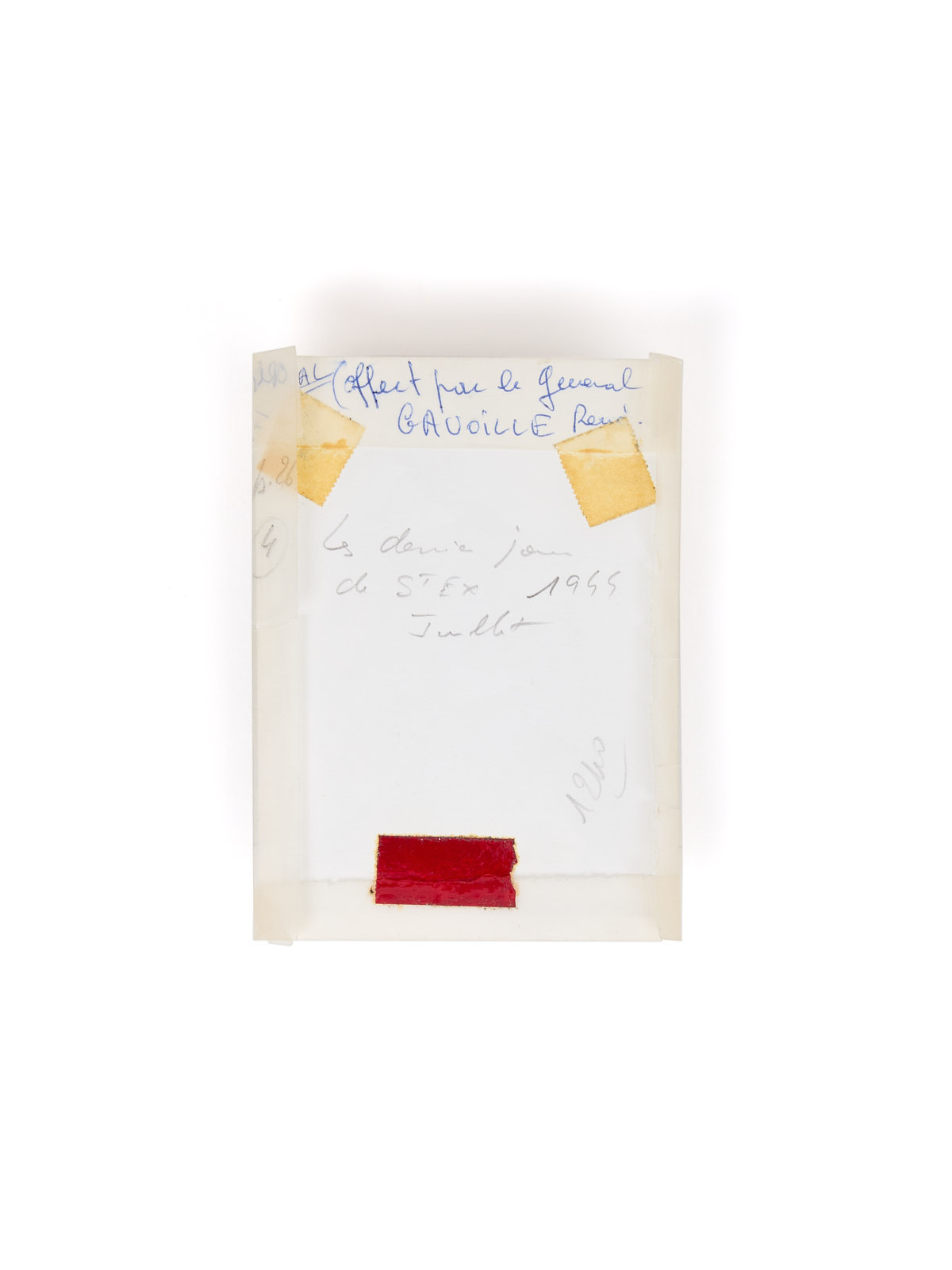
The photographer gave this precious print to René Gavoille, at an unknown date; Gavoille kept it for several decades inside his copy of Pilote de guerre, which still bears its trace. He removed the print to donate it, in 1989, at the Lausanne exhibition, to an enthusiast of Saint-Exupéry’s work who owned the 1959 first edition of La Lettre aux américains: one of the 11 deluxe copies on Hollande paper.
Provenance: John Phillips; René Gavoille.
Accompanied by: the deluxe-paper first edition of Migeo’s biography of Saint-Exupéry (Flammarion, 1958) and the catalogue of John Phillips’s photo essay in which this original photograph appears, Les Derniers jours de Saint-Exupéry (Musée de l’Elysée de Lausanne).