

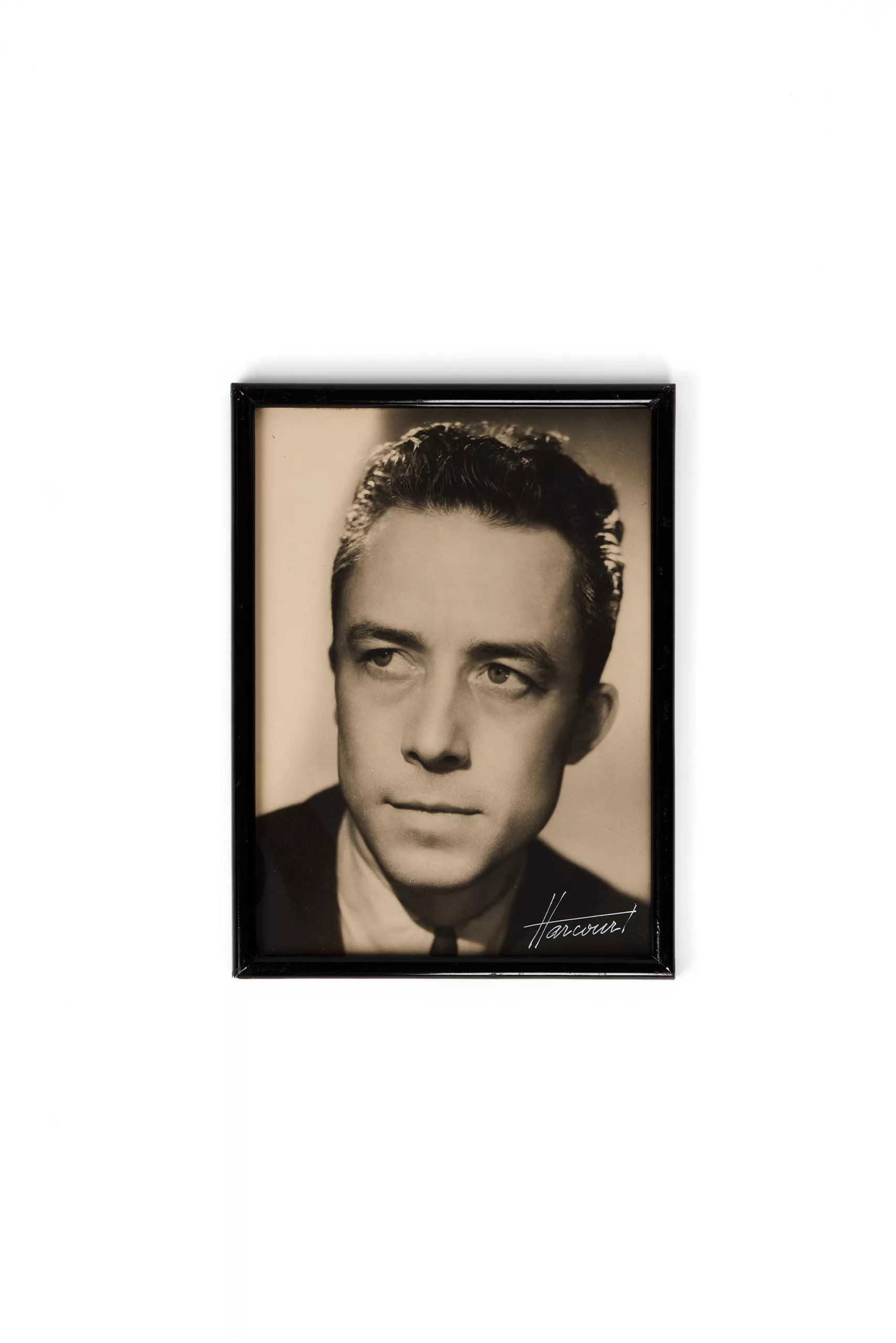
Portait photographique
This is the only portrait of Camus taken by Harcourt, and the only known print bearing the studio's autograph stamp, in white marker.
This portrait was taken in 1948–1949, probably at the request of Jean Hébertot. Only one print of this type was given to the “model” after the sitting, accompanied by other stamped prints, but bearing a small “Harcourt” label applied tone-on-tone on the image, from which the duplicate negatives used for private or commercial purposes were subsequently produced.
The only known contemporary use of this portrait was for the printed program of the play Les Justes. It appears in the program printed for the performances held at the Théâtre Hébertot, beginning December 15, 1949. In this program, Maria Casarès received the same treatment, and it can be assumed that this series was made at Hébertot’s request, in order to produce “Parisian and luxurious” portraits of the author of the play and its actors and actresses: besides Casarès, Perdoux, Brainville, Lahaye and Serge Reggiani were given the same Harcourt treatment. Only Paul Œttly and Michel Bouquet have a portrait from another studio. Note that the Harcourt portrait of Camus used is the one delivered with the printed stamp to the left of the image.
Since 1956, the Théâtre Hébertot had made it a practice to reproduce portraits of the actors and directors of its plays in the small program booklets distributed at performances. Most of the photographs were taken by the Harcourt studio.
We know of several other period prints, with the Harcourt stamp in the left corner, within the image. This portrait was also used starting the same year for the archives of the “Secrétariat d’État à la Présidence du Conseil et à l’Information,” a state body responsible for promoting French cultural activities and authors. A modern duplicate of our image, with the signed stamp, is held in the collection of the CDHA (Centre de Documentation Historique sur l’Algérie, located in Aix-en-Provence).
This photograph was subsequently reused in Albert Camus iconography, though not always properly credited, as it was sometimes cropped without the Harcourt stamp. It appears notably in the book Solitaire et solidaire (p. 44, as a Corbis agency photo).
Our original print is the only one known bearing the Harcourt signature in the right corner of the image, in white marker; the signature corresponds precisely to the autograph stamp used on portraits made in the late 1940s.
The Harcourt studio was founded in 1934 by the Lacroix brothers, press magnates, Robert Ricci, son of the couturière Nina Ricci, and Cosette Harcourt.
The goal was to meet the two brothers’ need for images for their publications and magazines. Cosette Harcourt, with experience gained at the Manuel brothers’ studio — which specialized in portraiture and industrial photography — quickly became the driving force behind the project. She established a clearly defined strategy that attracted clients and built the studio’s reputation by using cinema-style lighting, thus developing a new aesthetic.
Each print produced by the studio was stamped with the Harcourt mark, which evolved over the years. Installed from 1938 in a luxurious private mansion at 49, avenue d’Iéna in Paris, the Harcourt studio became a gathering place for celebrities and reached its peak at the Liberation. A brochure published in 1947 describes a client’s visit: “after choosing the pose that best flatters him, he passes into the hands of a makeup artist who, by emphasizing or softening a look […] makes possible a more faithful rendering of the face than earlier retouching methods.” He then enters the studio, where one of the eight photographers employed by the firm works. After the session, the negatives are developed on site and handed over for retouching. An original print, signed Harcourt, is given to the client in one of the salons. In addition to this print, he receives other prints, stamped either within the image or via a mounted label.
Writers, variety artists, actors, politicians, dancers and painters had their portraits taken there, followed by fashionable Parisian society, down to its pets. The studio thus produced more than four hundred thousand orders between 1934 and 1979.
In the late 1980s, the studio faced financial difficulties and considered selling its old negatives to a public institution. In July 1989, Minister of Culture Jack Lang decided to purchase the Harcourt studio’s collections: four million negatives and contact sheets from 1932 to 1979, of which the Ministry of Culture became depositary, custodian and manager, were thus entrusted to the Photographic Archives service at the Fort de Saint-Cyr.