

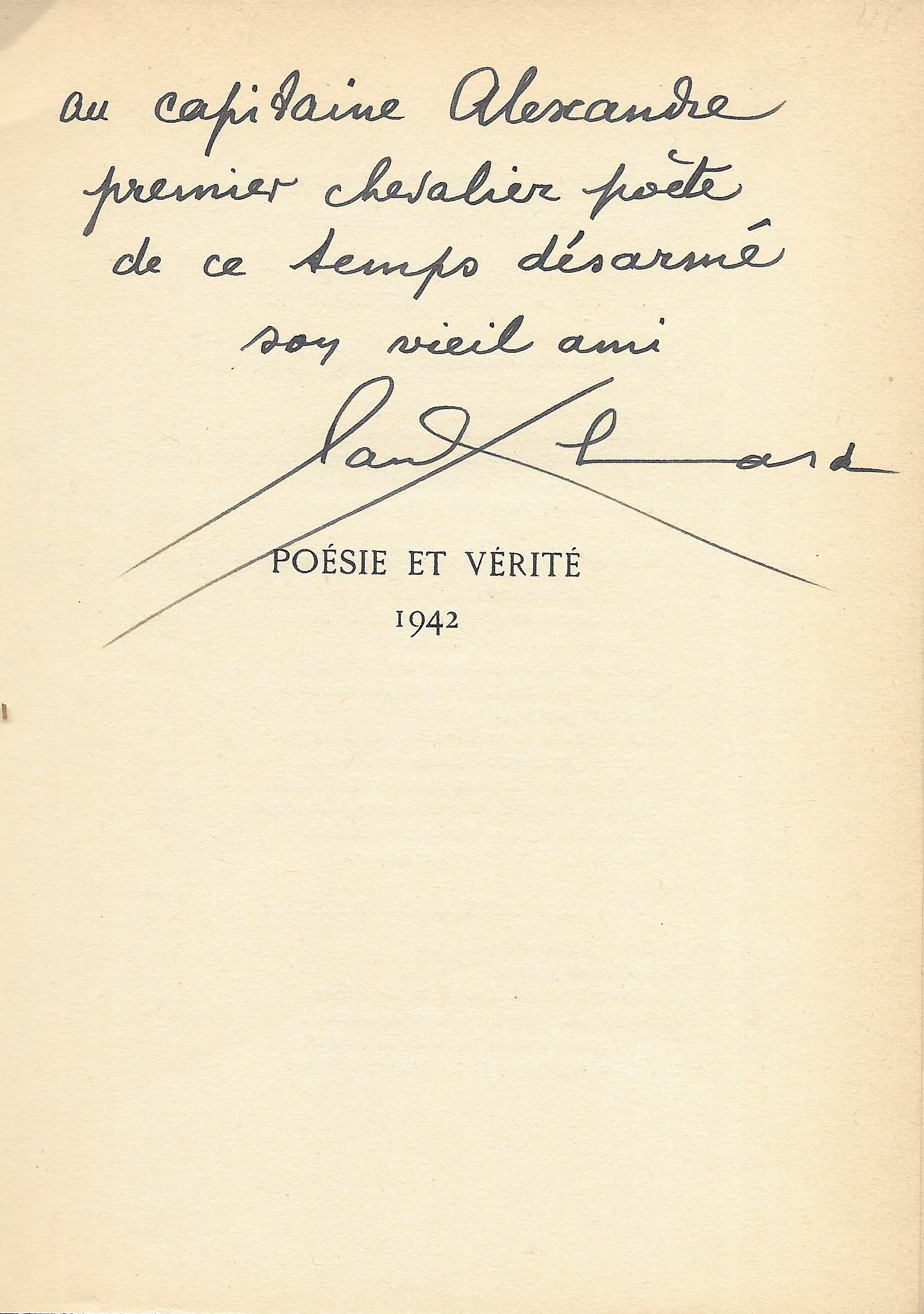
Poésie et Vérité 42
One of 1,000 numbered copies on vélin paper (no. 438).
Signed presentation inscription: “au capitaine Alexandre, premier chevalier poète de ce temps désarmé. Son vieil ami, Paul Eluard.”
At the end of the volume, René Char's manuscript ownership inscription, “R.C.,” in pencil.
Paul Éluard’s friendship with René Char dates to the very end of the 1920s, and a meeting in October 1929 marked the birth of their friendship and Char’s rallying to the Surrealist movement, which took concrete form the following year with the composition of Ralentir travaux: “Breton, Char and I have made a rather long book of thirty very beautiful poems, which Char’s printer is doing for us for nothing, in 200 copies” (letter to Gala, April 1930).
This friendship would be tested at the end of the following decade, owing to ideological choices and the difficult relations between Surrealism, Communism and poetic aestheticism, culminating in a break in 1938, when Éluard split from Breton and chose Communism.
But the war revived the dialogue between the two men, “carried by the ideal of a united Resistance,” as the two former companions, from a distance, followed each other’s paths. Deliberately silent during the conflict, Char’s first new publications appeared in three issues of L’Éternelle revue, run by Éluard and Parrot. The identity between “poetry and truth” set out in “Partage formel” — the third part of Seuls demeurent, a series of aphorisms written in 1941 and 1942 and the first book Char would publish at the Liberation — is no coincidence, and offers, if not a response, at least an echo to Éluard’s Poésie et Vérité 1942, published in October 1942, of which Char could not long remain unaware.
Of the pamphlet published by La Main à plume, no copy inscribed by Éluard to Char appears to exist: Char, deep in the maquis, was unreachable, and no such copy seems ever to have existed. It was only at the Liberation that the two men saw each other again and could catch up on each other’s respective books, happy to be reunited (cf. Chanson complète, no. and Poésie intentionnelle, no.). René Char, for his part, gave Paul Éluard a copy of Seuls demeurent, respectfully inscribed “à Paul Eluard, obstiné, exemplaire et pur, comme l’homme que tout menace, comme l’homme que rien n’atteint,” his first book published since 1939. A few months later, in December, the two poets took part in an exhibition on resistant Greece, organized by Yvonne Zervos, a sign of their renewed friendship; less than a year later, in November 1946, it was René Char who kept watch over Nusch’s body while Éluard was in Switzerland.
A precious and symbolic copy of Poésie et Vérité 1942, given by Éluard to the most emblematic poet of the wartime Resistance.
The volume and its inscription echo the war endured and the freedom regained: “capitaine Alexandre” gives way to the “chevalier poète de ce temps désarmé.” As is known, Char published nothing during the war. Partage formel, the first version of Seuls demeurent, was ready by 1941, but, as he confided to Victor Brauner in July, “the times are not propitious for elementary alchemy: turning writing into printing” (quoted by Antoine Coron in Dictionnaire René Char, p. 476). The manuscript was nonetheless sent to Gallimard, who accepted it, but in returning his signed contract in December 1943, Char expressed the wish that his collection not appear “until the situation of our country is definitively clarified.”
Paul Éluard, by then, had published a great deal. “Liberté” had appeared in Fontaine, Poésie et vérité in October 1942 and had since enjoyed a strong momentum of publication, in France and abroad. The second edition in book form of the complete collection was issued in Switzerland: printed, day for day, one year after the publication of Le Silence de la mer, by the Cahiers du Rhône, under the auspices of Albert Béguin, from Geneva, which offered understanding and ease to writers and poets in the Resistance. It was Aragon’s Les Yeux d’Elsa that, in March 1942, was the first published under this imprint. Paul Éluard, “because of the collection’s motto, that of Joan of Arc: ‘Dieu premier servi,’ did not immediately grant his collaboration to the review” (Pierre Seghers, in La Résistance et ses poètes, p. 179).
A marvelous testimony to a friendship and a freedom regained.