

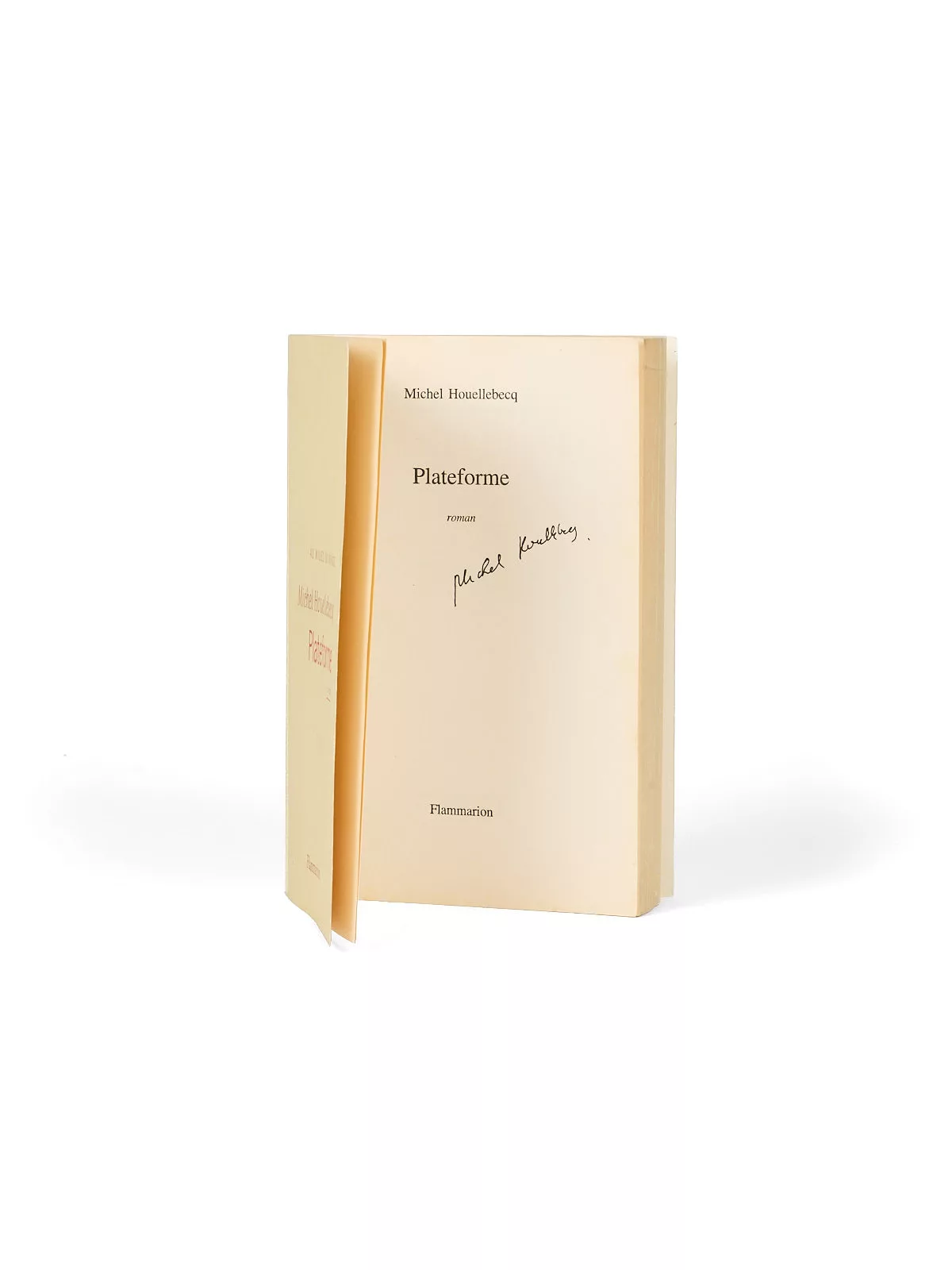
Plateforme
Copy signed by Michel Houellebecq in black ballpoint pen.
After his father’s death, Michel, a jaded, middle-aged civil servant, decides to travel to Thailand in search of exotic pleasures: “As soon as they have a few days off, the inhabitants of Western Europe rush to the other side of the world, flying halfway across the globe; they behave literally like escaped prisoners. I don’t blame them; I’m preparing to do the same thing (…) And yet, I like women. It’s something of a regret in my life, this bachelorhood. It’s especially awkward on vacation. People are wary of single men on holiday, past a certain age: they assume a good deal of selfishness, and probably a touch of vice; I can’t say they’re wrong.” “I hate no one,” Houellebecq has said. “I hold a kind of distance, a remove. That is the writer’s normal position. I know there is a demand for me to condemn what I describe, sex tourism in particular. I pass no negative judgment—neither on this or that behavior, nor on man in general. At worst, I feel compassion.”
Make no mistake, however: Plateforme is not a novel about sex tourism, but rather, against the backdrop of “a portrait of morals in the West at the start of the twenty-first century,” a story about the eternal, complicated affair between men and women — their perpetual misunderstanding, sometimes undone, as happens in life, by a real encounter, a kind of miracle or inner revolution. Unexpected, mysterious, self-evident, as such encounters are — or ought to be.