

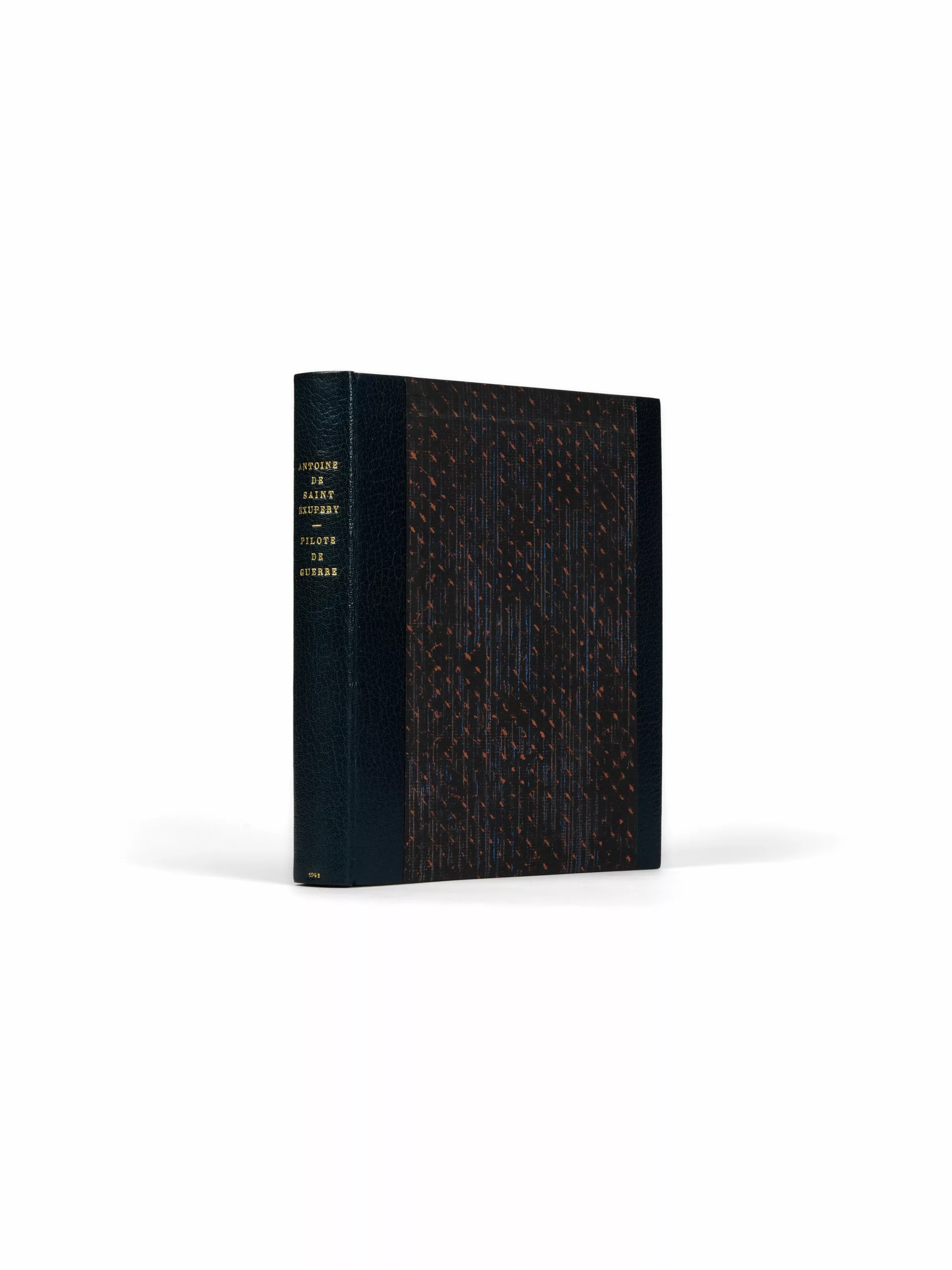
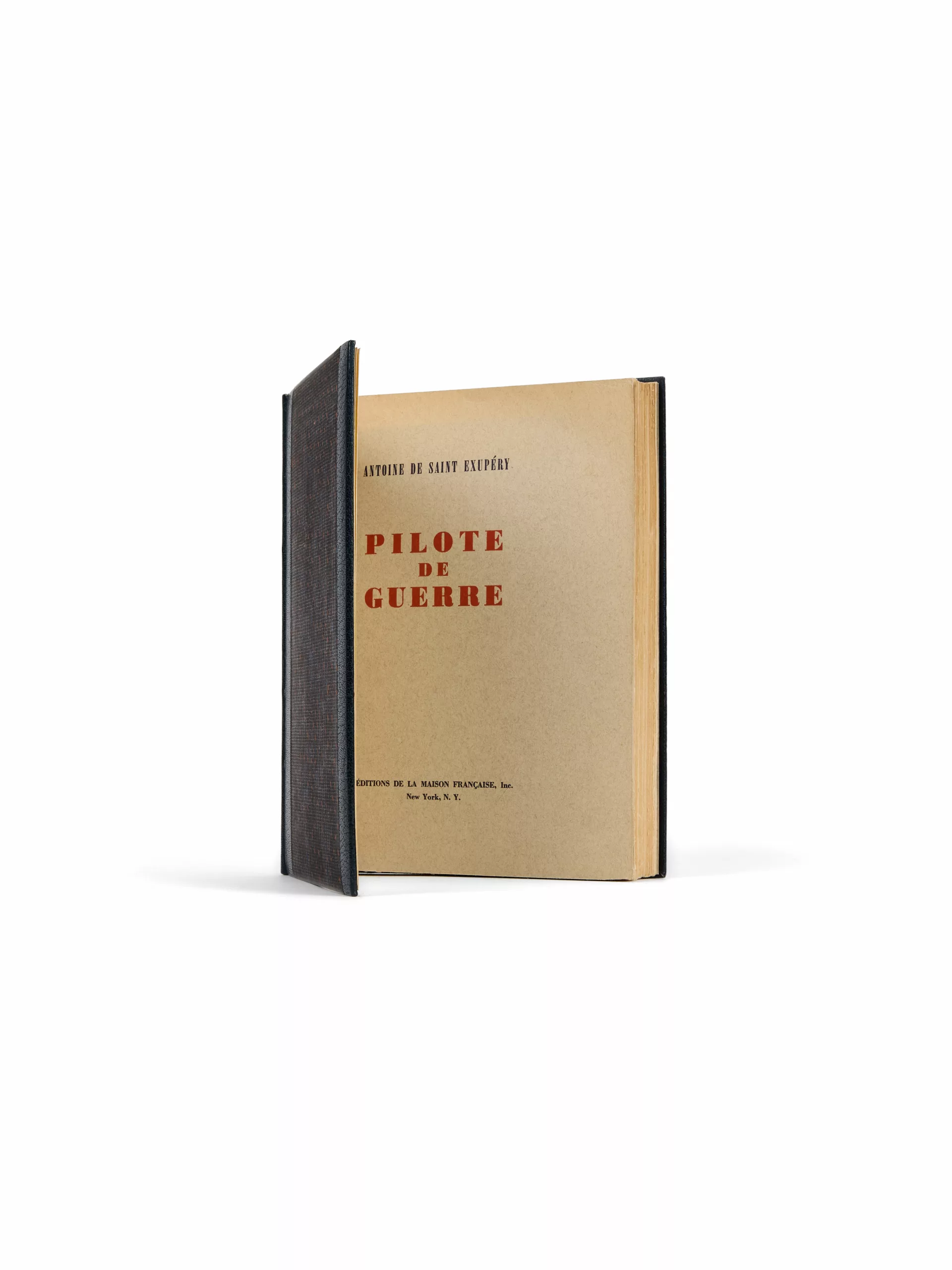
Pilote de guerre
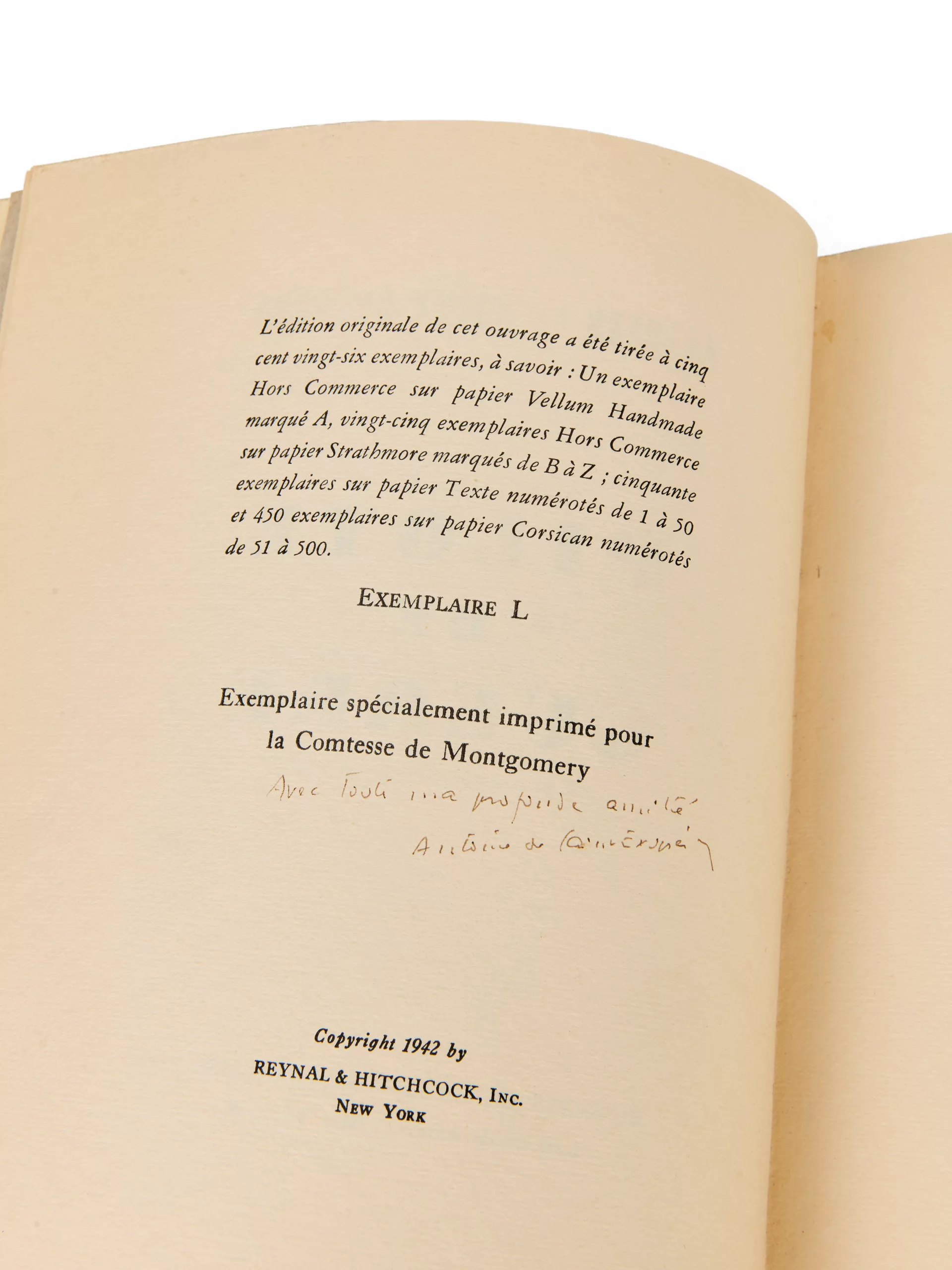
One of 25 deluxe copies on Strathmore paper (after a single copy reserved for the author). This copy is inscribed for Madame la Comtesse de Montgomery, with a signed presentation inscription: “avec toute ma profonde amitié, Antoine Saint-Exupéry.”
“I will fight anyone who tries to enslave the freedom of man to a single individual — or to a mass of individuals.” Before returning to the fighting in which he would lose his life, Saint-Exupéry, demobilized after the “Phoney War,” took refuge in the United States, and it was in New York that he wrote these lines. This edition, published in February 1942, is also the first complete edition, since it includes (p. 34) the seven words of a sentence in which the author collectively calls his orderly, a high-ranking staff officer and Hitler — “who unleashed this insane war” — “imbeciles,” a passage that French censorship would force Gallimard to suppress in its December 1942 edition. The text first appeared, in English, in the Atlantic Monthly in January 1942, then in book form the following month: it topped the bestseller lists for six months. “This book is a great and beautiful book, perhaps the true book of the 1939 war,” wrote Pierre Mac Orlan in Les Temps nouveaux on 8 January 1943.
A precious deluxe copy presented to the Comtesse de Montgomery: born in Paris in 1899, Madeleine de Montgomery spent her childhood at the Château de Fervaques, acquired in 1831 by her great-grandfather, the Marquis de Portes. From 1930 she kept a highly fashionable salon in her sumptuous apartment at 77 Avenue de Malakoff. Young, elegant and influential, her beauty and personality made her receptions one of the most popular gathering places in Paris, drawing publishers, press magnates and writers. Kessel, Cocteau, Malraux and Colette were regulars, as was Saint-Exupéry, who visited several times — all the more so as the young woman was a passionate aviator with her own aircraft, a Morane-Saulnier, in which she was photographed on the front page of Le Figaro in May 1935.
Mistress of the press magnate Jean Prouvost, she became director of the magazine Marie-Claire, which her lover launched in 1937. During the war she acted as a true Resistance heroine, taking refuge in Normandy, where she founded a maternal and infant care center in her manor house to shelter the children of mobilized soldiers; she later became director of the women’s and health sections of the French Mission to the Red Cross in the United States in 1943. It was probably during this stay in New York that she met Saint-Exupéry again — a reunion significant enough for him to reserve a personally inscribed copy of his book for her. After the war she resumed her salon and was mentioned several times in the diary of Pierre Lazareff, who described her as a “Diana the huntress with slender, sinewy limbs, ashen hair, aquamarine eyes and long delicate hands that punctuated each of her sentences like so many exclamation points; by her mere presence she inspired endless tournaments of ideas and eloquence.”
It was also during this mission to New York that she met the man who would become her husband in 1946: General Antoine Béthouart, a Compagnon de la Libération and a leading figure of the Free French military command during the Second World War. It was Béthouart, promoted to major general and appointed head of the French Military Mission in Washington, who met Saint-Exupéry in early 1943 to negotiate with the American government the delivery of equipment to re-arm the French army. Above all, it was he who signed, on 1 April 1943, the long-awaited mission order that Saint-Exupéry, desperate to serve his country, had been so anxious to obtain. His friends tried to make him change his mind, but on 4 May 1943, after a hasty departure and while Le Petit Prince was still being published, he landed in Algiers, where Georges Pélissier awaited him; Béthouart joined him there a few months later, in November 1943, when he was appointed chief of staff of National Defense in Algiers and promoted to lieutenant general. In that capacity he accompanied General de Gaulle on his various trips to Rome and London, and landed with him at Courseulles in Normandy on 14 June 1944.
Other known copies were presented to Consuelo, Léon Werth, Bernard Lamotte, Jane Lawton, Curtice Hitchcock, Elisabeth Reynal, Jacques Maritain, Isaac Molho, Anne Morrow and Charles Lindbergh, Jean Renoir, Natalie Paley, Nadia Boulanger and Lewis Galantière.
A very fine provenance for this deluxe-paper copy of Saint-Exupéry’s great text on the Second World War.
From the libraries of Michel Demont (bookplate) and Jean-Claude Mocellin (Alde, “Un siècle de littérature,” 19 May 2022, no. 50).