

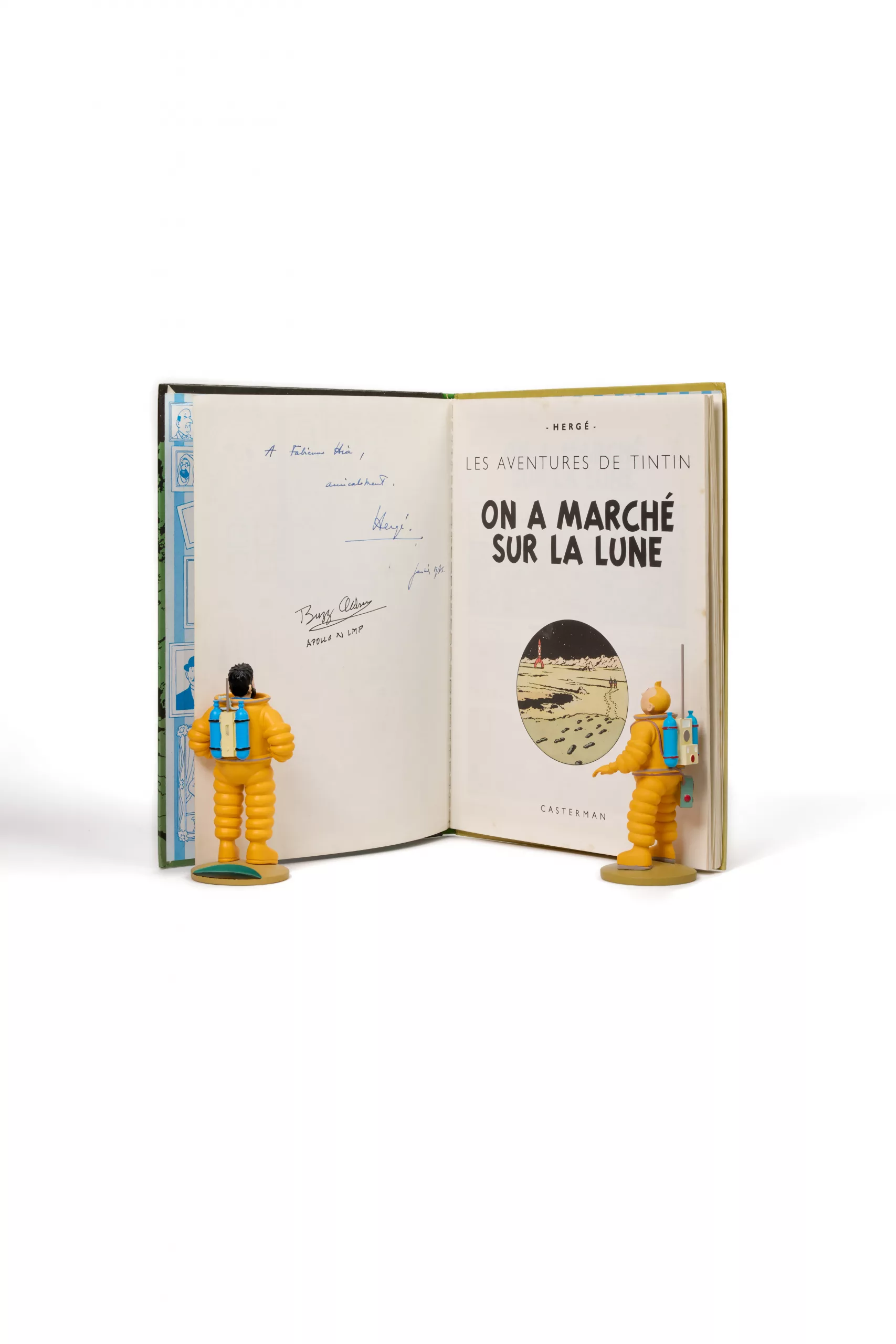
On a marché sur la Lune
— the first edition, first printing, of 1954;
— the last edition (1974), with the type-B variant: this album is here inscribed by Hergé and then signed by “Buzz Aldrin (Apollo XI LMP)” — the second astronaut after Armstrong to walk on the lunar surface, following the footsteps drawn fifteen years earlier by Tintin, Haddock, Thomson and Thompson, and of course Snowy, on the surface of the Earth's satellite.
The inscription is signed “Buzz Aldrin, Apollo XI LMP,” “LMP” standing for Lunar Module Pilot: the crewed missions of the Apollo program comprised a crew of three astronauts — the Commander (CDR: Neil Armstrong), responsible for the crew; the Command Module Pilot (CMP: Michael Collins), who remained in orbit while his two crewmates were on the Moon; and the Lunar Module Pilot (Buzz Aldrin), responsible for the lunar module's systems.
The seventeenth album in “The Adventures of Tintin,” On a marché sur la lune (Explorers on the Moon) is one of the series’ most iconic volumes, remarkable for its prophetic accuracy: it was published fifteen years before Neil Armstrong and Buzz Aldrin took the first steps on the Moon.
The album continues the lunar adventure begun in Objectif Lune (Destination Moon); the story was serialized at a rate of one weekly plate in the Belgian Tintin magazine from 30 March 1950 to 30 December 1953, totaling 117 plates.
The story was split for book publication into two albums of 62 plates each, partially reworked: Objectif Lune and On a marché sur la lune. They were produced with the help of the newly founded Studios Hergé, created on 6 April 1950, which carried out modifications including the addition of new, previously unpublished plates, the enlargement — entirely new at the time — of panels, and changes to certain colors. Also, under pressure from Catholic circles and the publisher, Hergé was forced to alter Wolff’s farewell letter into a softened version of his suicide, in which Wolff expresses the hope that “a miracle might save him.” Hergé later regretted having given in and added this unrealistic detail, since the scientist had no chance of surviving. Wolff, along with Mitsuhirato in Le Lotus bleu, is one of only two characters in the series to commit suicide.
The first edition appeared in January 1954: the album has the usual format, with a red ruled spine, endpapers showing the characters in white reserve on a dark blue background — this remained the standard until 1957, when light blue endpapers “with portraits” were introduced — and a type-B back cover (B11). The first edition is Belgian, printed in Tournai for Casterman. The French first edition is strictly identical, apart from the printer, Léonard Danel of Loos: it came off the presses in July 1954, once the Belgian print run had sold out.
A new version was issued from 1964, with a square green spine. The back cover is still type B (B42), and the present copy is the last variant of this type, soon to be discontinued with the publication of Vol 714 pour Sydney: starting with the following album, in 1976 (Tintin et les Picaros), type C back covers took over, still in use today, reproducing the covers of the albums “already published.”
Neil Armstrong was the first man to set foot on the lunar surface, on 21 July 1969 at 2:56 UTC, during the Apollo 11 mission. Buzz Aldrin followed fifteen minutes later. Together they unveiled a plaque reading: “Here men from the planet Earth first set foot upon the Moon, July 1969 A.D. We came in peace for all mankind.”