

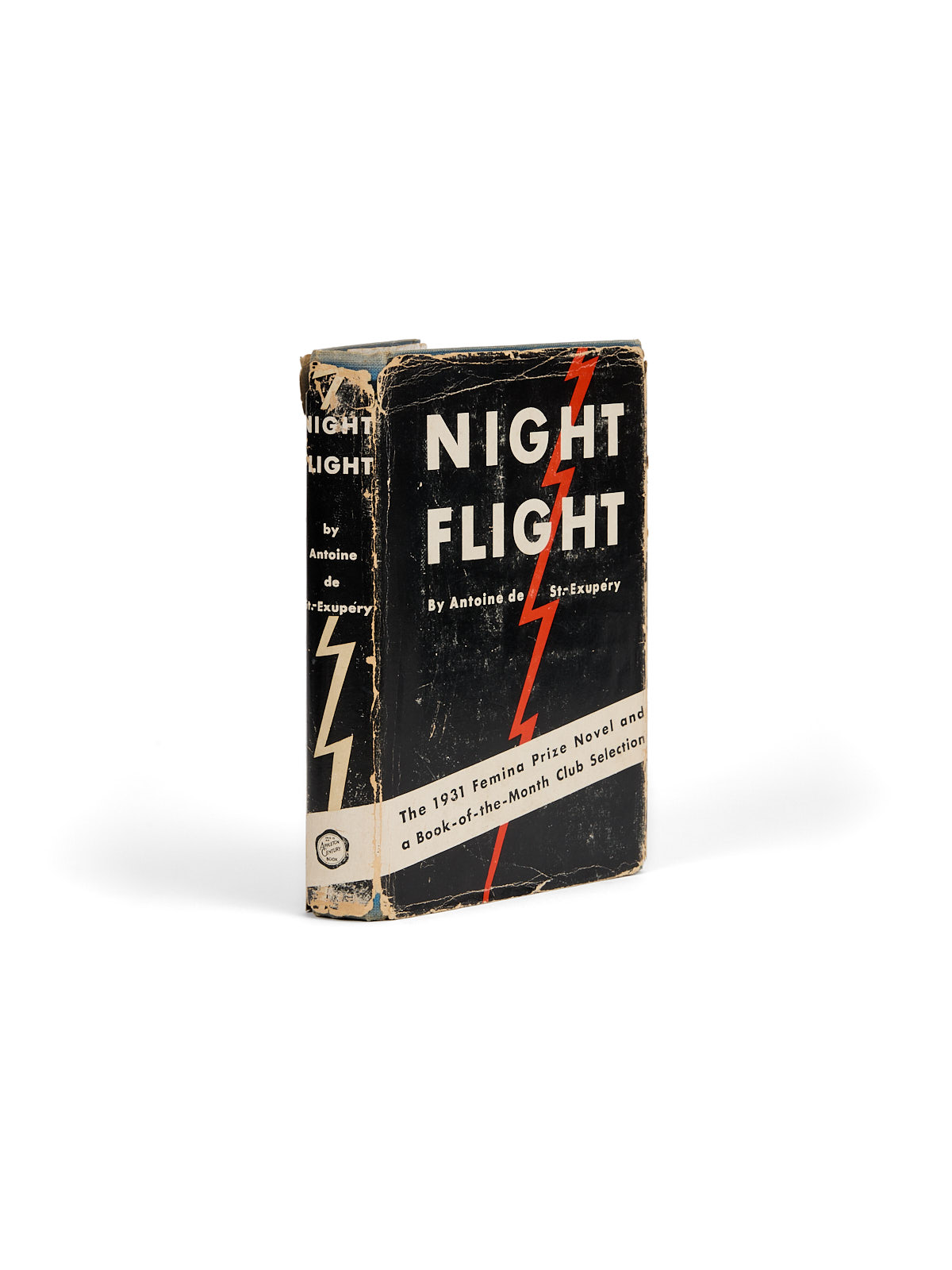
Night Flight
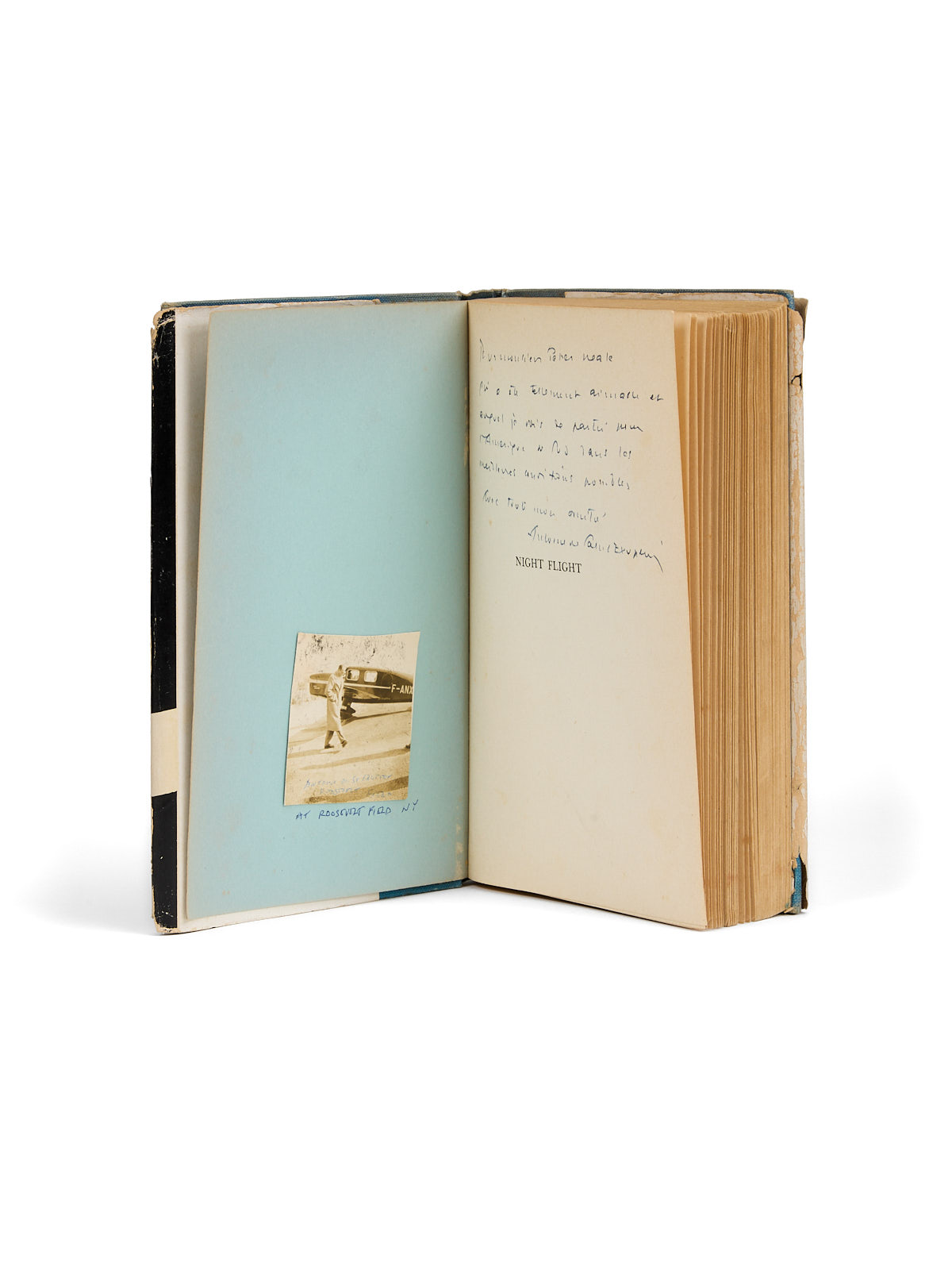
Presentation copy inscribed by Saint-Exupéry to Peter Neale: “Pour monsieur Peter Neale qui a été tellement aimable et auquel je dois de partir pour l'Amérique du Sud dans les meilleures conditions possibles. Avec toute mon amitié, Antoine de Saint-Exupéry.”
[“To Mr. Peter Neale, who was so kind, and to whom I owe my departure for South America under the best possible conditions. With all my friendship, Antoine de Saint-Exupéry.”]
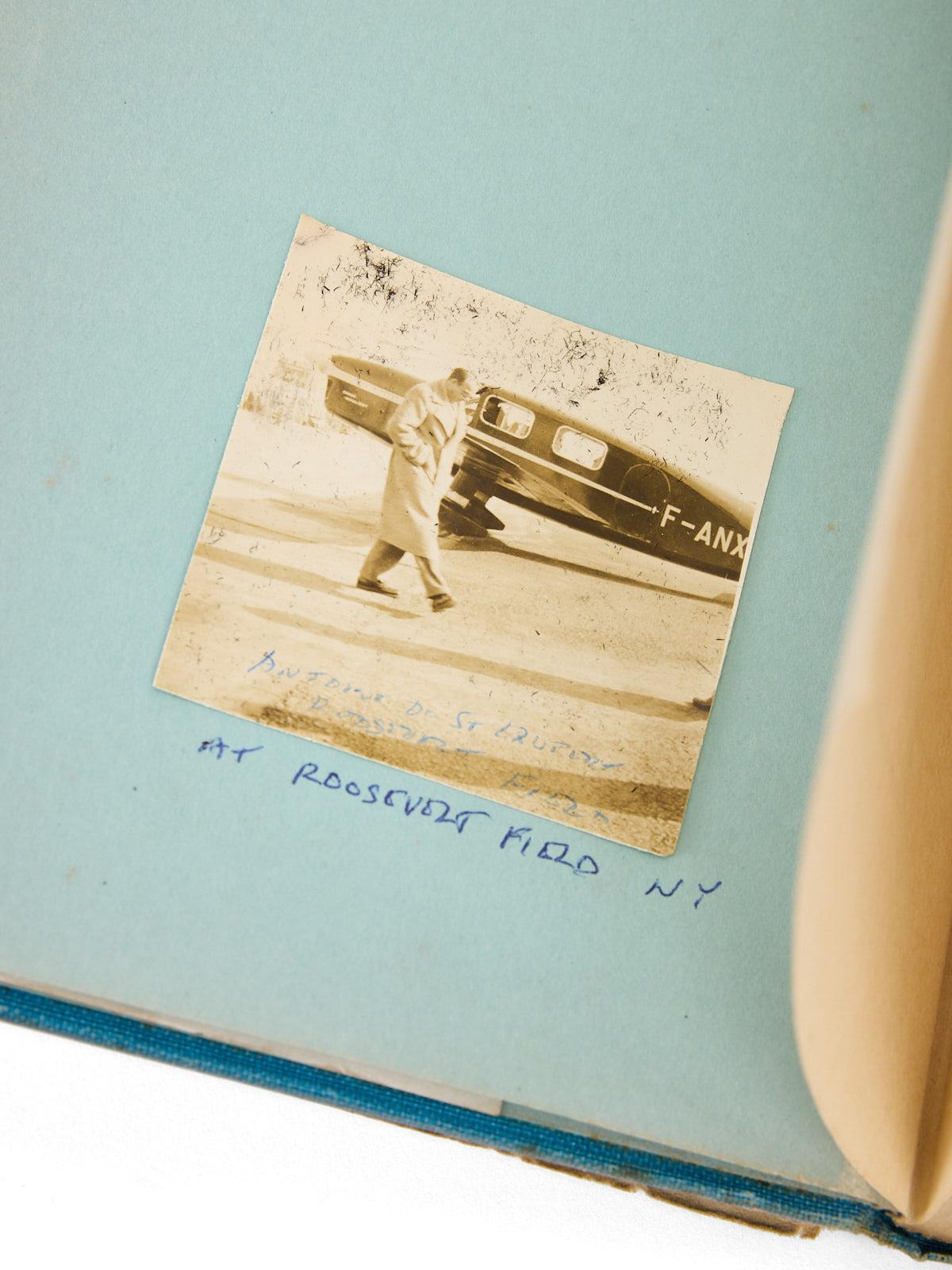
Original photograph mounted facing the inscription (on the endleaf), captioned: “Antoine de Saint-Exupéry, at Roosevelt field, NY.”
With the insurance payment received for the loss of his aircraft, wrecked in the Libyan desert, Antoine de Saint-Exupéry bought a Caudron Simoun, model C635, registered F-ANKX, in 1936. On 5 January 1938, he boarded the liner Île-de-France at Le Havre bound for America, together with his trusted mechanic André Prévot. His luggage was unusual: his airplane, dismantled into pieces! Ten days later it had been reassembled and was parked at Roosevelt Field — the oldest airfield built in New York.
It was from this legendary airstrip that, in June 1927, a then-unknown young pilot, Charles Lindbergh, had taken off alone aboard a small monoplane fitted with a 225-hp engine, the Spirit of St. Louis, on the first solo crossing of the Atlantic.
Less than a month after their arrival, on 15 February 1938, Saint-Exupéry and Prévot left New York intending to reach Punta Arenas, in southern Argentina. They stopped at Atlanta, Houston, Mexico City and Veracruz before landing, after 5,500 km, at Guatemala City on 16 February to refuel. Unaware — or perhaps forgetting — that the Guatemalan gallon of 4.5 liters differed from the American gallon of 3.8 liters, they overloaded the tanks. Too heavy, the aircraft failed to take off and crashed at the end of the runway. Prévot escaped with a broken leg, but Saint-Exupéry remained in a coma for eight days; suffering eight fractures, he narrowly avoided having his hand amputated. He was hospitalized for over a month in Guatemala before continuing his convalescence in New York. It was the most serious accident he had yet experienced.
This photograph was almost certainly taken just before their departure, and only two other photographs — both press photographs — are known showing Saint-Exupéry and Prévot at Roosevelt Field: one in the cockpit, the other in front of the airplane.
Our photograph, by contrast, is previously unpublished, most likely taken by the very person to whom the volume is inscribed: it shows Saint-Exupéry, lost in thought, walking in front of his aircraft on the tarmac, probably only a few days before departure.
We have not been able to identify the Peter Neale named in the inscription: given the wording, he was probably a mechanic on site, or an assistant who helped ensure the flight’s smooth preparation. Night Flight had been an enormous success, and Saint-Exupéry was, for the public — and even more so for anyone connected with aviation — a great celebrity. That the pilot-writer should inscribe his major work to him was undoubtedly, for Neale, a great honor.
After his accident, Saint-Exupéry was repatriated to New York in the spring, and used this period of enforced rest to write, on the advice of his friends and publishers, a new book — having written nothing since Vol de nuit (Night Flight). This became Terre des hommes (Wind, Sand and Stars), an autobiographical narrative interwoven with reflections on heroism, friendship, death and one’s relationship to existence. “I regret nothing. I have taken my chances and lost. That is all in the natural course of my profession. But I have breathed the wind of the sea, all the same. Those who have once tasted it do not forget. Isn’t that so, my comrades? And it is not a matter of living dangerously. That phrase is pretentious. I have little liking for bullfighters. It is not danger I love. I know what I love. It is life.”