

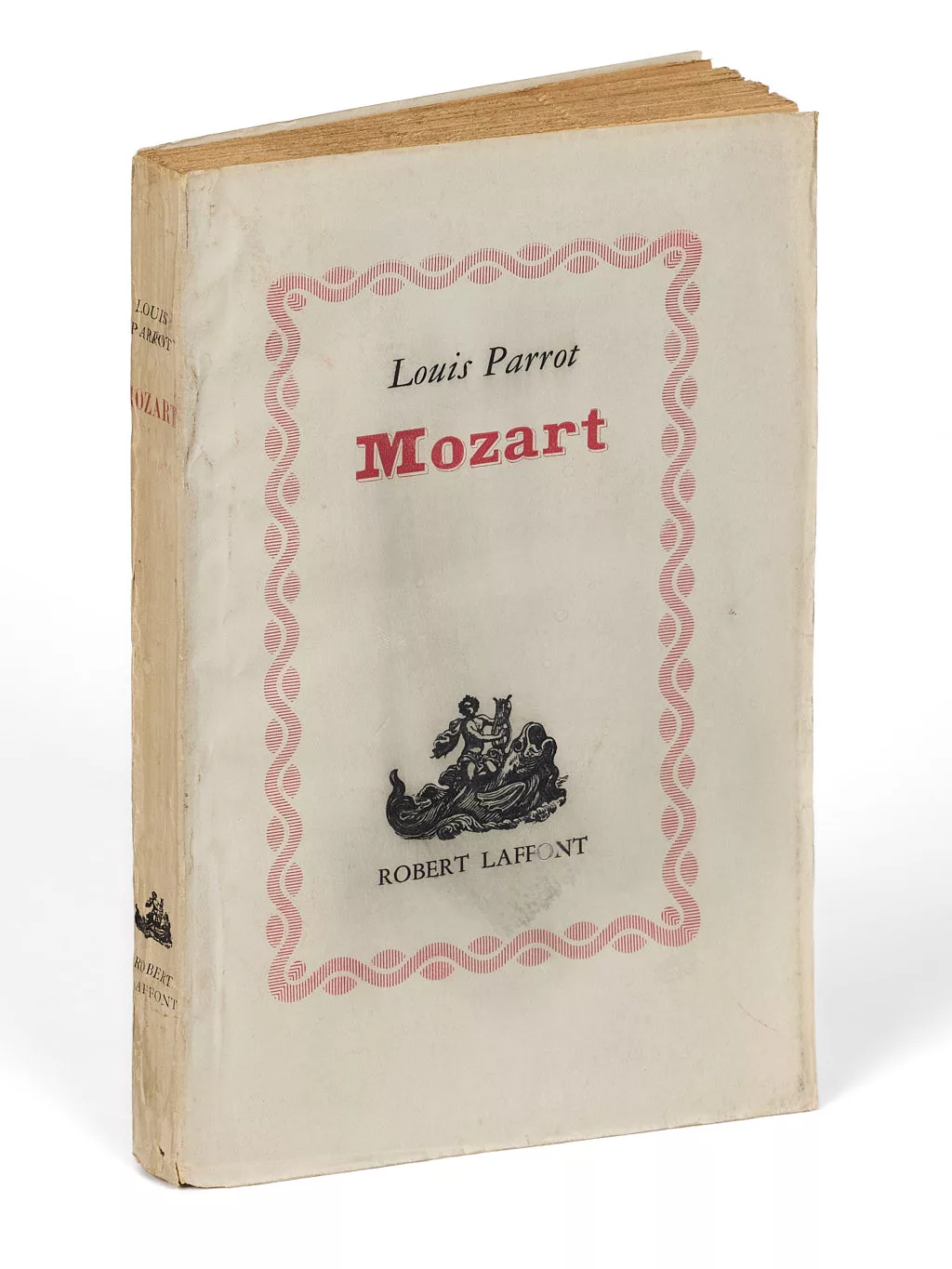
Mozart
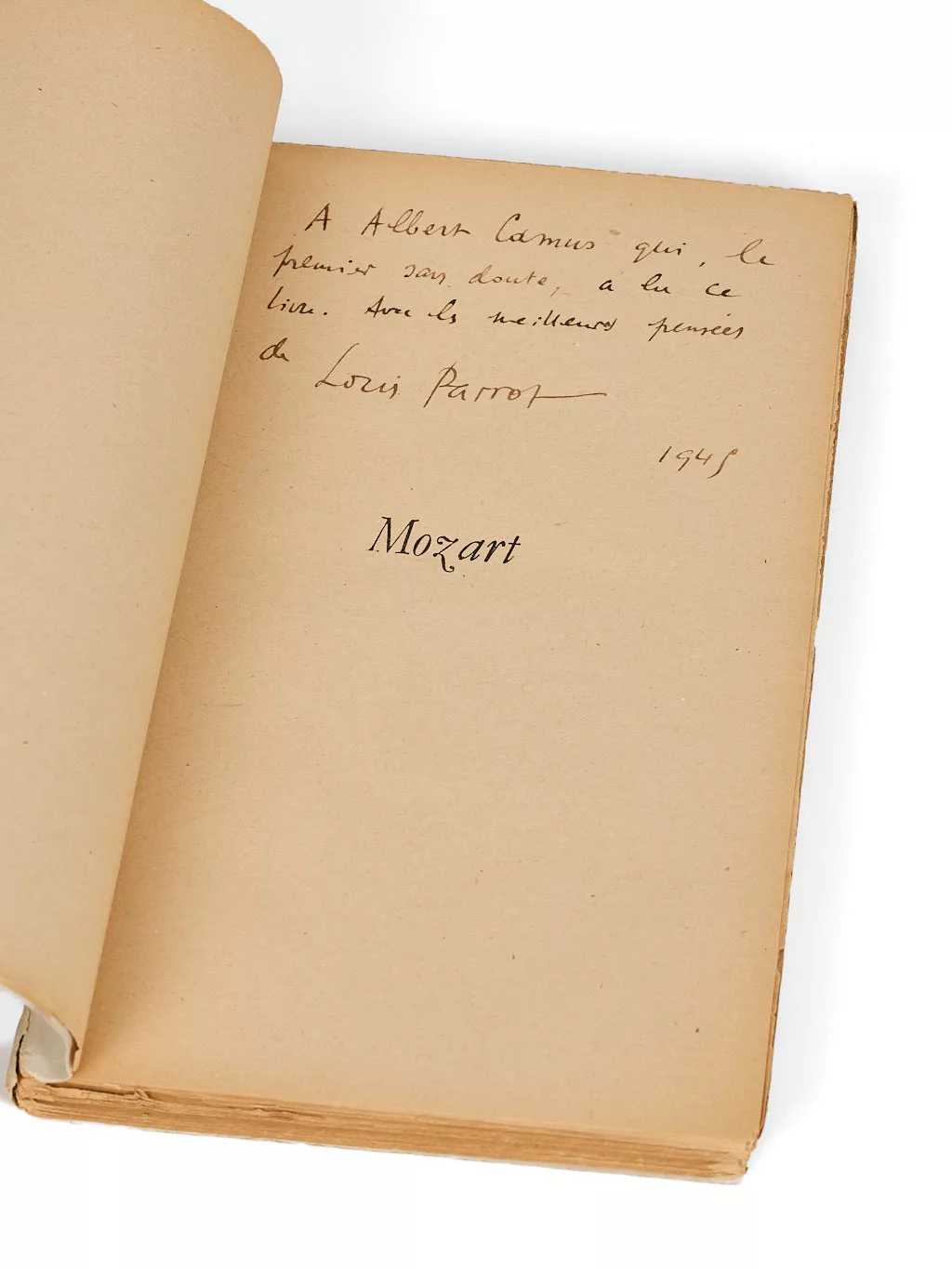
Presentation copy inscribed by Louis Parrot to Albert Camus: “À Albert Camus qui, le premier sans doute, a lu ce livre. Avec les meilleures pensées de Louis Parrot, 1945.”
Parrot’s Mozart is not, strictly speaking, a biography, but rather “a new approach to Mozart’s musical creation,” conducted with the intelligence and subtlety of a poet. Born in Tours in 1906, Louis Parrot shared with Albert Camus — long before knowing him — a poor childhood, far from books or culture, one that his eager taste and curiosity would soon transform. He became a friend of the greatest writers of his time, beginning with Paul Éluard, with whom he founded the emblematic Éternelle revue, after having helped distribute Poésie et Vérité 1942, containing Éluard’s most famous poem, “Liberté.”
The son of a stonemason, apprenticed on building sites at the age of twelve, Parrot’s curiosity and tastes soon led him into the world of letters, which he entered as a teenager by winning the poetry prize of the Jeux Floraux de Touraine with an “Ode à Minerve meurtrière.” He began corresponding with older writers, including René Char, and published his first collection, Misery Farm, in 1934. During the war, Parrot acted as an intermediary from Lyon for writers cut off between the northern and southern zones. It was there that he began writing his Mozart, perhaps even crossing paths with Camus, who arrived there in January 1943. He completed the text in 1944, in Clermont-Ferrand.
Whether or not he was its first reader, the text could not have suited its recipient better: Camus — a fact not widely known — always maintained a rare and erudite friendship with music. On Mozart, he published, on 2 February 1956 in the pages of L’Express, a “Remerciement à Mozart” on the occasion of the bicentenary of the composer’s death, a precise and profound text he had chosen to write on his own initiative.
One may also note, as an aside, that Camus — as Emmanuel Roblès recounts in his book Camus, frère de soleil — took Spanish lessons from Denise Parrot, Louis’s wife. These lessons took place after the war, around the time Camus received this copy of Mozart. Was it, perhaps, through the language of Cervantes, a way of better understanding Maria Casarès, whom he had met a few months earlier?
A very rare provenance: Albert Camus’s library was never dispersed, save for a few exceptions. This is one of them.