

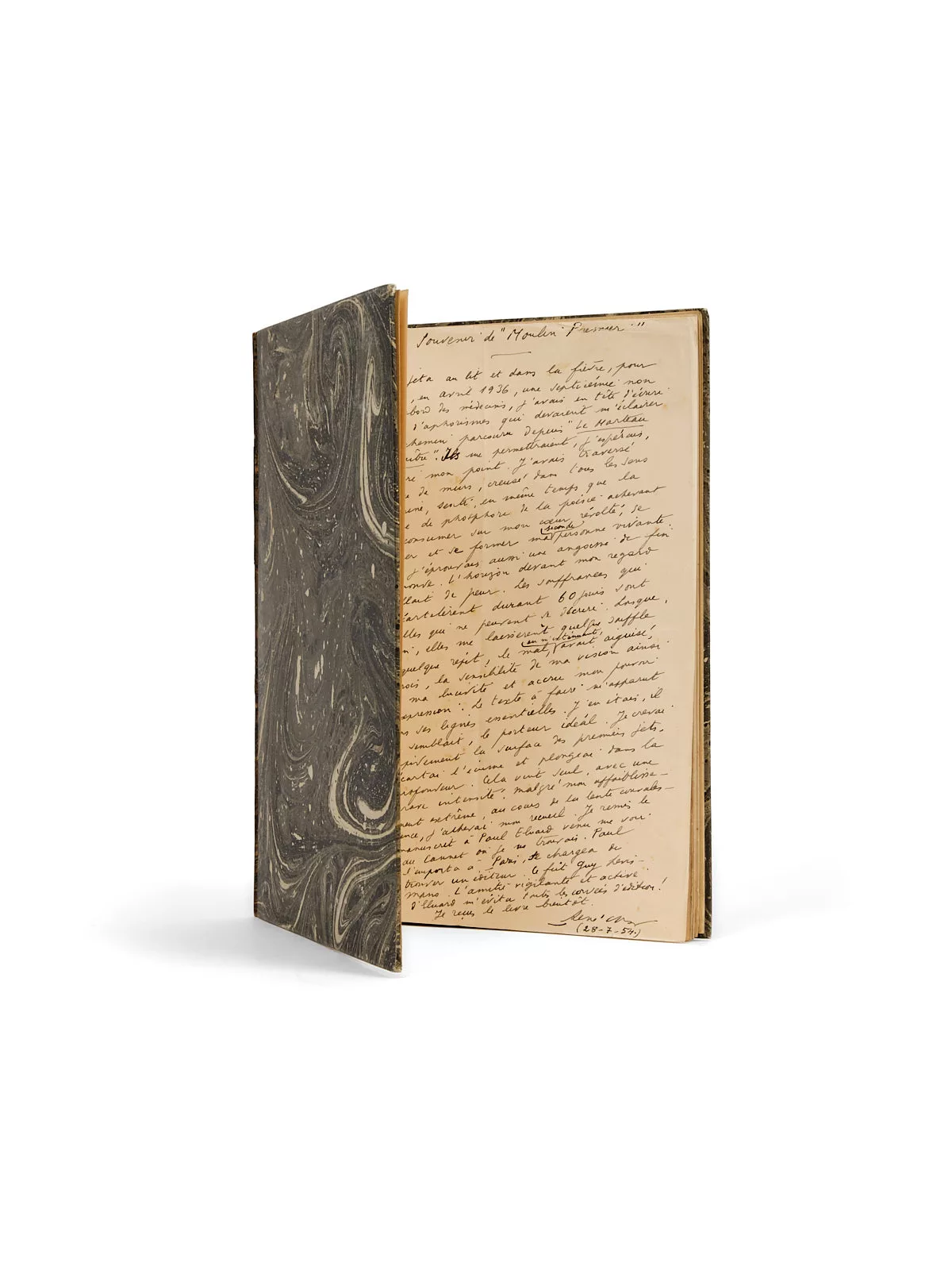
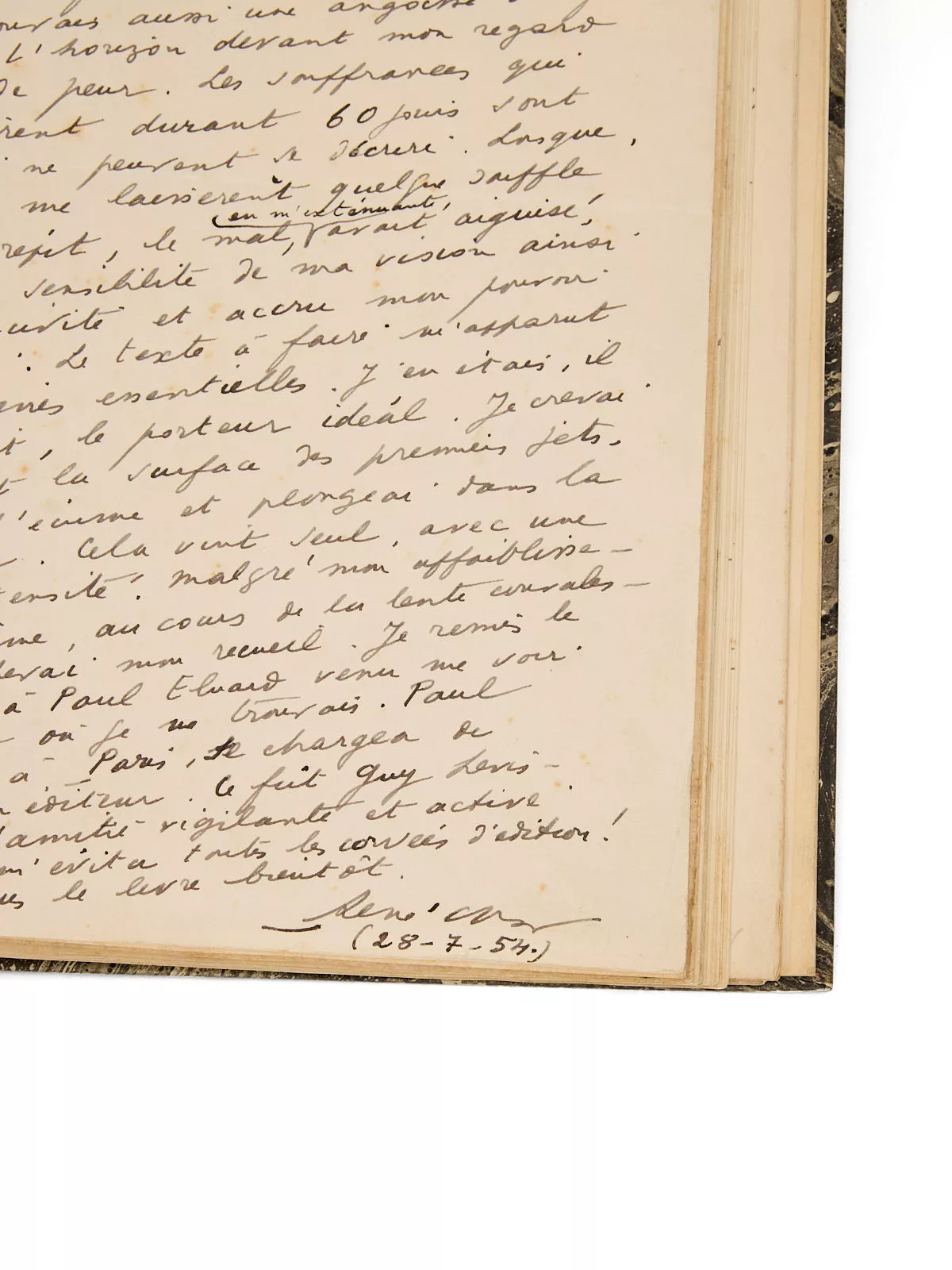
When the manuscript was bound, it was enriched with an essential text, signed and dated 28 July 1954 and entitled “Souvenir de Moulin premier,” in which Char looks back on the genesis of these texts and the circumstances of their publication. This text bears the following dedication: “Pour monsieur Conrado.”
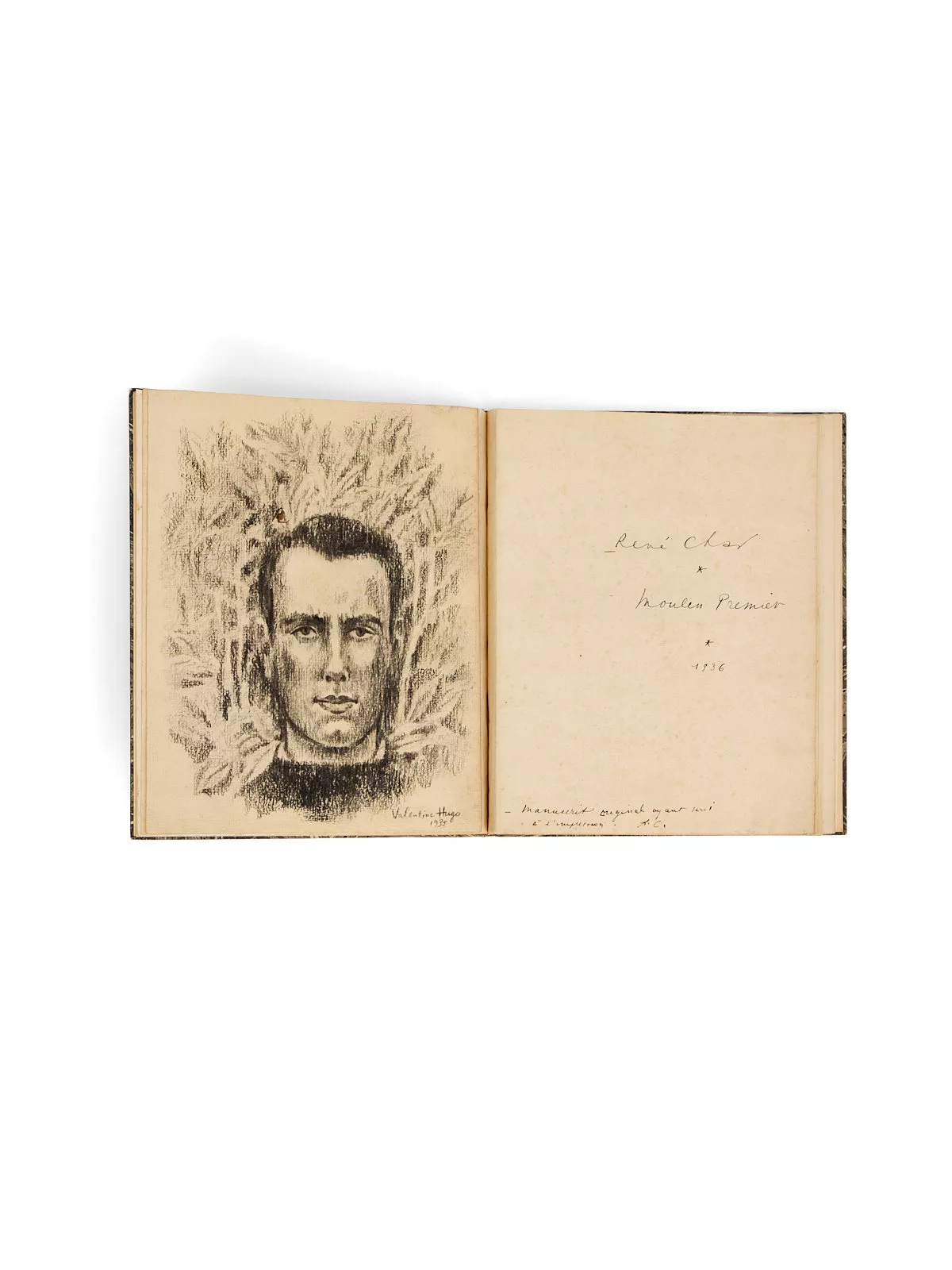
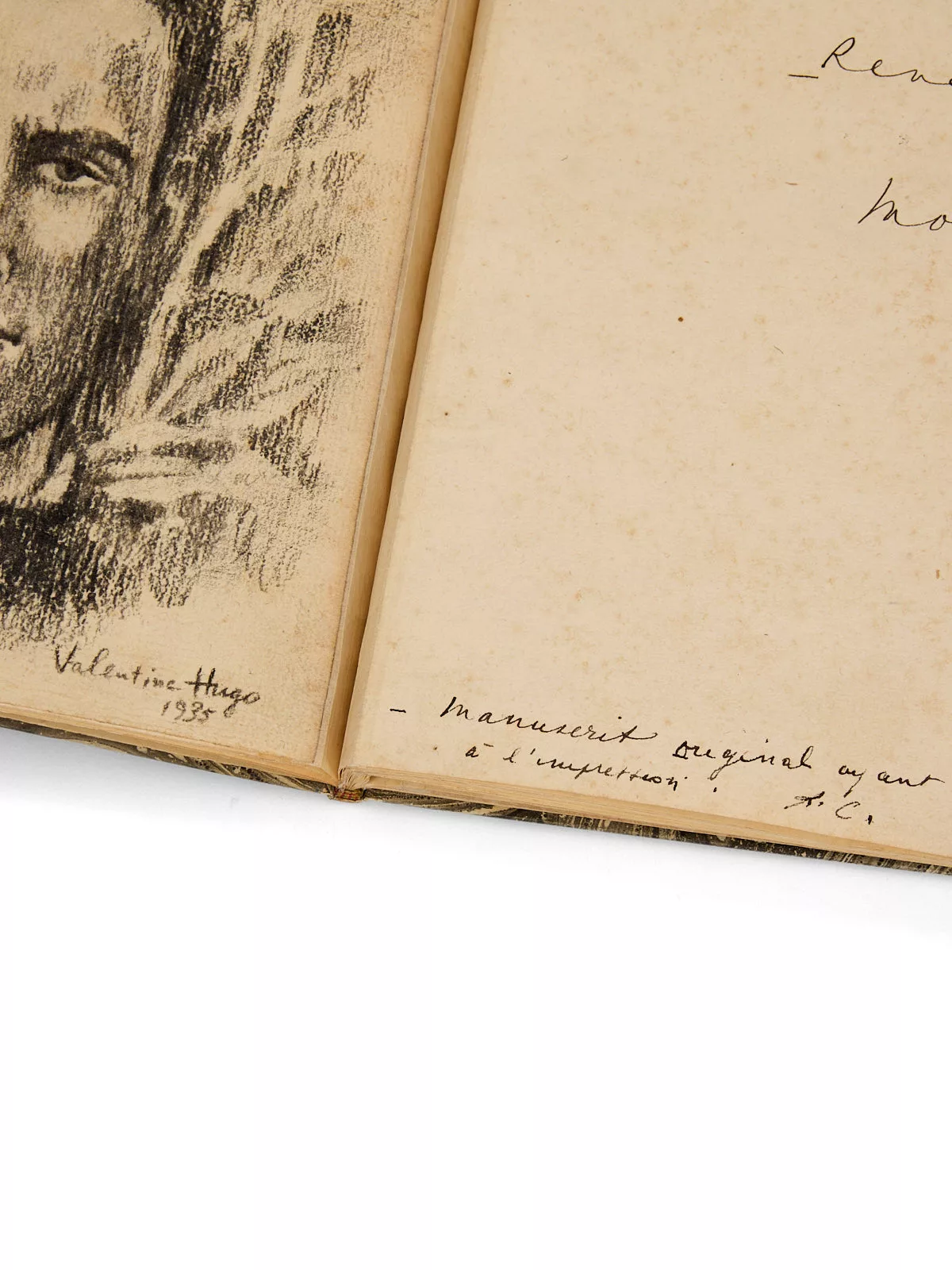
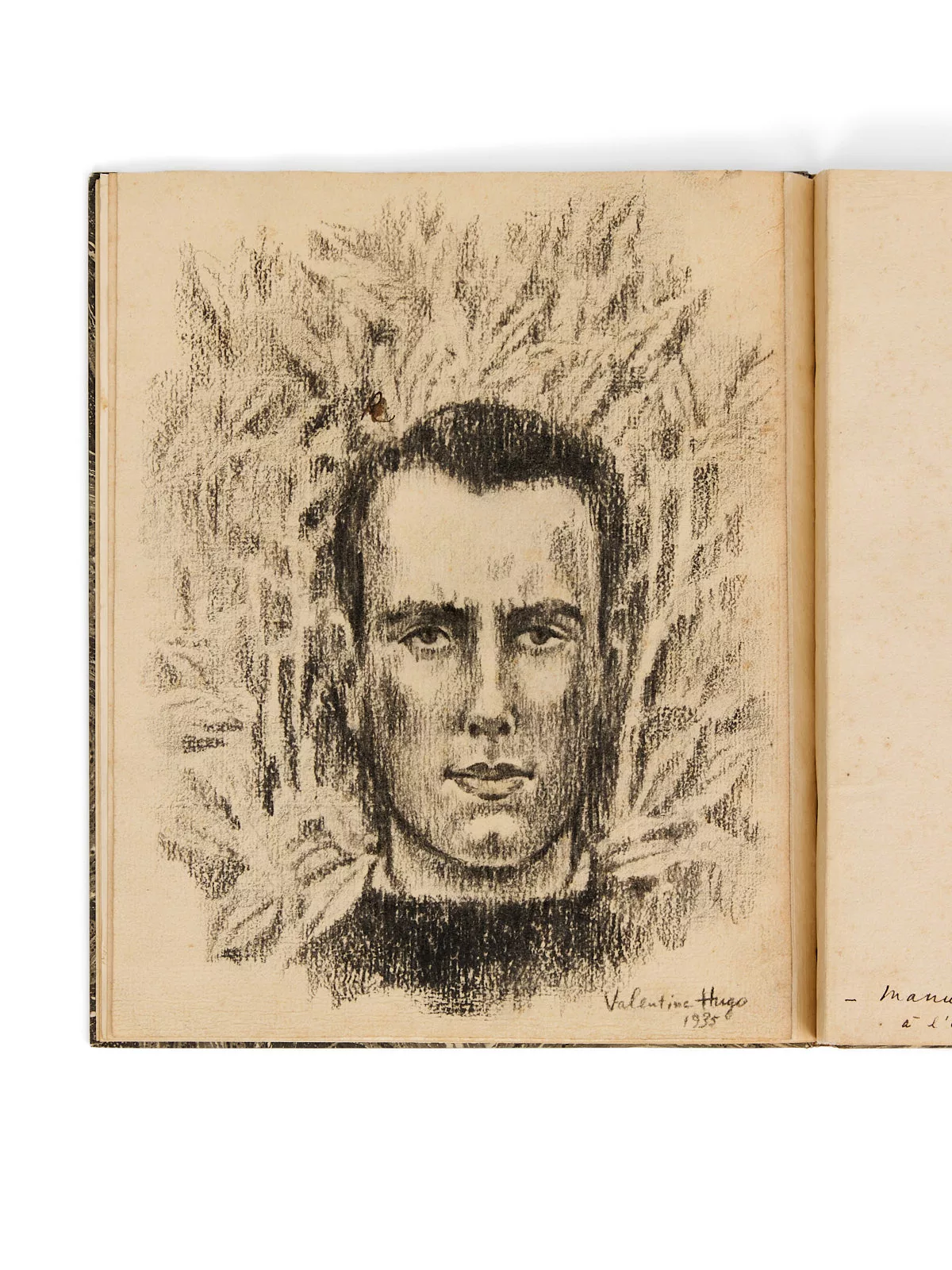
The whole is completed by various additional elements, including a portrait of René Char by Valentine Hugo, in charcoal, signed and dated 1937.
This version is also particularly notable for the misprint in section 27 and its emblematic line: “Ne trépane pas le lion qui le rêve,” which became “Ne trépane pas le lion qui rêve” in the postwar edition of Le Marteau sans maître, where Moulin premier was reprinted as an appendix.
Char later recalled that the manuscript used for the Corti edition had been corrected by Gaston Bachelard, and that the line as he actually wanted it was not retained: “…when I sent my manuscript to Corti, Bachelard corrected my text. I had written: ‘ne trépane pas le lion: il rêve’” (cf. René Char en ses poèmes, Gallimard, 1995).
When the manuscript was bound, it was prefaced with an essential text, signed and dated 28 July 1954, entitled “Souvenir de Moulin premier,” in which Char looks back on the genesis of these texts and the circumstances of their first publication. A severe illness (septicemia) that confined him to bed for two months gave rise to the poems of Moulin premier, whose foundational importance he describes in this memoir: “…the illness, by exhausting me, had, I believe, sharpened the sensitivity of my vision as well as my lucidity, and increased my power of expression: the text to be written appeared to me in its essential lines. It seemed to me that I was its ideal bearer. I quickly broke through the surface of the first drafts, pushed aside the foam and plunged into the depths. It came on its own, with grave intensity….”
This lengthy process of composition meant that texts begun in 1935 were not published until late 1936. “I gave the manuscript to Paul Éluard, who came to see me at Le Cannet, where I was staying. He took it to Paris and undertook to find a publisher. It was Guy Lévis Mano. Éluard’s friendship spared me all the drudgery of publication! I soon received the book” (same text, quoted in the critical apparatus of the Pléiade edition, from a communication by André Rodocanachi, Œuvres complètes, p. 1240). It was the second book published by this publisher, after Dépendance de l’adieu, with a frontispiece by Pablo Picasso.
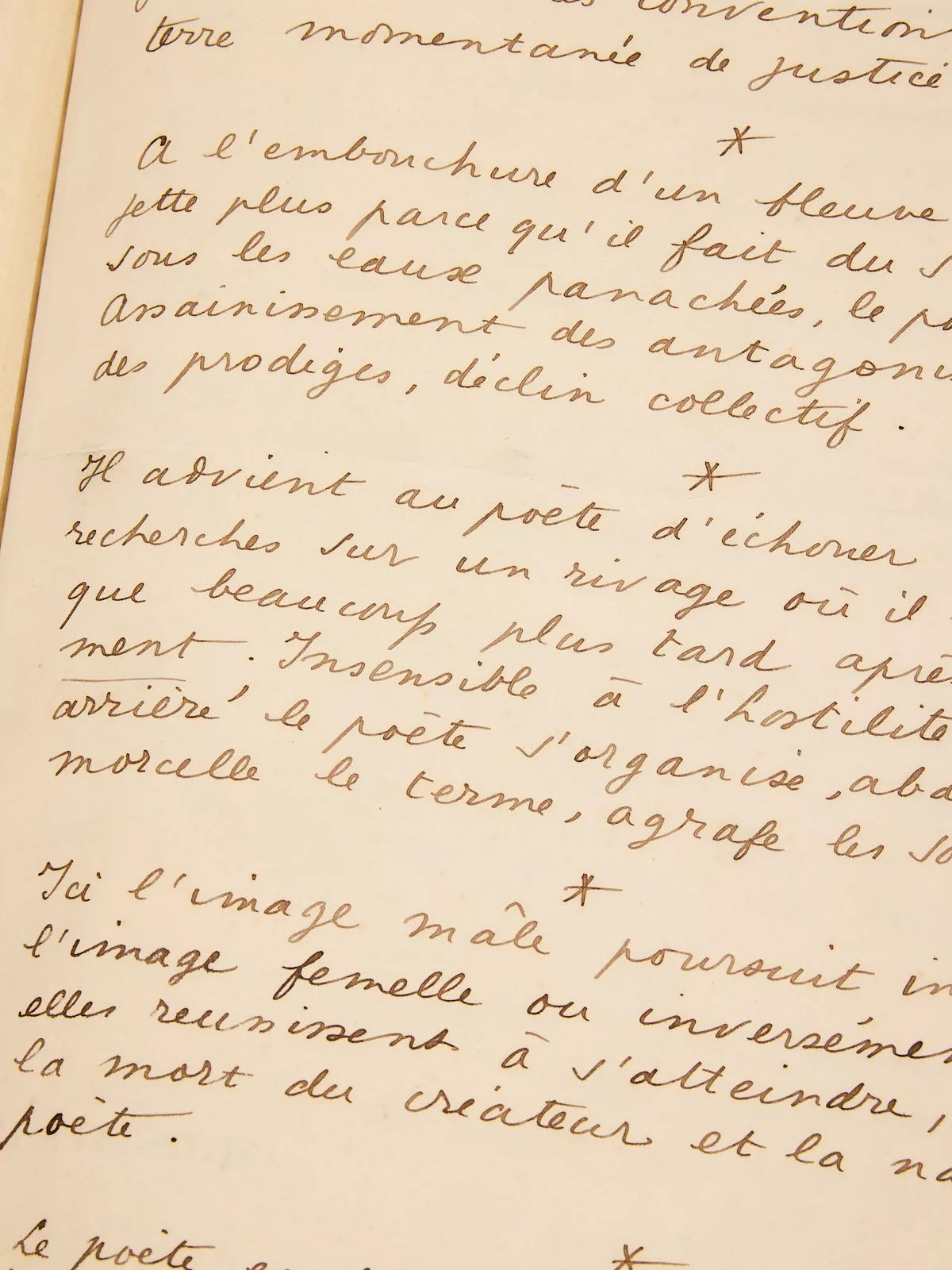
Corti rightly wrote, in his Souvenirs désordonnés: “A manuscript by Char is always a search for ultimate perfection. By the time it reaches the printing stage, second thoughts intervene: a word, an inversion, and no sooner is the book finished than something emerges that might have perfected it. Such a poem of a few lines has gone through no fewer than seven or eight states, each of which was definitive for a few hours….” This manuscript is a concrete example of that process, the poet constantly returning to his text — variants and corrections do indeed appear, in the end, in the printed volume. The manuscript opens with the “point of departure”: a quotation from Lautréamont and an excerpt from Guérard’s “grammaire élémentaire” (exercise 527).
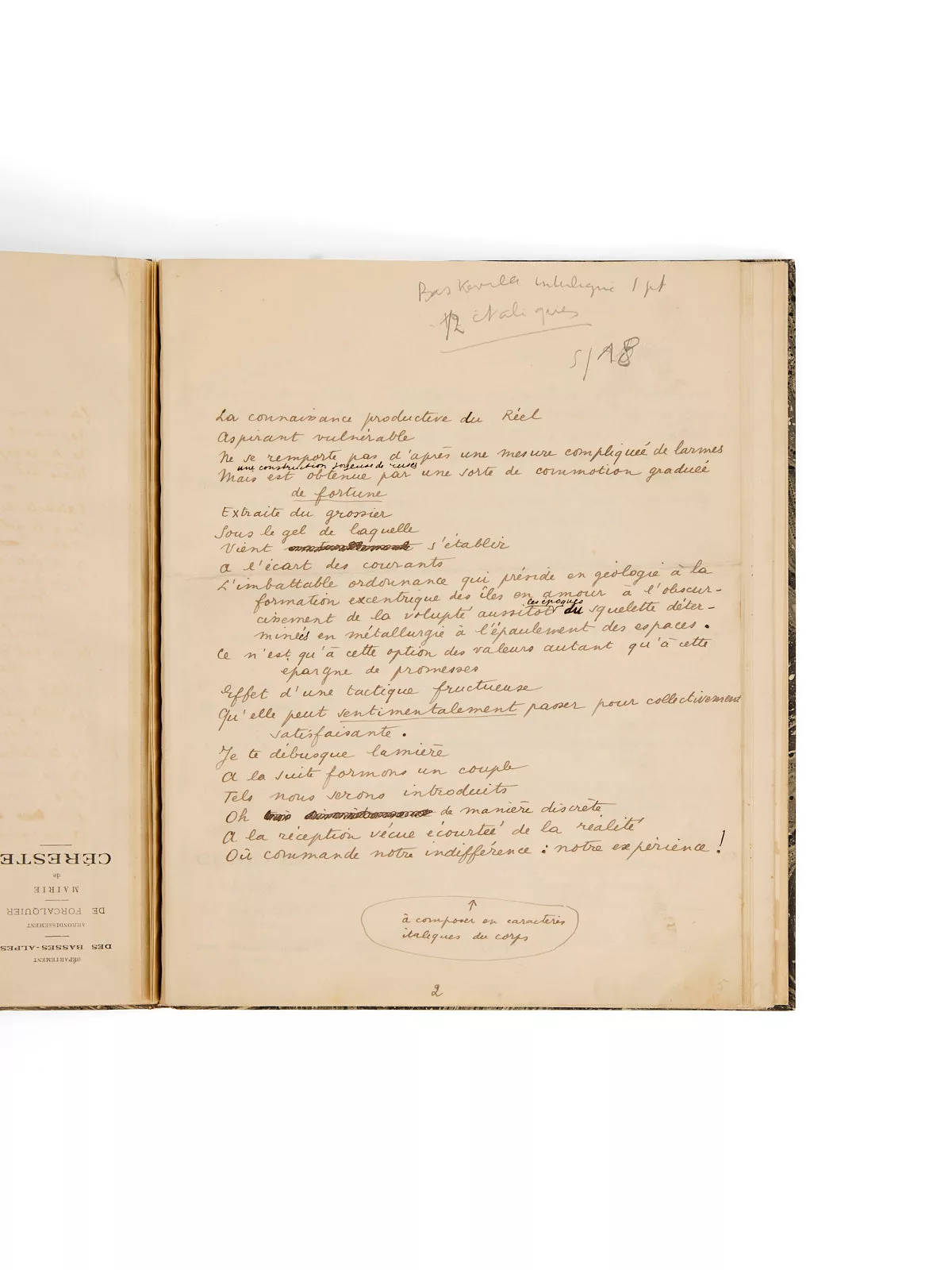
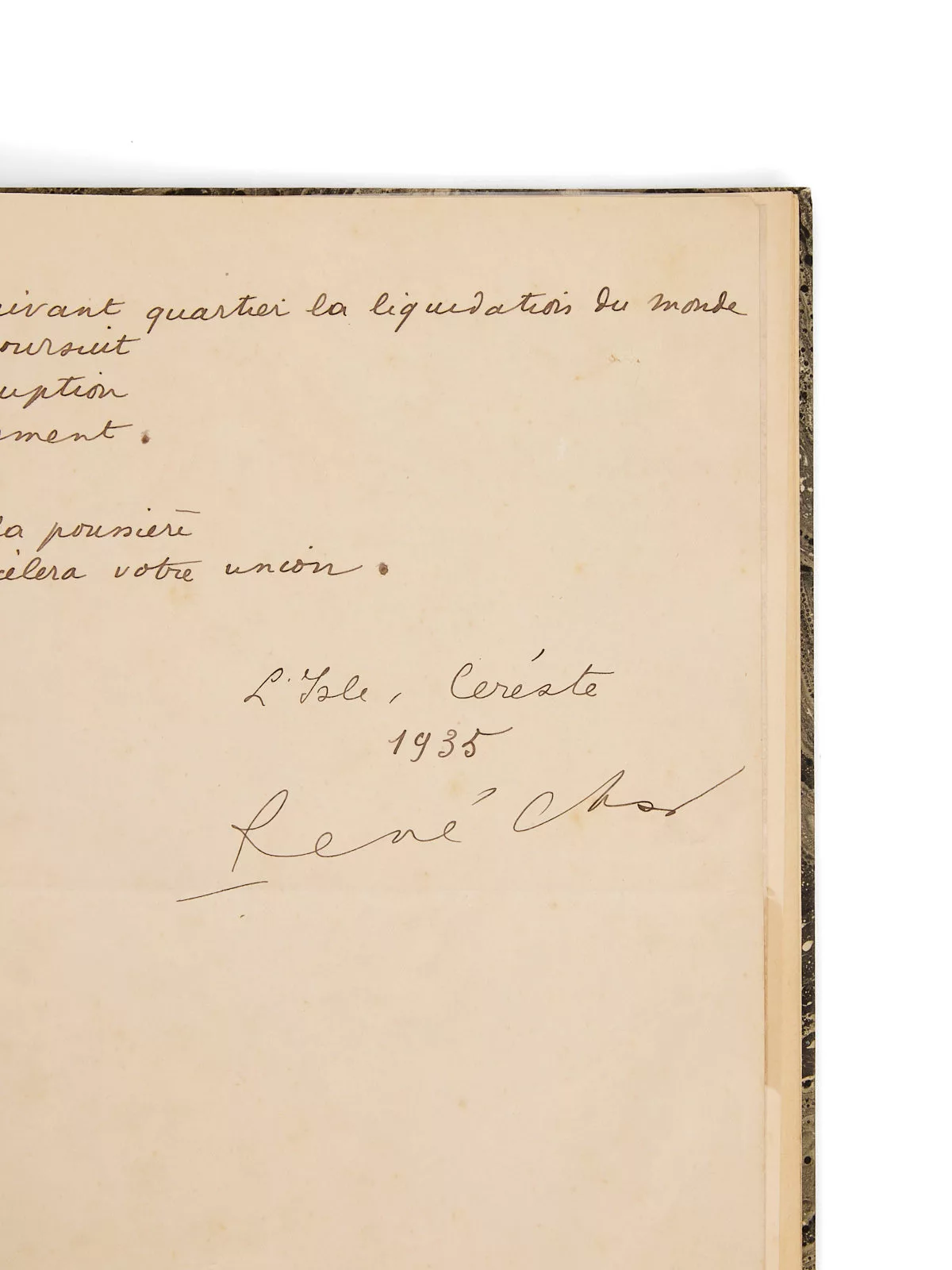
The manuscript is written in ink, partly on laid rag paper that the poet used as a wrapper — the same paper also used for the original portrait of the poet by Valentine Hugo — and, for the texts themselves, on the verso of letterhead paper from the “Mairie de Céreste.” The title leaf bears the date 1936 and this note, initialed by Char: “Manuscrit original ayant servi à l’impression.”
In the catalogue of the Char exhibition at the Bibliothèque nationale (p. 49, no. 53), where this manuscript of Moulin premier was exhibited, Antoine Coron notes the following about Valentine Hugo’s drawing: “Facing the title page, the charcoal portrait of René Char by Valentine Hugo, dated 1935, is certainly of later date, connected with the sale of this manuscript, and therefore made from an old photograph. Char added, for the first purchaser, a South American diplomat, ‘Souvenir de Moulin premier,’ etc.” It seems clear indeed that the poet composed a complete and finished ensemble to present to the future buyer.
“The title Moulin premier arose from the surprises of familiar vocabulary. The moulins premiers, paper mills of very ancient origin, stood on the Sorgue known as the Sorgue de Velleron, in a district of L’Isle-sur-Sorgue that still bears this name. The mill, since the poet’s childhood, held all the more important a place because his ancestor Arnaud, father of his paternal grandmother, was himself a miller” (Pléiade, p. 1240).
This precious, complete manuscript is enriched with a portrait of René Char by Valentine Hugo.
Provenance: M. Conrado (autograph inscription, for the added letter, in 1954); André Rodocanacchi (who communicated the text “Souvenir de Moulin premier” to the editor of the Pléiade edition); private collection.
Exposition René Char, Supplément d’âme, nos. 15–20; Antoine Coron, G.L.M., 120.