


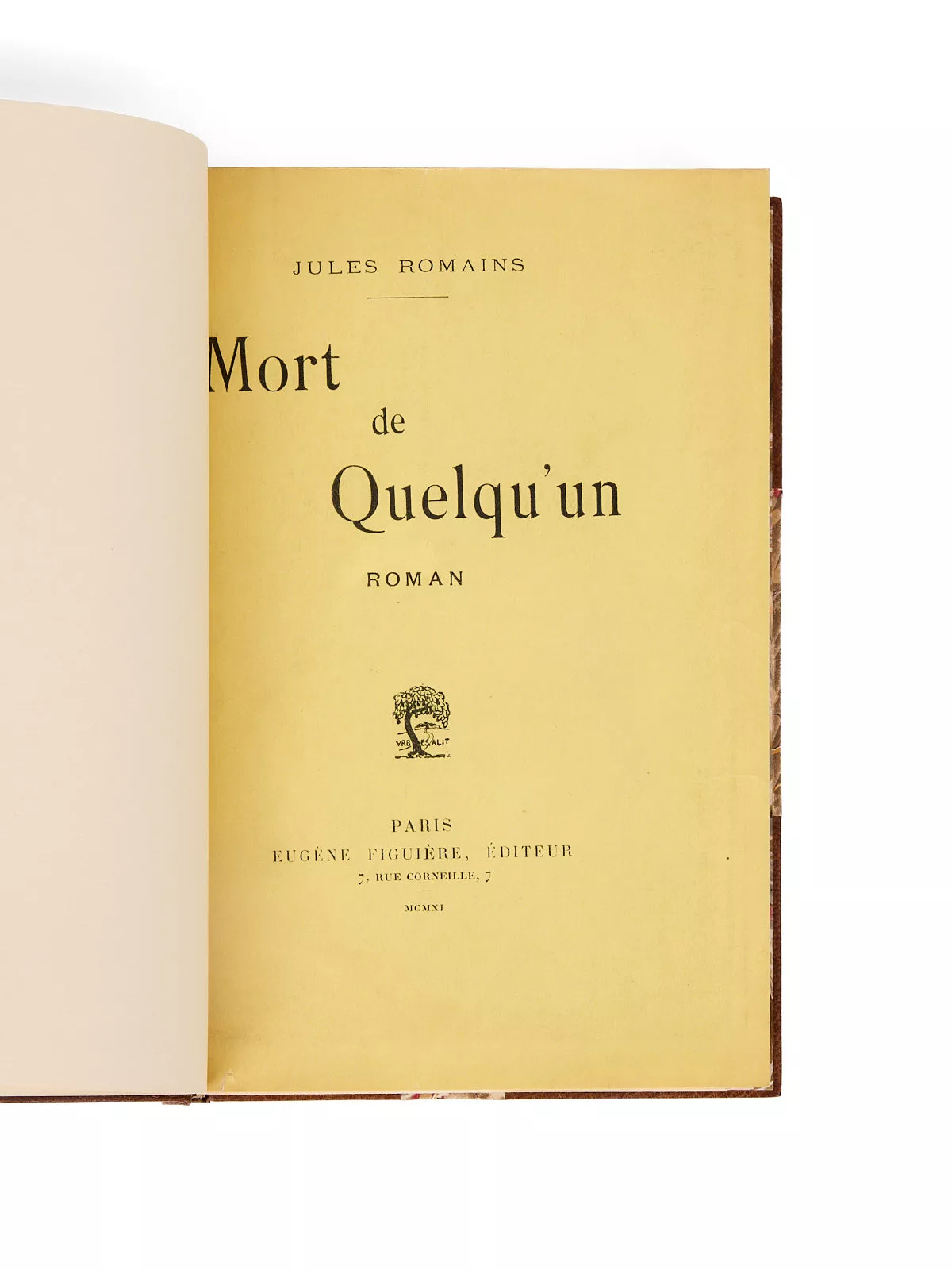
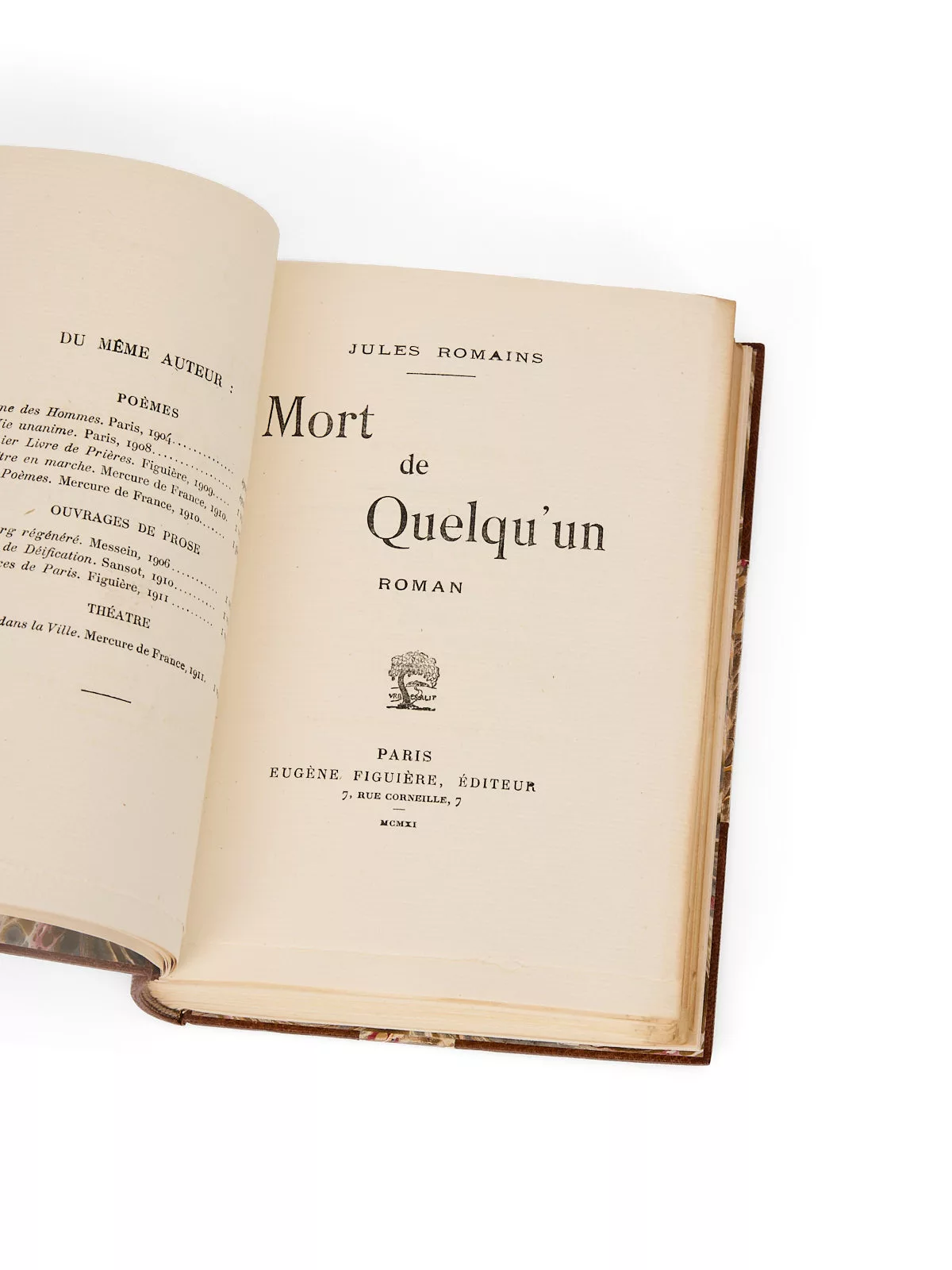
Mort de quelqu’un
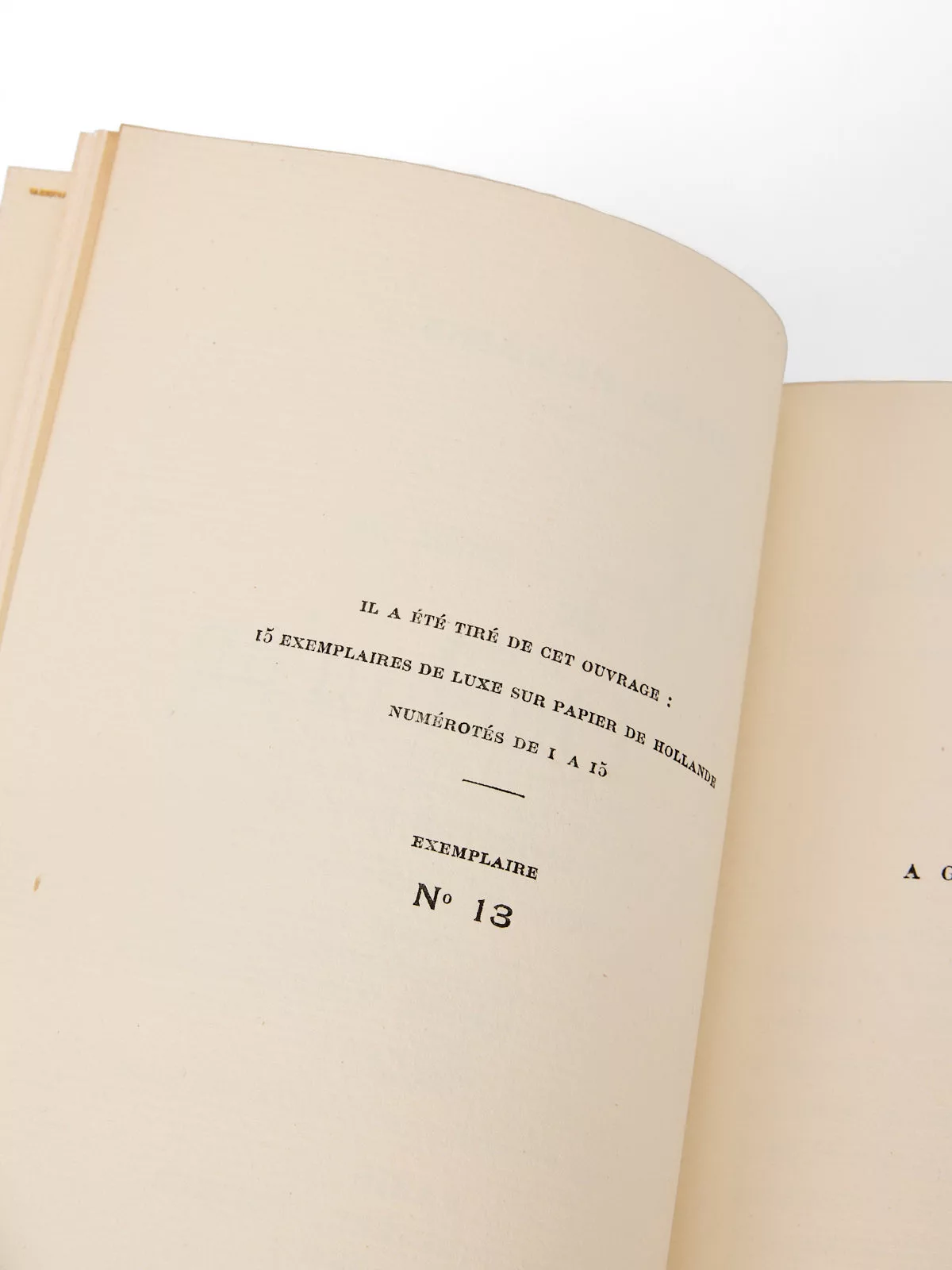
One of 15 copies on Hollande paper (no. 13), the only deluxe paper.
Jules Romains does not set out to tell an exceptional destiny. On the contrary, he chooses a man as anonymous and ordinary as possible — Jacques Godard — so as to shift the novel’s center of gravity: the true protagonist is no longer the individual but the group that forms around him. The result is less a novel than a kind of “psychological epic” devoted to the circulation of a single idea through a multitude of consciousnesses, a “brilliantly banal narrative, imbued with an indestructible humanity,” to borrow René Arcos’s admirable phrase. Stefan Zweig was also among those who particularly praised the book.
When, twenty years later, Romains undertook the vast construction of Les Hommes de bonne volonté — 27 volumes published between 1932 and 1946 — he faced the same problem again: how to depict a society without artificially placing a single individual at its center? He explicitly returned to his 1911 novel: “One of my oldest and most constant concerns [was] to find a mode of composition that would allow us to escape our habit of seeing things centered on the individual […]. As early as 1911, I published Mort de quelqu’un which, to speak only of technique, offered, I believe, a first solution to the problem and opened the door to others.”
It is rare for an early work to show so clearly a writer inventing the form he would need twenty years later for his major work. In 1911, Romains starts from almost nothing: the death of an obscure retiree. But by refusing to give this man the traditional role of hero, he shifts the novel’s center toward all those whom his death briefly brings into relation; the paradox is a fine one: to show how a group comes to life, Romains begins by killing off his main character.
Rare deluxe printing, limited to 15 copies.
Spine slightly faded.