


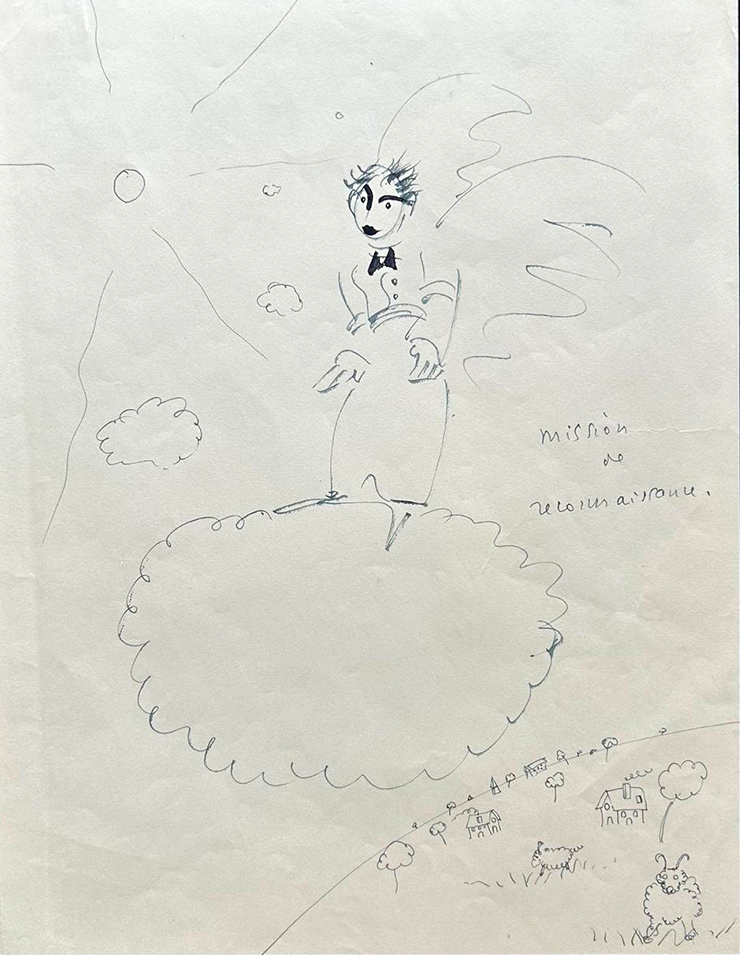
Mission de reconnaissance
Several drawings by Saint-Exupéry are known reproducing, with variations, this “reconnaissance mission” scene, most of them on loose sheets of paper. One was given to Pierre Chassin, one of the two sons of Colonel Chassin, and is mounted at the front of one of the three known copies of Le Petit Prince bearing a dedication by Antoine de Saint-Exupéry, exhibited at the Musée des Arts décoratifs in the 2022 exhibition.
It is worth recalling that Saint-Exupéry barely experienced the reception of his book, since he left the United States on April 20 for Algiers, where he undertook training at Laghouat before joining Group 2/33 at Oujda in Morocco, where he was promoted to major in June 1943. Several incidents, however, placed him “on the reserve list” as early as August and, given his age and poor general health, he returned to Algiers, where he stayed with his friend Dr. Pélissier, finding his forced inactivity increasingly hard to bear. He was finally able to resume active service in spring 1944, flying his first mission on July 21 out of La Marsa in Tunisia.
He never returned to the United States: on July 31, 1944, on a final reconnaissance mission, his plane crashed into the Mediterranean. In fact, it appears that the author never saw a copy of his book before his departure, since no copy inscribed from New York is known.
The only three copies presented by Saint-Exupéry were given from North Africa, and all belong to a later printing:
– the Lionel-Max Chassin copy (second-printing statement), with drawings and inscriptions to his children, Max and Pierre (“Doudou et Piou”);
– the Malou and Jean-Michel Sturm copy (third-printing statement);
– the Nelly de Vogüé copy (third-printing statement).
This drawing is one of the most accomplished, and the connection between the aviator on his mission and the future Little Prince is unmistakable, placing it among the important preparatory elements of the author’s future masterpiece. The figure, its wings — later truncated into the famous windblown scarf — and the presence of the ram, later softened into a sheep, all point toward the origins of Le Petit Prince.
“You can see it in the very features of the Little Prince: Antoine de Saint-Exupéry gradually simplifies the face. He removes the eyebrows. He gives him his famous ‘cache-nez,’ as he calls it in the book, that is, his scarf. There is an entire process at work, and the results do not come immediately. Four of the drawings of the Little Prince with wings testify to Saint-Exupéry’s search for a way for his character to reach Earth or travel from one planet to another. Before imagining the migration of wild birds, it is clear that this was not obvious to him at first. And in his earlier drawings, when he gives wings to a figure, it is generally to aviators. Saint-Exupéry drew very few airplanes, because for him a plane was not a machine but a man with wings. All of this shows that the graphic work lies at the very source of his literary thinking” (Alban Cerisier).
As confirmed by Olivier d’Agay, the author’s great-nephew and director of the Saint-Exupéry estate, “it is him, the Little Prince, it is obviously Saint-Ex. He draws himself in situations in a plane, on a cloud. He stages himself, he puts himself into the scene. This Little Prince is himself as a child, himself as an adult. It is the adult meeting the child, just as it happened in the desert. Everything stems from there, after the plane crash of December 31, 1935, between Paris and Saigon. In his delirium, he meets the Little Prince, and for him it is a shock that will generate the tale, six years later” (Radio France interview, April 5, 2022).
The identification of the author with his character, and of that character with the Little Prince, is fully evident, and is confirmed in several other New York documents. A mirror of his soul, this not-yet Little Prince is more than a traveling companion: he is a poetic double, a bridge between imagination and real life, amplified by the experience of the war. “A plane is a man who flies, not a flying machine. And the little prince, cradle of his heart and of what is most intimate in him, lends itself easily to the representation of others. That is his generosity” (Alban Cerisier, op. cit.).
“Captain (reserve) Antoine de Saint-Exupéry was mobilized in September 1939, upon his return from a stay in New York […]. He flew missions over France and neighboring countries, and to report to those close to him on these highly dangerous flights, he took to drawing scenes depicting not airplanes but figures, sometimes winged, perched on clouds […]. Although Antoine de Saint-Exupéry customarily depicted [them] as winged figures perched on their cloud, rather than in the cockpit of their plane, it is not impossible that the writer at one point considered giving his character a pair of wings […]. What if the little prince had no age? […] For his book, the writer decided in favor of giving his character the features and silhouette of a child […]. The youth of the little prince is nothing other than the youth of his gaze upon the kingdom of the world. He is a child as a symbol. He is not a child by virtue of belonging to an age group…” (À la rencontre du Petit Prince, Paris, Gallimard, Musée des Arts décoratifs, pp. 163 and 205).
A rare and wonderful self-portrait of the author, filled with elements foreshadowing the character of the Little Prince, on a “double mission”: personal and poetic.