

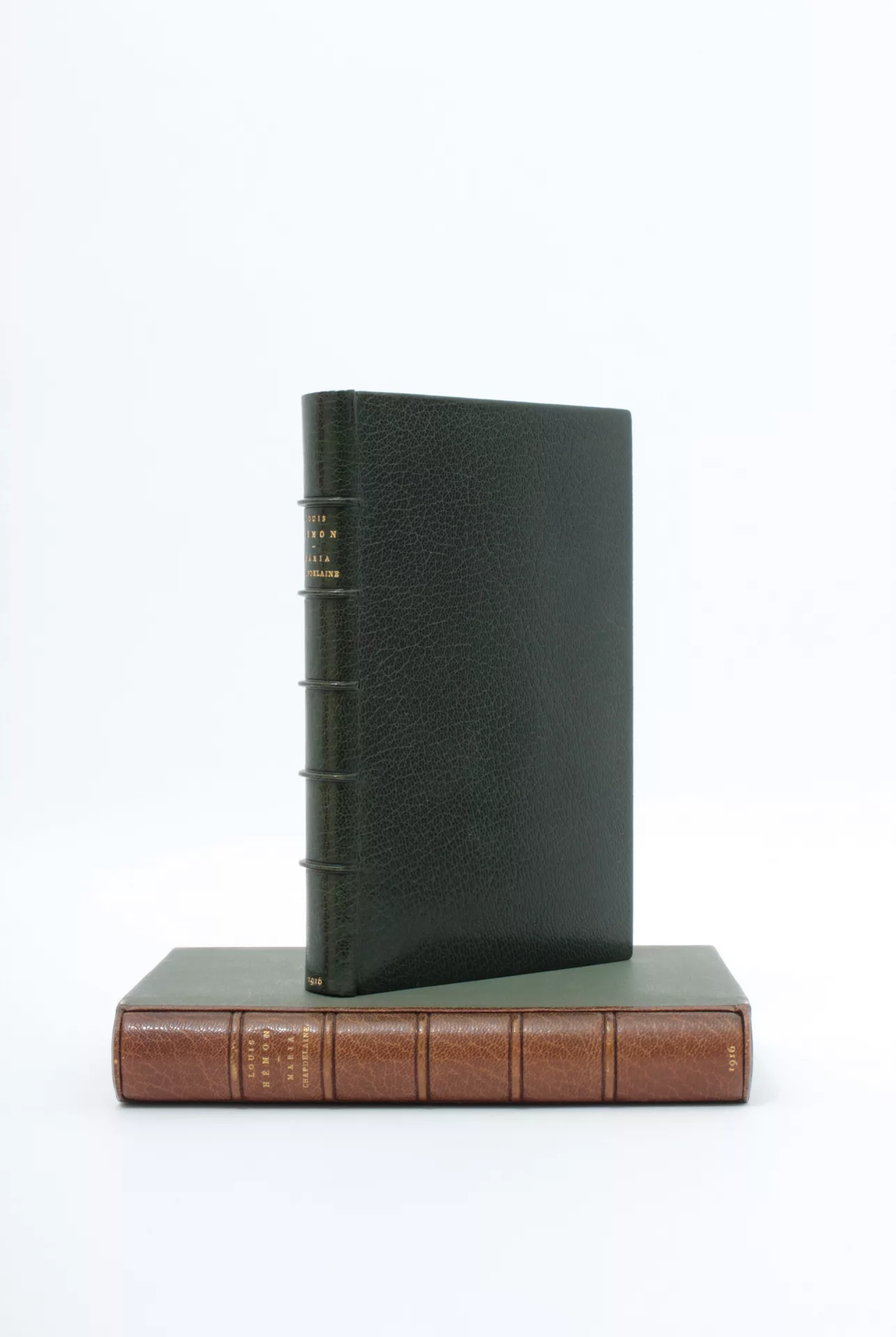
Maria Chapdelaine
The plot of Maria Chapdelaine, the celebrated masterpiece of the Québécois “roman de la terre,” was written by the Frenchman Louis Hémon. Hémon had sailed for Canada in 1911 and spent the winter in Montreal before walking to Lac Saint-Jean, settling in Péribonka, one of the smallest villages in the province of Quebec. There, a farmer, Samuel Bédard, hired him as a farmhand. His solitary musings and habit of taking notes earned him the nickname “Bédard’s madman,” and the following year he wrote Maria Chapdelaine. Back in Montreal that spring, he sought a secretarial position in order to have access to a typewriter, needed to prepare his manuscript: two copies were made, one for his sister in Paris, the other for the newspaper Le Temps, where he had begun his career, before setting off westward again for the harvest. He was struck and killed by a train at Chapleau, Ontario. He died at thirty-three, entirely unknown, and never learned the fate of his novel — a book structured throughout by scenes of meals on one hand and observations of the weather on the other, the Péribonka episodes unfolding under several meters of snow. It is also, above all, before Genevoix, Giono or Pourrat, a “roman du terroir” or novel of peasant manners, and the first of its kind.
Thanks to his sister and father, the novel was nonetheless able to appear as a serial in Le Temps, from 27 January to 19 February 1914, before being published in book form in 1916 by the Montreal publisher Joseph-Alphonse Lefebvre, with illustrations by the Québécois painter Aurèle Suzor-Coté. The edition was printed in 1,500 copies, divided between the booksellers Lefebvre, in Montreal, and Delagrave, in Paris. But the 500 copies intended for France, because of the war and the cost of shipping, were never delivered, and only a few copies crossed the Atlantic individually. The stock normally allotted to Delagrave was then entrusted to another Montreal bookseller, Garneau, who had his stamp applied to it. Our copy is one of these.
It was not until 1921, when Daniel Halévy launched the famous series “Les Cahiers verts,” that he inaugurated it with a new edition of this title: widely distributed, it turned Maria Chapdelaine into a genuine best-seller, perhaps the first of its kind: 600,000 copies were sold within a few months.
A splendid copy bound by Martin, no doubt one of the finest and most luxuriously executed.
Karin Becker, “Les repas frustes, mais harmonieux dans le ‘roman de la terre’ québécois Maria Chapdelaine de Louis Hémon,” Sociopoétiques, 3, 2018; Talvart et Place, VIII, 122; Carteret, IV, 199: “Très rare, recherché et coté.”
Chemise of the slipcase faded by light.
Otherwise faultless.