

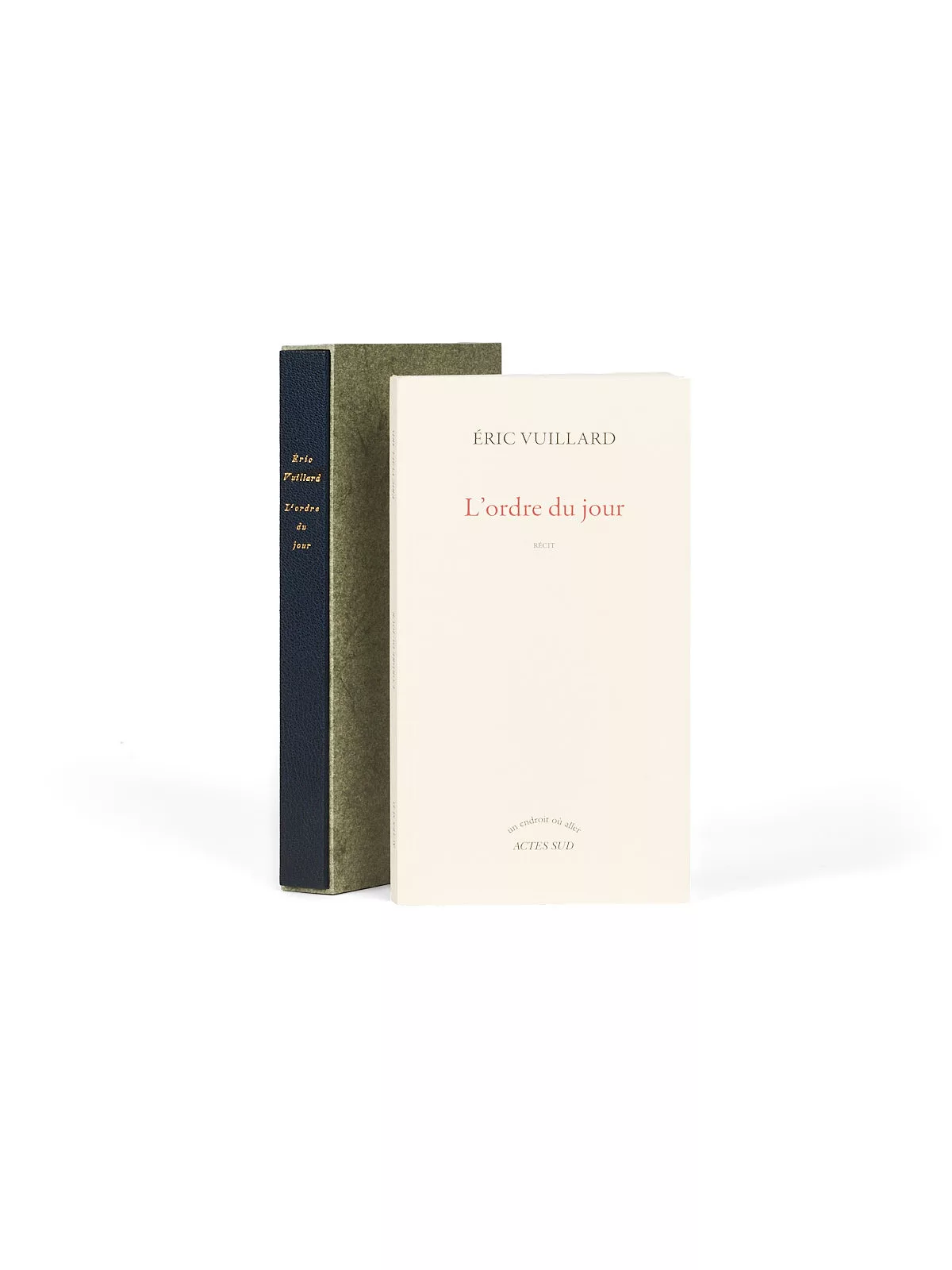
L’Ordre du jour
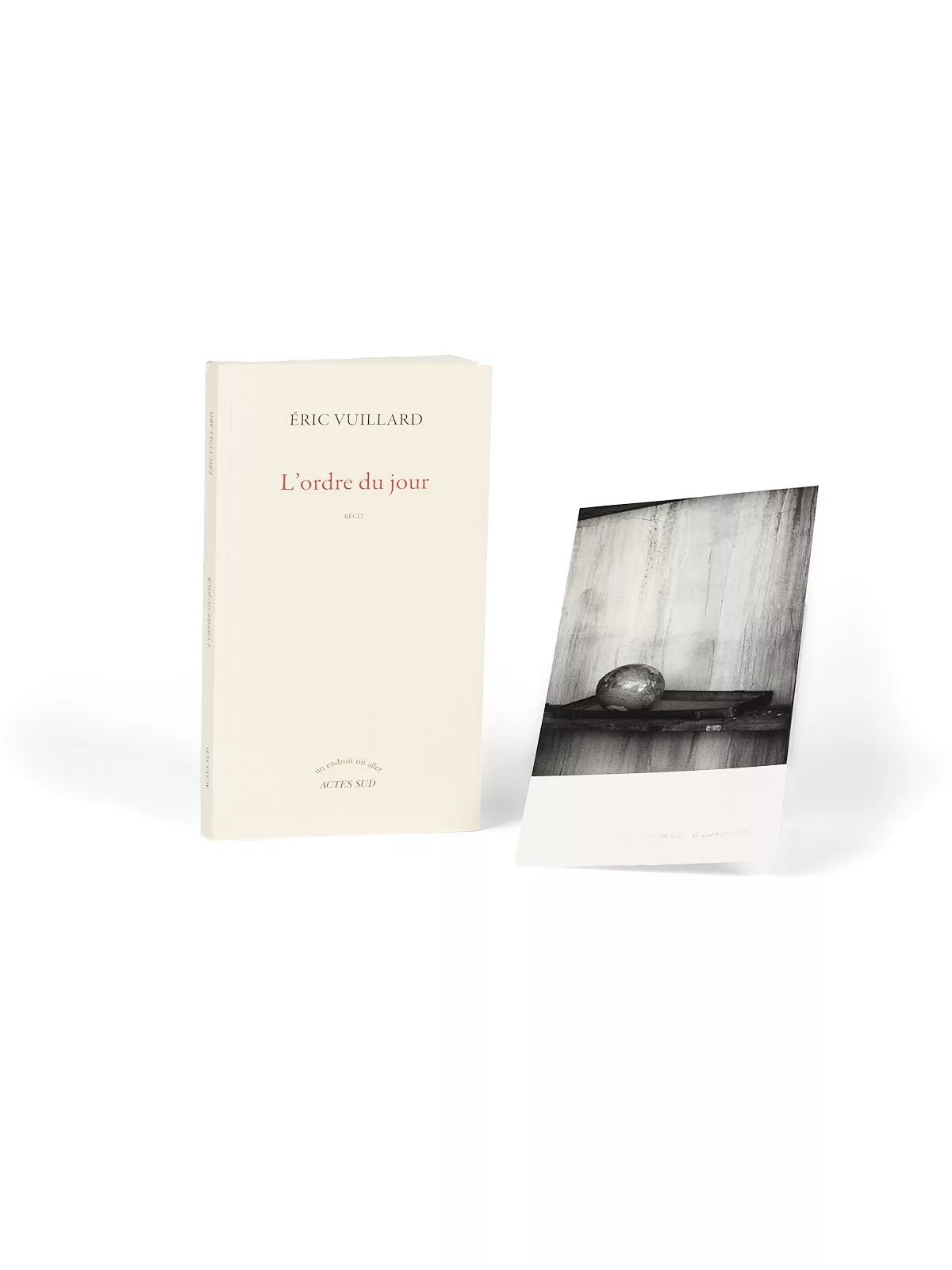
One of the first 60 copies on Rives paper. These copies are accompanied by an original signed photograph by Marc Blanchet (no. 57).
Éric Vuillard’s ninth book seemed to accumulate handicaps when it appeared among the finalists for the 2017 Prix Goncourt: it was a “récit,” not a novel, published moreover by the house that Françoise Nyssen — then Minister of Culture — had still been running only six months earlier, and it had appeared in May rather than during the autumn literary season (the last case of a “spring” book winning in November dated back to 1998, with Paule Constant’s Confidence pour confidence).
And yet. It was crowned on the third ballot, by six votes to four for Véronique Olmi’s excellent Bakhita, sweeping aside all the reservations and semi-tacit rules that might have kept it from the prize.
Its success owed chiefly to its narrative power: L’Ordre du jour is a book of startling force in its simplicity. In 160 pages, it shows how “the greatest catastrophes often announce themselves in small steps” and lifts “the hideous rags of history” to tell the story of Europe’s march toward the abyss through two moments. The first is that unique episode in the history of industrialists, an extraordinary compromise with the Nazis that was, for Krupp, Opel and Siemens, nothing more than an ordinary piece of business, a routine fundraising exercise — all of whom would survive the regime and go on to finance many parties in proportion to their profits, the author writes, caustically. The second is the Anschluss, the annexation of Austria by Germany on 12 March 1938 — another fundraising exercise, so to speak, heralding the brown wave about to engulf Europe.
Fine condition.