

Long Live Man
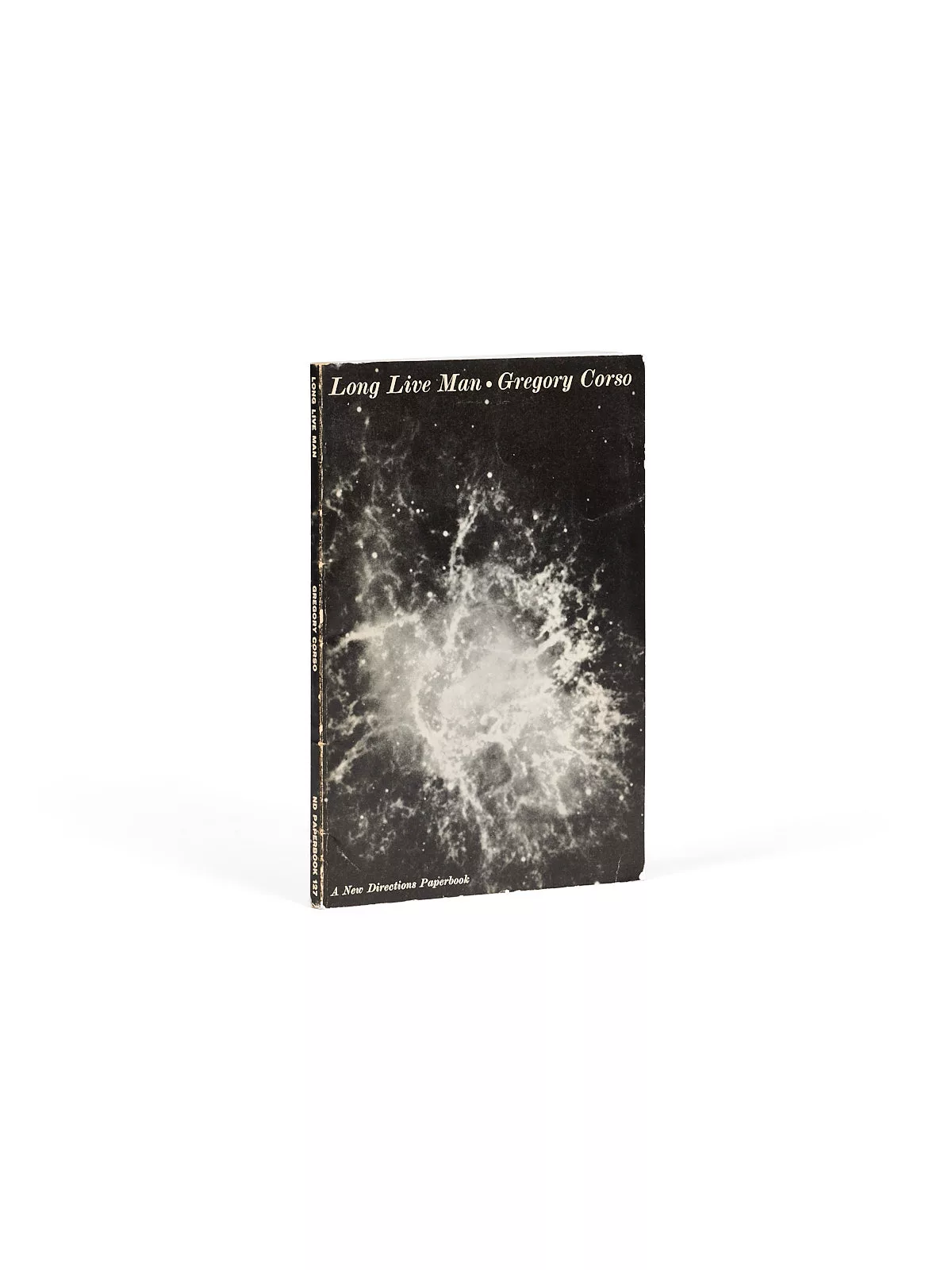
First edition, first printing [5,000 copies].
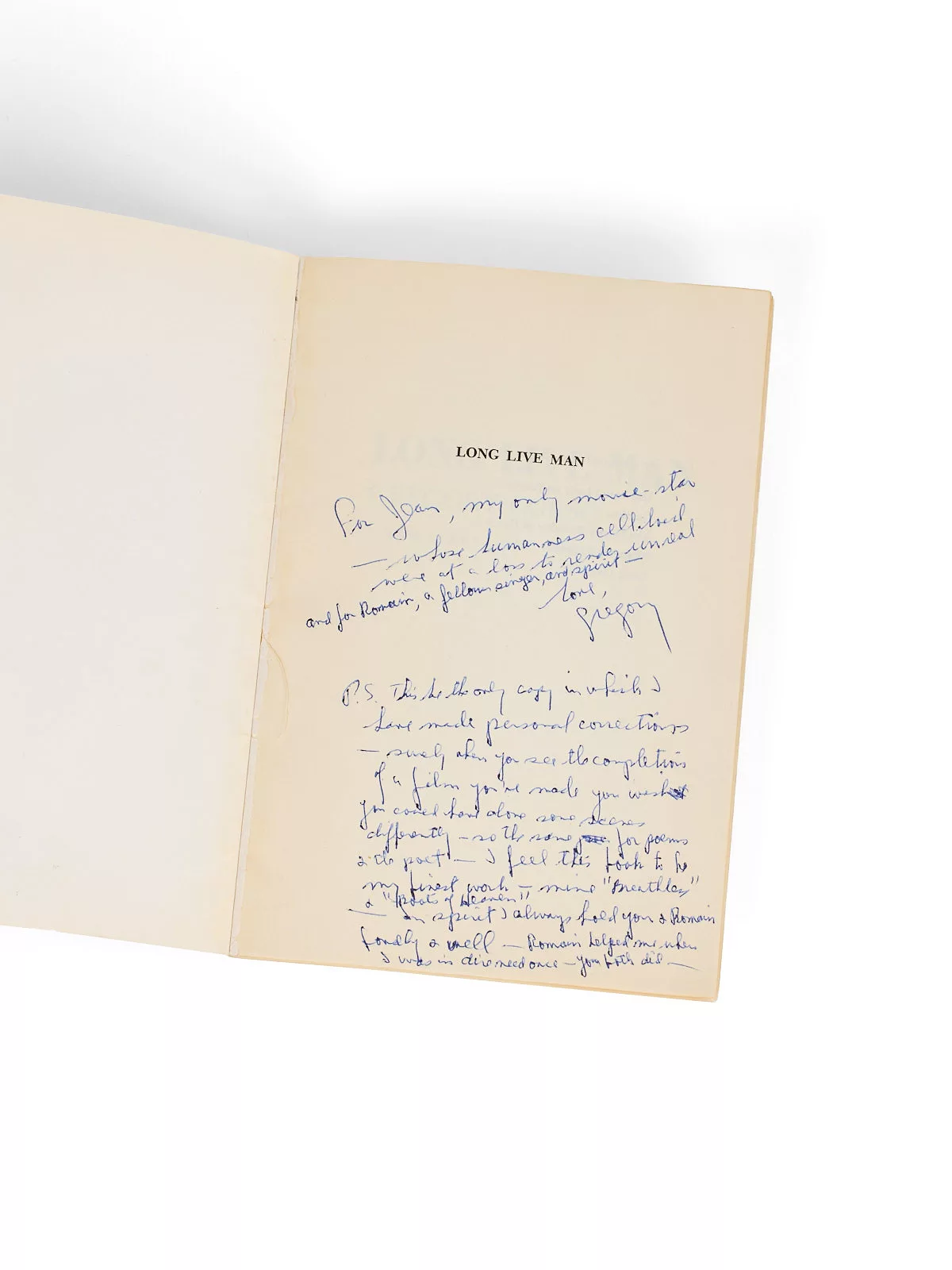
Signed presentation inscription: “For Jean, my only movie-star – whose humanness celluloid were at a loss to render unreal and for Romain, a fellow singer, and spirit – love, Gregory
P.S. This be the only copy in which I have made personal corrections – surely when you see the completions of a film you've made you wish Jean could have done some scenes differently – so the same for poems and the poet – I feel this book to be my finest work – mine “Breathley” & “Roots of Heaven”– In spirit I always hold you & Romain fondly & well – Romain helped me when I was in dire need once - you both did.”
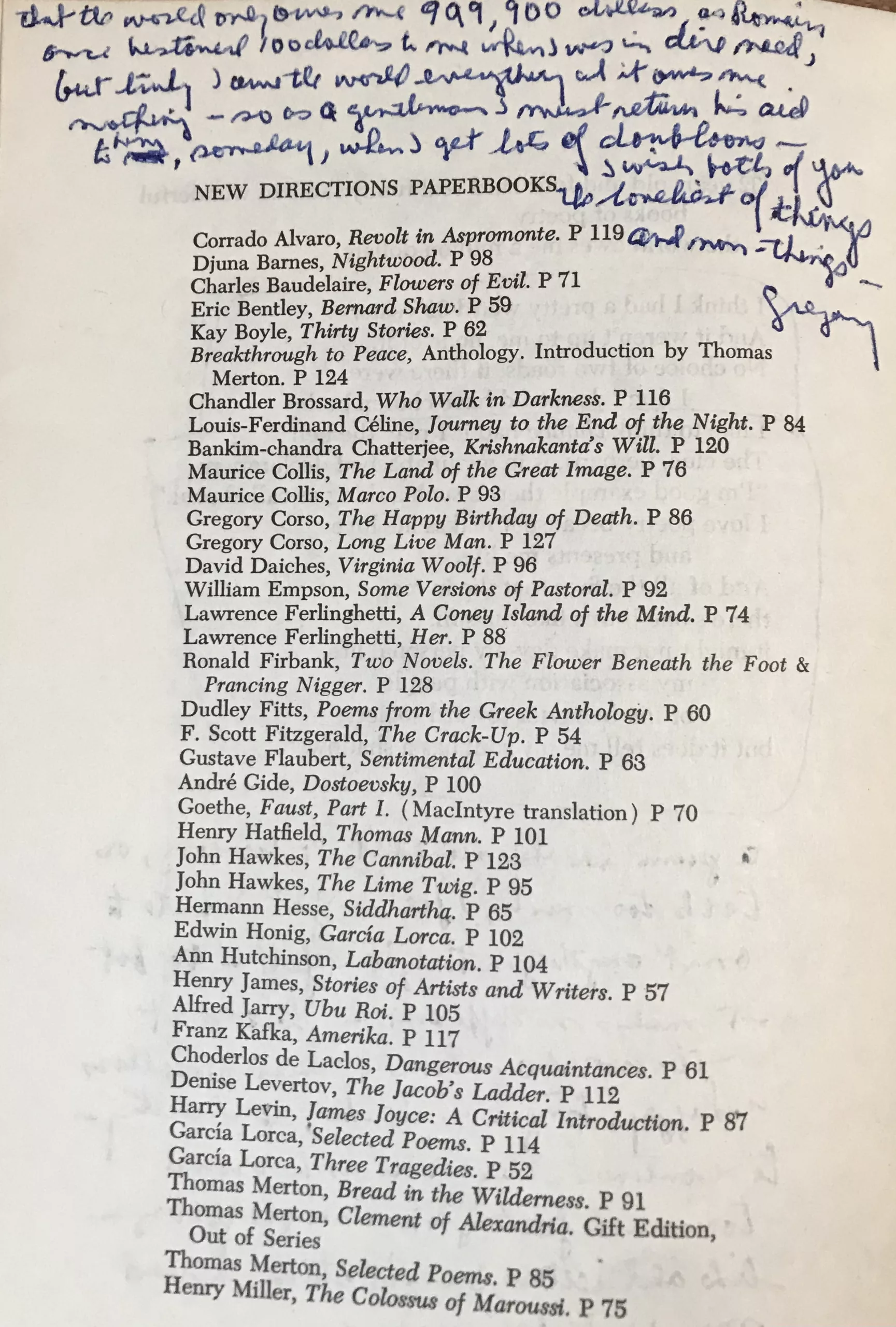
This inscription is accompanied by a long note written after the last poem of the collection, “Writ on the eve of my 32nd birthday”:
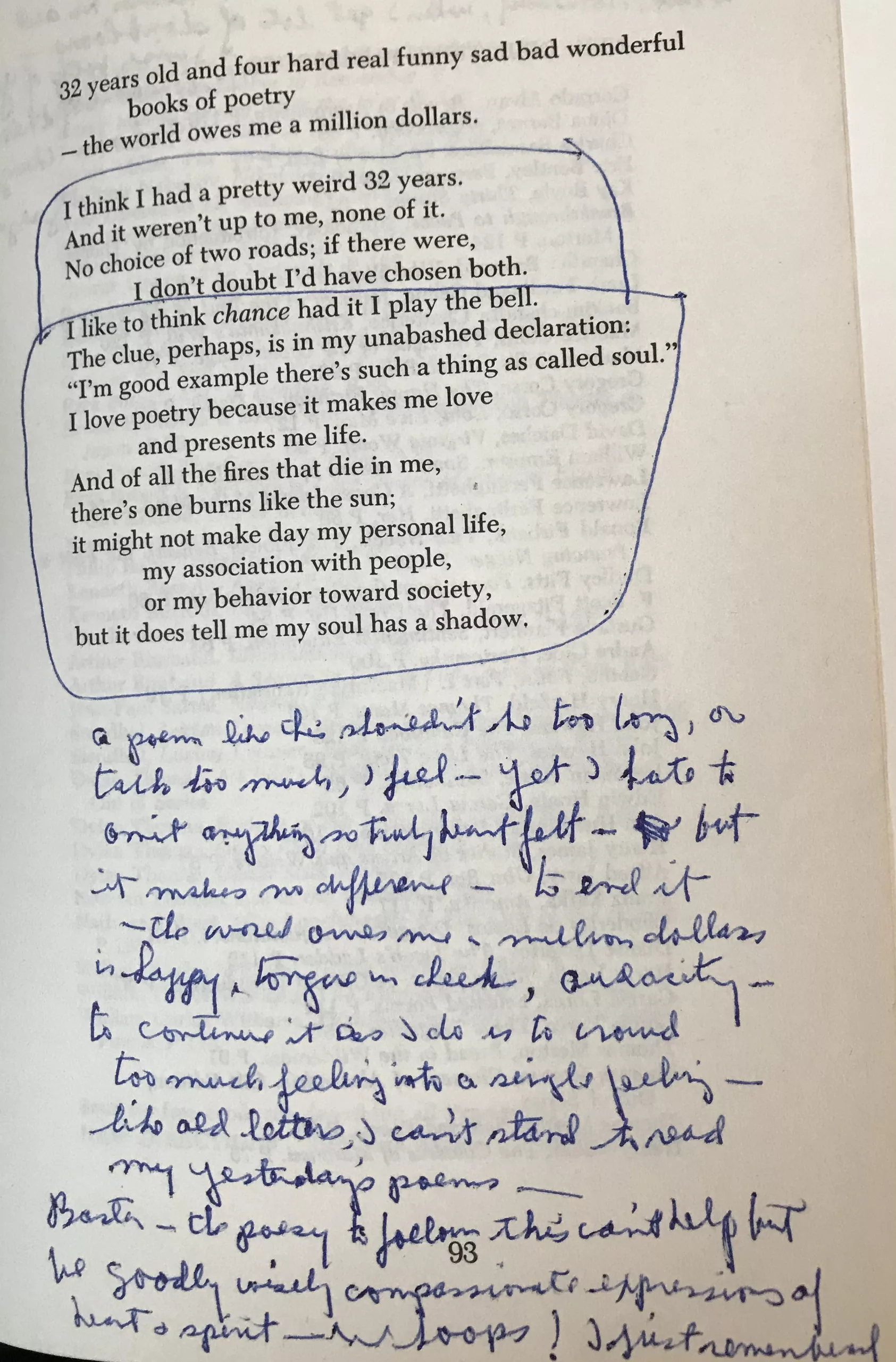
“a poem like this shouldn't be too long, or talk too much, I feel – yet I hate to omit anything so truly heartfelt – but it makes no difference – to end it – the world owes me – a million dollars is happy. Tongue in cheek, audacity – to continue it d(?) I do is to crowd too much feeling into a single poetry – like old letters, I can't stand to read my yesterday's poems – Basta – the poesy to follow this can't help but be goodly wisely compassionate expressions heart and spirit – whoops! I just remembered that the world only owes me 999,900 dollars as Romain once bestowed 100 dollars to me when I was in dire need, but truly I owe the world everything and it owes me nothing – so as a gentleman I must return his aid to him, someday, when I get lots of doubloons - I wish both of you the loneliest of things and non-things – Gregory.”
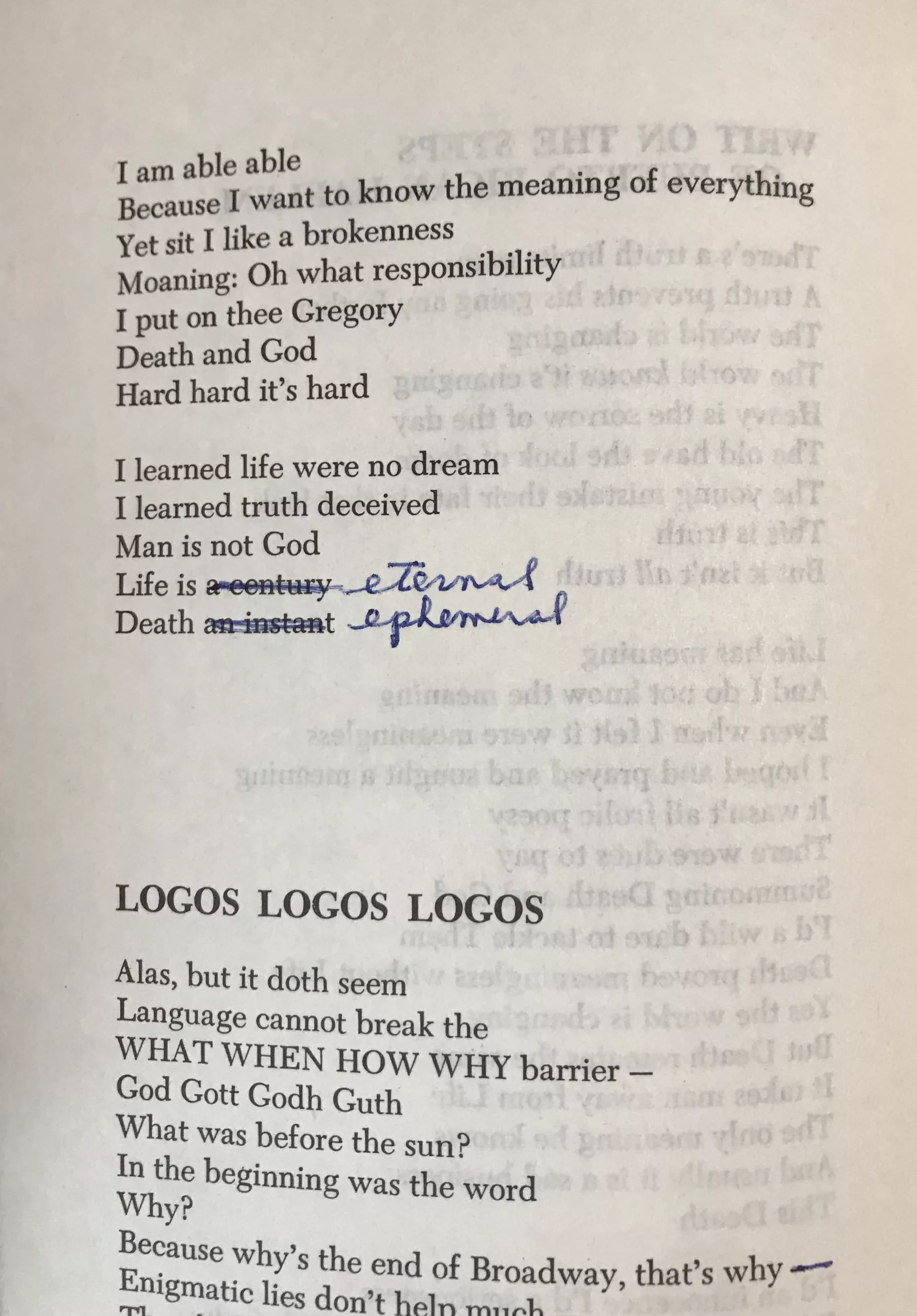
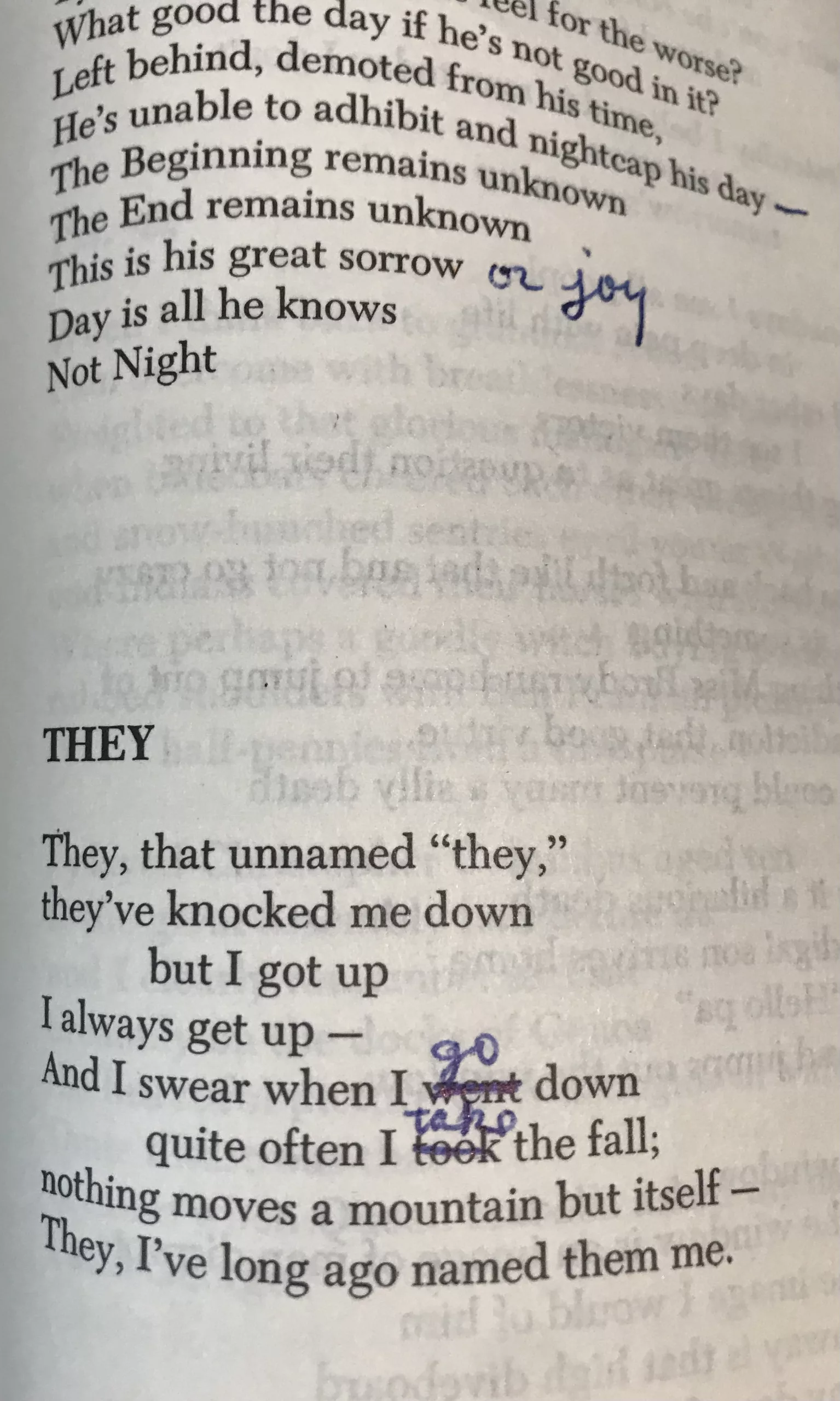
Autograph corrections and additions to 7 poems:
p. 58: two stanzas circled with the note “omit”
p. 66 and 67: corrections and variants for the poem “Man Enterring the Sea, Tanger”
p. 73: one addition to the poem “A Race of Sound”
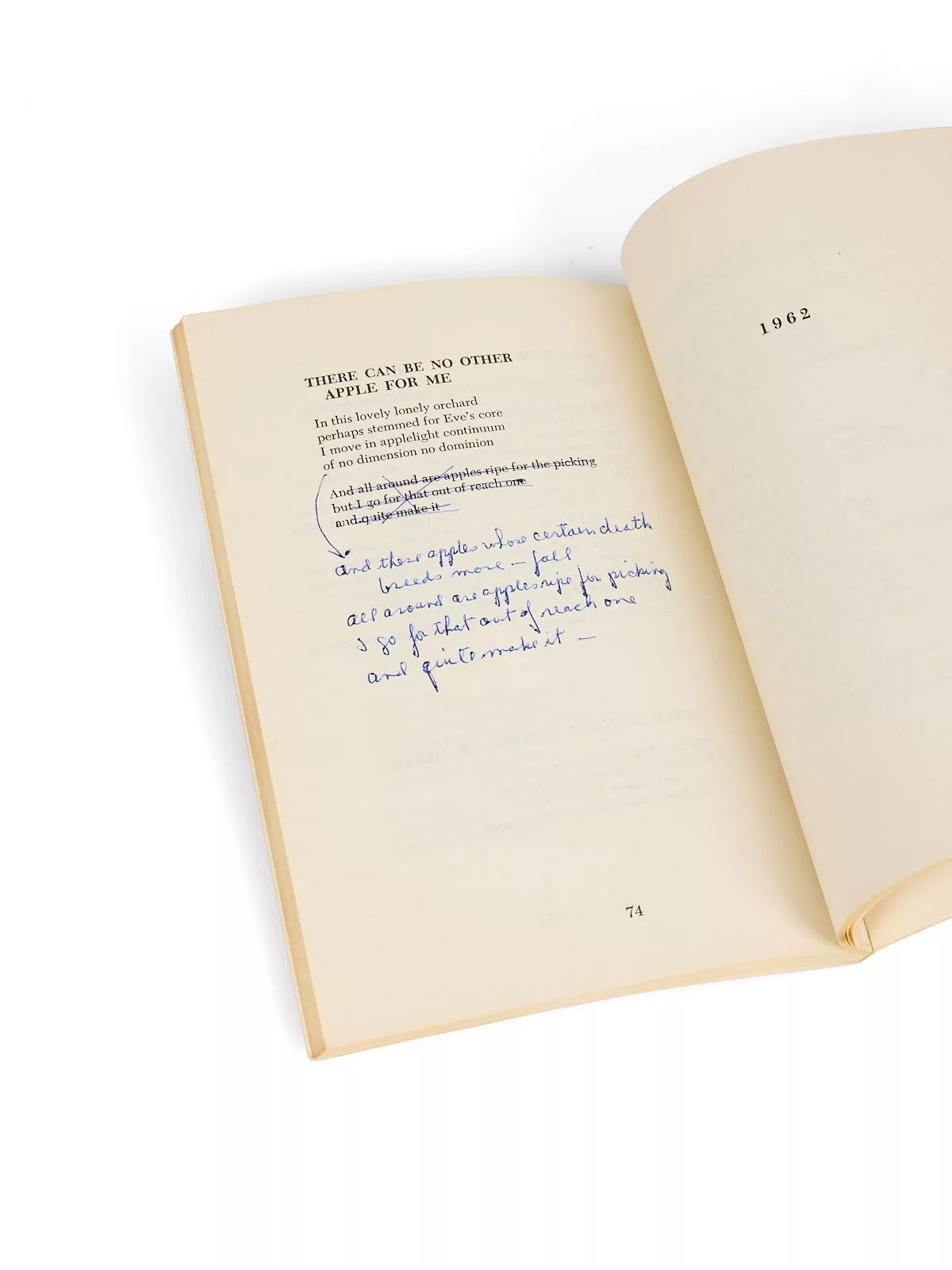
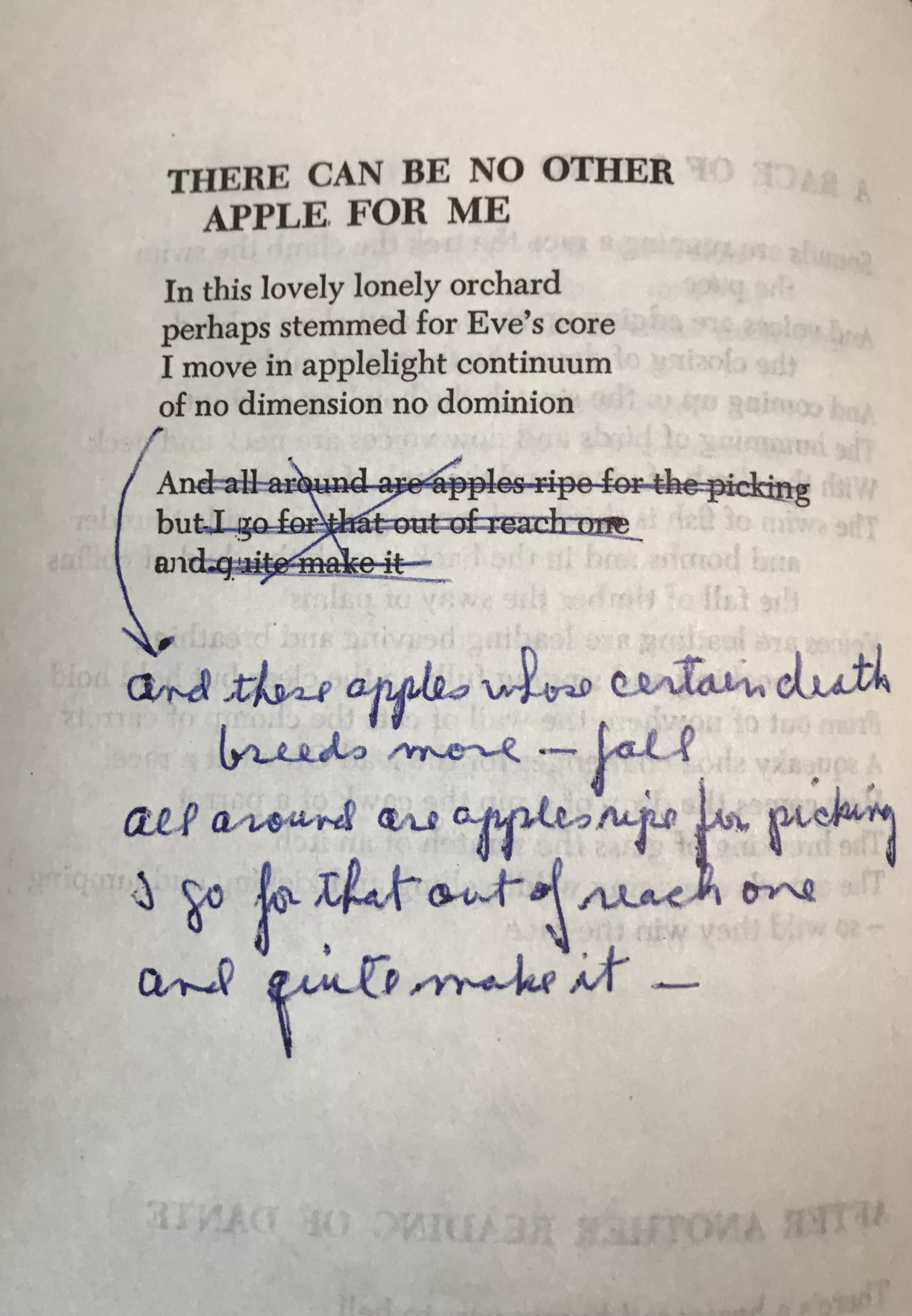
p. 74: one added stanza to the poem “There can be no other apple for me”
p. 78: two variants to the poem “Writ on the Steppes of Puerto Rican Harlem”
p. 83: two variants to the poems “A City Child's Day” and “They”
p. 87: one variant to the poem “P.S. 42”
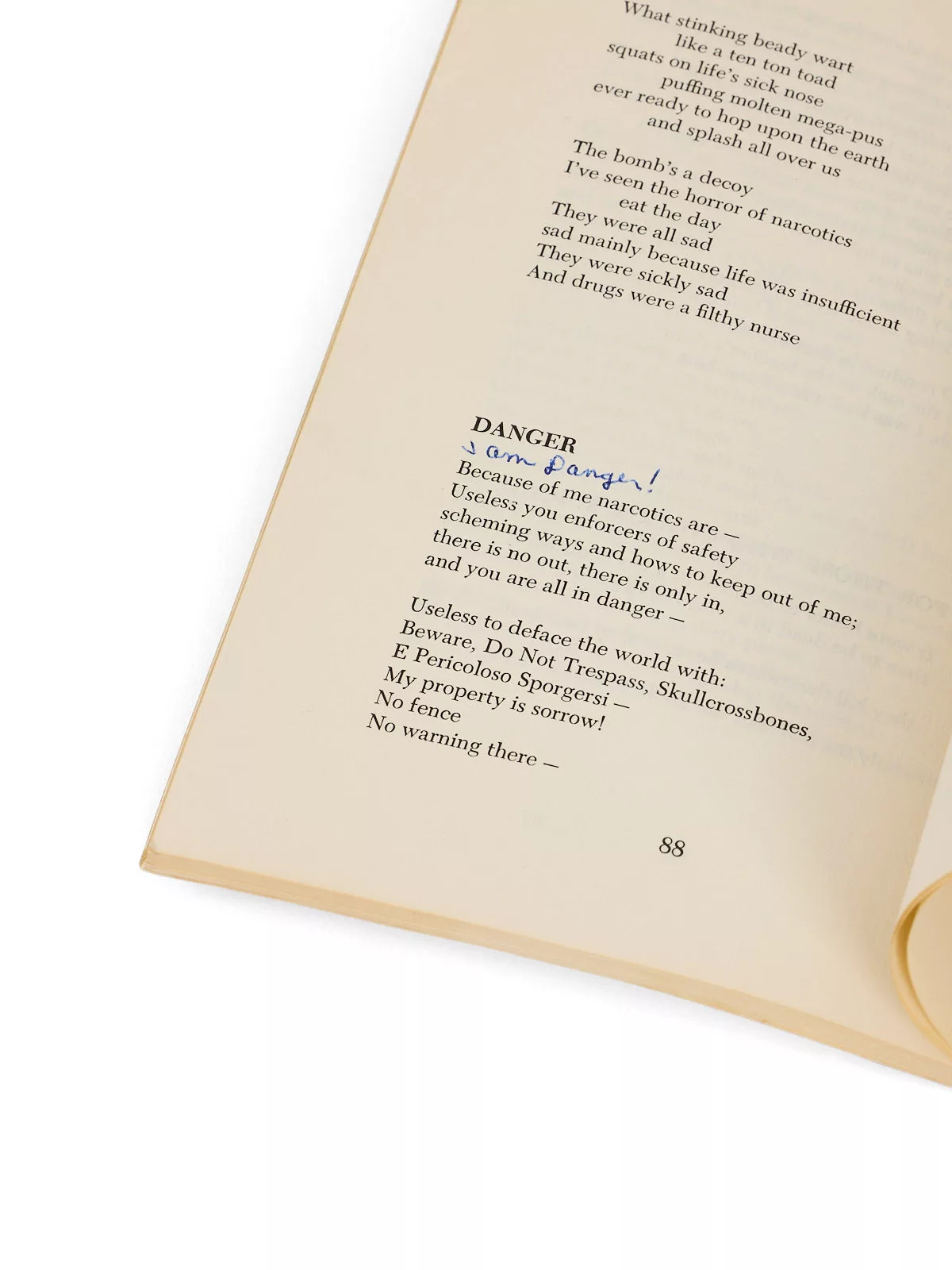
p. 88: one addition to the poem “Danger”
p. 89: one stanza circled with the note “omit” for the poem “After Reading in the Clearing”
p. 93: note transcribed above.
From the library of Romain Gary and Jean Seberg.
Long Live Man appeared in New Directions’ legendary poetry anthology series. Two years earlier, The Happy Birthday of Death had gathered Corso’s early poems, including the celebrated “Bomb.” Founded by James Laughlin in 1936, New Directions (ND) was created to support unknown and daring writers and poets; the house soon expanded into fiction, drama and more. Its catalogue today includes many of the great names of world literature who at last found a publisher willing to champion them: Ezra Pound, Dylan Thomas, Tennessee Williams…
By 1960, three major figures of the Beat Generation had already published with Laughlin: Kerouac had just brought out the celebrated Visions of Cody (December 1959); Ginsberg had joined the “Prose and Poetry” series as early as 1953; and in 1961 the three Beat poets appeared together in no. 17 of that same series.
By the time this Corso collection appeared, four of the leading Beat poets had already published their major works: On the Road (Kerouac), Howl (Ginsberg), Bomb (Corso) and The Naked Lunch (Burroughs). Gregory Corso, the last to join the group, had become one of its most prominent spokesmen. Yet when he inscribed this copy to Jean Seberg and Romain Gary, he was recalling a very different period of his life. The material help he mentions twice here was almost certainly no small matter to him: Corso’s circumstances in the 1950s bore little resemblance to those of Gary, a recognized diplomat and writer married to a Hollywood star.
Corso was a true New Yorker, born in 1930 in the heart of Greenwich Village, above a morgue at the corner of Bleecker and MacDougal, then part of Little Italy. He had no memory of his mother, who was barely sixteen when she had him. Abandoned at birth, with a father scarcely older who could not raise him, he was shuttled through no fewer than eight foster homes within a few years. The hardships of his childhood and adolescence led him to the notorious Tombs prison, and later, at seventeen, following a burglary, to Clinton Correctional Facility at Dannemora, near New York. It was there that he discovered literature and poetry. Shortly after his release, having found work and committed himself to poetry, he met Allen Ginsberg, who later recalled the care Corso had taken with the poems he showed him: “all of them typed, unusual for a boy living in the Village who called himself a poet.” Ginsberg introduced him to Kerouac. Corso then took part in every gathering, trip and event of the group, and became part of the legendary circle installed in Paris at a small hotel at 9 rue Gît-le-Cœur. This shabby establishment, with its 42 rooms occupied almost exclusively by foreign artists, had no name of its own, but it would be remembered as the Beat Hotel, a name Corso himself coined at the time (a commemorative plaque has since been placed on the building, now the Relais Hôtel Vieux Paris).
Whether it was in Paris or in California that Corso met Seberg and crossed paths with Gary is difficult to establish, but Gary is known to have traveled constantly between Europe and the United States between 1950 and 1960, following Seberg’s film work on both continents.
During his years in Los Angeles, Gary witnessed the rise of these countercultural movements and took a close interest in them. His assessment of the author of On the Road was perceptive: “He was a prophet, Kerouac. He was the first and only one to predict, fifteen years in advance, the America of the hippies, an America engaged in a desperate spiritual quest, beginning with marijuana and ending with heroin.” (La nuit sera calme).
Though he could be ironic about these “lost young Americans,” Gary clearly did not confuse Corso with one of them, and it is easy to imagine him coming to Corso’s aid. Passages from Chien blanc recall what Gary himself experienced at the time, both in his Paris apartment on rue du Bac and in his Los Angeles house, often given over to endless Black Panther meetings hosted by his wife: “Seberg spends her time giving our address to every lost young American who believes Atlantis exists, which explains why I once found six beatniks asleep in sleeping bags in our apartment on rue du Bac. One of them had had our address for four years, and had shared it with friends.”
Tough Poets Press has recently published a collection of Corso’s works, reminding readers that he was a major, founding figure in the movement launched by Kerouac, not merely a follower.
This copy is almost certainly the only surviving evidence of Romain Gary’s encounter with one of the leading figures of the Beat Generation.
From the library of Romain Gary and Jean Seberg.