

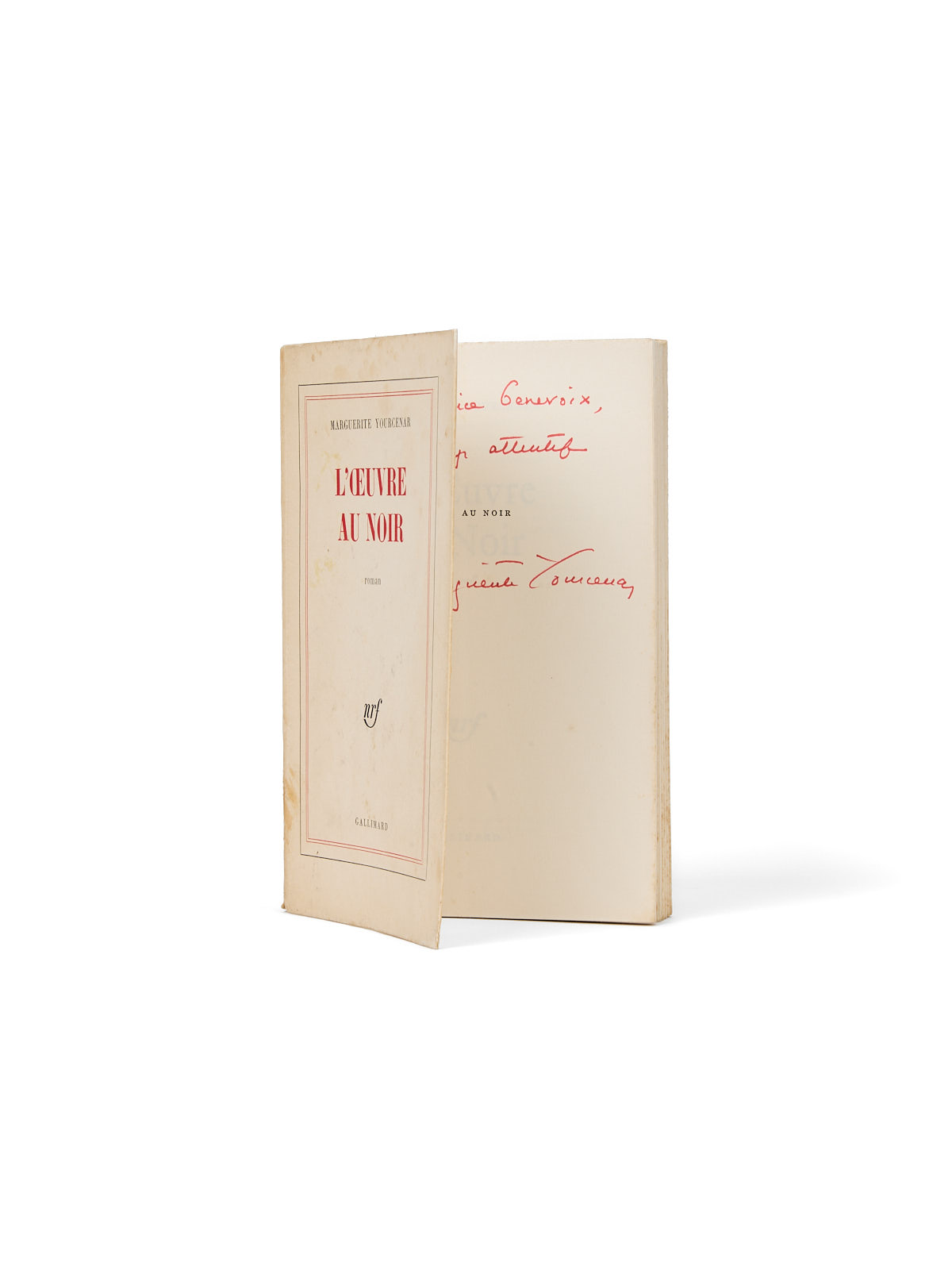
L’OEuvre au noir
One of the copies stamped as review copies.
Presentation copy inscribed by the author to Maurice Genevoix: “à Maurice Genevoix, hommage attentif. Marguerite Yourcenar.”
The cover shows, over the NRF logo, red ballpoint pen highlights of the kind Maurice Genevoix habitually made.
Awarded the Prix Femina unanimously, the novel achieved considerable public success from the year of its publication. “The phrase ‘L’Œuvre au noir,’ used as the title of this book, designates in alchemical treatises the phase of separation and dissolution of matter, said to be the most difficult stage of the Great Work. It is still debated whether this expression applied to bold experiments on matter itself, or was to be understood symbolically as the trials of a mind freeing itself from routine and prejudice. No doubt it meant, by turns or at once, both.”
L’Œuvre au noir centers on Zénon, a physician, philosopher, alchemist and free thinker in sixteenth-century Flanders, a figure at once Promethean and Stoic. Embracing his era without lapsing into anachronism, Yourcenar composed a historical and existential meditation, nourished by encyclopedic learning and a prose style of great purity.
Maurice Genevoix (born 1890) and Marguerite Yourcenar (born 1903) shared several essential traits: a lucid humanism, a demanding style and a deep commitment to the transmission of memory. At the time the novel appeared, Genevoix had been Permanent Secretary of the Académie française for ten years. Marguerite Yourcenar would join him there on 6 March 1980, in the seat once held by Roger Caillois (no. 3), a historic turning point: never before had a woman been received under the Coupole. She had previously received, in 1976, the Académie’s grand prix de littérature for her body of work. Three years later, Jean d’Ormesson formally approached Yourcenar to propose that she join the Forty. She replied to him on 22 October 1979: “[…] since I am not obliged to put myself forward as a candidate, which I instinctively find distasteful, all the more so because my being a woman makes the gesture seem even more conspicuous, and since I am also not obliged to maintain a fixed residence in Paris, even for part of the year, nothing would certainly make me refuse the honor you so generously wish for me. To do so would seem to me an insult to more than three centuries of French literary history.”
It should be noted that Yourcenar was first elected to the Académie royale de Langue et de Littérature françaises de Belgique, received on 27 March 1971, before a packed hall and in the presence of Queen Fabiola. Maurice Genevoix was present: the Permanent Secretary of the Académie française had come to award the Prix Habif, the Grand Prix de littérature française hors de France, to the Canadian writer Anne Hébert.