

L’Inde (sans les Anglais)
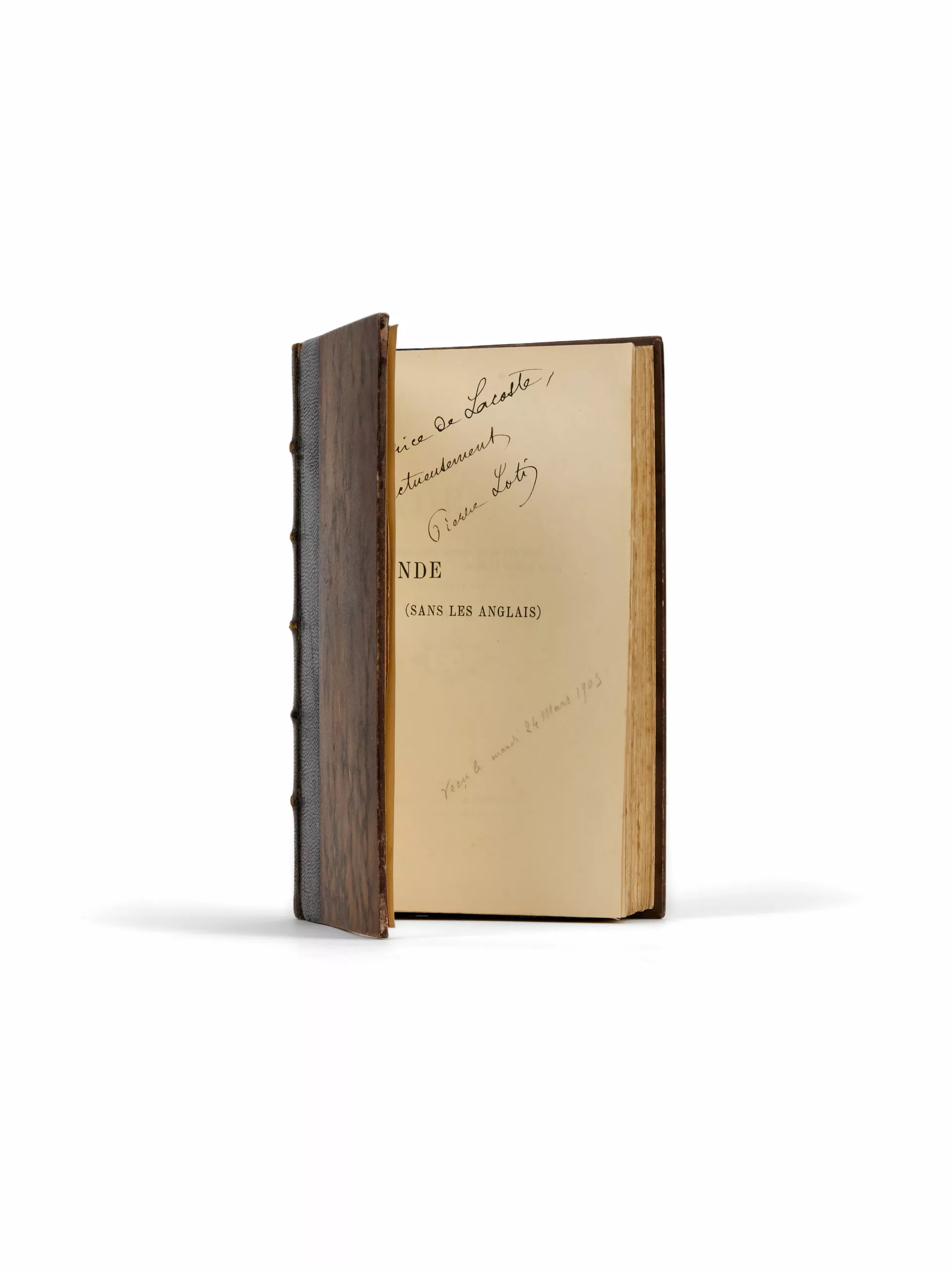
Presentation copy inscribed by Loti to Maurice de Lacoste: “à Maurice de Lacoste, bien affectueusement, Pierre Loti.” The latter noted on the presentation leaf “reçu le mardi 24 mars 1903.”
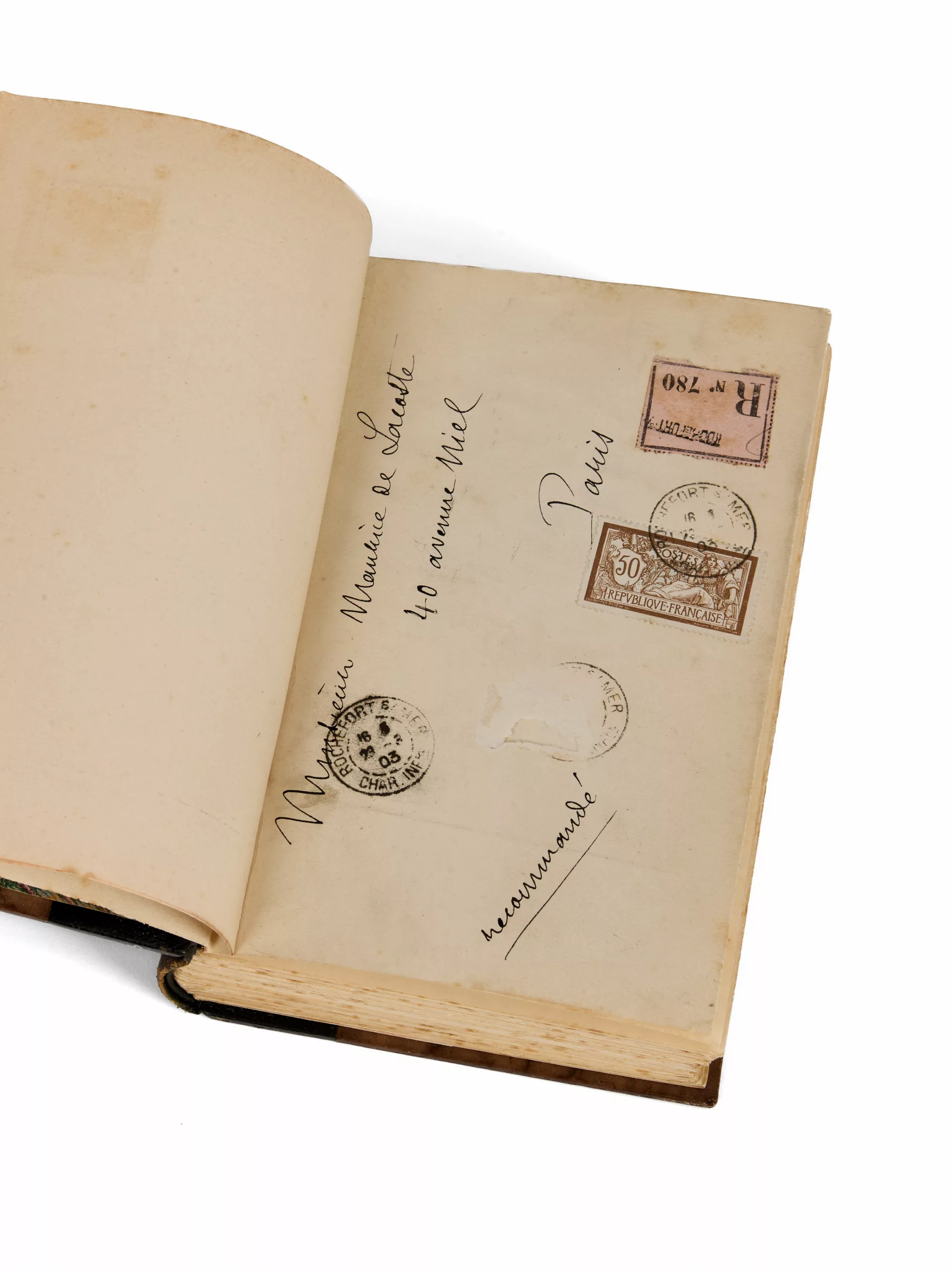
Mounted at front: one registered-mail envelope addressed to “Monsieur Maurice de Lacoste, 40 avenue Niel / Paris.”
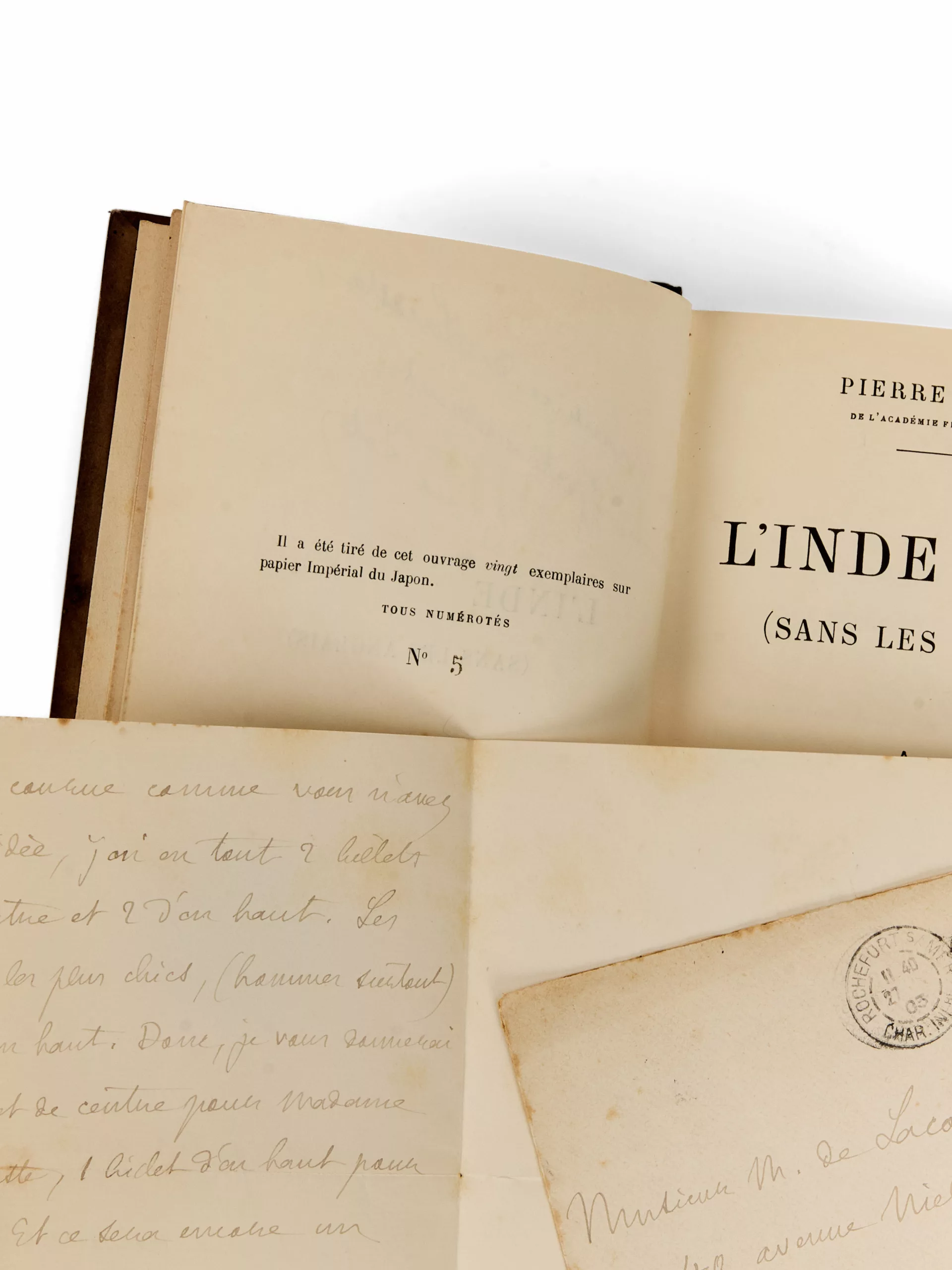
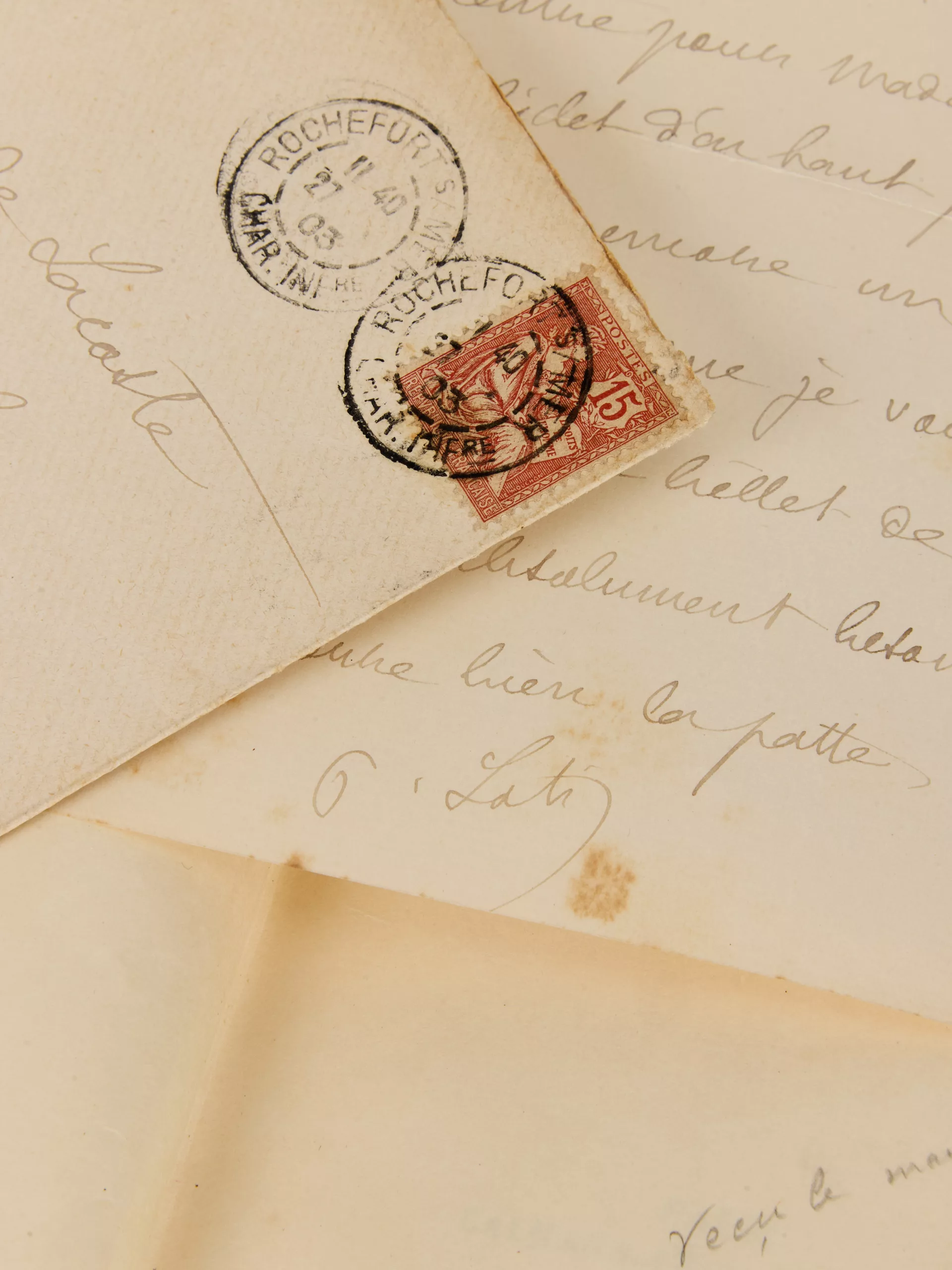
Preserved with the copy: an autograph letter signed to the same, with its envelope preserved:
“My dear friend, You must be reasonable. I am very kind to you, am I not? I gave you a fine edition of L’Inde. For Rostand’s reception, which will be attended as you cannot imagine, I have in all 2 center tickets and 2 upper tickets. The smartest people (men especially) sit upstairs. So, I will give you 1 center ticket for Madame de Lacoste, and 1 upper ticket for you. And that will still be a magnificent gift on my part. My other center ticket, I absolutely need it myself. I shake your paw warmly. P. Loti.”
Written on returning from a long journey (December 1899 – spring 1900), L’Inde (sans les Anglais) is one of Loti’s most personal travel narratives: a sequence of “tableaux” combining lyrical contemplation with a stark observation of poverty and crowds. Pre-published in installments in La Revue des Deux Mondes, the work appeared in book form in 1903 with Calmann-Lévy, its author adopting the deliberate stance — “without the English” — of favoring direct contact with native sites, rites and towns, from Mahé to Pondicherry and on to major places of pilgrimage.
The copy is of great interest for its dedicatee: presented to his friend Maurice de Lacoste in March 1903, the latter, to thank him further, asked the Academician Loti for seats to an event that, three months before it took place, was already the talk of Paris: the reception of Edmond Rostand under the dome.
Elected to the Académie française in 1901, Rostand was received on Thursday, 4 June 1903; the session, marked by unusual fervor, gave rise the very next day to an enthusiastic account in the press:
“It was rather like the premiere of Cyrano!… Such youthful enthusiasm had never been seen,” exclaimed Le Figaro in its edition of 5 June 1903. Indeed, the recipient’s speech was interrupted at every moment by lengthy ovations. The Institut, according to Le Figaro, felt rejuvenated by the poet’s early arrival — he was only thirty-five. The dome was filled with a brilliant audience: men of letters, diplomats, artists, the actor Coquelin and the illustrious actress Sarah Bernhardt: “When she was not applauding, in order to listen, she rejoiced, and with the head of her feathered hat she beat time, marked the rhythm of the fine sentences and confirmed the impeccable accuracy of the diction.” Rostand himself testified to this fervor: “No, I had never entered the Institut before. My reception is the first I have ever attended. That great hall frightened me. I was also afraid of not being heard. What if my voice failed me? What if the acoustics were poor? Above all I was afraid of the audience. Who were they, this audience? Academicians, scholars, serious men, society people, women… An audience not very demonstrative at the theater. So, what if the reading of my speech went on in silence and coldness?… Well, no! I was wrong. This audience is charming, truly charming, you know, warm, alive, quick to understand and to underline, and which understands everything and underlines it with marvelous ardor. A true dress-rehearsal audience, in which I immediately recognized sympathy, and which put me at ease, and which gave me, from the very first, by applauding kindly at my entrance, the delightful sensation of finding myself among friends, ready to grow enthusiastic, and more inclined to exaggerate their satisfaction than to show displeasure. And that revived me at once, and I then clearly saw that I had been wrong to be so afraid.”
The small society scene sketched by Loti in his letter — the tight negotiation over “center” and “upper” tickets — fits well with this moment of triumph and the scarcity of seats to witness it. Having only four seats at his disposal, he nonetheless agreed to give up two to his friend Maurice de Lacoste.
Born in Metz in 1864, Lacoste entered the naval academy in 1882, fifteen years after Loti. A first-class midshipman in October 1885, he was first posted to the Far East naval division. It was during these early voyages that he met Pierre Loti, who had been sailing those seas since the same year aboard the Mytho, one of the eleven official transport vessels of the naval forces in the Far East. It was aboard this ship, during a month-long crossing, that Loti wrote part of the manuscript of Pêcheur d’Islande.
Lacoste was promoted to ensign in October 1887, serving aboard numerous vessels of the French Navy. Promoted to lieutenant in October 1893, he was successively assigned to several battleships and then cruisers, the spearheads and most powerful warships of the era. He was later assigned to the central directorate of naval artillery, then became a frigate captain before being posted to the general staff in 1909.
A fine copy.