


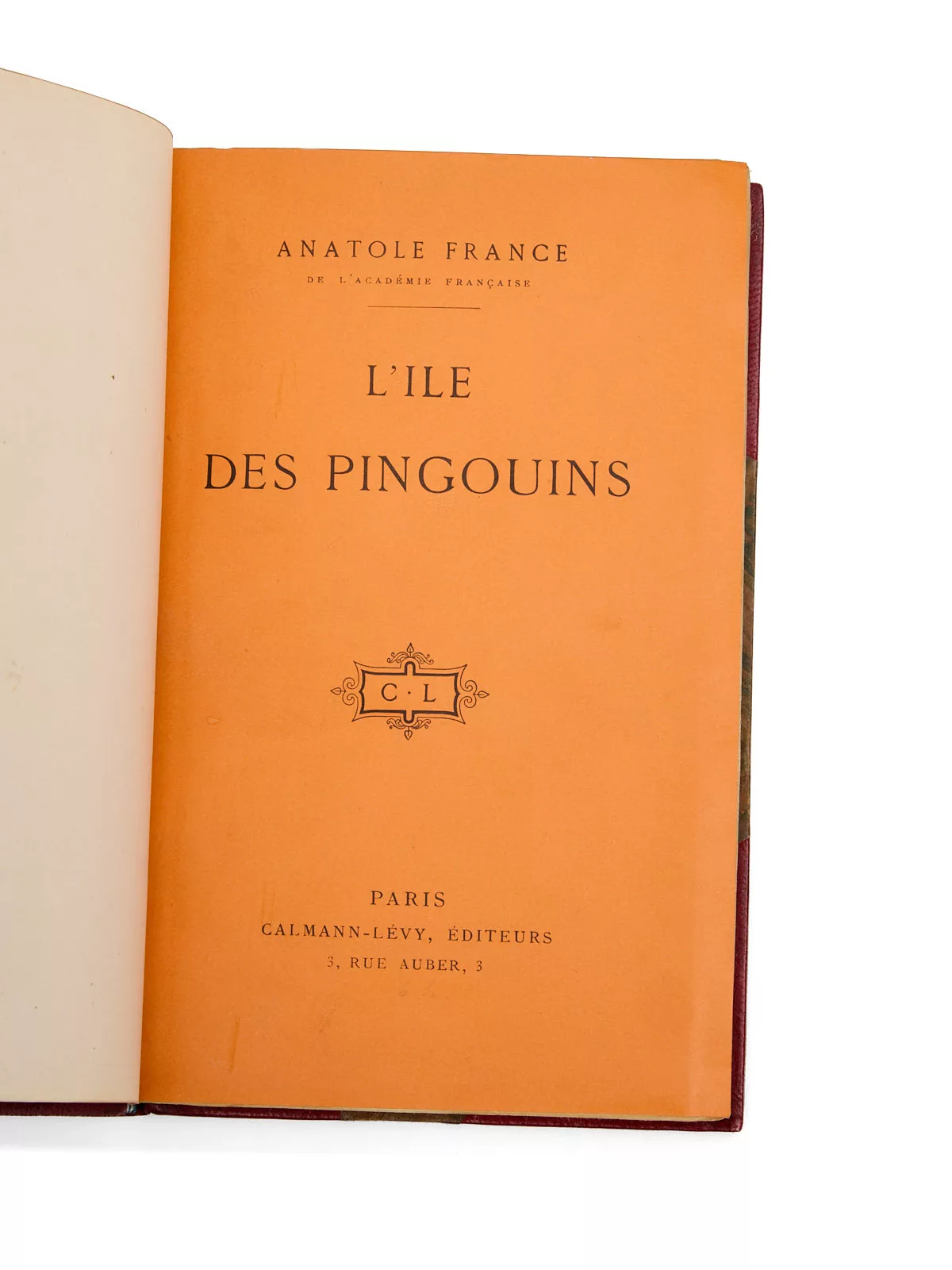
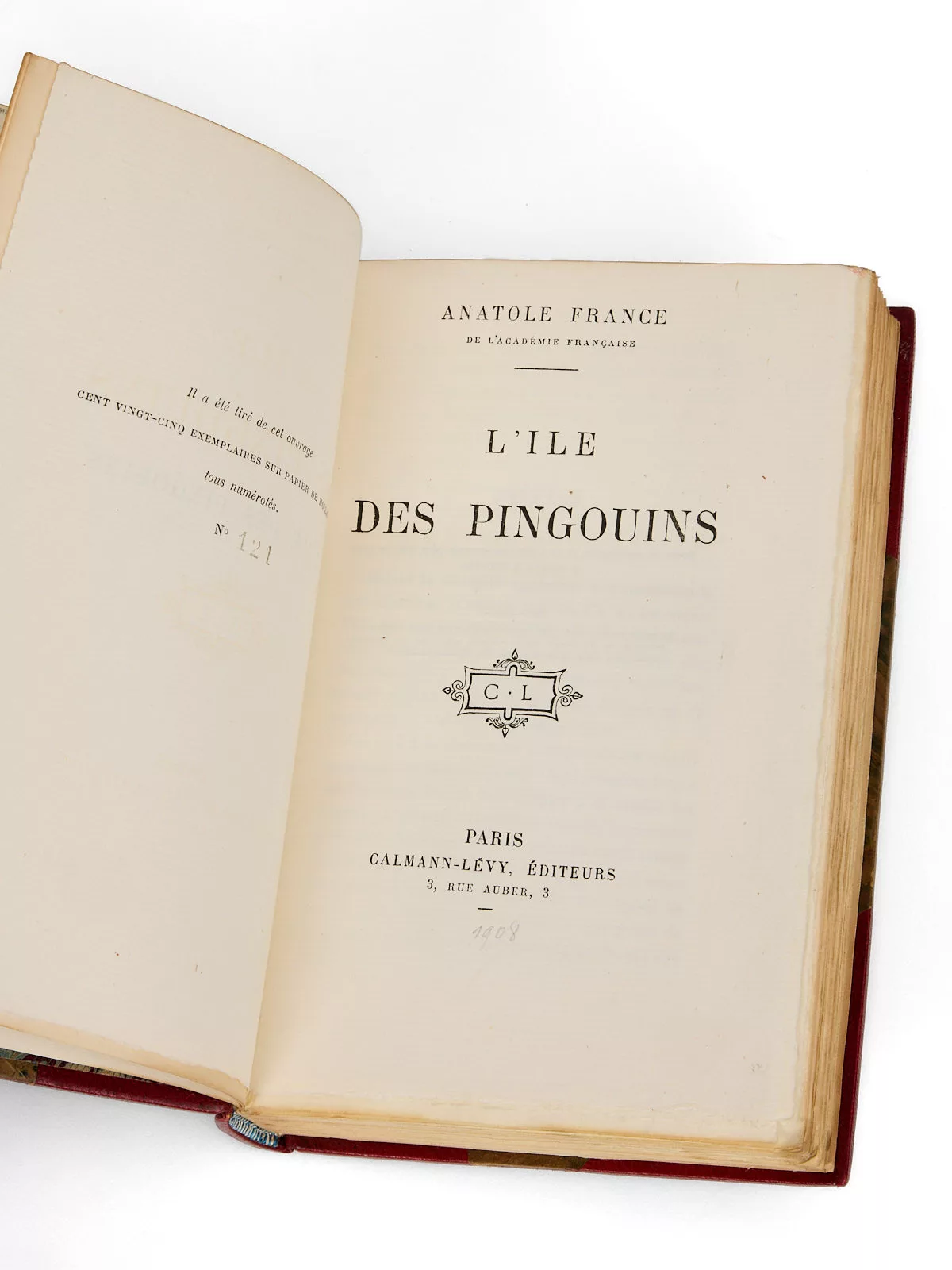
L’Ile des pingouins
One of 125 copies on Hollande paper (no. 121).
Published in the autumn of 1908, Penguin Island holds a singular place in Anatole France’s work and stands as one of the most far-reaching historical satires ever devoted to modern France.
The premise is famous: a shortsighted saint, Maël, evangelizing the northern lands, mistakenly baptizes a colony of penguins, taking them for men. To avoid the theological scandal, God transforms the penguins into humans. From this absurd premise, France traces the entire history of their civilization — antiquity, feudalism, monarchy, revolution, republic, capitalism — as a transparent mirror of French history.
Book VI, “Modern Times,” contains the episode of the “Pyrot affair,” a barely veiled allegory of the Dreyfus Affair, of which Anatole France was one of the most steadfast intellectual defenders. But it is above all in the final books that the novel takes on a strikingly prospective dimension, where Anatole France describes a future capital — a transparent allegory of Paris projected into the future — that becomes a vertical megalopolis of thirty or forty stories, saturated with banks, corporate headquarters, industries and speculation. Fifteen million men work there under artificial light, the sky darkened by smoke. A striking anticipation for a text of 1908, at once a utopia and a radical critique of modern utilitarianism, in which every civilization, after reaching its peak, collapses into economic excess and dehumanization — a theme already sketched in Sur la pierre blanche, which describes the repetition of historical cycles — Greek, Latin, Egyptian, Chinese — and the inevitable entropy of human societies.
A very fine copy, handsomely bound.
Minor rubbing to the joints and edges.
From the library of the baron de Fleury (bookplate).