

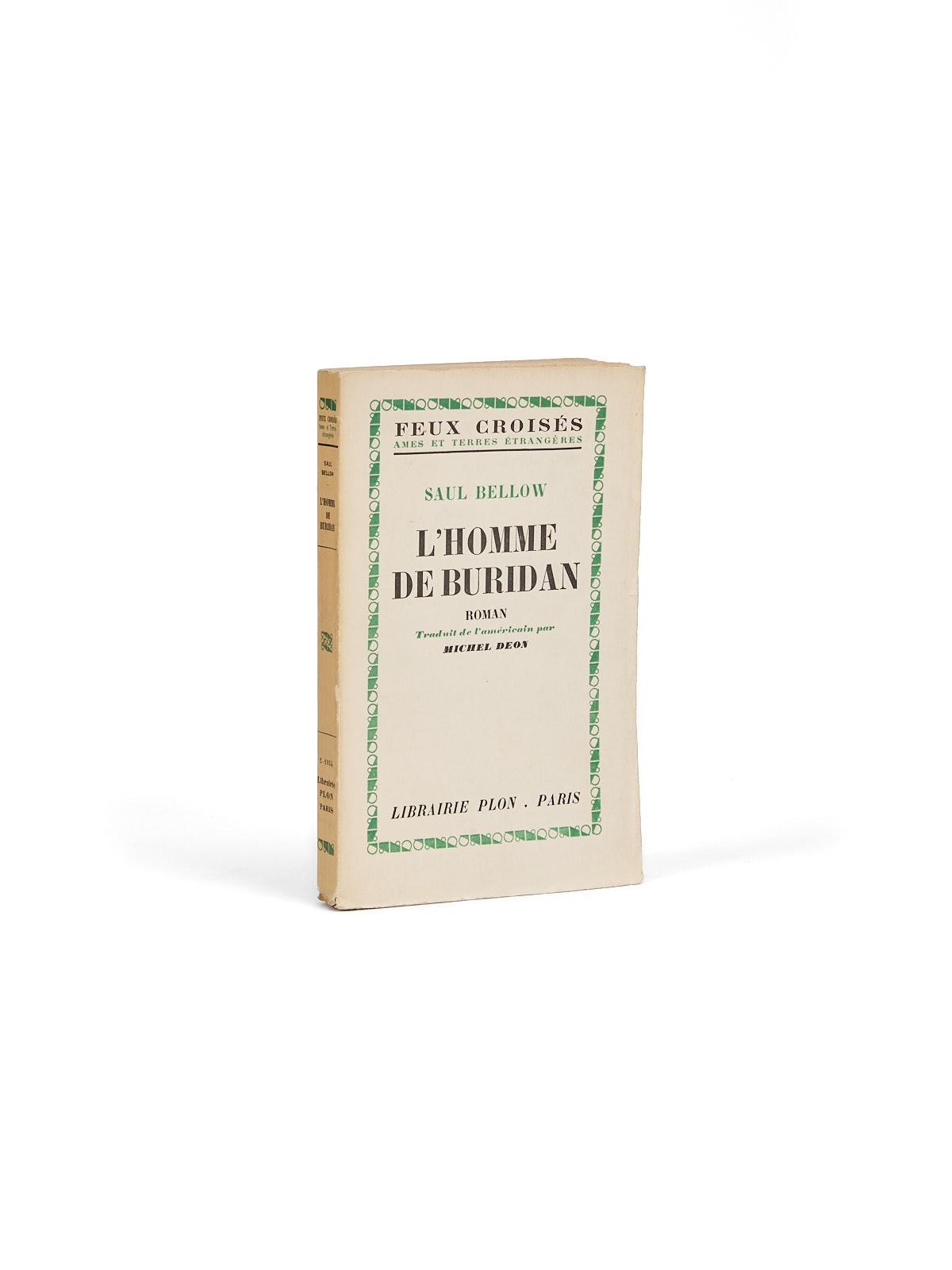
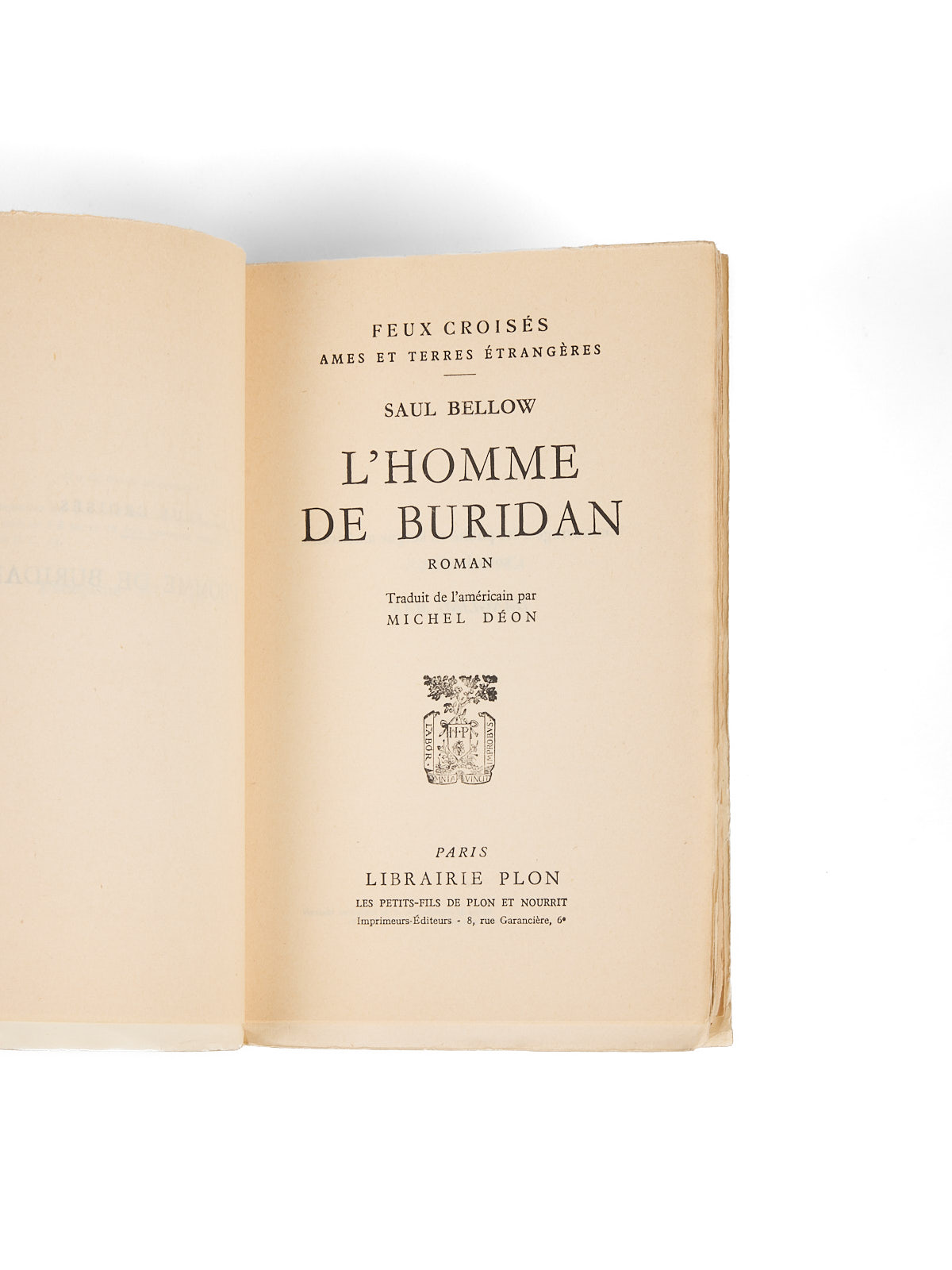
L’Homme de Buridan
One of 62 copies on alfa paper (no. 19), from the deluxe issue.
Inspired by Dostoevsky’s Notes from Underground, Saul Bellow wrote The Dangling Man at the age of twenty-five while serving in the merchant marine. Born in Lachine, Quebec, in 1915, the son of Russian-Jewish immigrants, he was raised on the streets and, like Salinger, Bernard Malamud, Philip Roth or Norman Mailer, was profoundly shaped by the Jewish community from which he came. Like his heroes, he felt himself a minority and an outsider, “maladjusted,” searching for his “status” and “identity” within the “lonely crowd.” This is precisely the case in this first book, Dangling Man, published in 1944, which portrays an irresolute man incapable of commitment or action: the journal of a young Chicagoan named Joseph, like Kafka’s hero. He has left his job and is awaiting his call-up into the army.
A text captured and magnificently translated by Michel Déon, his only translation.
When he died in 2005, at the age of eighty-nine, Bellow was “one of the last giants of American letters. At this point, it is not yet clear which direction he took. Perhaps the underworld, since he knew every corner of it, having explored it in a subversive body of work, always Voltairean, and thoroughly scandalous. Sometimes more ‘vivacious’ than that of Philip Roth, to whom it is constantly compared. The two masters indeed hunted the same grounds — the fallow dreams of an America squatted by the devil — but Bellow the Spartan often had the edge, thanks to the electric concision of his prose, his incendiary irony, and the devastating precision of his shots. His favorite target? The cretinus americanus, a species whose decline he observed with a fierce eye, denouncing the dictatorship of the right-thinking, majority opinions, and the flattening of minds in the land of Mickey Mouse […]. This gentle perfidy did not prevent Bellow, who wore elegant hats, from being the most decorated author on the American side of the Atlantic: a Pulitzer Prize, three National Book Awards, and of course a Nobel, in 1976.” (André Clavel, Le Temps, 7 April 2005).
A very fine copy, in perfect condition.