

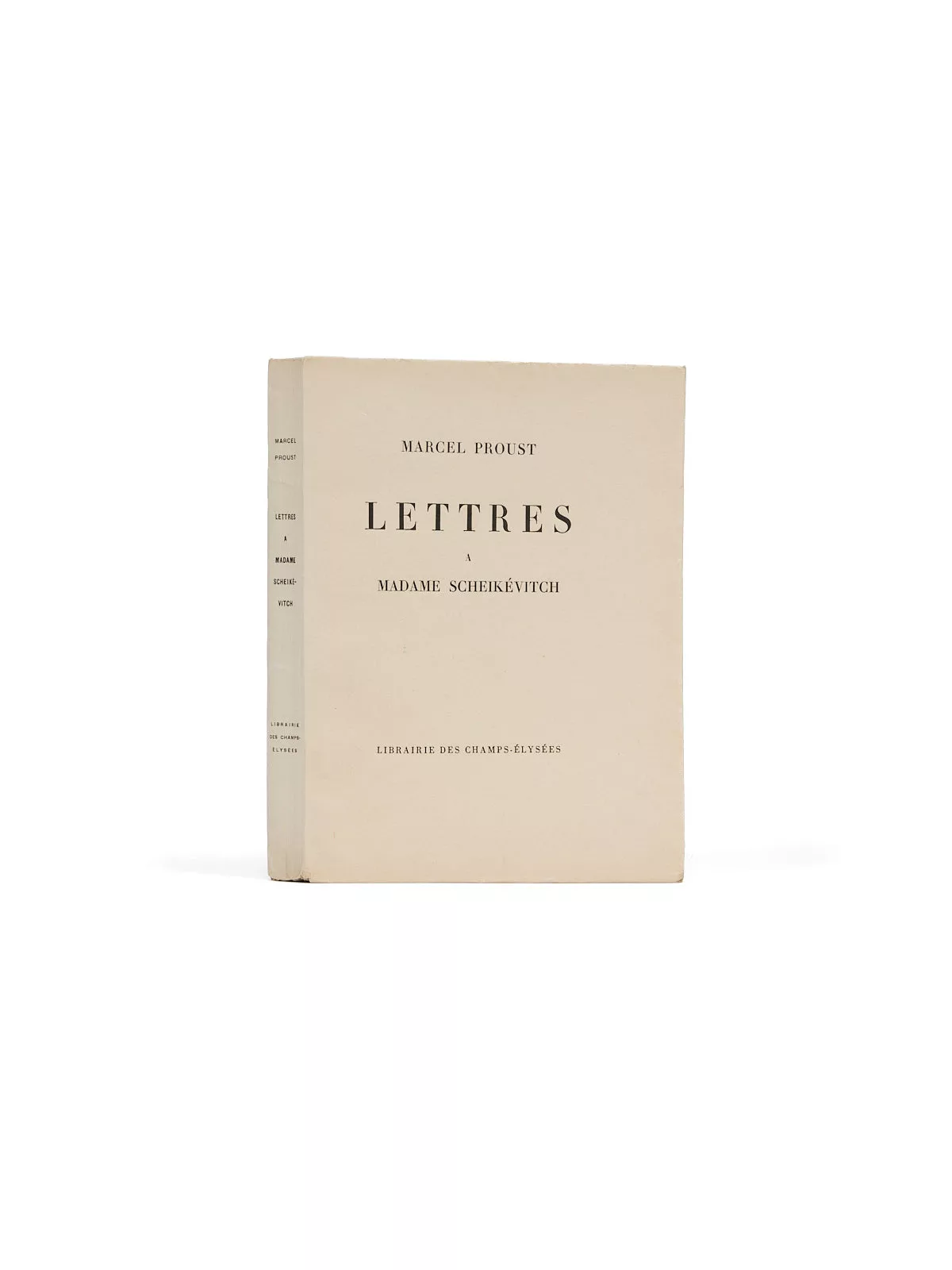
Lettres à Madame Scheikévitch
One of the hors commerce copies, this one on old Japanese paper, marked C, numbered and signed by the publisher.
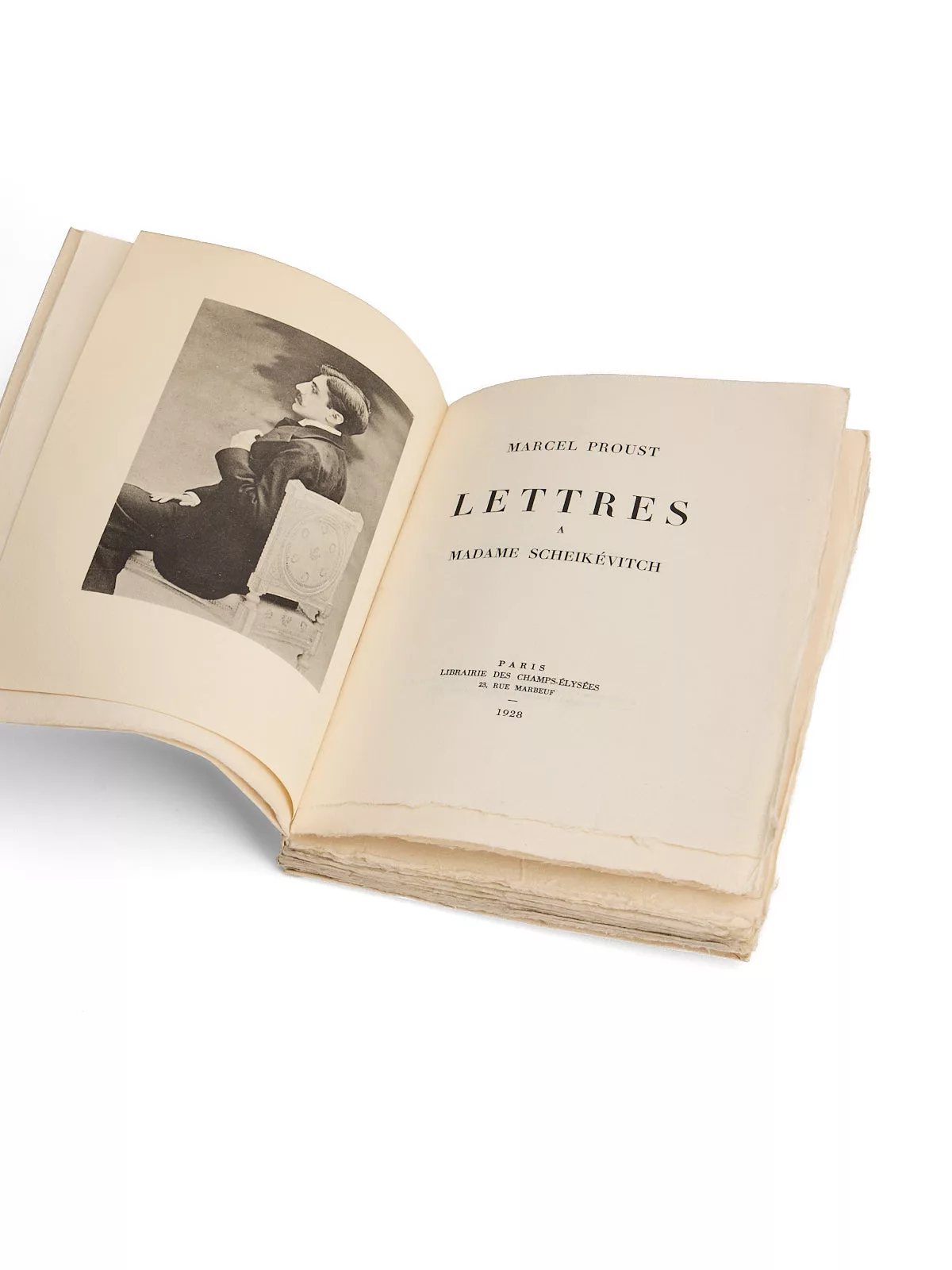
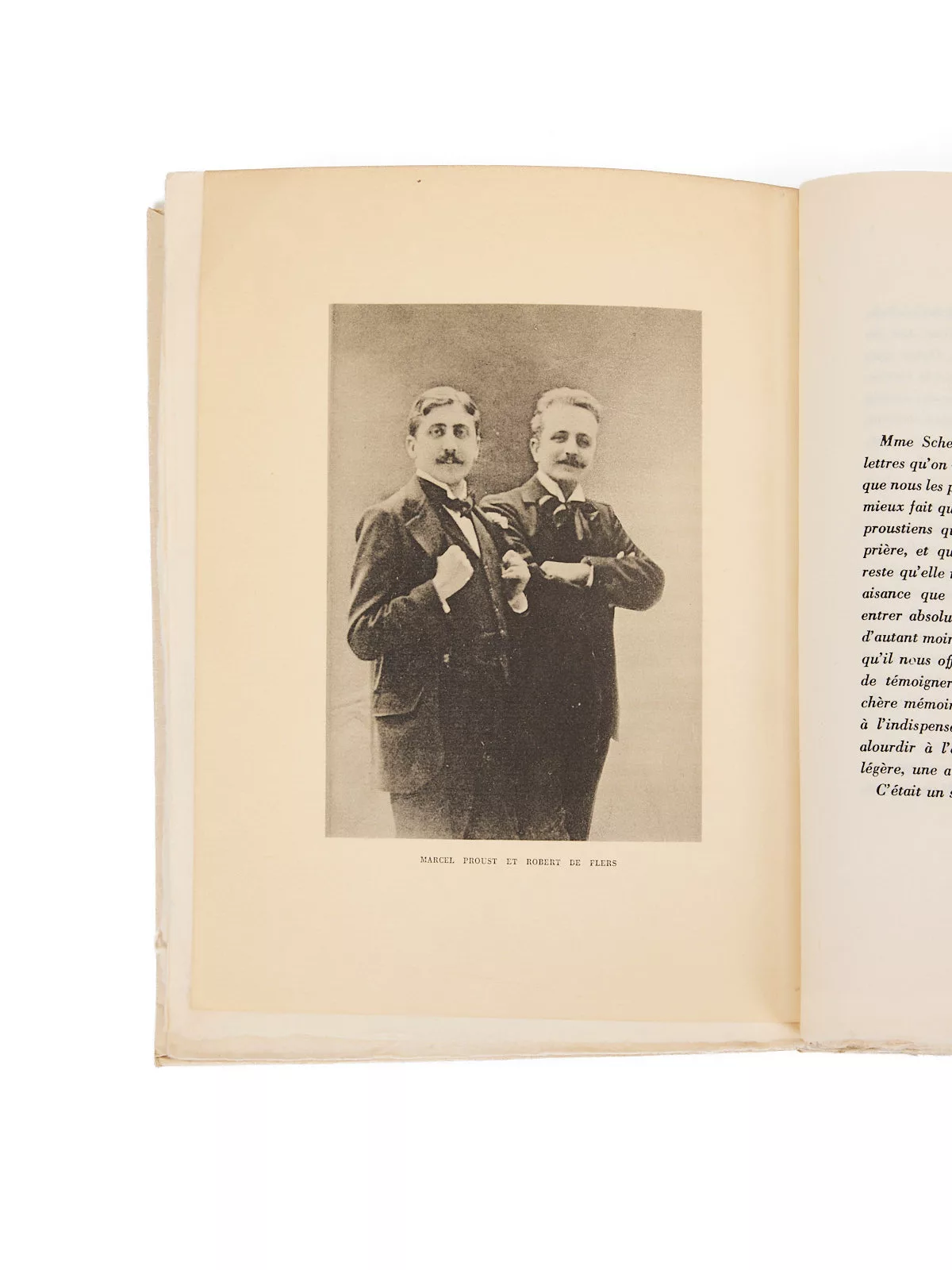
The volume reproduces twenty-eight letters from Marcel Proust to Marie Scheikevitch, together with telegrams, press cuttings and two photographs of the writer (one of them with Robert de Flers).
The daughter of a wealthy Russian magistrate who settled in France at the end of the nineteenth century, Marie Scheikevitch (1882–1964) was one of the great society and intellectual figures of Belle Époque and interwar Paris. George D. Painter described her as “one of the most intelligent and prominent hostesses of the new generation.” A patron of artists and writers, she brought together in her salon such figures as Jean Cocteau, Anna de Noailles, Reynaldo Hahn and the Arman de Caillavet family.
Although Proust had briefly glimpsed her as early as 1905 in Madeleine Lemaire’s salon, their real relationship began in 1912. That year, Jean Cocteau and Marie Scheikevitch together read in Le Figaro an article by Proust on “La Grande Pitié des églises de France” and decided to send him telegrams of congratulation. This gesture marked the beginning of a lasting relationship that continued until the writer’s death in 1922.
The two friends saw each other very frequently thereafter — “almost every day,” she later said — which explains the relative scarcity of their correspondence: only twenty-eight letters are known today. Marie Scheikevitch nevertheless played a significant role in Proust’s career. She opened the doors of her salon to him and actively helped to promote his work in Parisian society and intellectual circles. It was she, in particular, who recommended him to her lover Adrien Hébrard, director of the newspaper Le Temps, making possible the celebrated interview of Proust by Élie-Joseph Bois on 12 November 1913 — the first major press article devoted to À la recherche du temps perdu, on the eve of the publication of Du côté de chez Swann.
Proust paid tribute to her in Sodome et Gomorrhe in the character of Madame Timoléon d’Amoncourt, a “charming little woman, whose wit, like her beauty, was so delightful that either alone would have sufficed to please.”
A fine hors commerce copy on old Japanese paper.