

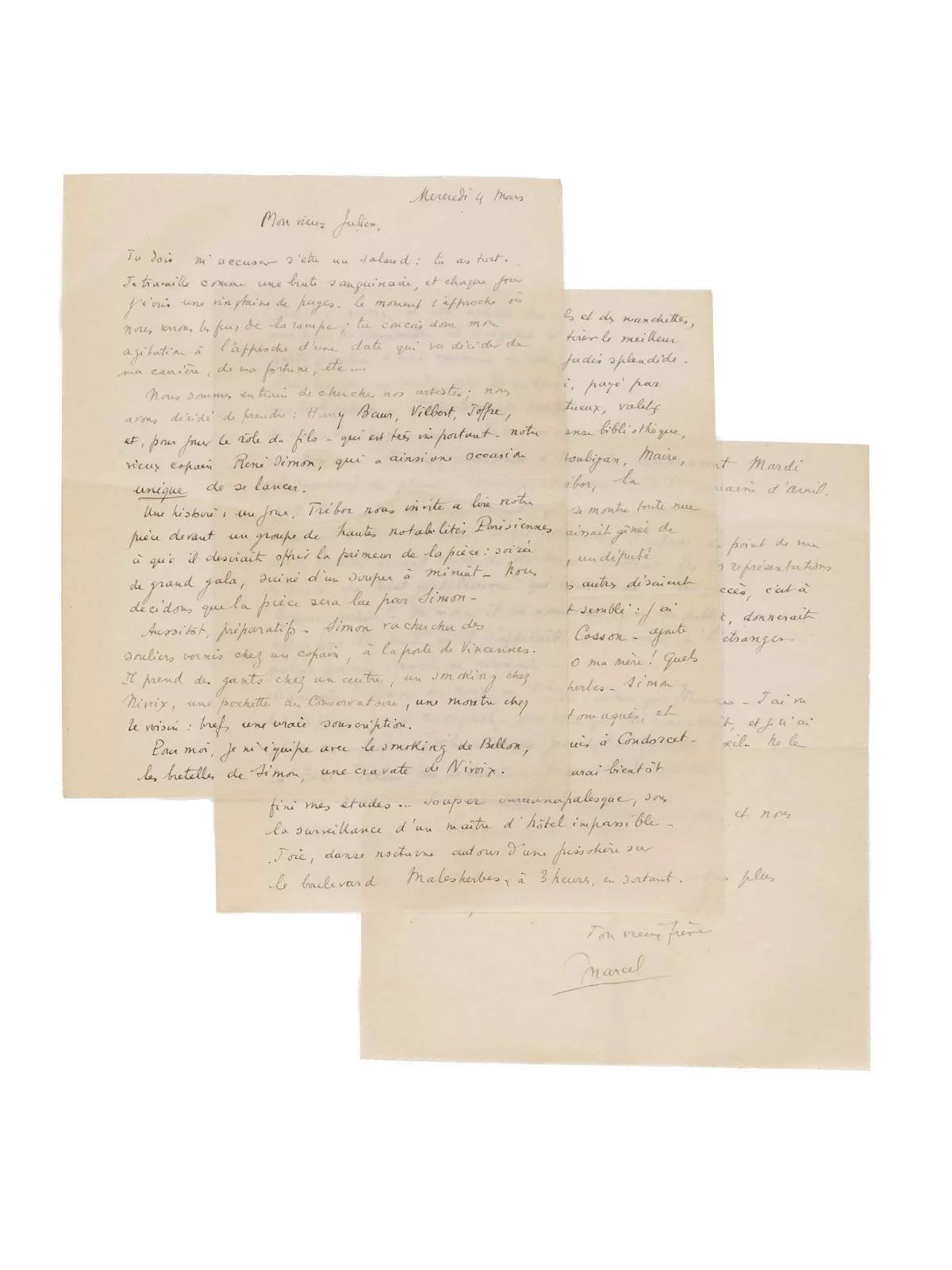
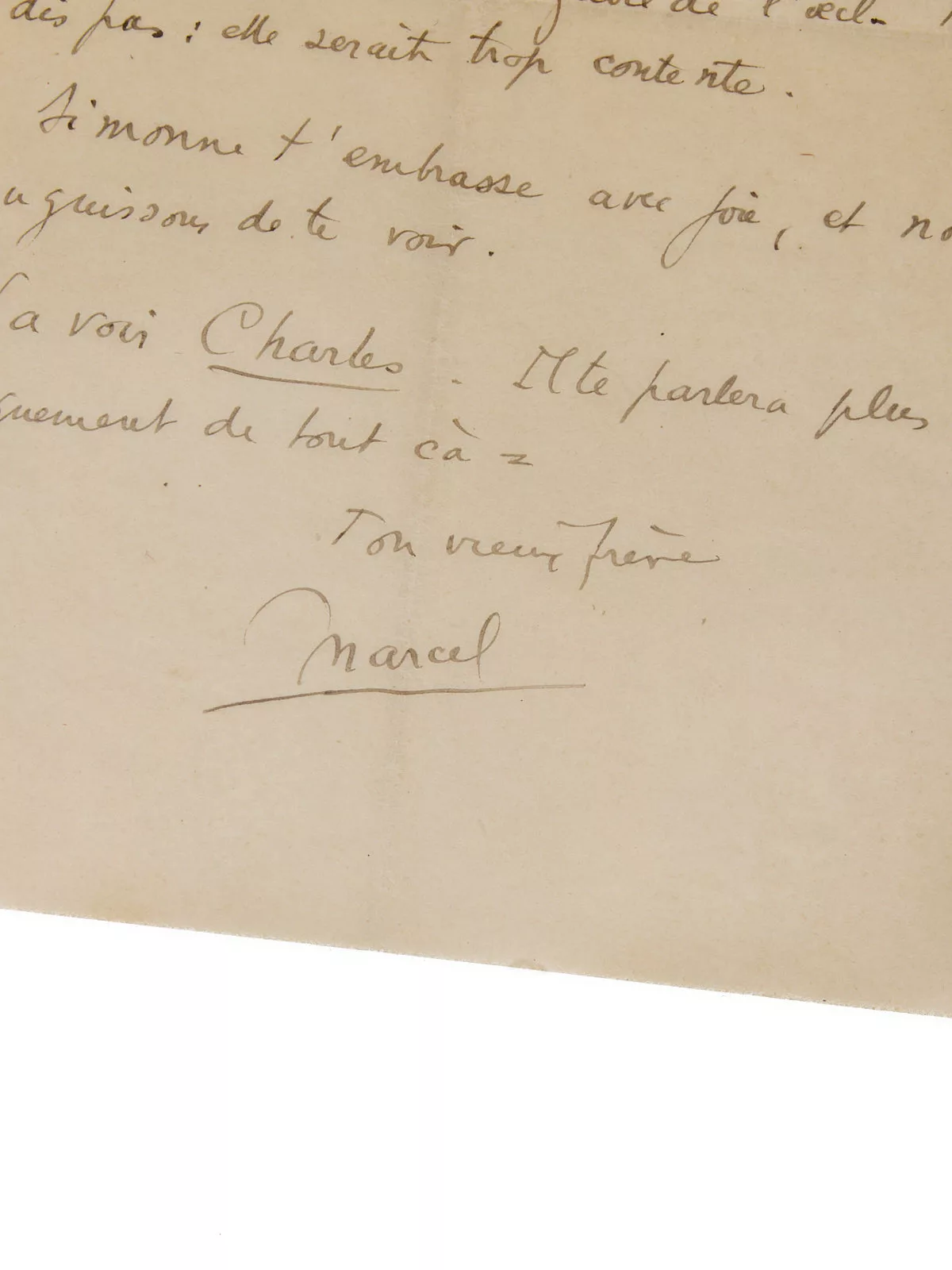
Lettre autographe signée
Ambitious and optimistic, Pagnol had just presented the play he hoped would soon be staged, Les Marchands de gloire, and describes its first private performance to his friend Julien Coutelen: a fellow contributor to Fortunio, the first review Pagnol had founded, whose first issue had appeared on February 10, 1914. The review would bring together, among others, Jean Ballard, later the director of Cahiers du Sud — of which Fortunio is the direct ancestor. The son of a wealthy flour miller, Julien Coutelen shared with Pagnol a passion for inventions (together they devised several “finds,” including a children’s toy for which they filed a patent). A Parisian since 1921, Pagnol would join him in the capital from September 1922, after being appointed as a supervisor at the Lycée Condorcet.
Shortly afterward he threw himself into writing his first plays, until he was satisfied with the finished version of Les Marchands de gloire. After enormous exertions, he gave a private performance of it that, he hoped, would open the doors to fame:
“[…] I am working like a bloodthirsty brute, and every day I write some twenty pages. The moment is approaching when we shall see the footlights; you can imagine my agitation as the date approaches that will decide my career, my fortune, etc. One day, Trébor invites us to read our play before a group of eminent Parisian notables, to whom he wished to offer the first hearing of the play: a grand gala evening, followed by supper at midnight. We decide the play will be read by Simon. Preparations immediately begin. Simon goes to fetch patent-leather shoes from a friend, at the Porte de Vincennes. He gets gloves from another, a tuxedo from Nivoix, a pocket square from the Conservatoire, a watch from the neighbor: in short, a real collective effort. As for me, I outfit myself with Bellon’s tuxedo, Simon’s suspenders, a tie from Nivoix. As for Nivoix, he dashes off to buy collars and cuffs, a pair of socks, and does his best to make the most of a once-splendid silk shirt. We arrive at the appointed place in a taxi, paid for by a shared contribution. Sumptuous apartments, lordly valets. In an immense library, we find Monin, the owner of Houbigant, Maire, a great feather merchant, Parisys, Trébor, the beautiful Jickiss of the Concert Mayol, who appears nude every evening before 2,000 people, and who seemed embarrassed to be seen clothed before so many people […]. Add a few women bedecked with diamonds — oh, mother! Such diamonds! Like walnuts! — and pearls. Simon reads the play: a triumphant success, the audience astonished, full of respect. Trébor mentions that I am at Condorcet. The beautiful Jickiss asks me if I will soon be finished with my studies […]. The full rehearsals begin Tuesday, March 12. We open in the first week of April. That’s it. Success or not, I am out of financial trouble. Even a flop would still mean 20 performances, or 10 to 12,000 francs for me. A success, that is 100 performances, with an audience, would bring close to 100,000, with foreign sales. Hip, hurrah! […]”
The contract was fulfilled for Pagnol: starting April 15, 1925, he had his Marchands de gloire staged at the Théâtre de la Madeleine — his first play to reach the boards. A respectable success, encouraging enough to allow him to continue his career.