

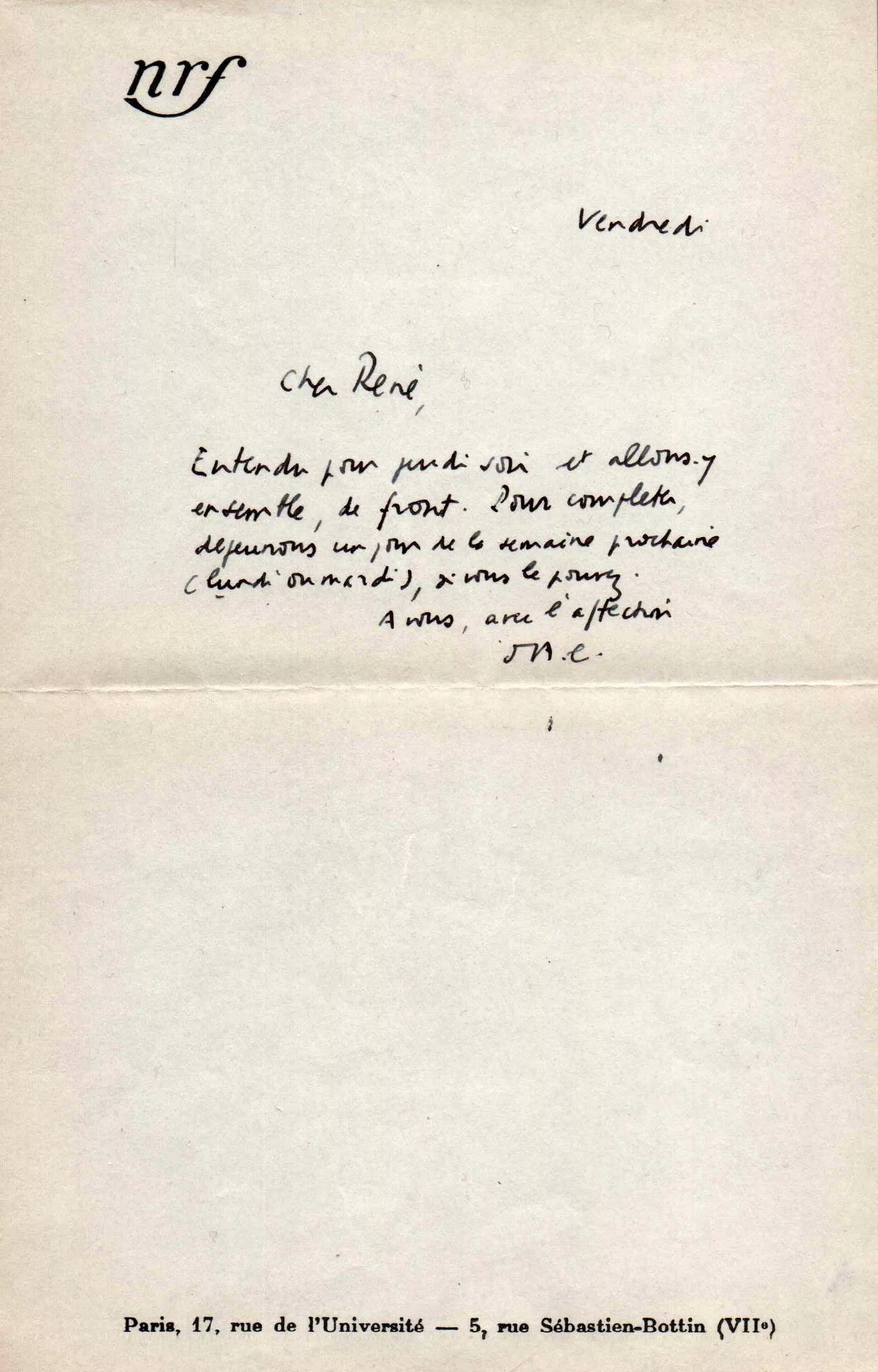
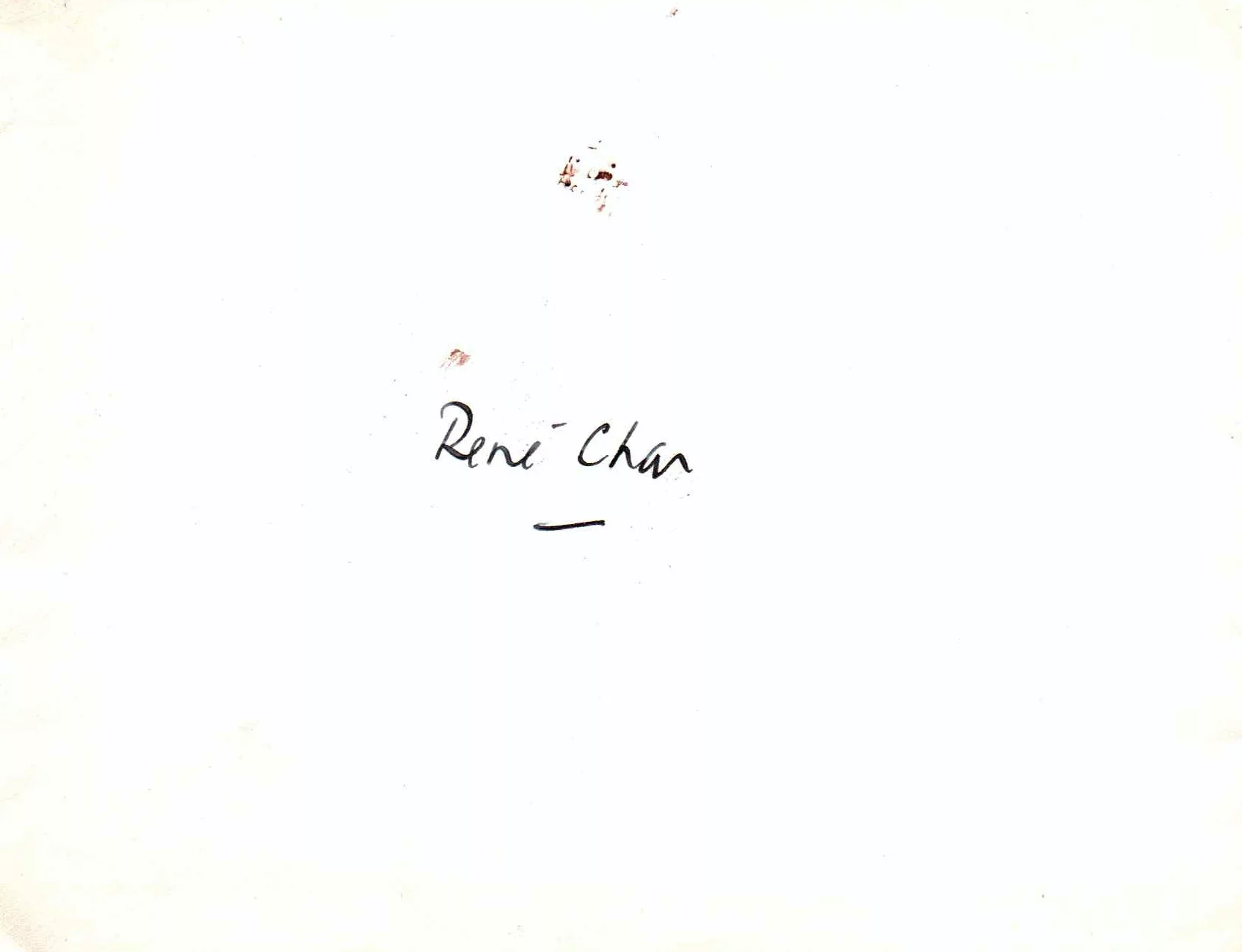
Lettre autographe signée adressée à René Char
“Vendredi Cher René, Entendu pour jeudi soir et allons-y ensemble, de front. Pour compléter, déjeunons un jour de la semaine prochaine (lundi ou mardi), si vous le pouvez. À vous, avec l'affection d'A.C.”
Undated and without postal marks, this letter was probably written by Camus from his office at Gallimard, addressed to René Char, or from Char’s own home on rue de Chanaleilles: “from 1956, Albert Camus lived in a two-room apartment in the same building as René Char, on rue de Chanaleilles. It was not uncommon for them to slip notes under each other’s doors” (Camus-Char, Correspondance, p. 192).
This letter is missing from the first edition of the correspondence between the two men — included here — but will appear in the expanded 2017 edition (Folio collection, no. 6274, letter 185, p. 220), where it is placed among the “letters of uncertain date,” though probably written in October 1957, a few days after the announcement of the Nobel Prize. Camus and Char were due to join André Rousseaux, who had invited them to dinner at his home, 5 rue d’Assas.
Rousseaux, the severe critic of Le Figaro, had followed Camus since L’Étranger, reviewing it — the second review of the novel — on 19 July 1942. Rather unfavorable, Rousseaux saw in it “a disguised plea for cowardice (…) The least one can say is that this pitiful humanity is truly without interest. It must be added that Mr. Albert Camus’s undertaking completely misses its mark. The author of L’Étranger certainly believes he is producing a profoundly realist work by revealing to us the realities hidden deep within a human being. We have said what we think of that.”
Nevertheless, his view evolved, notably after La Peste, and especially after La Chute, published in 1956: Rousseaux wrote that reading it had brought back to mind the harshest pages of L’Étranger and Le Malentendu, and praised the book at length, concluding that Camus represented in contemporary French literature “a perfect example of intellectual honesty,” as the rigorous guardian of the most threatened of all faiths: faith in man.
Camus and Char thus awaited the dinner with impatience, “side by side,” all the more so as Char was preparing a text for his newspaper in tribute to his friend, published on 26 October: Je veux parler d’un ami. It appeared the same day alongside a new article by André Rousseaux, in which the critic saw the Nobel Prize as the consecration “of a just man,” praising in Camus that nobility which commands above all the love of mankind, and that truthfulness and honesty which make the writer “a perfect example of intellectual loyalty in contemporary literature” (Le Figaro, 26 October 1957). The dinner, evidently, would win Rousseaux over for good.