

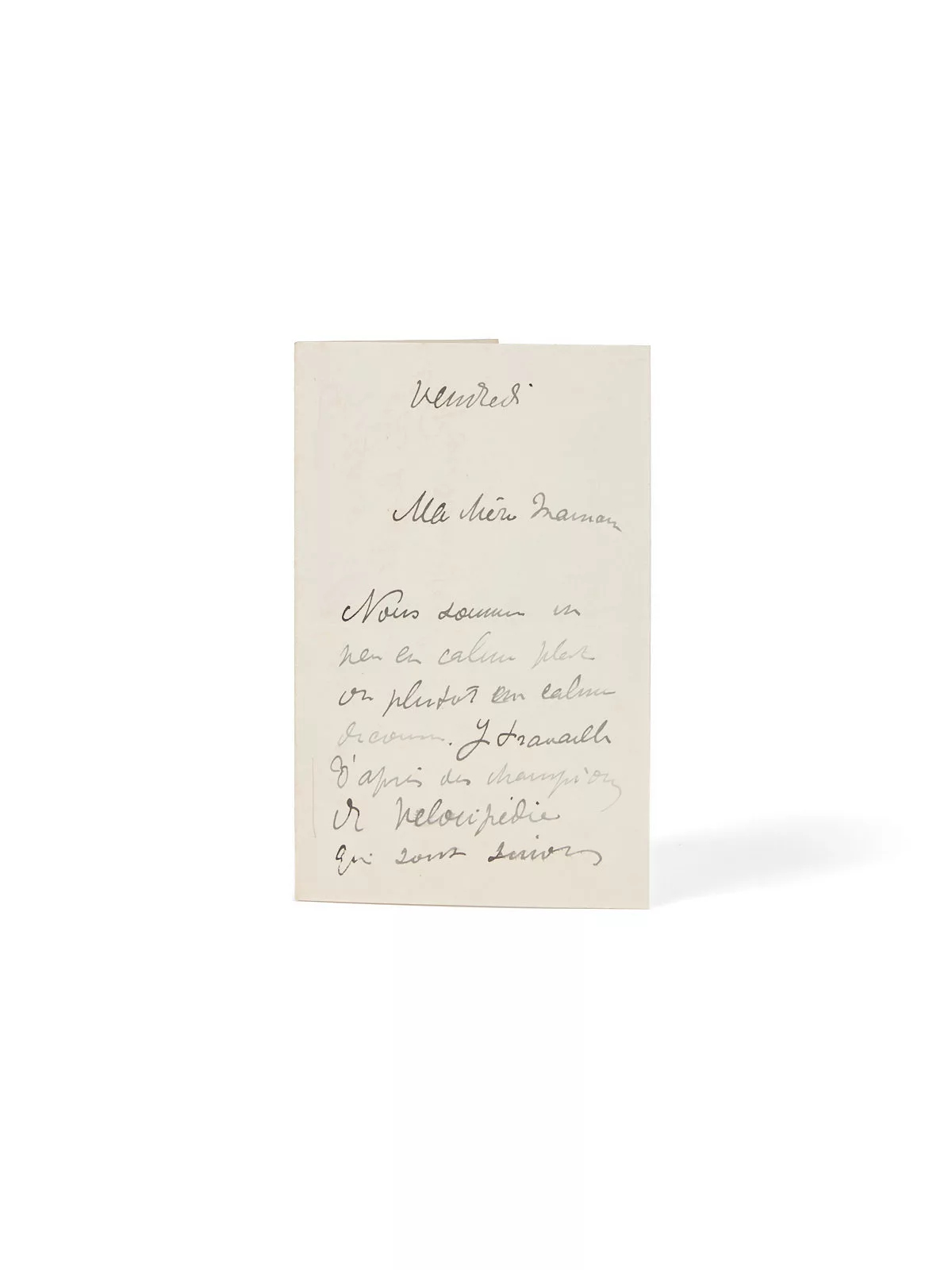
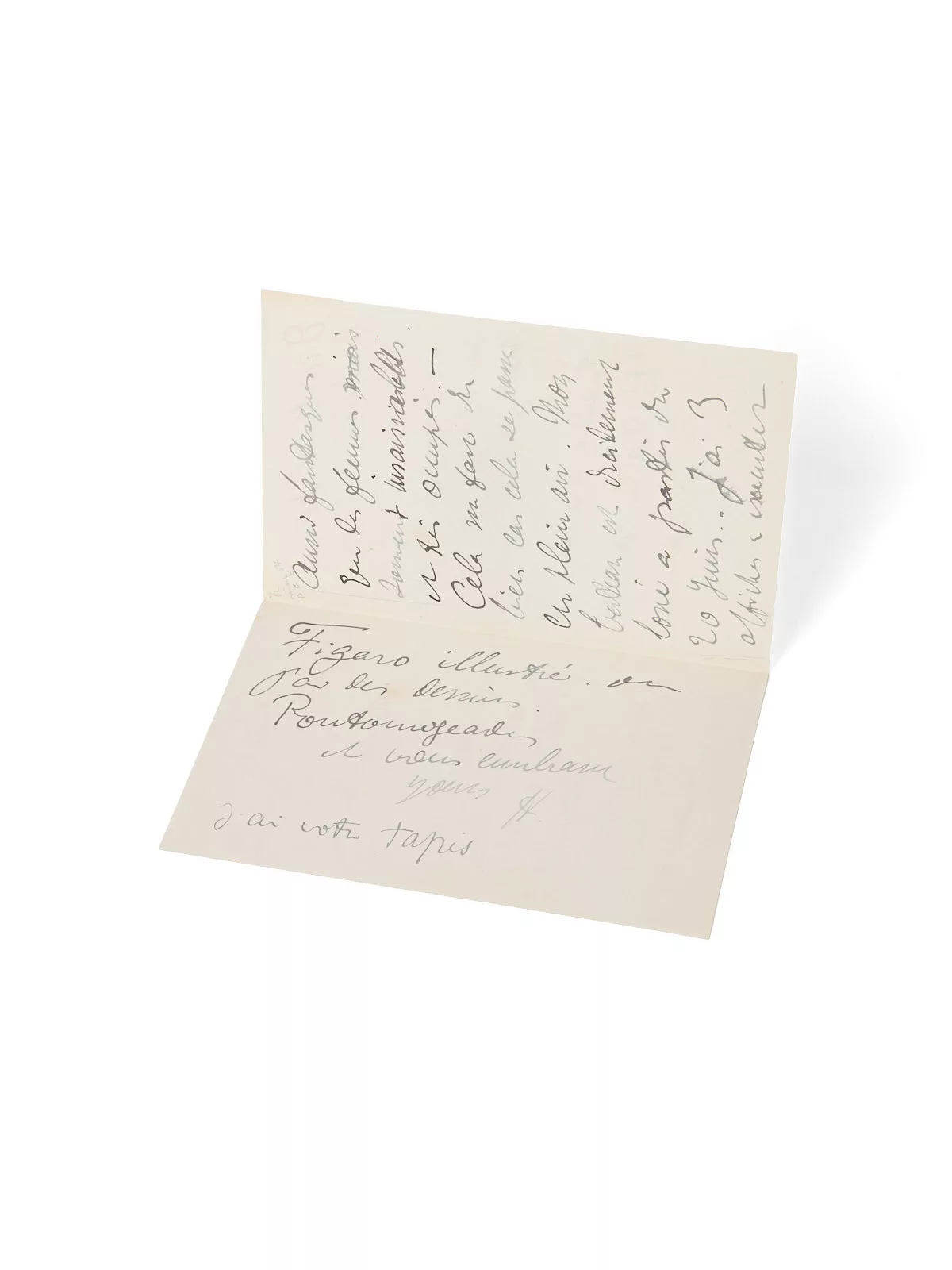
Lettre autographe signée à sa mère
“Vendredi
Ma chère maman, nous sommes un peu en calme plat ou plutôt en calme de course. Je travaille d'après des champions de vélocipédie qui sont sinon aussi fantasques que des femmes mais [struck through] souvent insaisissables et très occupés. Cela me fait du bien car cela se passe en plein air. Mon bateau est décidément loué à partir du 20 juin... J'ai 3 affiches à exécuter d'ici là et par la chaleur qu'il va faire ce sera tout juste amusant. Je n'ai pas pu repincer encore Guibert [his friend the wealthy Maurice Guibert, an amateur photographer who left several famous portraits of Toulouse-Lautrec, who in turn made a portrait of him] mais j'ai d'autres camarades pour aller à Anvers. - Quan[t] à Arcachon... Pas d'autres nouvelles en vue. Je vous ferai envoyer le Figaro illustré, où j'ai des dessins. Poutogeades et vous embrasse. Yours... H. (…)”.
A letter absent from the Correspondance edited by Herbert Schimmel, written at the precise moment when Lautrec accompanied Louis Bouglé (known as L. B. Spoke), representative of Simpson chains, to London to sketch racing champions from life for the great poster “La Chaîne Simpson,” commissioned for the cycle business that Bouglé, a native of Orléans, was about to open on the boulevard Haussmann in Paris. Toulouse-Lautrec, himself fascinated by movement, sport in general and cycling in particular, took on Bouglé’s commission with enthusiasm, crossing the Channel with him and attending, shortly before the summer of 1896, a major race at the Catford velodrome in Greater London.
The note to his mother fixes the schedule of this hectic month of June and situates the artist “in the open air,” in direct contact with the cycling champions then at the height of their fame. In the background of the celebrated English composition that resulted, one can make out the faces of the winner, Constant Huret, paced by a quintuplette, the officials on the lawn (Bouglé and W. S. Simpson), the military band, the mechanics of the relays, and the whole “war of the chains” that gripped sporting Europe in 1896. A third figure might have appeared on this poster: Tristan Bernard, who ran two velodromes — the Seine velodrome at Levallois and the Buffalo at Neuilly — but who was not in London that day. Toulouse-Lautrec, despite his atrophied legs and his growth forever arrested at 152 cm, could never practice the sport himself, but he was probably the first illustrator “to understand that the moving bicycle was not an ‘unworthy subject,’ and became passionate about it. His friend, a certain Paul — the future Tristan Bernard — got him onto the lawn among the officials. But the little man would move away to sit quietly on the grass: watching the myriad picturesque scenes, listening to the crowd’s shouts, his eyes behind his pince-nez as quick to seize the essential as his pen would be to hastily fix on paper the most striking features of his models, ‘pinched’ without their suspecting it” (Jean Durry, chapter V, “dire le cyclisme,” L’En-Cycle-opédie).
The year 1896 marked the creation of two of the oldest cycling races in France: Paris-Roubaix, first held on 19 April (51 starters), then Paris-Tours, on 17 May; it also saw the founding of the Union Cycliste de France, while the Frenchman Jean Dubois raised the world hour record to 38.220 km at the Vélodrome Buffalo in Paris. At the time, 256,084 bicycles were counted in the country, reserved for an urban elite: the price of a bicycle then corresponded to some 800 hours’ wages.
A rare and previously unpublished document.