

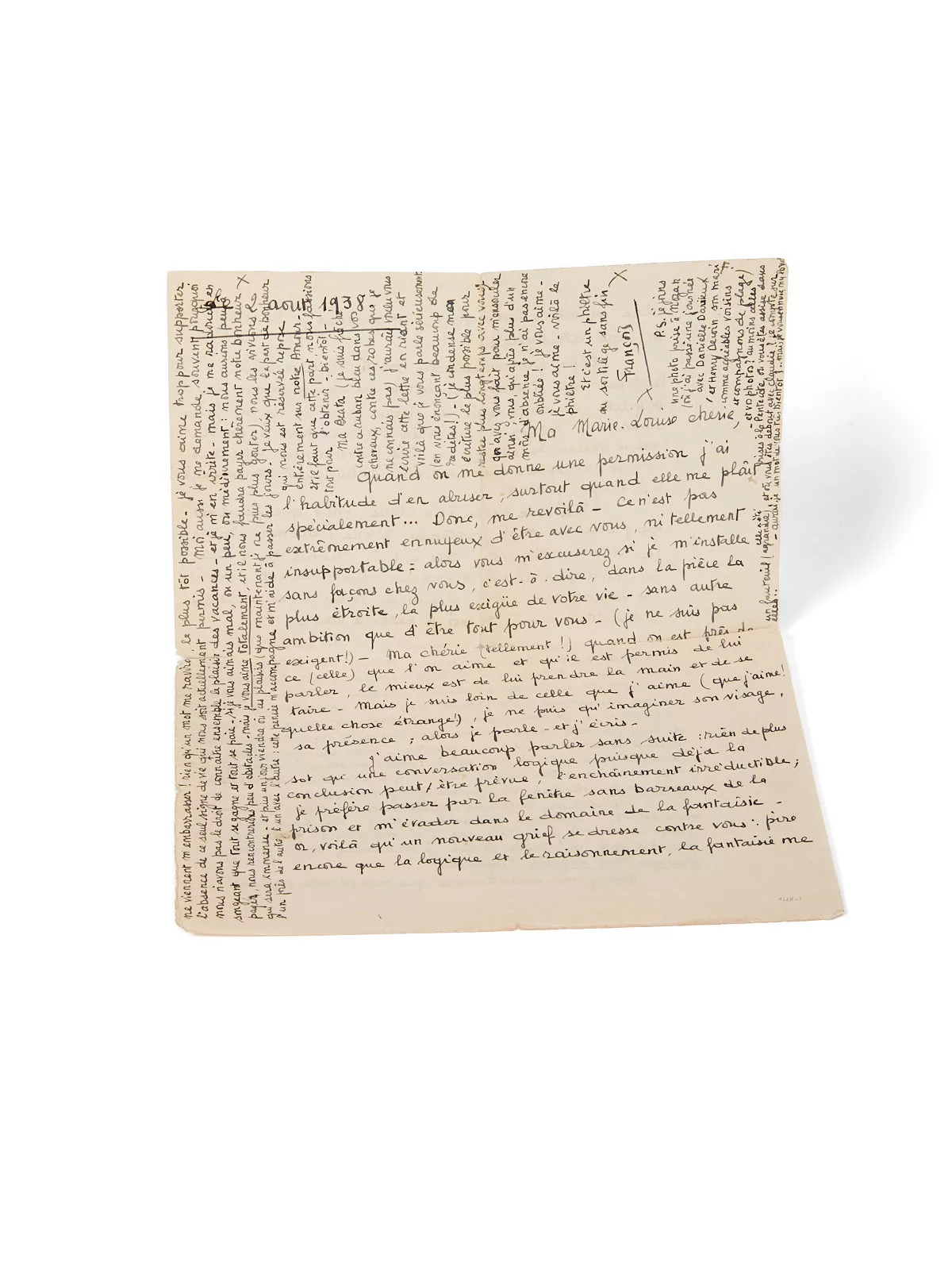
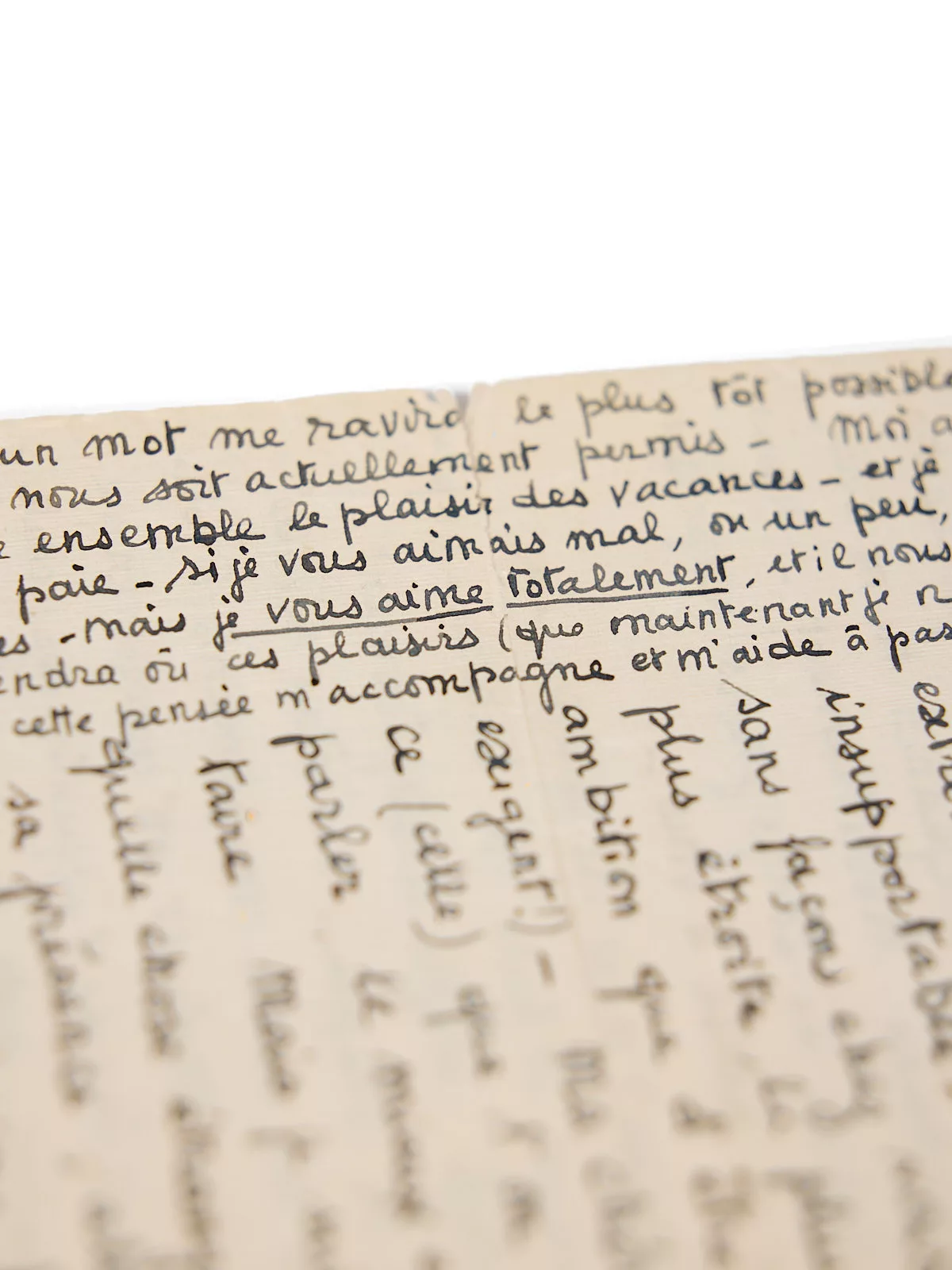
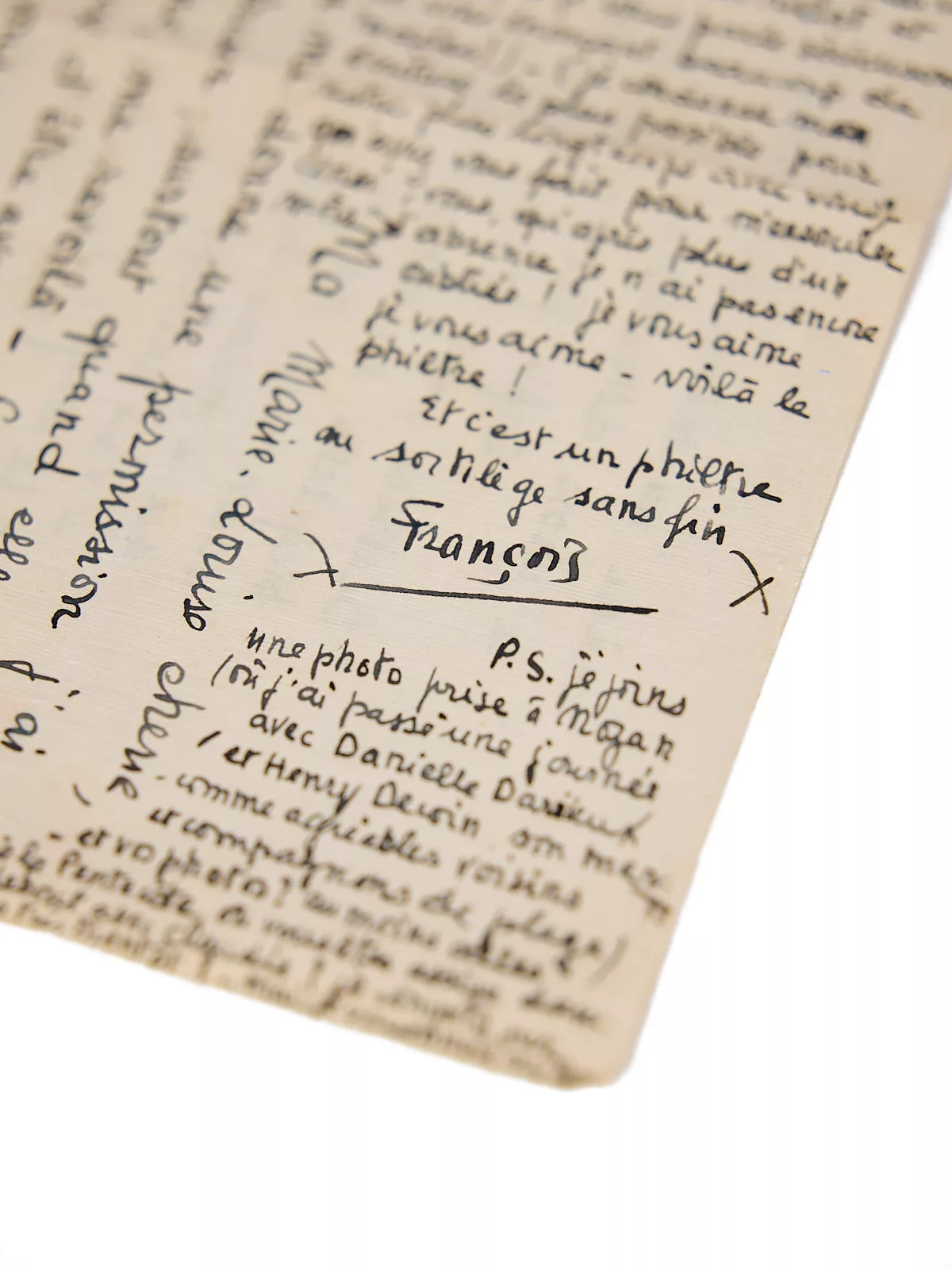
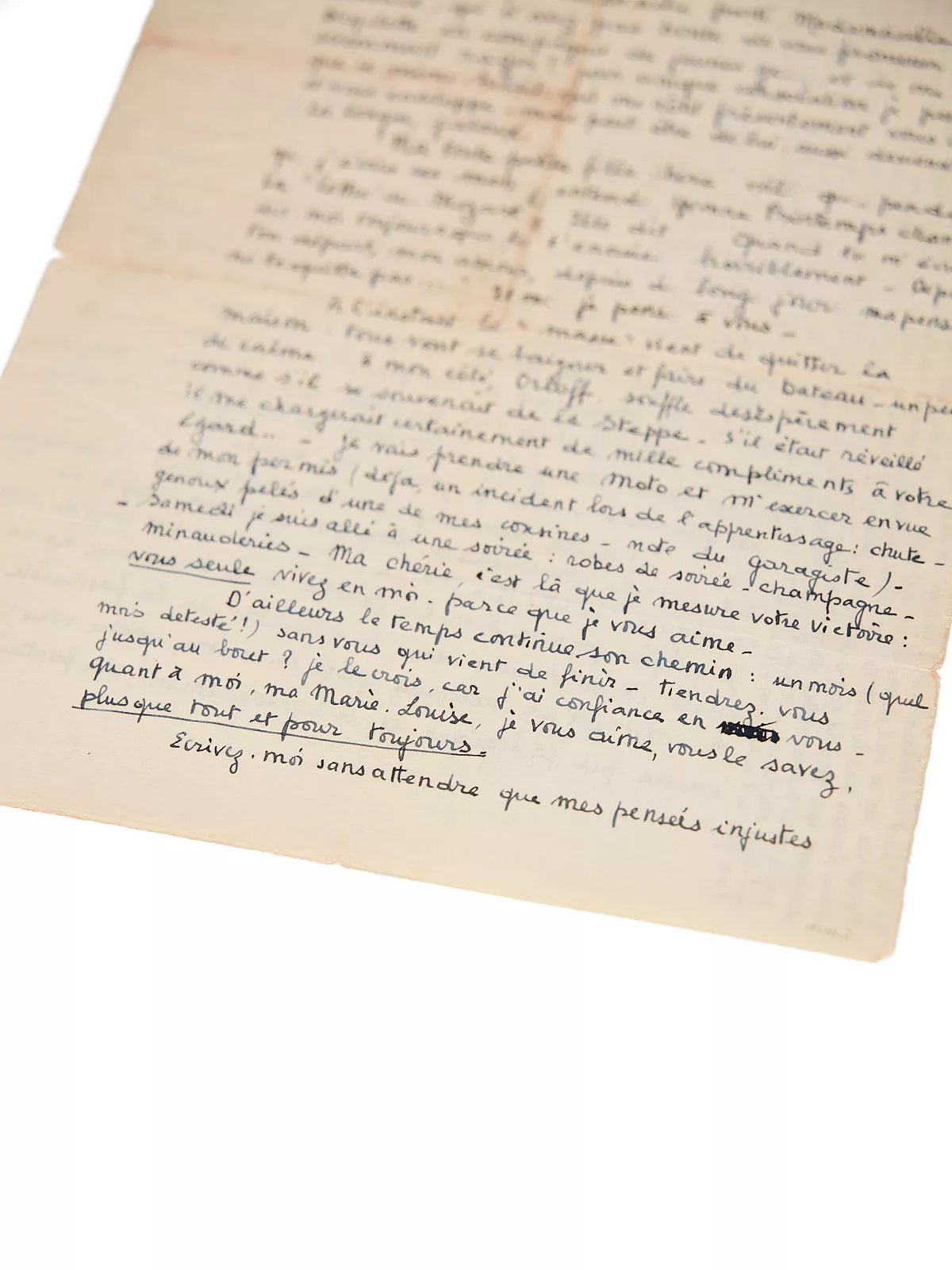
Lettre à Catherine Langeais
Catherine Langeais (1923–1998), born Marie-Louise Terrasse, met François Mitterrand on 28 January 1938 at a ball held by the École normale supérieure. Two years later, a prisoner at Stalag IX-A in Hesse, he described their meeting to Jacques Biguet, a fellow prisoner: “One Saturday, I was feeling low, I went into my room, and came across a card I had forgotten on a table. It was an invitation to the Normale sup ball. I went. I saw a blonde girl with her back to me. She turned around. I stood there, rooted to the spot. Then I asked her to dance. I was mad about her.” The young blonde woman was accompanied by her parents, who had forbidden her from giving her name to her dance partners. Mitterrand called her Béatrice, after Beatrice Portinari, the Florentine muse of the Divine Comedy. She told him only that she was a student at the Lycée Buffon, in the classe de troisième. From the following Monday, he waited for her outside the school, followed her at a distance, and discovered that she lived near the Place Denfert-Rochereau — until a first kiss in the Jardin du Luxembourg.
Genuinely smitten as never before, he was eventually introduced to her parents. He was invited to Valmondois, to their country house. Marie-Louise’s father was a university professor and her brothers had attended the École normale; there Mitterrand met brilliant minds, writers such as Georges Duhamel, and politicians. Marie-Louise’s father had served in the cabinet of the former foreign minister Pierre-Étienne Flandin and was secretary-general of the Alliance démocratique, a small party founded in the nineteenth century by Waldeck-Rousseau, one of whose most illustrious representatives had been Paul Deschanel. Mitterrand felt at home in this milieu, more open than the one he had known in Charente. He had already asked Marie-Louise’s parents for her hand, but her mother thought the marriage premature: Marie-Louise was not yet sixteen and François had not yet done his military service. “No matter!” he replied. As a student he could have obtained a further deferment, but out of love he volunteered early, in September. The summer, meanwhile, separated the two young people. François spent it with his father in Jarnac, writing Béatrice ardent letters every day.
“When I am given leave, I usually make the most of it, especially when I particularly enjoy it… So, here I am again. It is not extremely tiresome to be with you, nor terribly unbearable: so you will forgive me if I settle in with you without ceremony […]. I am far from the one I love (I love her! What a strange thing!); I can only imagine her face, her presence, and so I speak and I write. Let us make the best of it, Mademoiselle Béatrice, who are not ashamed to go bicycling in the company of young men and evidently to make me rage! My only consolation is that I think the same sun now roasting me is gilding and enveloping you. But perhaps in time I shall grow jealous of it too. As I write these words, I hear Yvonne Printemps singing Mozart’s “Lettre”; she sings, ‘when you write to me, always tell me that you are dreadfully bored, that since your departure, my love, for many long days my thoughts have not left you’ […]. I am going to take out a motorcycle and practice for my license (already an incident during the lesson: a fall, one of my cousins’ knees scraped, a note from the garage owner). On Saturday I went to an evening party: evening gowns, champagne, simpering. My darling, that is when I measure your victory: you alone live in me, because I love you […].”
François Mitterrand would write more than 300 letters to the woman he nicknamed Zou. Despite their engagement in March 1940, he never married her. The war, and then his captivity, drove them apart. It was a painful separation for Mitterrand; in June 1942 he wrote to his confidante Marie-Claire Sarrazin: “Do I still love this Béatrice with her unsettling doves? Surely. But I love her because I loved her, and there is a distinction there. I do not suffer, and yet I can love outside of her. But she will never be a stranger to me, and is now for me one of those ‘little allegorical goddesses’ Proust speaks of […]. The fine road of ideal walks that draws me is still hard going for me — love seems perfect to me, or rather complete, only when it can be felt. And yet, there too, bitterness is close at hand.”