

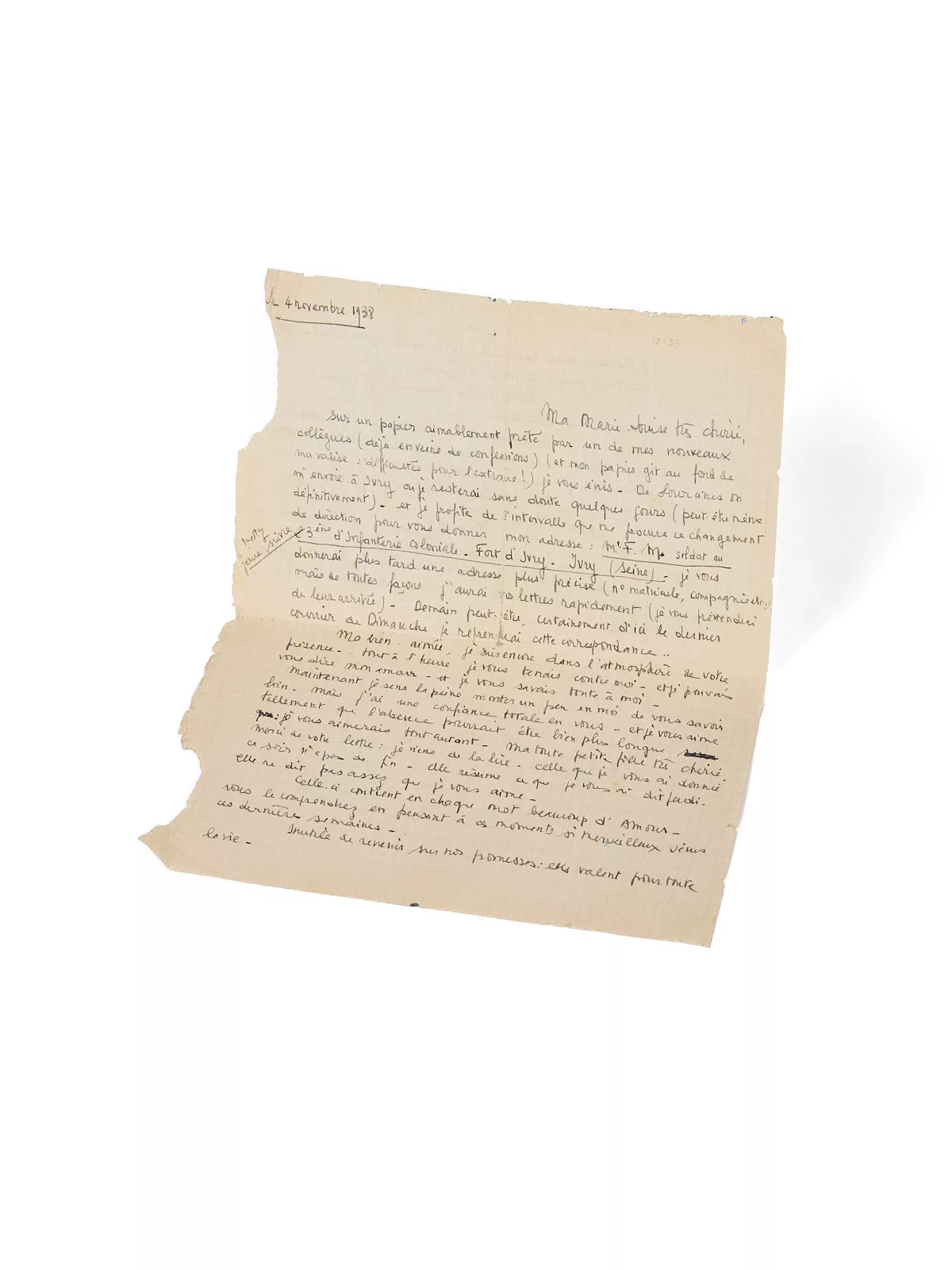
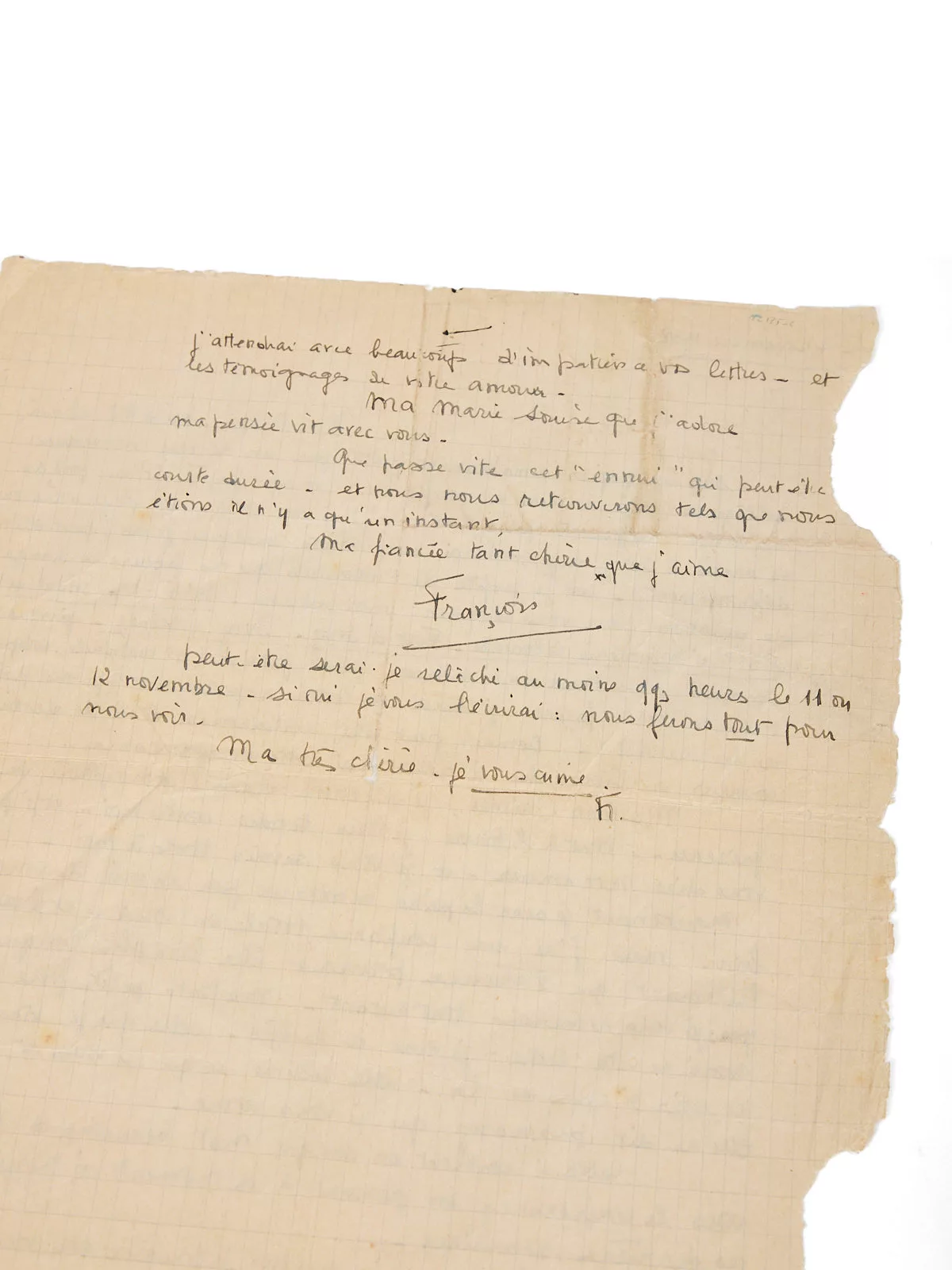
Lettre à Catherine Langeais
François Mitterrand had just been enlisted in the 23rd Colonial Infantry Regiment, under whose flag he would fight in the Battle of France.
Catherine Langeais (1923–1998), whose real name was Marie-Louise Terrasse, met François Mitterrand on 28 January 1938, at a ball held by the École normale supérieure. Two years later, imprisoned at Stalag IX-A in Hesse, he would describe the encounter to Jacques Biguet, a fellow prisoner: “One Saturday, I was feeling low, I went back to my room, and I came across an invitation card I had forgotten on a table. It was an invitation to the Normale Sup ball. I went. I saw a blonde girl with her back to me. She turned around. I stood there, rooted to the spot. Then I asked her to dance. I was mad about her.” The young blonde was accompanied by her parents, who had forbidden her to give her name to any of her dance partners. Mitterrand nicknamed her Béatrice, after Beatrice Portinari, the Florentine of the Divine Comedy. She told him only that she was a student at the Lycée Buffon, in the third form (troisième). By Monday he was waiting outside her school, following her at a distance, and discovered that she lived near the Place Denfert-Rochereau — until a first kiss in the Jardin du Luxembourg.
François Mitterrand was genuinely smitten, as never before in any relationship. He had already asked Marie-Louise’s parents for her hand, but her mother judged the marriage premature: Marie-Louise was not yet sixteen, and François had not yet completed his military service. “No matter!” he replied. As a student he could have obtained a further deferment; instead, out of love, he volunteered ahead of his call-up in September. He could have requested assignment to a reserve officers’ school in the provinces. “He chose the 23rd Colonial Infantry Regiment, again out of love — a decision he would pay for dearly. For the moment, he was pleased not to be far from Béatrice, whom he also called “his little peach.” He was posted to the Fort d’Ivry, then to the Lourcine barracks, boulevard du Port-Royal, in Paris” (Robert Schneider, Les Mitterrand). On 4 November 1938, he saw Marie-Louise, had lunch with her father and Robert, then returned to the Fort d’Ivry.
He wrote to her immediately — this is the very first letter he composed after his enlistment — “on paper kindly lent by one of my new comrades (already inclined to confidences)… I am still in the atmosphere of your presence. A little while ago I held you against me, and could tell you of my love […] now I feel the pain of knowing you are far away […] there is no need to return to your promises: they hold for a lifetime. I will wait impatiently for your letters — and the proofs of your love […] Perhaps I will be released for a few hours on the 11th or 12th of November. If so, I will write to you: we will do everything to see each other. My darling, I love you. F.”
In September 1939 came mobilization, then deployment west of the Maginot Line. It was during a leave that their engagement took place, on 3 March 1940, at the Terrasse family home in Paris. Then, once again, the front. On 14 June, after fierce fighting for which he was decorated, he was wounded by shrapnel at Verdun. Evacuated to a military hospital, he was captured by the Germans and sent to a prisoner-of-war camp. François Mitterrand became a “K.G.” — Kriegsgefangener, prisoner of war — under number 27716-968 at Stalag IX-A, near Ziegenhain, in Thuringia. He escaped — after two failed attempts — in January 1942.
François Mitterrand would write more than 300 letters to the woman he nicknamed Zou. Despite their engagement in March 1940, he never married her. The war, and then his captivity, drove them apart — painfully so for Mitterrand. In June 1942, he wrote to his confidante Marie-Claire Sarrazin: “Do I still love this Béatrice of the disquieting doves? Surely. But I love her because I loved her, and there is a nuance there. I do not suffer, and I can love beyond her. But she will never be a stranger to me, and she is now for me one of those ‘little allegorical goddesses’ that Proust speaks of […]. The beautiful road of ideal walks that draws me is still hard on my step — love seems perfect to me, or rather complete, only when it can be felt. And yet, there too bitterness is close at hand.”
A few small losses at the edge of the leaf, not affecting the text.