

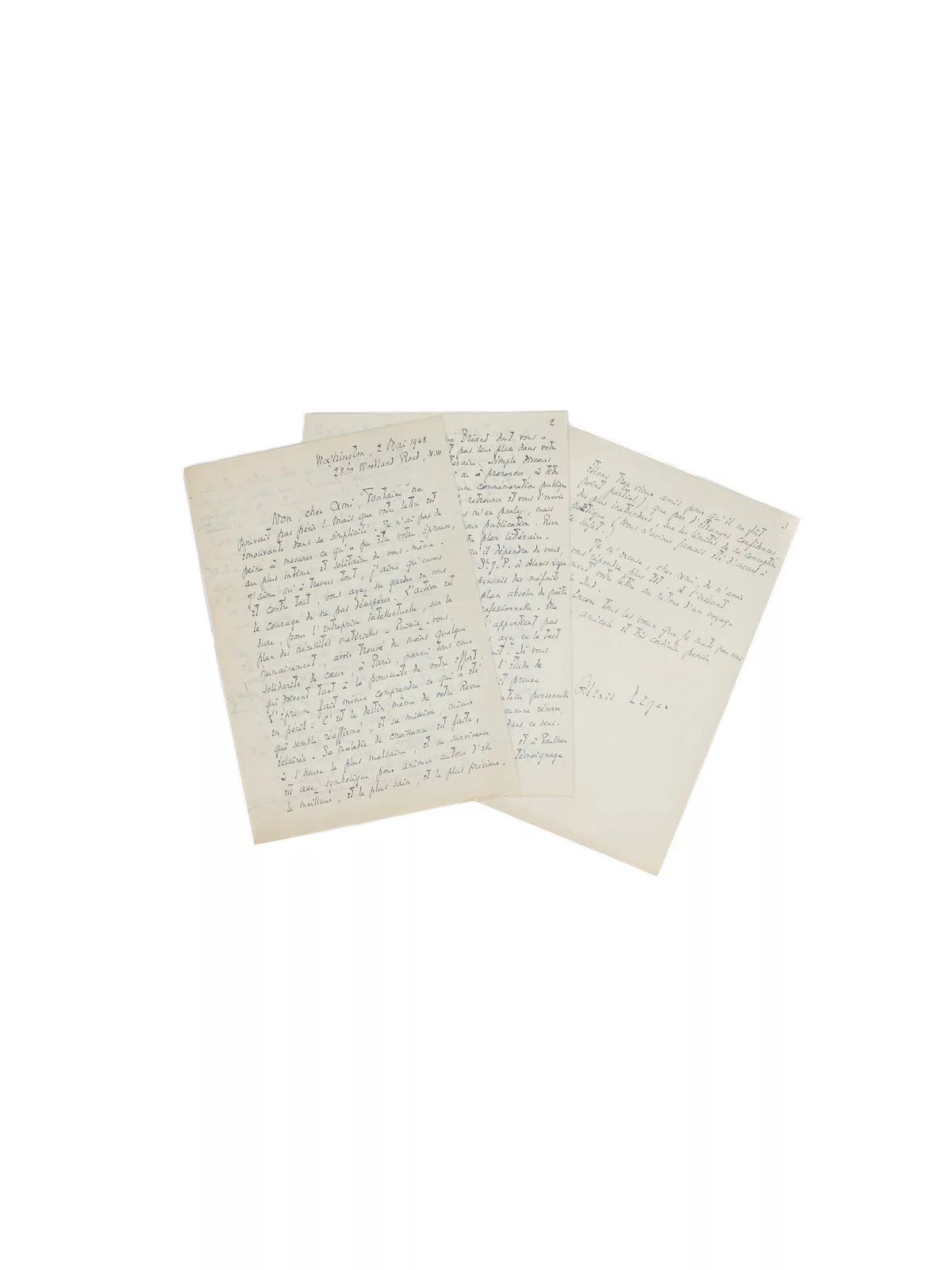
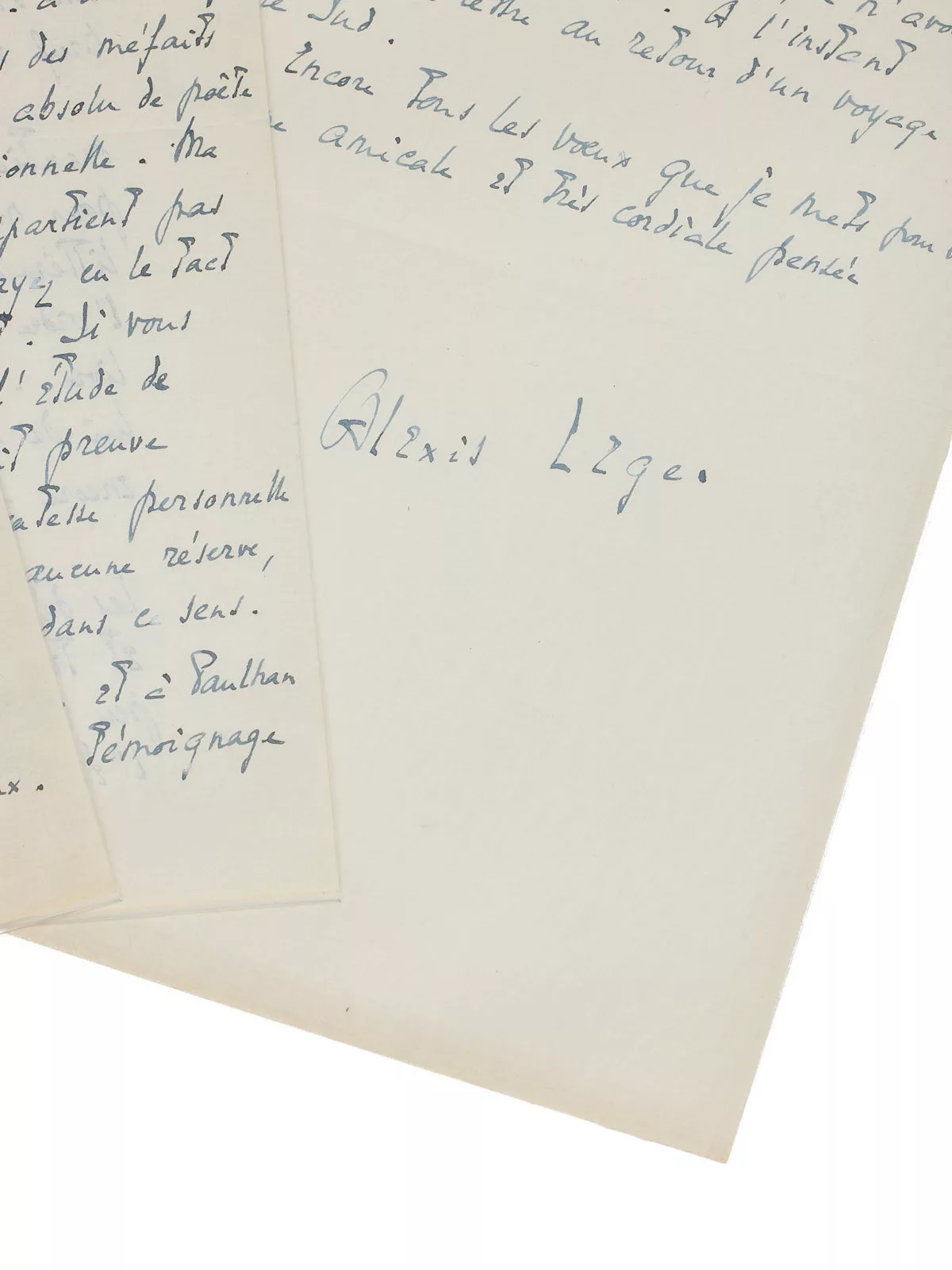
Lettre autographe signée
A fortnight earlier, Max-Pol Fouchet had confirmed to Perse that all signs were favorable: “To work, more than ever. I have not stopped preparing future issues, in the certainty that Fontaine could not disappear. The tribute to Saint-John Perse has lost none of my attention. I foresee it for no. 66 (July 15). All the contributors (André Gide, Denis de Rougemont, Gaëtan Picon, Albert Béguin, Marcel Raymond) have been ‘prompted’ again. In a week, I will tell you the outline of the contents and who is taking part. I have just written to Georges Schéhadé and Gabriel Bounoure, who were enthusiastic about this project. As soon as these essays reach me, we will build the issue. […]” (letter from M.-P. Fouchet to Saint-John Perse, April 15, 1948).
Such good news delighted the poet, at a time when Fontaine was facing difficulties:
“No, dear Friend, Fontaine could not perish!… But how moving your letter is in its simplicity. I have no difficulty gauging what your ordeal must have been, in the most intimate and solitary part of yourself. I love that through everything, I love that against all odds, you have managed to keep within you the courage not to despair. Action is hard, for an intellectual enterprise, on the level of material necessities. May you, humanely, have found at least some solidarity of heart in Paris, among all those who owe so much to the pursuit of your effort. The ordeal makes one better understand what was at risk. It is the very destiny of your Review that seems reaffirmed, and its mission better illuminated. Its growing pains have occurred at the unhealthiest hour, and its survival is symbolic enough to rally around it the best, the healthiest and the most precious. My congratulations on your victory, and, for your new battle, my wishes, more confident and more ‘demanding’ still. I shall do my best, on this side of the water, to secure you as much sympathy as possible, and, if I can, solidarity. There is something of French affairs at stake here, as I would wish it to be understood. I am touched to think that amid so many worries you have kept in mind this tribute issue you are kind enough to mention to me again.”
The last issue of Fontaine then on sale dated from… November 1947 (no. 63). Since then, tables of contents had been planned and texts gathered. But reviving Fontaine soon seemed impossible, despite the wish to do so. An announcement was even made to the authorities on April 28, 1948, with a detailed publication schedule. This is probably what made Fouchet so optimistic about his project with Perse, which would have represented a most important return to literature. Alas, the publication of issue 64 was continually postponed, prolonging the title’s slow demise, which caused legitimate concern for Saint-John Perse by June. This tribute issue was nonetheless published two years later, “in the Cahiers de la Pléiade, augmented with other texts in autumn 1950, that is, a few months after the liquidation of the Société des Éditions de la Revue Fontaine, pronounced on July 15, 1950. The names of Max-Pol Fouchet and Fontaine are not mentioned there once” (in François Vignale, La Revue Fontaine, Rennes, PUR, p. 247).
Perse, in fact, had prepared everything for this special issue on which he had placed so much hope.
“Here, without further ado, are my answers to your letter:
1° – I am sending you under the same cover the text you are waiting for from me — title: ‘Et vous mers…’ (opening of the poem) — [Please have it printed in a fairly bold italic, if possible]; And above all, please assure me of a proof sent for me to correct myself. (I insist on this essentially, having always had every misfortune in this respect: ‘misprints’ have a particular taste for my texts, as certain snails do for shoreline plants.) It is unnecessary to return the manuscript with the proofs.
2° – The pages on Briand that Rougemont mentioned to you have no place in your literary tribute issue. Simply an occasional speech I had to deliver, in a purely personal capacity, at a public commemoration abroad. I was able to find it and send it to you as a friend, since you mention it, but for personal use and not for publication. Nothing by me, or about me, outside the literary sphere. Protect me, as far as it depends on you, against any linking of St.J.P. to Alexis Léger. I have already told you what I think of the harm done by such a connection, between my absolute plane as a poet and the lateral plane of a professional life. My private personality likewise does not belong to the public, and I appreciate that you had the tact not to ask me for any portrait. If you feel you must keep Marcel Raymond’s essay as it is, since he showed me the greatest personal delicacy and I have in fact expressed no reservations toward him, so be it, but no other exception of this kind.
3° – I have asked Breton and Paulhan to give you something. Their contribution would please me, both as a friend and intellectually. But I do not know whether they are aware of the resurrection of ‘Fontaine’ and the revival of your project. Would you make sure of this directly with them?
Among the following generations, whom I know poorly, Michaux and Char are the only ones whose literary sympathy would mean something to me. But I do not know the former personally, and with the latter, whom I consider a true poet, I have only ever had a brief exchange of letters.
I am glad to hear you mention Béguin. I am counting on Rougemont to avenge me somewhat against absurd literal interpretations, he who dealt so intelligently with the ‘fabulous’ order in his last and very fine book. With my affectionate thought, convey this reproach to him from me: that he has still not let me know his address in Europe.
I am trying to find for you, among the scattered deposits of a homeless life, the last and very long letter I received from Valéry, shortly before his death — interesting less for its excessive praise of my early poems (we were too old friends for him not to be partial) than for strange confidences, most unexpected, on the limits of his poetic conception (we had never agreed on this subject). I apologize, dear Friend, for not having been able to answer you sooner. Your letter reached me only just now, upon returning from a trip to the South.
Once more, all the wishes I hold for you, in a friendly and most cordial thought. Alexis Léger.”