

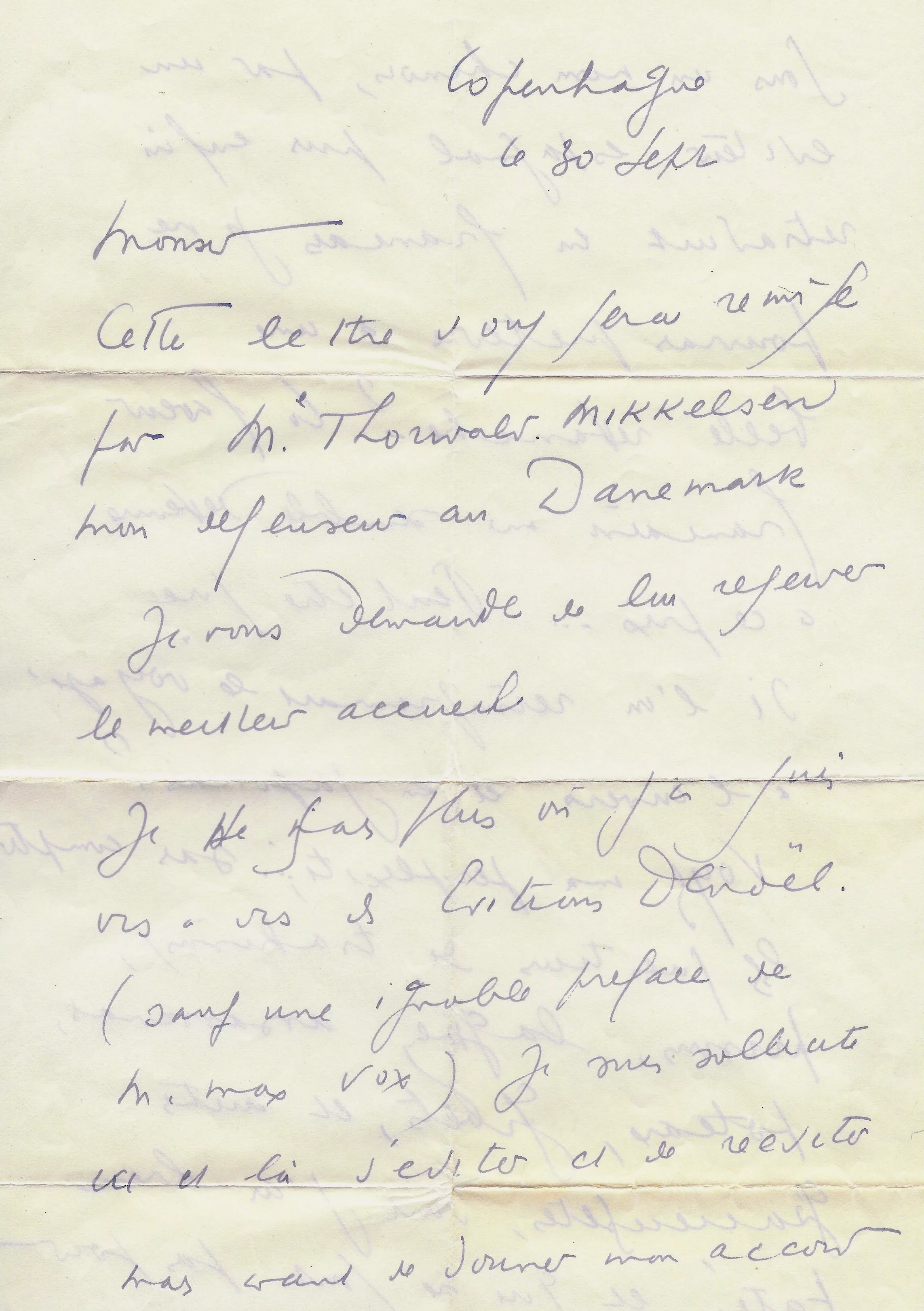
Lettre autographe à Gui Tosi
A fine letter, full of irony and humor, entrusted from Denmark to his lawyer, Mr. Thornwald Mikkelsen.
Céline asks Tosi to “give the warmest welcome” to his lawyer, as he no longer knows where he stands “with the Éditions Denoël — (except for a vile preface by Mr. Max Vox) — and wonders whether, by writing in English, published in America, under a Chinese name, by a Spanish publisher, and then finally retranslated into French, I might not claim a fine revenge?… Perhaps if the Voyage were reprinted backwards and in Japanese? You see my perplexity… not to mention the questions of treason, prisons, hard labor, murder, the firing post, gallows and other such pleasantries which I have had my fill of and which are no laughing matter…”
On October 20, 1944, Maximilien Vox was appointed provisional administrator of Éditions Denoël and, in October 1945, published a scathing article on the occasion of the publication of Cendrars’s L’Homme foudroyé: “This immense book is built on the model of the interior monologue, a form of which Joyce left a monument […] And here, by an irresistible symmetry, comes the memory of Voyage au bout de la nuit, so that we discover that the real Céline is Cendrars; I mean that from the ancestral man that is Blaise there broke off the artichoke leaf that is Céline, but an outer one, far from the savory heart, to which he had to give an artificial flavor by dipping it in all sorts of sauces (…) When he says: ‘Ah! the bastards’ — that is worth forty pages of the inoculo-donco-cuco-candries of the doctor-rhetorician Destouches.”
Céline did not learn of this until two years later, in the summer of 1947, and reacted immediately: “I sent Cendrars a letter in the terms you can imagine — in which I call Vox a queer, a slut, a filthy scoundrel, and worse. Everything he deserves. To besmirch a man in chains who feeds you is quite something.” Vox had in the meantime left his post at Denoël since June — something Céline was probably unaware of — and, from September onward, the Céline file was handled by Jeanne Loviton and then by Guy Tosi, to whom Céline sent this new letter. At Jeanne Loviton’s request, Tosi traveled to Copenhagen on November 18. And on December 3, Éditions Denoël sent Céline his author’s account, which “currently stands entirely settled,” but the very next day the writer, by registered letter, terminated his contracts and began a war against the Denoël publishing house: tensions rose steadily until the following year, when the break became official, after sixteen years of collaboration.
Céline had a new edition of the Voyage published in June 1949 by a Belgian publisher, Frémanger, at Éditions Froissart, followed by further publications with Chambriand and Monnier, before Gaston Gallimard, orchestrating the move, bought out Éditions Denoël in October 1951. Le Voyage au bout de la nuit was thus finally reprinted in France, officially, in March 1952, in a printing of 9,000 copies, plus 1,050 copies in boards by Paul Bonet.