

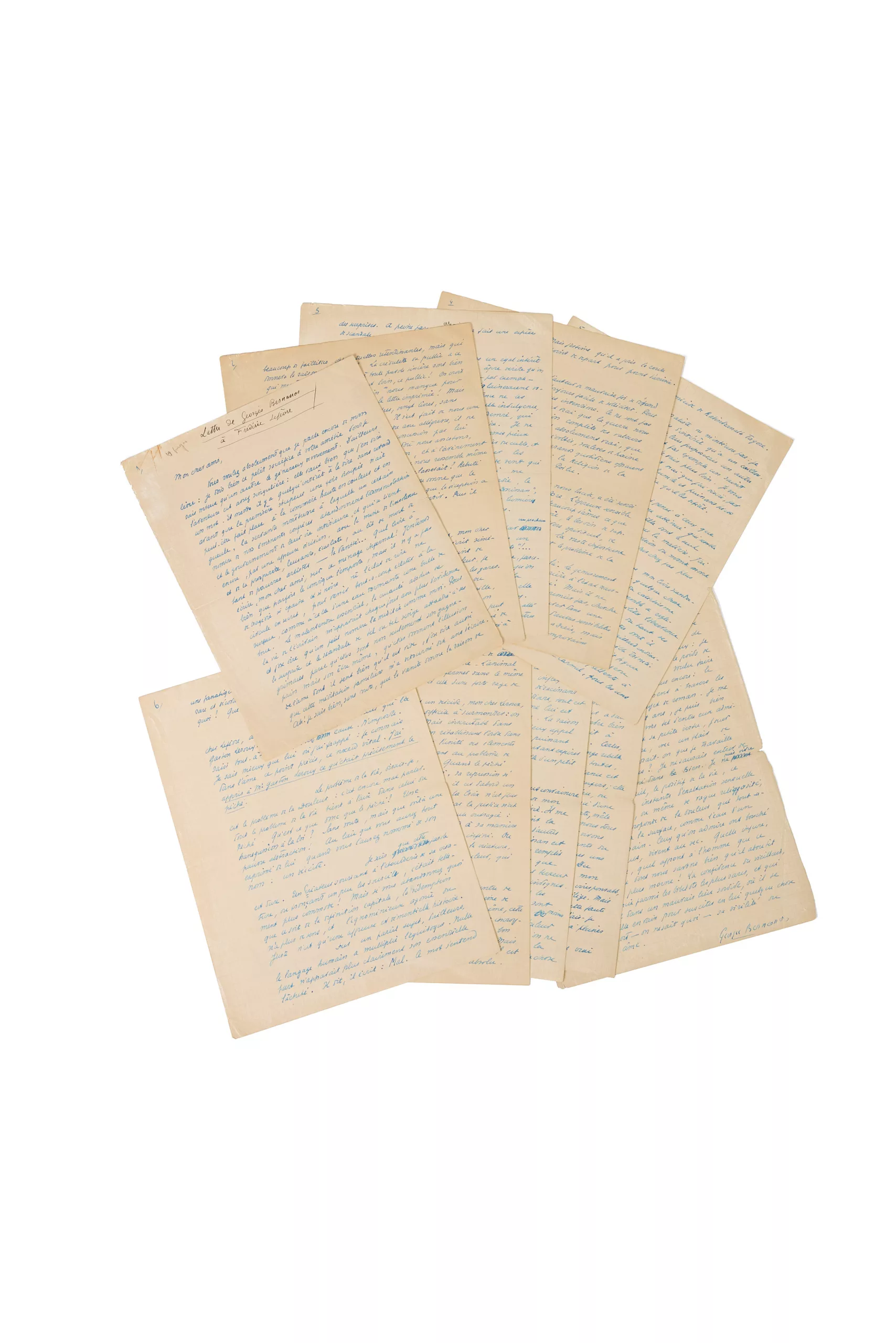
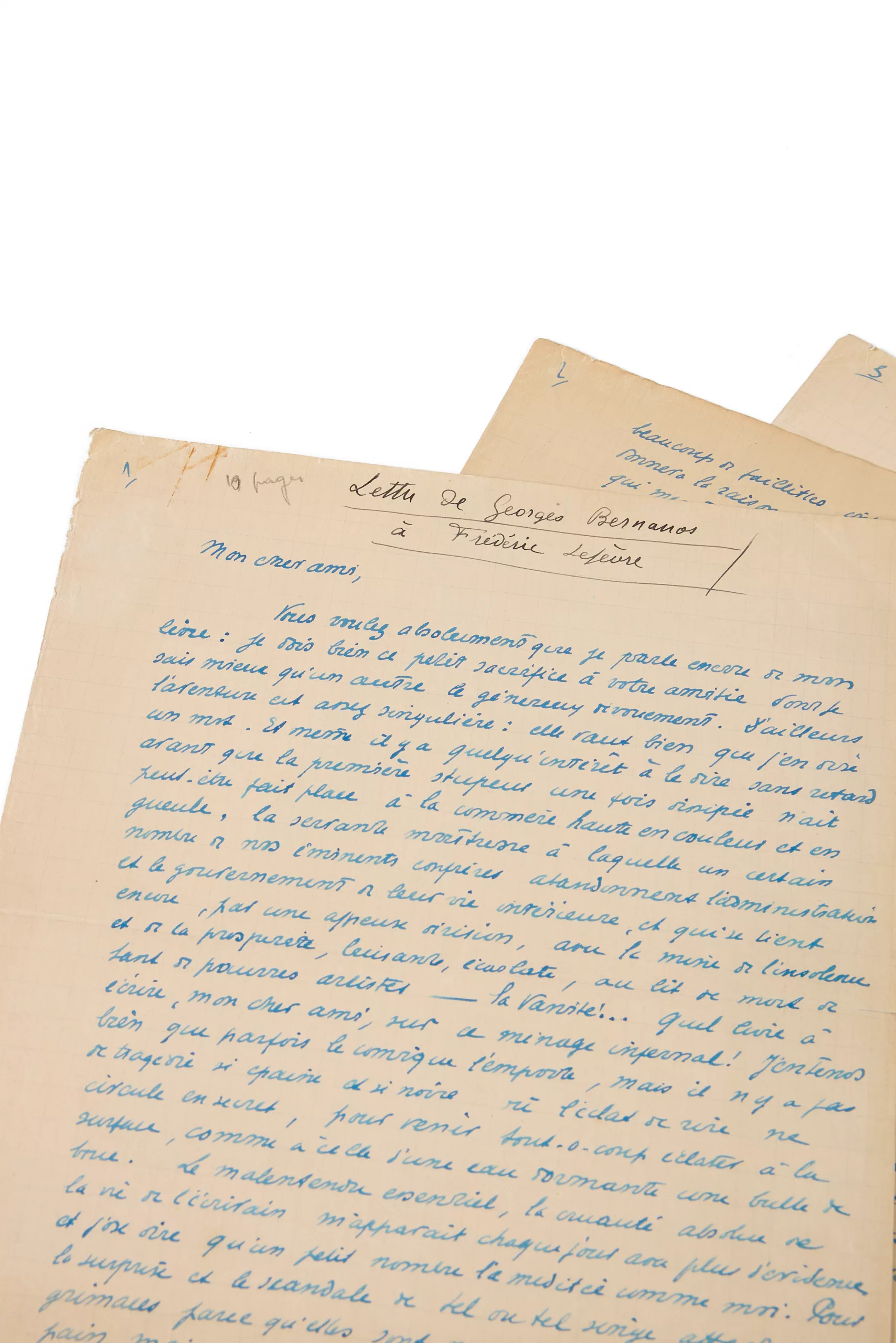
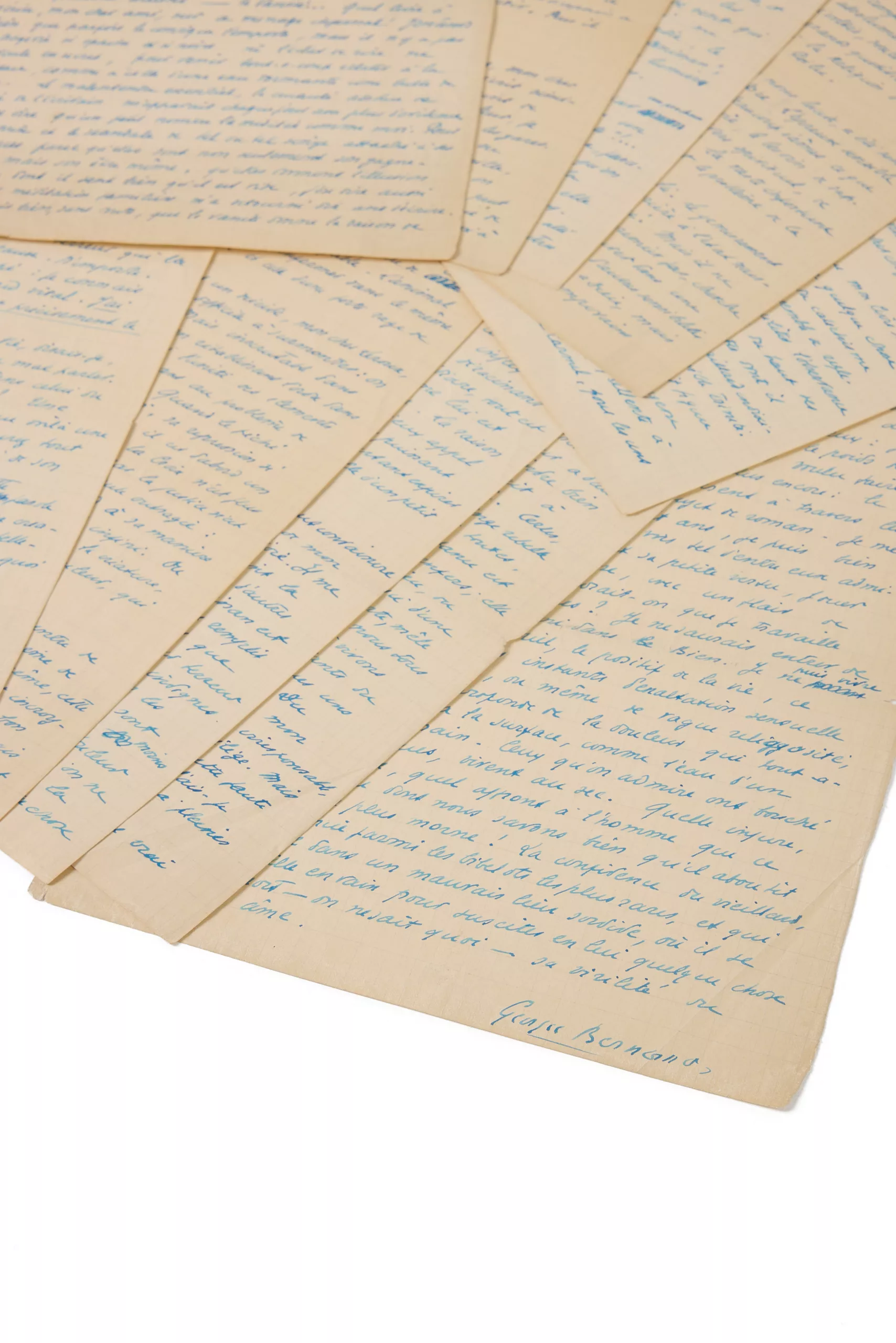
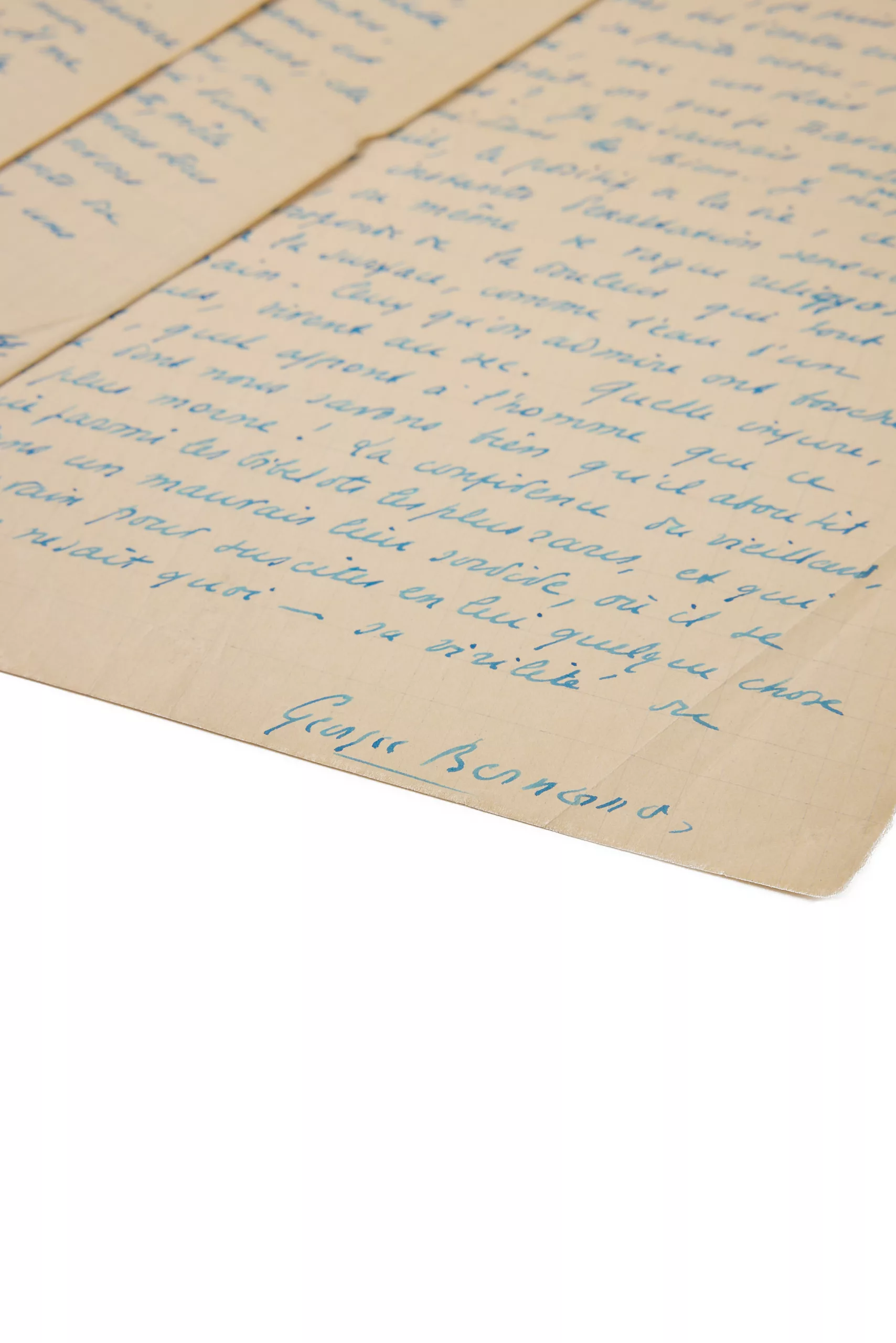
Lettre autographe à Frédéric Lefèvre sur [Sous le soleil de Satan]
Bernanos composed his letter in 17 clearly distinct paragraphs of uneven length. The manuscript contains only a few deletions and, in a different ink, two additions, as well as the title “Lettre de Georges Bernanos à Frédéric Lefèvre.”
This letter follows the famous interview Bernanos gave to the same Frédéric Lefèvre, then editor of Les Nouvelles littéraires, in April — probably only days or weeks earlier. In that interview, Bernanos began by stating: “I do indeed believe that my book is a book born of the war,” even though the novel nowhere depicts the war or even alludes to it. Frédéric Lefèvre expressed his surprise: “I would be very curious to hear you explain how the war and its aftermath could have engendered in you this powerful, dramatic and mystical novel, all the more dramatic for being mystical.” Bernanos’s answer is remarkably illuminating about what he intended: “Ah, well: one must first know how I wrote it. One can say what one likes about it. Truly anything can be said. I threw myself into it completely. I gave myself to it entirely. In fact, I began it a few months after the armistice. The face of the world had been ferocious. It was becoming hideous. The universal release of tension was an unbearable spectacle. Hunted for five years, the horrible pack finally thrown off the scent, the human animal, back in its den, exhausted, was emptying its belly and expelling the insipid water of puritanical idealism. Which of us did not then feel dispossessed? Democratic ideology had still been bearable, in our Latin country, because until then it had worn the jovial, good-natured mask of political self-interest. For the first time, we had seen its true face. Everything had been taken from us. Yes! whoever held a pen at that moment found himself obliged to reconquer his own language, to throw it back onto the forge. The surest words were rigged. The greatest ones were empty, rattling in the hand. Men commonly called — I won’t even say a hero, but a saint — the re-enlisted sergeant, killed by chance at his post. Pain and death had become a kind of state monopoly. The deified fatherland received the incense of every cult, as though the kingdom whose coming the Lord’s Prayer implores were that of Universal Democracy.” That much had been said, but perhaps not enough. Lefèvre returned to the charge in this important letter, a veritable manifesto even more illuminating than the interview itself: “You absolutely want me to speak again about my book: I owe your friendship this small exercise…
“The essential misunderstanding, the absolute cruelty of a writer’s life, appears to me each day more clearly…”
“Le Soleil de Satan, on the contrary, I wrote sincerely, with a fine recklessness…”
It is true that the war forced upon us a complete revision of moral values […] that we felt ourselves in revolt, roused to hatred by the mysticism the great newspapers offered this poor exhausted people: the religion of the goddess France and Saint Poilu…”
When Bernanos was completing his first novel — during the winter of 1924–1925 — he knew very well the effect it would produce. A young priest (Abbé Pierre Camonin, just out of seminary) had come to visit the writer. Bernanos received him in the ground-floor room where he worked, and as he saw him out told him: “Father, I am writing a book that will cause a stir among your colleagues!” — an early announcement of the novel that would bear the title of a Romantic, almost Hugolian poem, in the manner of an oxymoron: Sous le soleil de Satan. Bernanos often explained the historical circumstances surrounding the novel’s genesis, and his statements varied little in substance. He emerged from the war transformed. He had been an insolent activist, a highly polemical journalist and something of a dandy student: “[…] I loved noise.” Such a prospect, and such an uproar, hardly troubled him; yet the resulting clamor would exceed all predictions, spreading far beyond the circle of presbyteries to the whole of French literary life (Robert Vallery-Radot’s phrase is well known: “a thunderclap in the sky of Letters”).
Interview of Bernanos by Frédéric Lefèvre, Les Nouvelles littéraires, 17 April 1926; Essais et Écrits de combat, I, pp. 1039–1040.