

Lettre à André Belamich
[August 1, 1956].
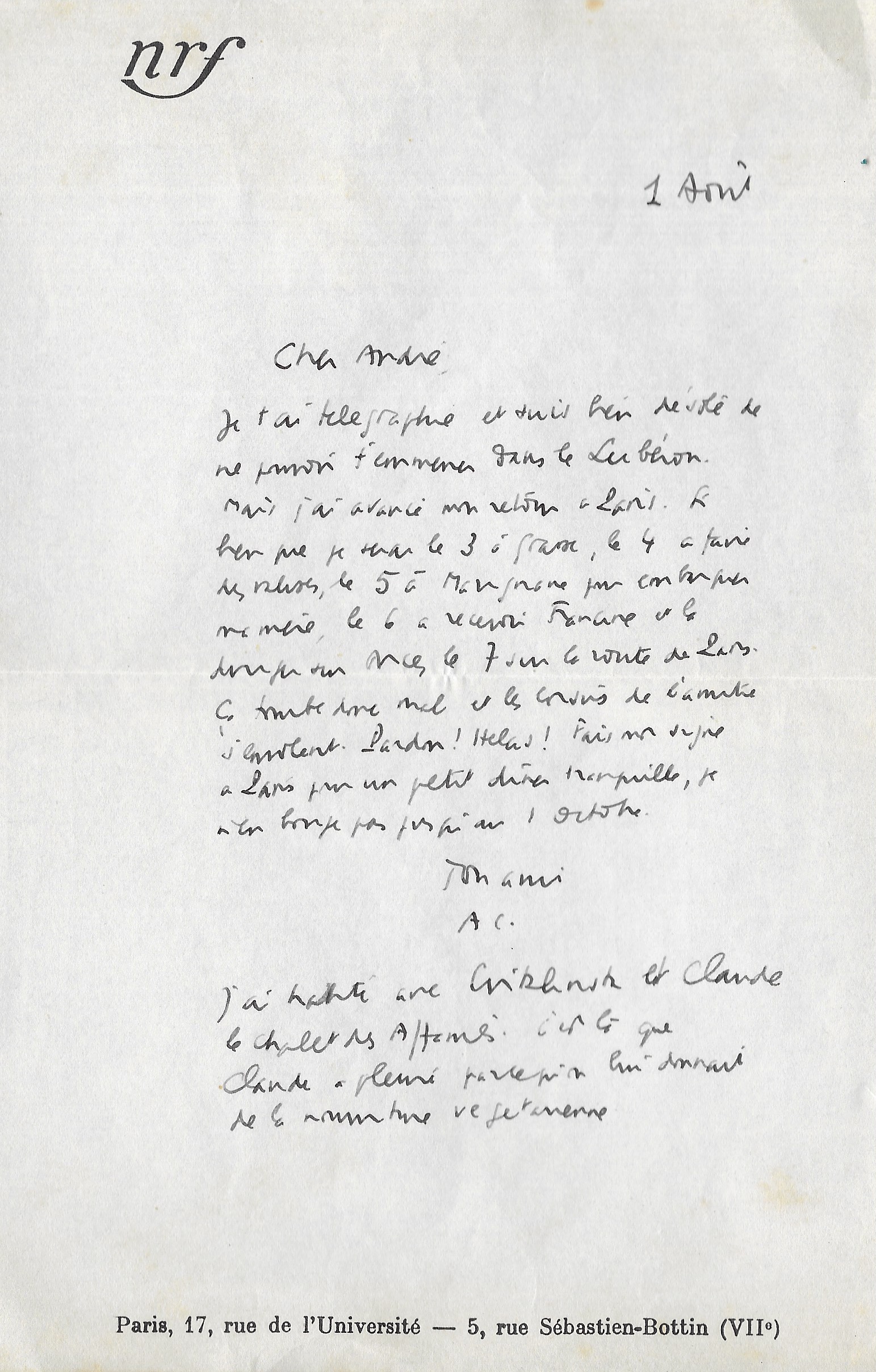
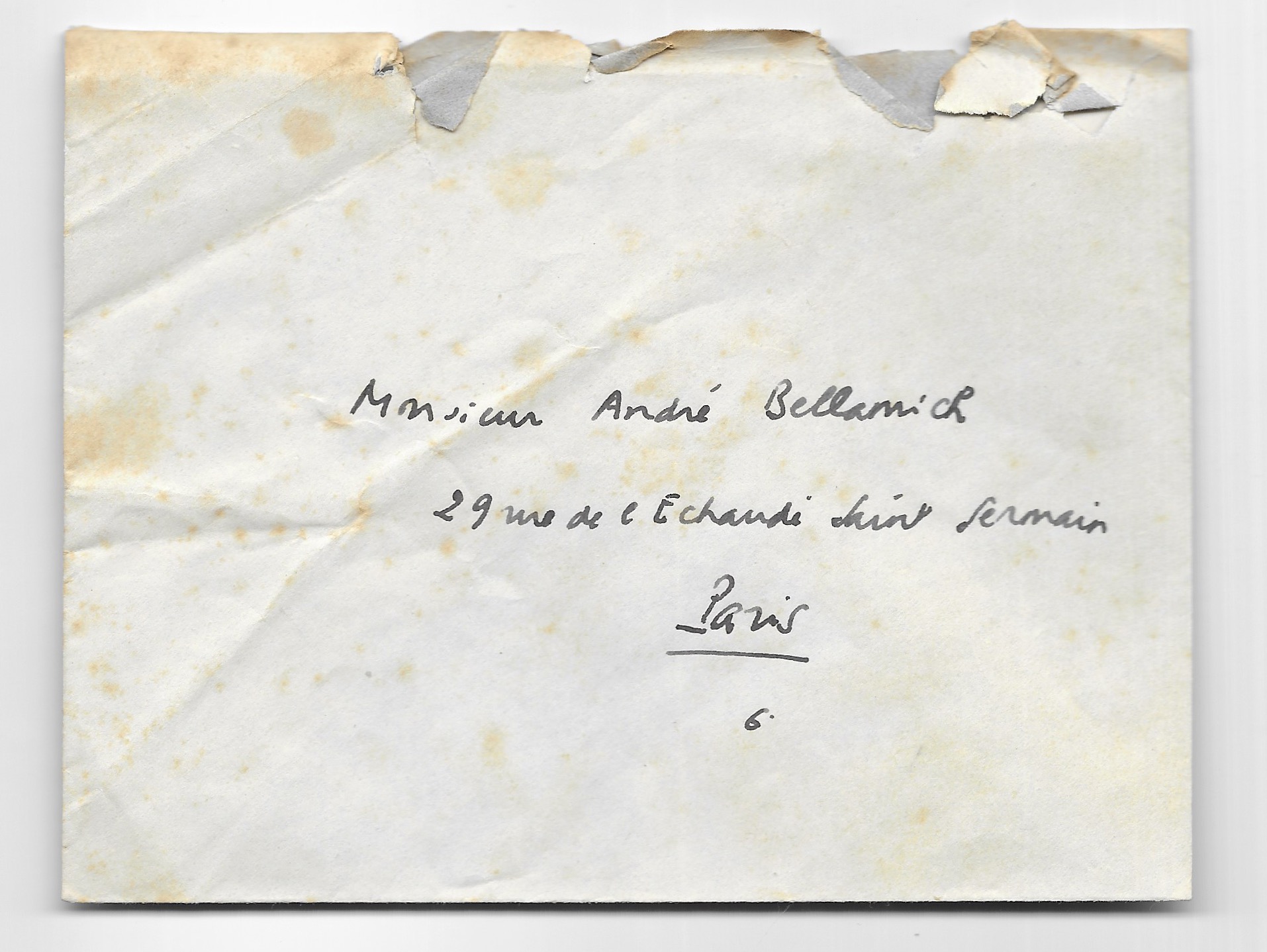
1 p. octavo. Envelope preserved, NRF letterhead.
Camus apologizes for being unable to take his friend to the Luberon: “mais j'ai avancé mon retour à Paris [...].” He continues the letter by giving the stages of his journey: Grasse, Marignane, Nice, then Paris. “Pardon, hélas ! Fais moi signe à Paris pour un petit dîner tranquille, je n'en bouge pas jusqu'au 1er octobre.” Camus did indeed leave the Palerne estate, where he had been staying since July 12, to accompany his mother to Marseille-Marignane airport on August 5. As planned, he was back in Paris on the 8th, in time to attend the first rehearsal of Requiem pour une nonne.
The most interesting part of the letter is yet to come: a postscript that took us some time to understand. “J'ai habité avec Cviklinski et Claude au Chalet des affamés. C'est là que Claude a pleuré parce qu'on lui donnait de la nourriture végétarienne.” The anecdote refers to a distant episode, probably in response to a letter from Belamich whose content we do not know: this stay dates from 1937. The place is above Lucinges, in Haute-Savoie, deep in the Voirons massif. Although it offers a fine view over Lake Geneva and the Jura massif, it is chiefly known for having sheltered Russian émigrés before the 1917 Revolution. Lenin, then living in exile in Geneva, is said to have visited his compatriots at the Affamés. The anecdote carries particular resonance for Camus and Belamich, both members of the Algerian Communist Party during their school years.
In 1937, Albert Camus made a stay at Lucinges, his first visit to the south of France. He was welcomed by his friend Jean Degueurce, who took him to this chalet, called “le Château des affamés.” Owing to its discomfort (no running water, no heating, no electricity), Camus left it for the chalet des Sans Soucis, belonging to Stanislas and Marguerite Cviklinski, another couple from his Algiers circle. Stanislas — then known as Stacha — was a friend of Camus, and Marguerite, then known as Morella, was a young Algerian actress who had played Anna in Malraux's Le Temps du mépris, a production of the Théâtre du travail directed by Camus, at the time of Révolte dans les Asturies. She married Dr. Stanislas Cviklinski the year after the play, in 1935. It was Stacha Cviklinski who, in 1942, advised Camus to seek treatment at Le Panelier.
According to our archives, Albert Camus had made only one other allusion to this stay (which, to our knowledge, is mentioned in no biography of Camus), in a letter to Lucien Bénisti (brother of Louis) dated August 4, 1937: “Mais, je suis arrivé à Lyon dans l'état du voyageur traqué. J'ai choisi le plus facile. Le plus facile était le plus près : Lucinges. On m'y avait offert un chalet (Château des Affamés) (…) le chalet est proprement inhabitable. C'était une farce. Par bonheur, Mme Cviklinski (l'« Anna » du Temps du Mépris) m'a accueilli dans son chalet.”
This letter to André Belamich reveals that another friend of the group was present: a certain Claude, who can only be Claude de Fréminville, with whom Camus founded the short-lived Éditions Cafre (CAmus-FREminville) the following year. Fréminville, it appears — something of a scoop — did not care for vegetarian food! Camus had left Algiers for Marseille with Fréminville on July 29, 1937. Arles, Avignon and Orange followed, then Lucinges, then Paris, and finally, from July 16, Embrun, for a cure. This long stay, which continued until September and into Italy, together with Jeanne-Paule Sicard and Marguerite Dobrenn, his Communist Party comrades and actress friends from the Maison Fichu, remains poorly documented. This letter allows us to establish that Fréminville was still with him at that point, at least as far as Paris. The two men appear to have met again in September, in Marseille.
The most interesting part of the letter is yet to come: a postscript that took us some time to understand. “J'ai habité avec Cviklinski et Claude au Chalet des affamés. C'est là que Claude a pleuré parce qu'on lui donnait de la nourriture végétarienne.” The anecdote refers to a distant episode, probably in response to a letter from Belamich whose content we do not know: this stay dates from 1937. The place is above Lucinges, in Haute-Savoie, deep in the Voirons massif. Although it offers a fine view over Lake Geneva and the Jura massif, it is chiefly known for having sheltered Russian émigrés before the 1917 Revolution. Lenin, then living in exile in Geneva, is said to have visited his compatriots at the Affamés. The anecdote carries particular resonance for Camus and Belamich, both members of the Algerian Communist Party during their school years.
In 1937, Albert Camus made a stay at Lucinges, his first visit to the south of France. He was welcomed by his friend Jean Degueurce, who took him to this chalet, called “le Château des affamés.” Owing to its discomfort (no running water, no heating, no electricity), Camus left it for the chalet des Sans Soucis, belonging to Stanislas and Marguerite Cviklinski, another couple from his Algiers circle. Stanislas — then known as Stacha — was a friend of Camus, and Marguerite, then known as Morella, was a young Algerian actress who had played Anna in Malraux's Le Temps du mépris, a production of the Théâtre du travail directed by Camus, at the time of Révolte dans les Asturies. She married Dr. Stanislas Cviklinski the year after the play, in 1935. It was Stacha Cviklinski who, in 1942, advised Camus to seek treatment at Le Panelier.
According to our archives, Albert Camus had made only one other allusion to this stay (which, to our knowledge, is mentioned in no biography of Camus), in a letter to Lucien Bénisti (brother of Louis) dated August 4, 1937: “Mais, je suis arrivé à Lyon dans l'état du voyageur traqué. J'ai choisi le plus facile. Le plus facile était le plus près : Lucinges. On m'y avait offert un chalet (Château des Affamés) (…) le chalet est proprement inhabitable. C'était une farce. Par bonheur, Mme Cviklinski (l'« Anna » du Temps du Mépris) m'a accueilli dans son chalet.”
This letter to André Belamich reveals that another friend of the group was present: a certain Claude, who can only be Claude de Fréminville, with whom Camus founded the short-lived Éditions Cafre (CAmus-FREminville) the following year. Fréminville, it appears — something of a scoop — did not care for vegetarian food! Camus had left Algiers for Marseille with Fréminville on July 29, 1937. Arles, Avignon and Orange followed, then Lucinges, then Paris, and finally, from July 16, Embrun, for a cure. This long stay, which continued until September and into Italy, together with Jeanne-Paule Sicard and Marguerite Dobrenn, his Communist Party comrades and actress friends from the Maison Fichu, remains poorly documented. This letter allows us to establish that Fréminville was still with him at that point, at least as far as Paris. The two men appear to have met again in September, in Marseille.
#29695
Back