

L’Étranger
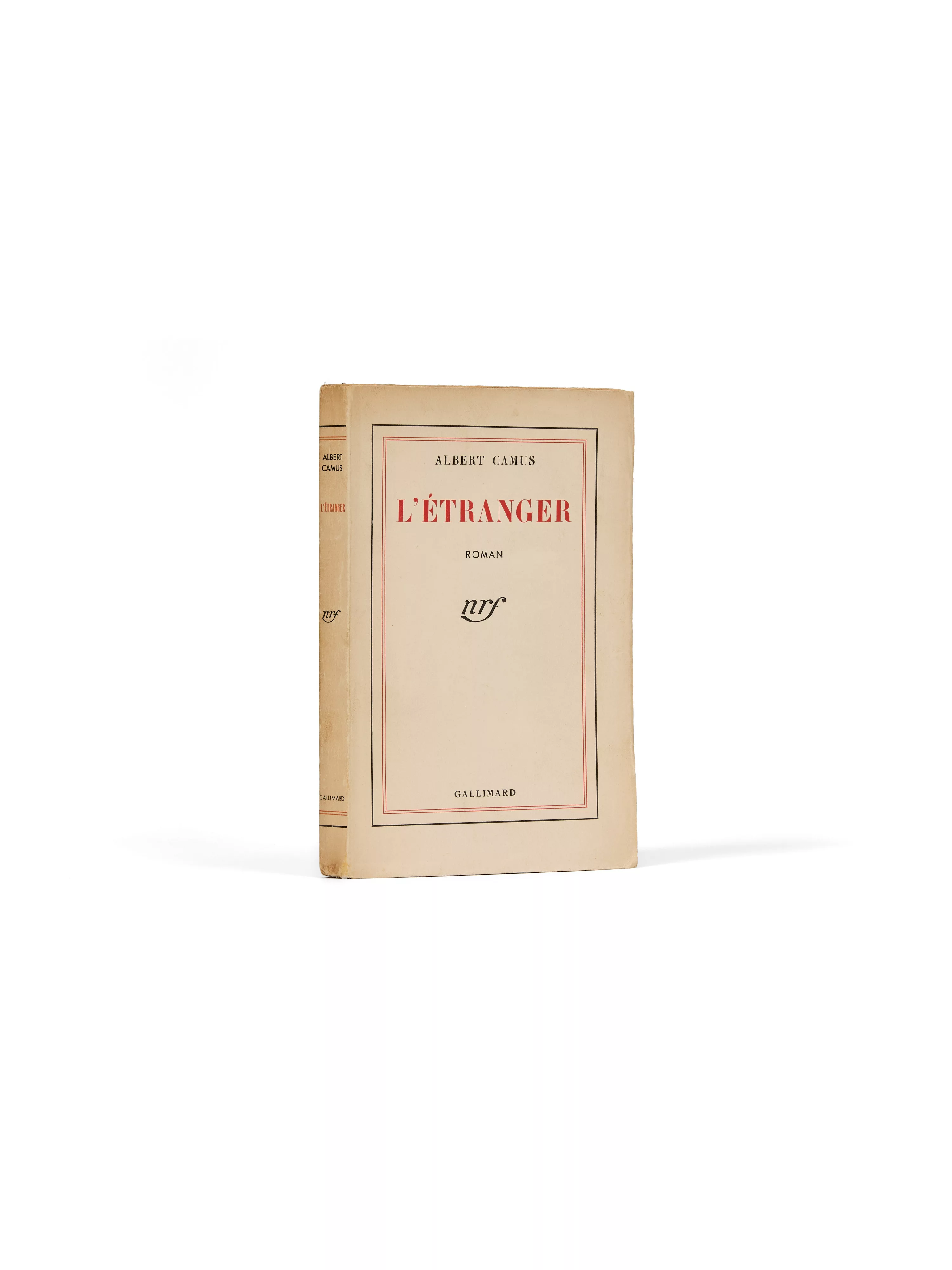
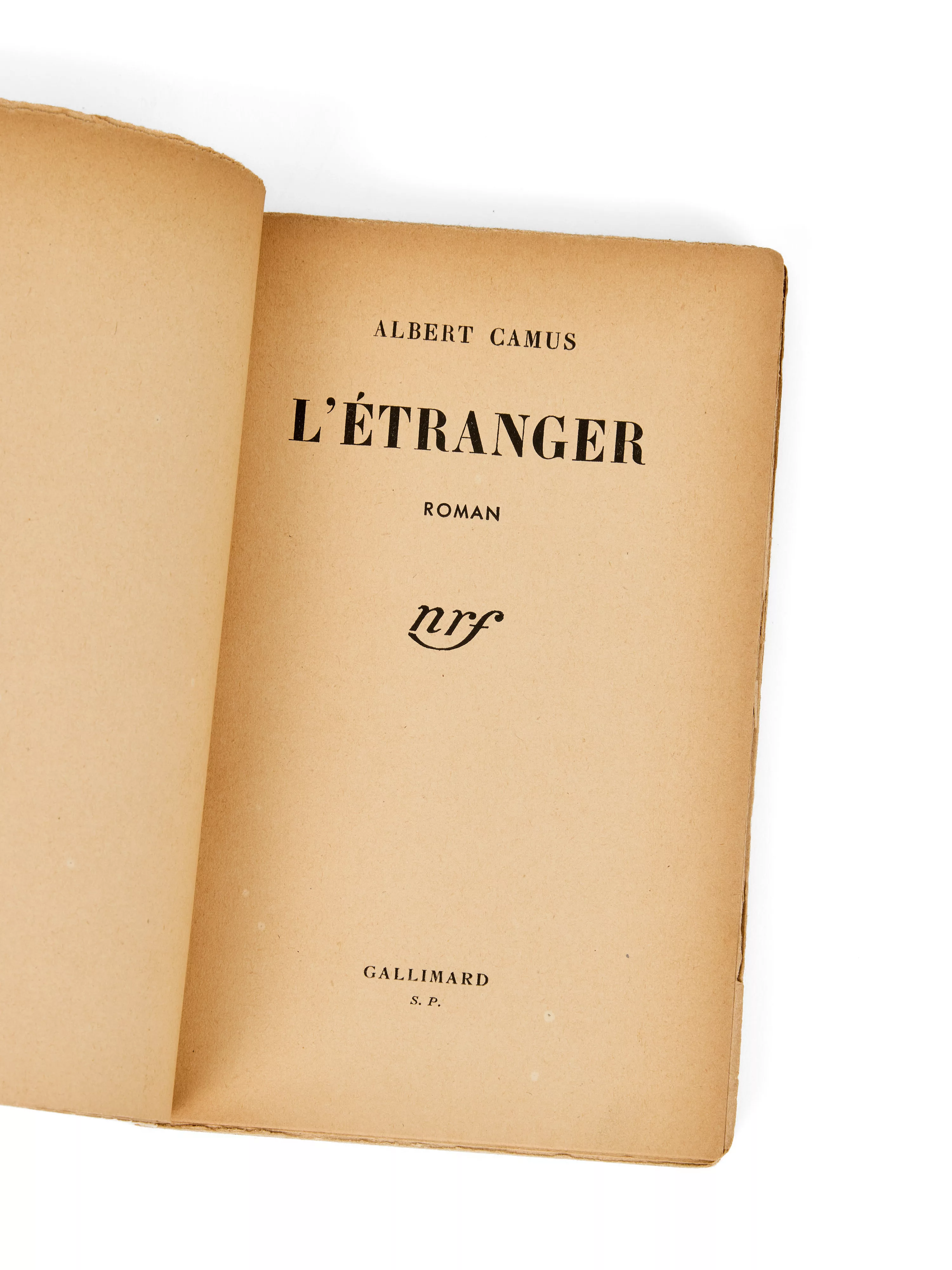
These copies are distinguished by the “S.P.” (service de presse) markings on the title page and rear wrapper and by the absence of the 25-franc price on the spine.
Only 4,400 copies were printed in the first production run: the first 400 were reserved for review, followed by successive commercial issues. Published in occupied Paris in May 1942, amid wartime paper shortages, L’Étranger initially received limited attention before becoming one of the defining novels of twentieth-century literature.
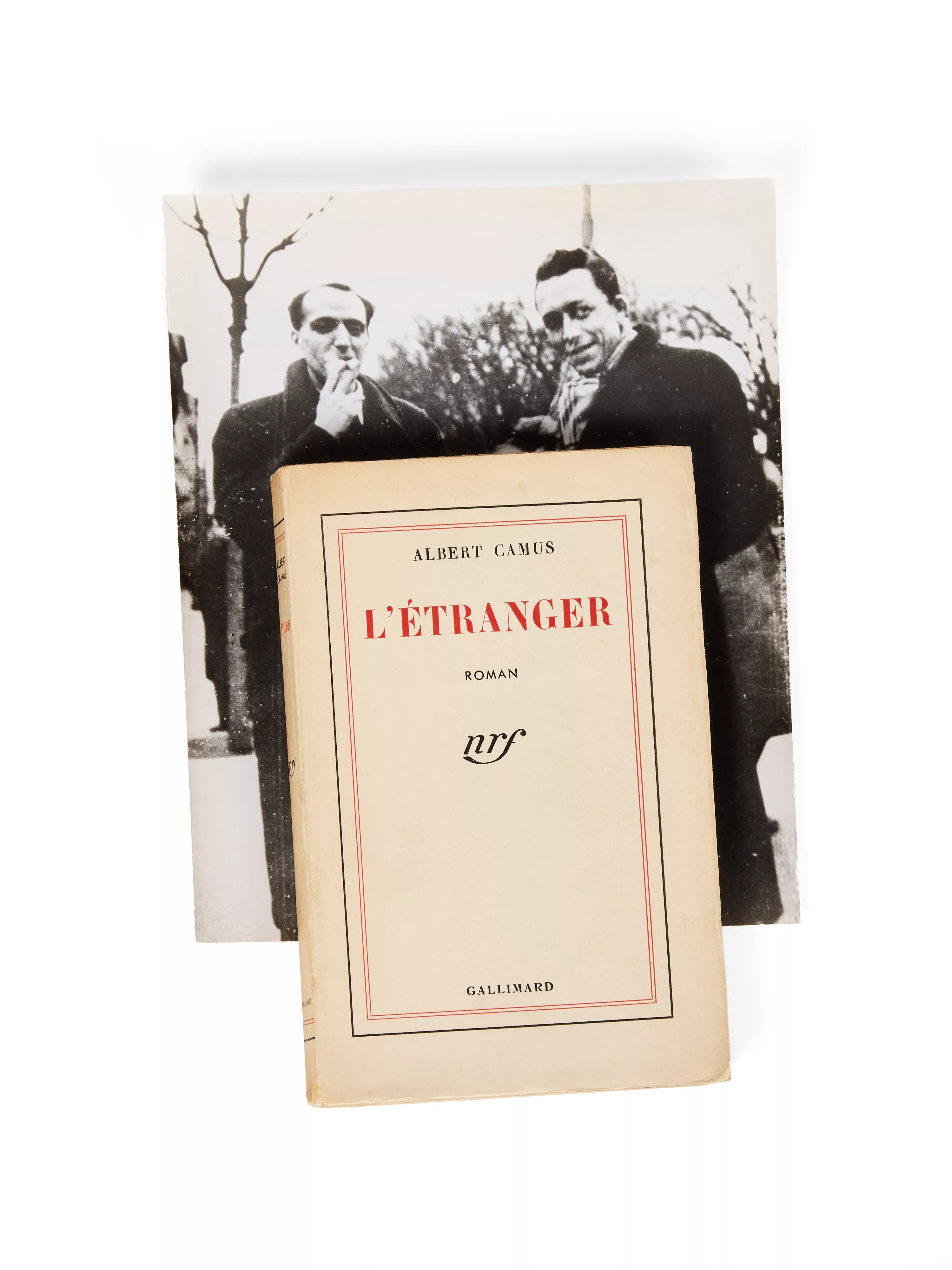
With: an original photographic print showing Albert Camus and Pascal Pia in Lyon in December 1940.
In February 1942, Albert Camus entrusted the final proofs of *he Stranger to Gallimard, who sent them to its printer nearby, at 45 rue de l’Abbé-Grégoire in Paris’s 6th arrondissement. Wartime paper shortages delayed production until 1 April. Barely three weeks were needed to complete the printing, which was finished on 21 April. The book reached the shops a month later, on 19 May 1942.
A total of 4,400 copies were printed: 400 review copies, followed by 4,000 copies divided into seven printing batches. Only the first of these bears no edition statement; as confirmed by the printer’s proof, the edition statement was changed every 500 copies. Thus, after the first 900 copies, another 3,500 were issued, all bearing “Chantenay, Imp. Paris, 21-4-42” at the foot of the final page and stating “second”, “third”, “fourth”, “fifth”, “sixth”, “seventh” or “eighth edition”.
The novel initially met with only modest success. Despite Gaston Gallimard’s efforts, it received fewer than a dozen reviews, and Camus himself gave a mixed assessment of its critical reception: “The reviews: mediocre in the Free Zone, excellent in Paris. In the end everything rests on misunderstandings. The best thing is to shut one’s ears and work.” (Letter to Fréminville, 6 September 1942, quoted by Todd.) The novel nevertheless sold well, and the first reprints appeared that autumn.
The earliest review copies, not intended for sale, can be identified by two distinctive features: the letters S.P. on the title page and at the upper left of the rear wrapper, and the absence of the price [25 francs] from the spine.
This is one of those copies. Camus, then in Algiers, did not see them. He had to wait more than six months, until a trip to Paris in January 1943, before finally holding “his” book in his hands. Only one copy is known to have reached him earlier: in August 1942, his friend, the physician Georges Elghozy, brought a copy from Paris to Algiers. To date, this is the only copy known with certainty to have been seen by Camus in the year of publication.
What followed is literary history. The Stranger became one of the most widely read French-language novels in the world and one of Gallimard’s greatest publishing successes. Above all, it remains an extraordinarily powerful novel and a cornerstone of any major collection of twentieth-century French literature. The scarcity of copies from the earliest issue makes them particularly desirable.
The ‘Service de presse’ copies are the rarest and most sought-after issue, and represent the finest state of this landmark of French and world literature.
Several were placed in important bindings relatively early: seven examples by Pierre-Lucien Martin are known, and two by Paul Bonet. These are naturally the most spectacular. Others were bound later by Miguet, Duhayon, Leroux and Alix.
A very good copy, the contents in excellent condition.
Todd, Albert Camus, une vie, Gallimard, 1996, pp. 587–588; Histoires d’un livre : L’Étranger, IMEC, October 1990, pp. 7–8; L’Étranger, essay and documentation by Bernard Pingaud, Gallimard, 2009.