

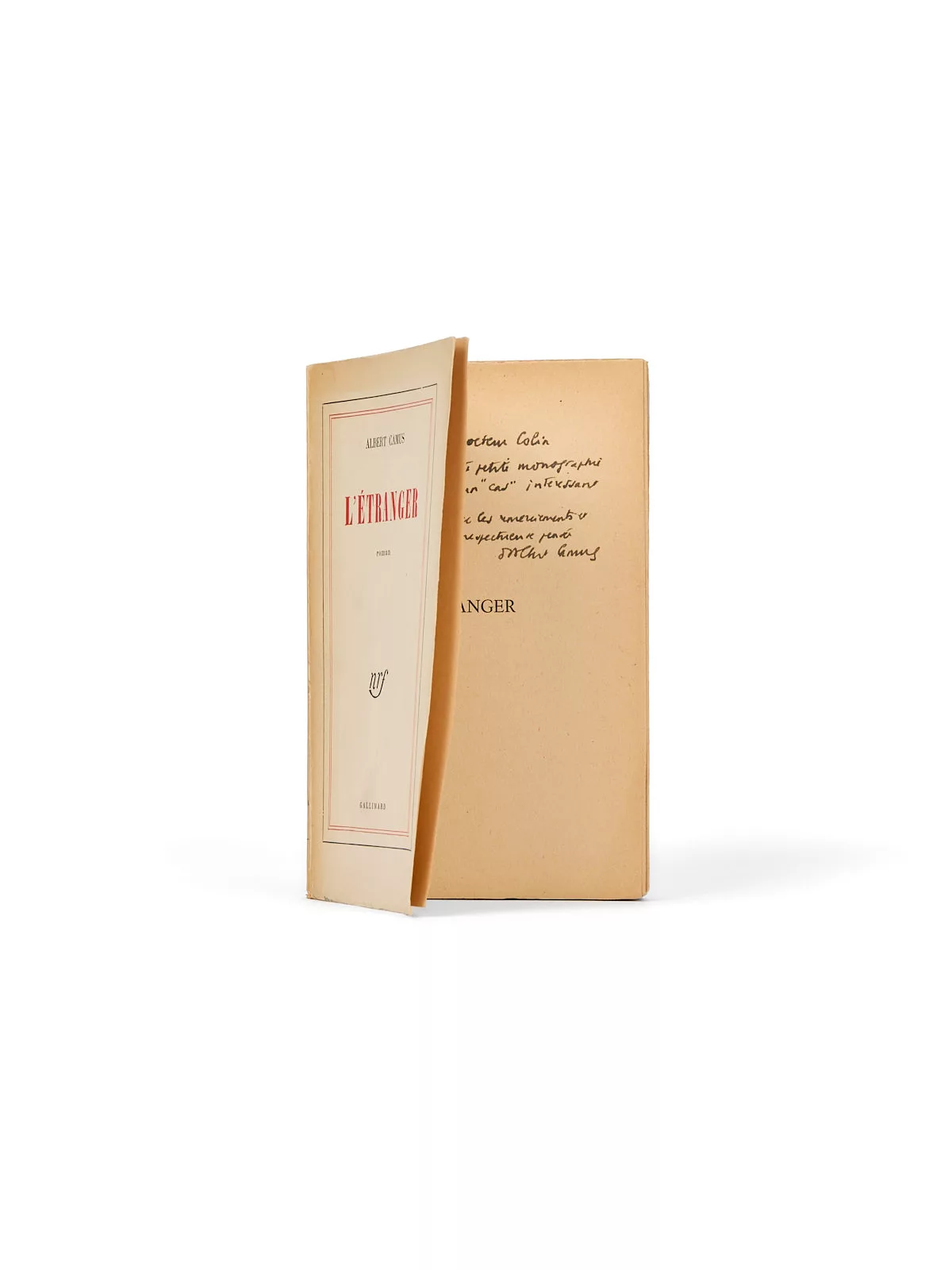
L’Étranger
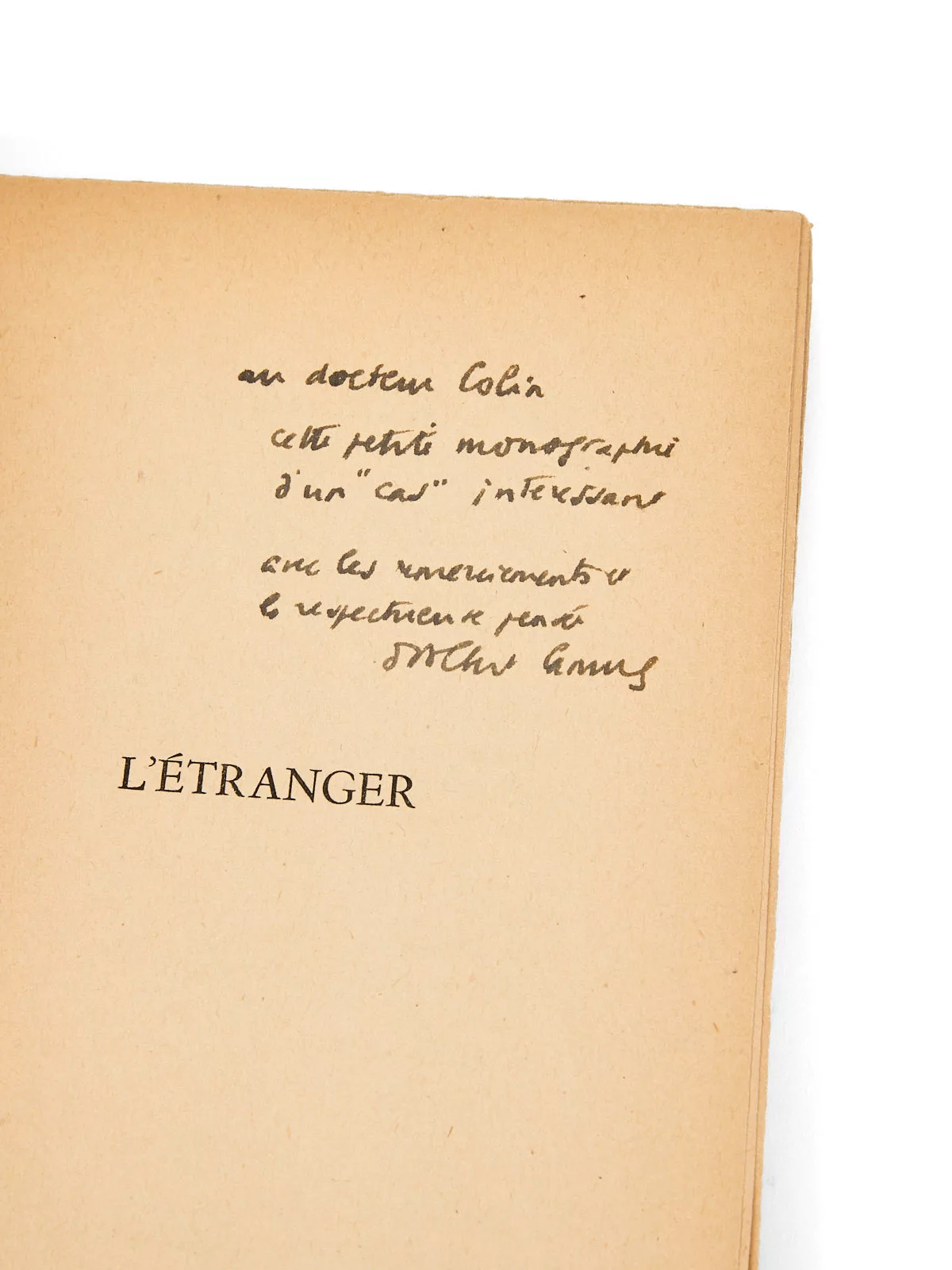
“au docteur Colin, cette petite monographie d'un “cas” intéressant, avec les remerciements et la respectueuse pensée d'Albert Camus.”
A little more than ten years after its publication, L’Étranger was already a classic and had just been reissued in a Bonet cartonnage binding. On that front, all was well for Camus. But it was perhaps the only thing that was: “Either the world is mad, or we are,” he wrote to René Char at the end of June. “Which is bearable? In the end, the soul is worn down, one lives against a wall. But one must endure, as you know as well as I do. Simply endure, and day…” (Correspondance, p. 118). The years 1953–1954 were among the most painful of Camus’s life.
In the autumn of 1953, Francine’s mental health seriously deteriorated. After a stay in Algeria and an initial period of care, she was treated at the Saint-Mandé clinic by Doctors Marcel Montassu and Tatiana Collin — whose name Camus, like Olivier Todd after him, spells here with a single l. It is to this woman doctor, then closely involved in the writer’s domestic drama, that this copy is inscribed. A few months later, following the episode of the jump from the window and the difficult decision to undergo electroshock treatment, Francine went to convalesce at Divonne-les-Bains, a spa town at the foot of the Jura, a few kilometers from Lake Geneva. “For years I lived enclosed within her love. Today I must flee, though I have never stopped loving her, in order to have one less worry about her, which is hard.” (Carnet III, p. 122). In his Carnets, Camus judges himself harshly, holding himself responsible for a catastrophe he was unable, or failed, to prevent.
The inscription is worth far more than a witty phrase. By describing L’Étranger as the “monograph of an interesting ‘case,’” Camus is playing on several levels at once. There is first Meursault, observed, judged, reduced by others to his gestures, his silences, his very strangeness. In the hands of a psychiatrist, the novel thus offers itself as a strange study of maladjustment, judgment and deviance.
There is also, in this year 1954, an evident echo of Dino Buzzati, whose Un cas intéressant Camus was about to adapt for the stage: the word is never innocent with Camus, and it takes on a particularly dense resonance here if one adds, in the background, Francine’s own “case,” then subjected to the observation, hypotheses and diagnoses of doctors. The word, addressed to the woman who had charge of Francine’s care at Saint-Mandé, cannot be incidental.
Un cas intéressant was presented to the Parisian public in March 1955. With great modesty, Camus explained in his preface that he had merely faithfully followed “the studied nonchalance of its language, its disdain for external effects, and otherwise [had] scarcely intervened, except when the play had to be adjusted to the stage on which it was performed.” In a letter to Buzzati, Camus confided that “the theater is a place of truth (…). Do not think that my name will be decisive for its success. Alas, no. I love your play because it is powerful and painful. But, in my opinion, it has little chance of public success here. Its vision will seem unbearable to our very frivolous Paris. Simply, it is an honor for me to accompany you in this difficult struggle and to help you as best I can.”
The adaptation of Un cas intéressant would prove salutary for Camus. Better still, this return to the theater did him a great deal of good. In March 1955, when Buzzati arrived in Paris, he recorded moments of grace which deserve to be transcribed: “It was the first time for me — I dashed straight to the Théâtre La Bruyère. I was awaited, at that deserted hour, by Camus, who had made the adaptation, by the director Georges Vitaly and by someone from the radio. A microphone was placed before my mouth and, in catastrophic French, I managed to say two or three foolish things, I still wonder how. I felt like a grub: the classic provincial arriving in the City of Light, presented to one of its greatest minds. Camus had not yet received the Nobel Prize, but he was already famous the world over. His face, however, more than his words, gave me a little courage. Thank heaven, it was not the face of a rotten intellectual; it was rather that of an athlete: open, the face of a man of the people, solid, expressing what seemed a good-natured irony; a “garage mechanic’s face,” as I heard someone describe it — it was rather a good find… And when he began to speak, I realized, to my great relief, that the inside matched the outside (…). It was from Camus that my salvation came. Even if he had not immediately understood my embarrassment and state of mind — in fact he had understood — his very personality would have put me at ease. How far we were from philosophy, from existentialism, from the revolt of man! When that infernal man sent by the radio had disappeared, Camus invited me to lunch with Vitaly at a small restaurant near the theater. One would have thought he had known me for years, as if he found my awkwardness perfectly natural. Although he was younger than I, he simply had the manner of a concerned elder brother, eager that everything should seem simple and familiar to me. He did not even seem surprised that I had never been to Paris (…) Where did he take me? What did he show me?… There was such confusion, such excitement in my head!… Things I had seen on postcards, in photographs, in films. But this time they were real. And, at my side, was Albert Camus. He showed me the compassion of a great lord. When I ventured — I no longer remember about what — an allusion to his book, L’Étranger, he cut it short with extreme elegance by pointing out to me a house where a famous man, whose name escapes me, had once lived. The last image I recall of him?… At the home of Ludmila Vlasto, the owner of the theater, who received us after the performance. At a certain hour, once the ‘personalities’ and the critics had taken their leave, only the actors remained, along with a few young men and some very pretty young women. Dance records were put on. Camus could not stay still for a second. He danced one dance after another, with the gaiety of a twenty-year-old. Philosophy? The great problems of man? The drama of modern communities? Our eternal condemnation to solitude? That evening, at least, Camus was happy to be alive. He was dressed in blue. Dino Buzzati. January 1960.”
A good copy, well preserved.
146th-edition statement on the title leaf; recall that the first edition (April 1942) was printed in 4,400 copies, of which only the first 550 bear no edition statement. Inscriptions on L’Étranger are particularly rare: those revealing so interesting a connection are exceptional.
Provenance: Tatiana Collin (signed inscription), thence by descent.
Todd, Albert Camus, une vie, Gallimard, 1996, pp. 587–588; Histoires d’un livre: L’Étranger (Imec, October 1990, pp. 7–8); L’Étranger, Essai et dossier by Bernard Pingaud, Gallimard, 2009; Buzzati, Cronache terrestre, translated by Yves Panafieu, Mondadori, 1971, p. 414ff.; Bortoli-Doucet, Le fonds Henri Collin du musée des Beaux-Arts de Rouen, in Revue des études slaves, 63-1, p. 245.