

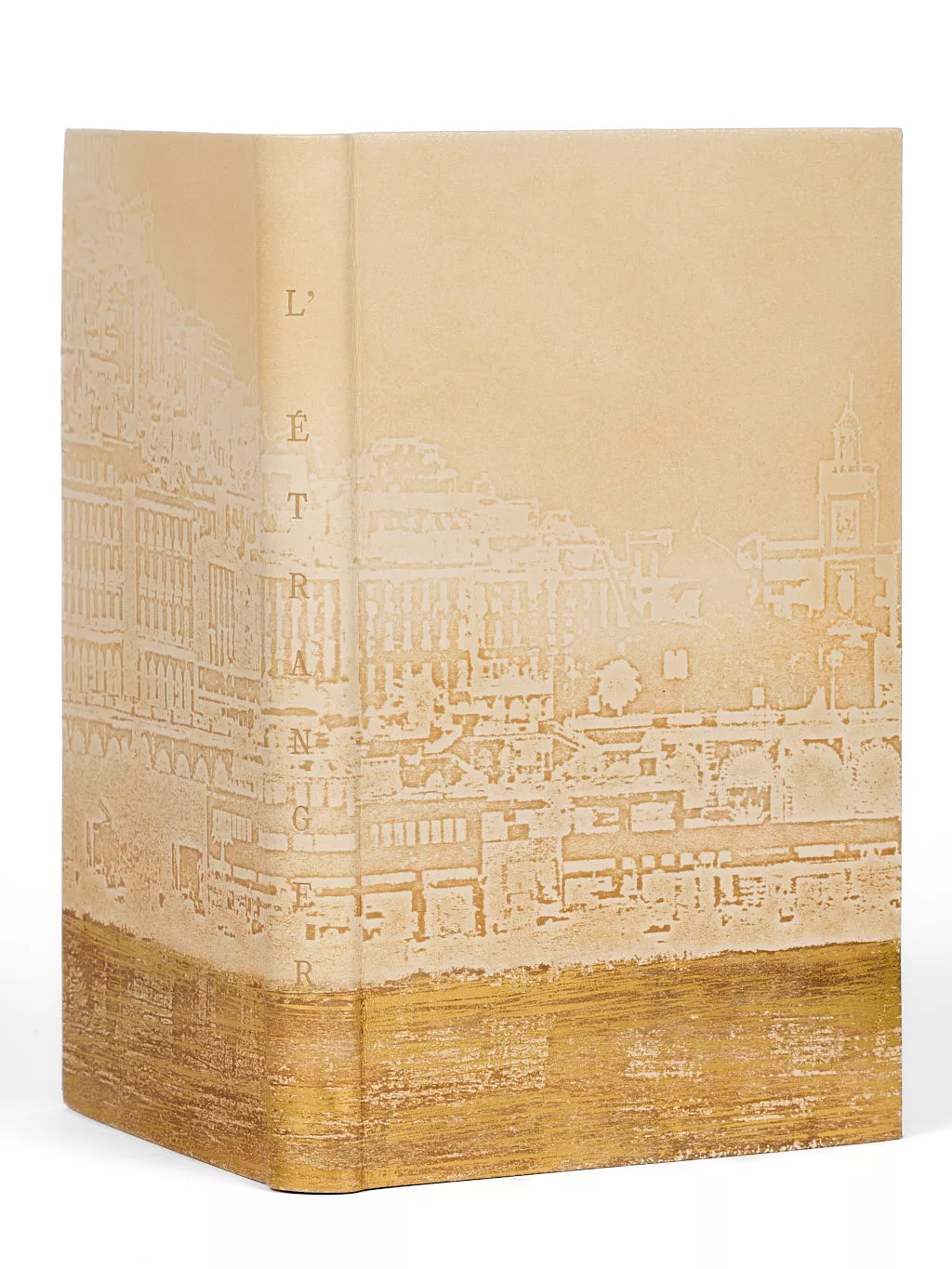
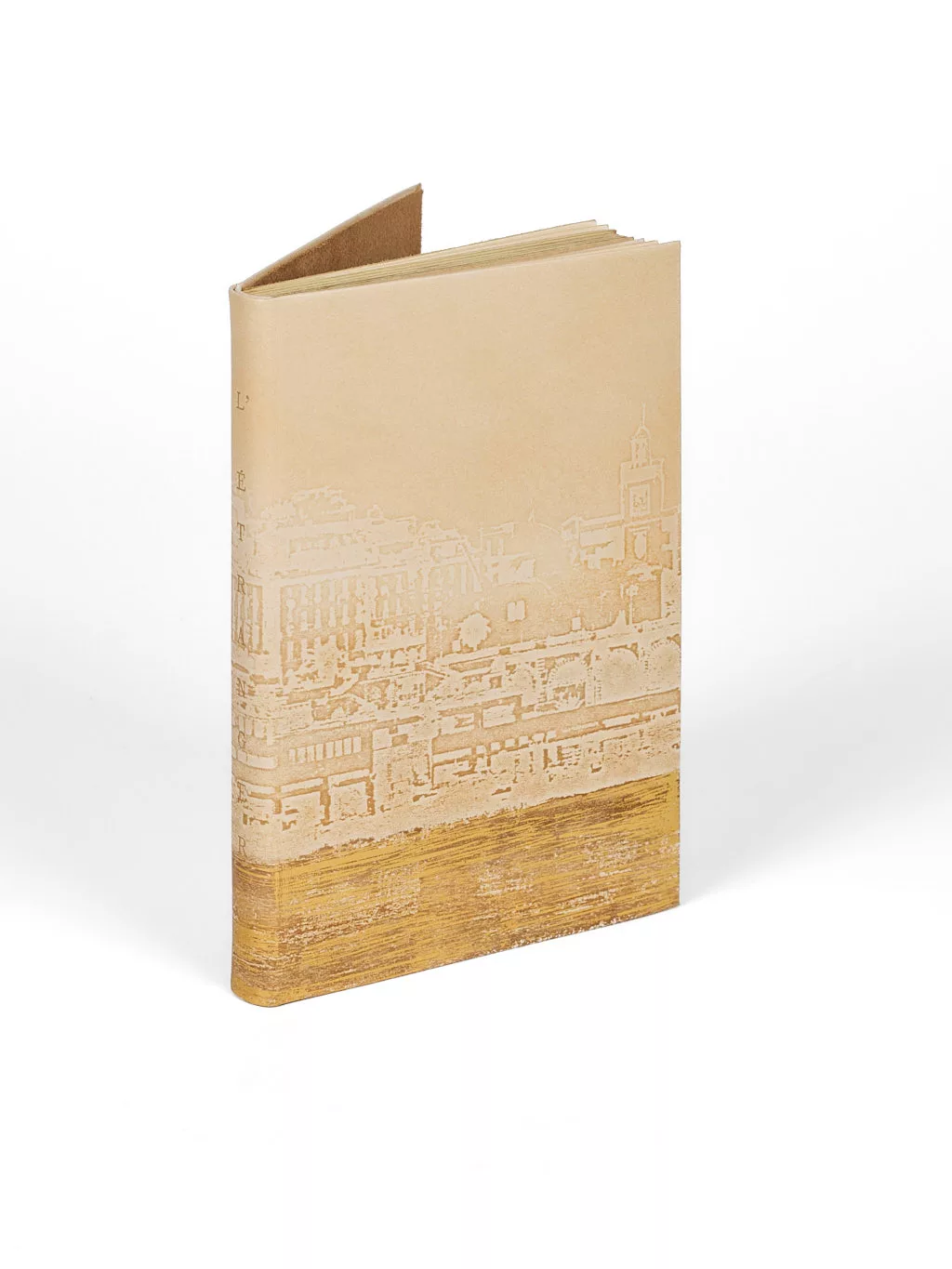
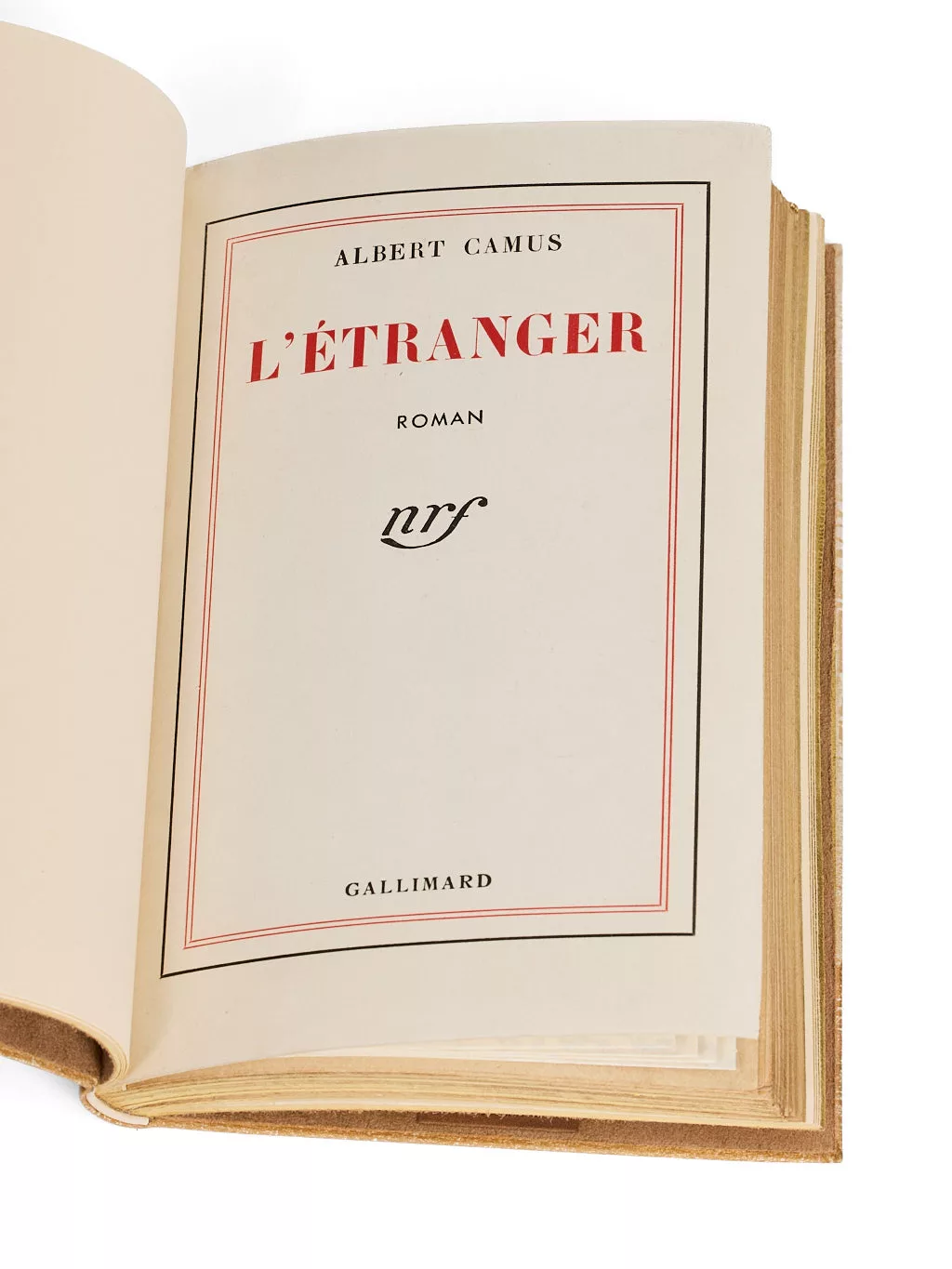
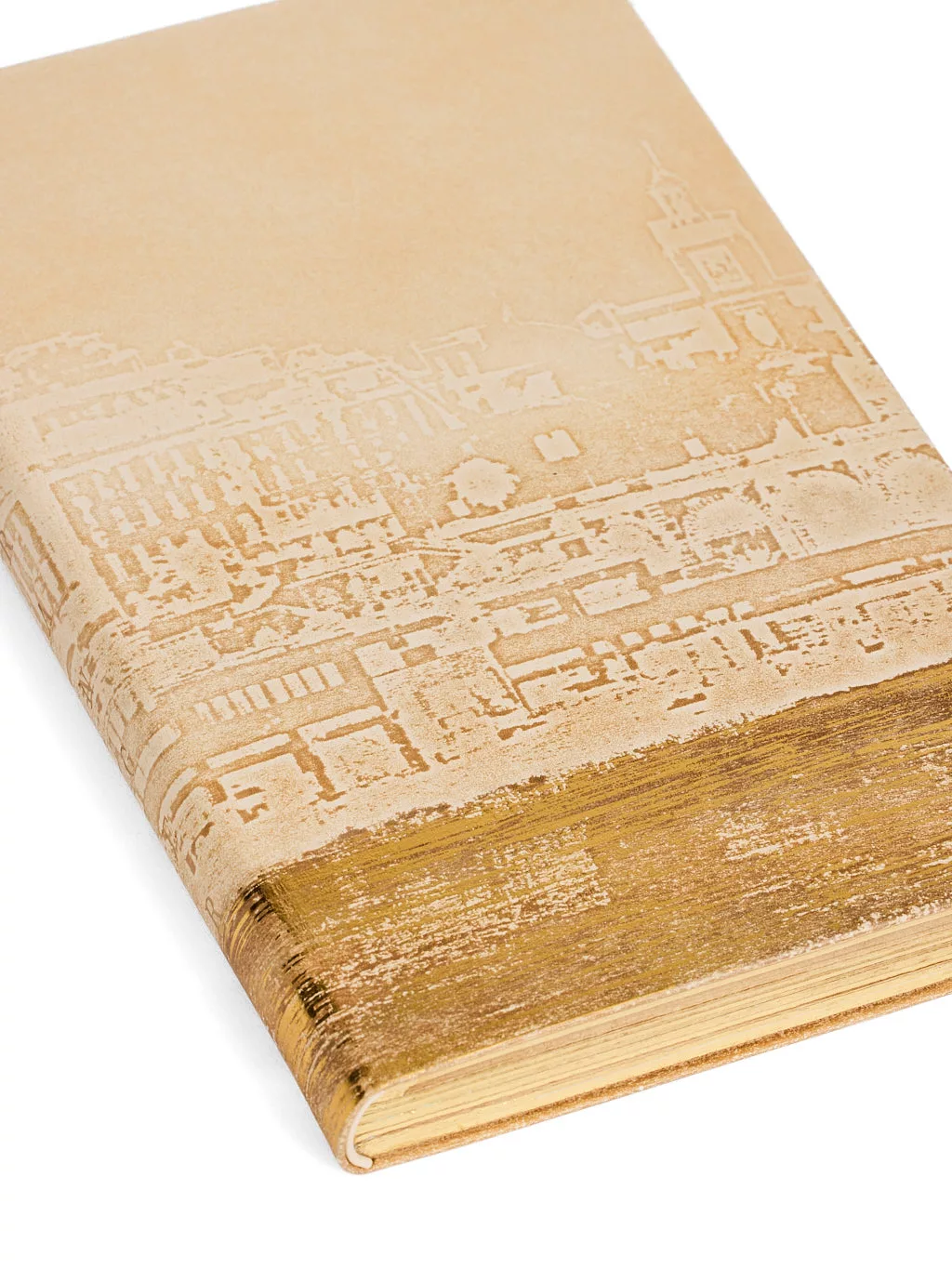

L’Étranger
Printed review copy.
A precious copy enriched with a major piece of evidence on L'Étranger: Albert Camus agrees to the adaptation of his novel, offering his opinions and clarifications.
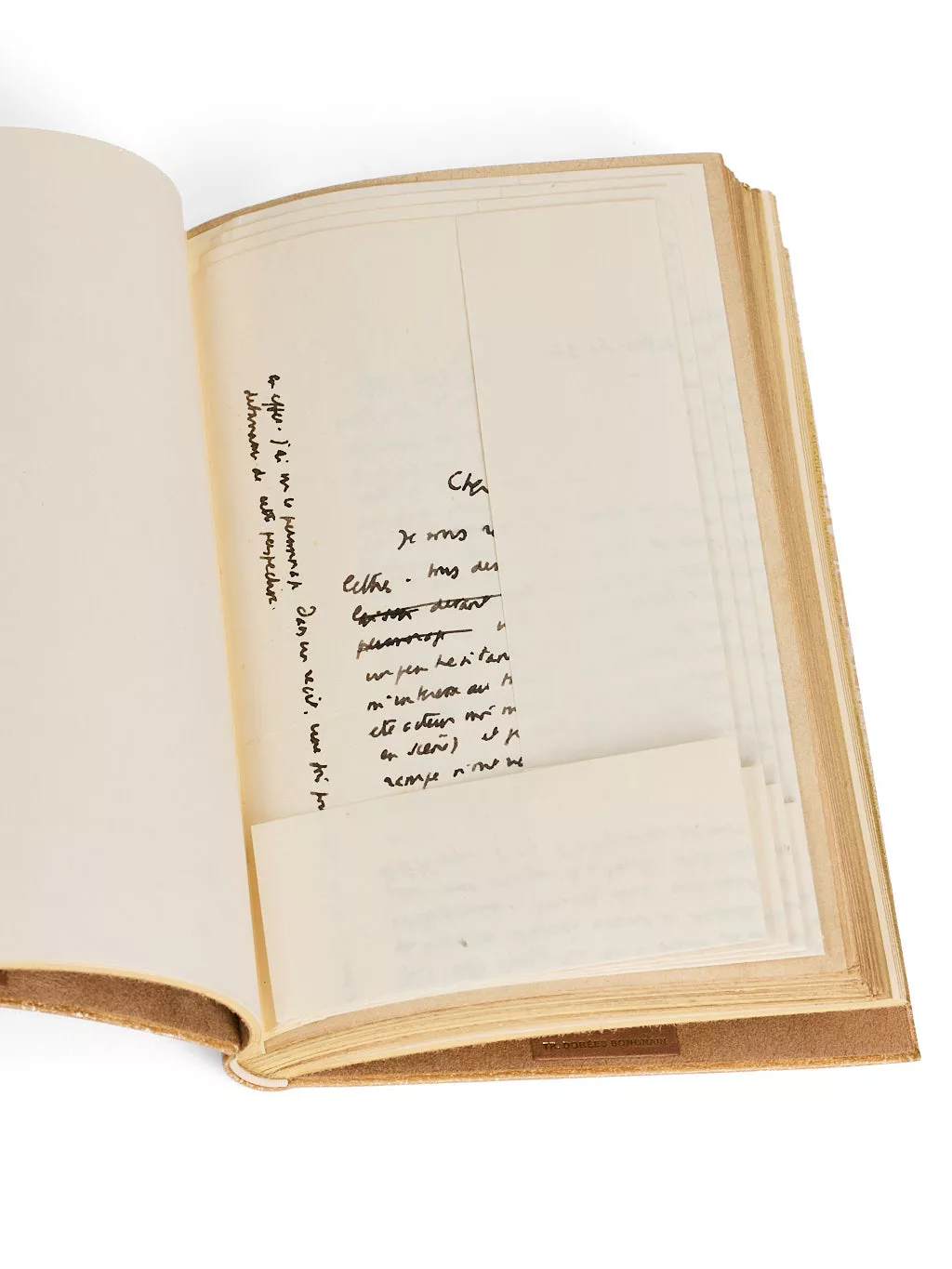
Bound in at front:
[Paris], September 4, 1954. 4 p. on 2 leaves (135 x 205 mm), in black ink, signed “A.C.”
Autograph draft of the letter to Rolf Hadrich, who wished to adapt L’Étranger.
The final letter is not known. Although several passages have been quoted before, its full content remains unpublished. It is an important document, since it sets out Camus’s own vision of the text and of its central character. Camus would later formulate this officially in the preface to the American edition of L’Étranger, published the following year: “I summarized The Stranger a long time ago, in a sentence I admit is highly paradoxical: ‘In our society any man who does not cry at his mother’s funeral is liable to be condemned to death.’ I only meant that the hero of the book is condemned because he does not play the game. In this sense he is a stranger to the society in which he lives, wandering on the fringe, on the outskirts of private, solitary, sensual existence. This is why some readers have been tempted to view him as a piece of social wreckage. A more accurate idea of the character, and one closer to his creator’s intentions, may be gained by asking in what way Meursault fails to play the game. The answer is simple: he refuses to lie. Meursault, for me, is not a piece of wreckage but a poor, naked man in love with a sun that leaves no shadows. Far from lacking sensibility, he is animated by a deep and tenacious passion: the passion for the absolute and for truth. This truth is still a negative one, the truth of being and feeling, but without it no conquest of self or of the world is ever possible.”
Roger Quilliot links this preface to “what Camus wrote in 1954 in a draft letter to Mr. Hädrich, who had submitted to him an adaptation of L’Étranger that was neither realistic nor fantastic.” Quilliot goes on to quote Camus, from the very document presented here: “I would see it rather as an embodied myth, but one very firmly rooted in the flesh and warmth of everyday life. Some have wanted to see in it a new kind of immoralist: that is quite wrong. What is directly attacked here is not morality, but the world of the trial, which is as much bourgeois as Nazi or Communist — in a word, the cancer of our times. As for Meursault, there is something positive in him: his refusal, to the point of death, to lie. To lie is not only to say what is not true; it is also to agree to say more than one means, most often in order to conform to society. If you look at the book from this angle, you will find in it a morality of sincerity, and an exaltation, both ironic and tragic, of joy and of the world.”
The opening of the letter is no less significant: “I have been interested in the theater in all its forms for twenty years, and I know that the footlights have nothing to do with the calculated light one can introduce into a novel. But your letter, and Mr. Deblue’s, have made me want to attempt this adventure with you. I know from experience that such sympathy is the only guarantee one can wish for before deciding on a collaboration. You therefore have my authorization to try to adapt and stage L’ÉTRANGER. Here is what I think of your plan: it is good. I have two objections of detail: 1) It is unfortunate not to see the murder, since it is the center of the story. 2) The monologue with which you end the sixth tableau seems to me impossible.”
A further paragraph follows, urging that the adaptation “avoid the Kafka genre and Expressionism,” before the passage on the “embodied myth” quoted above by Quilliot, who reproduced this passage in the Pléiade edition (2011, I, pp. 1268–69).
The document remains entirely unpublished, never reproduced in full and only partially quoted, notably in the biography of the writer (Solitaire et solidaire, Lafon, 2009, p. 67), in L’Étranger, Essai et dossier par Bernard Pingaud (Gallimard, 2009, pp. 191–192), and, more extensively, in Histoires d’un livre: L’Étranger (Imec, October 1990, pp. 7–8).
The letter as sent is dated September 8, 1954, four days after this draft was written. It remains unknown, and no letter from Hadrich, either before or after, appears in the public or private archives consulted — including the Camus archive (formerly Imec-Méjanes) — nor is there any more developed project for an adaptation of L’Étranger during Camus’s lifetime.
Sun-motif binding by Louise Bescond.