

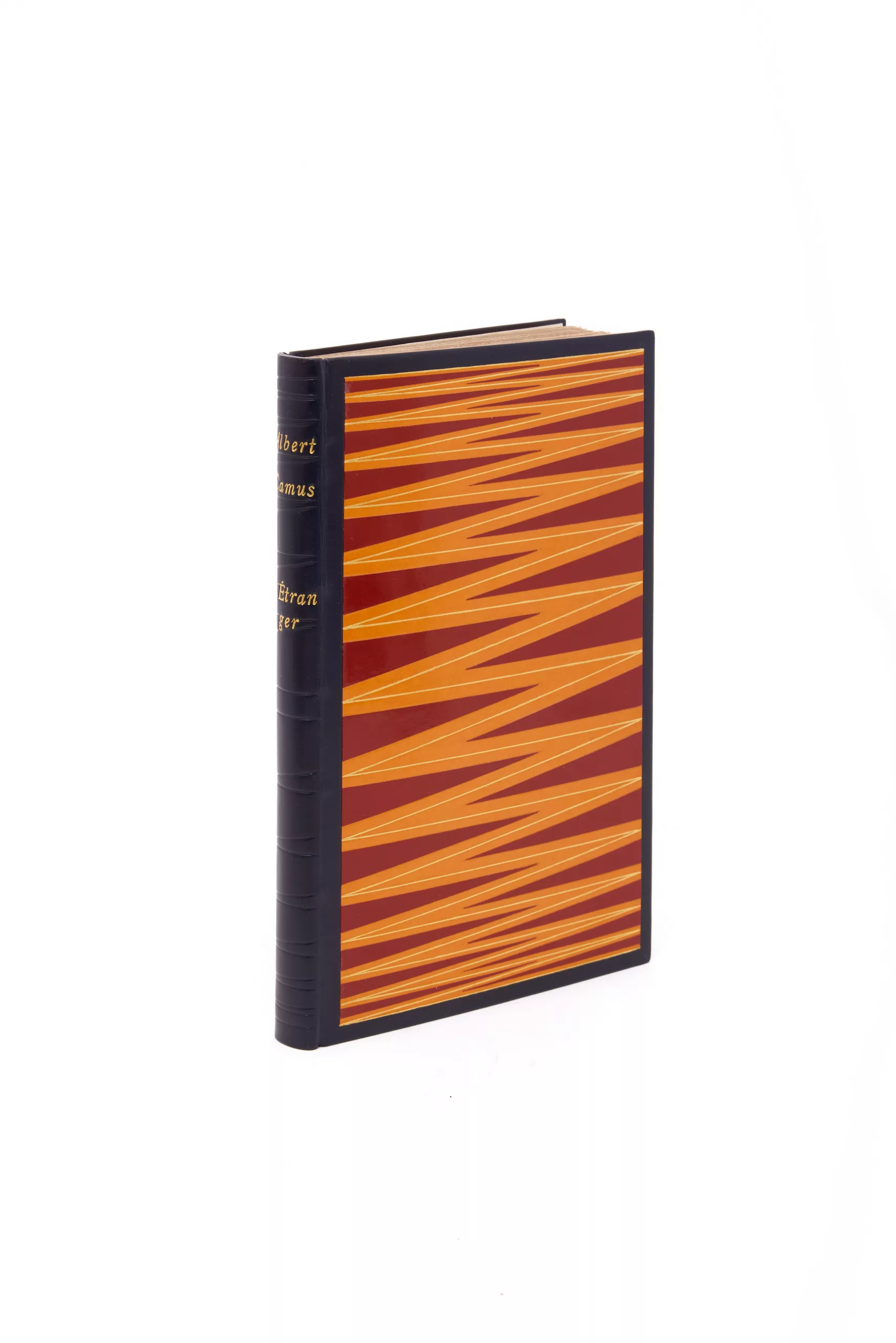
L’Etranger
The drafts and manuscripts of L’Étranger were the product of a long gestation, begun as early as 1938 but only taking definitive shape after Camus left the newspaper Alger républicain in January 1940. Camus arrived in Paris in March to join Paris-Soir. He wrote nothing there, since he was given only minor tasks, and devoted his time to his own writing; as early as May 1, 1940, he could write to Francine, who had remained in Oran, that he had “just finished [his] novel […] but my work is not done.” It would not be finished for another year, when in March 1941 he entrusted one manuscript to Jean Grenier and a second to Pascal Pia. Both — on April 19 for the first, April 25 for the second — congratulated him, Pia writing that he was “convinced that, sooner or later, L’Étranger will find its place, which is among the very first.”
The proofs were entrusted to the Chantenay printing house, at 45 rue de l’Abbé Grégoire in the sixth arrondissement, and production began on April 1, according to the Gallimard archives. Some twenty days sufficed to complete the book (printing completed on the 21st), which was put on sale less than a month later, on May 19, 1942, at the price of 25 francs, alongside the house’s other publications. Despite the war, activity was intense: 11 new titles and 19 reprints. Among the latter were already classic Gallimard authors — Claudel, Saint-Exupéry, Martin du Gard, Valéry, Gide and Morand — and three foreign titles: Nietzsche, Jünger and Dostoevsky.
A small portion of the first 550 copies was distributed from early May, in a “special” press printing bearing the words “S.P.” printed on the title page and on the back wrapper. The spine of these copies bears no price indication [25 francs]. Albert Camus, then in Algiers, could not inscribe any of them.
The remaining 4,400 copies (minus press copies) were delivered and offered for sale, divided as usual at Gallimard into eight print runs of 550 copies each, all bearing at the foot of the last line of text the words “Chantenay, Imp. Paris, 21-4-42.”
Two further printings, from the same plates and therefore strictly identical — Chantenay had been asked to preserve an impression of the book along with its original setting — took place in November (9th and 10th editions) and then December 1942 (11th to 14th editions). These copies bear edition statements (on the title page and back wrapper, without the printed press mark) and the printer’s completion statement for one or other of these two months. As a rule, copies without any edition statement have become rare, and those printed for the press are rarer still, considered, for lack of a better term, the “deluxe copies” of L’Étranger.
The first printing, in April, met with only modest success, and despite Gaston Gallimard’s efforts was reviewed in barely a dozen articles, with a mixed critical reception according to Camus:
“The reviews: mediocre in the free zone, excellent in Paris. In the end it all rests on a misunderstanding. Best to shut one’s ears and get to work” (letter to Fréminville, September 6, 1942, quoted by Todd).
The novel nonetheless sold well — and Camus had the greatest difficulty obtaining copies of his own. In September 1942 he was still complaining that he had held only a single copy of his novel in his hands. He would not return to Paris until June 1943, where he was finally able to give away a few copies, drawn from later printings or from copies bearing an edition statement. Copies without any edition statement proved hard to find, and to date we have encountered only eight inscribed examples, two of them on press copies (inscriptions made after the second half of 1943). Three other copies without an edition statement also contain an autograph note by Camus, though the copy itself is not inscribed; these notes, too, were added much later.
Finally, inscriptions on copies bearing an edition statement (but still from the April 1942 printing) do exist: our census currently records 14 such copies. Further inscriptions appear on post-1950s reprintings, though these too are not especially common.
Press copies are the rarest and most sought after.
Several were luxuriously bound relatively early, by Pierre-Lucien Martin (9 copies known) or Paul Bonet (2 copies). These are naturally the most spectacular examples.
28198