

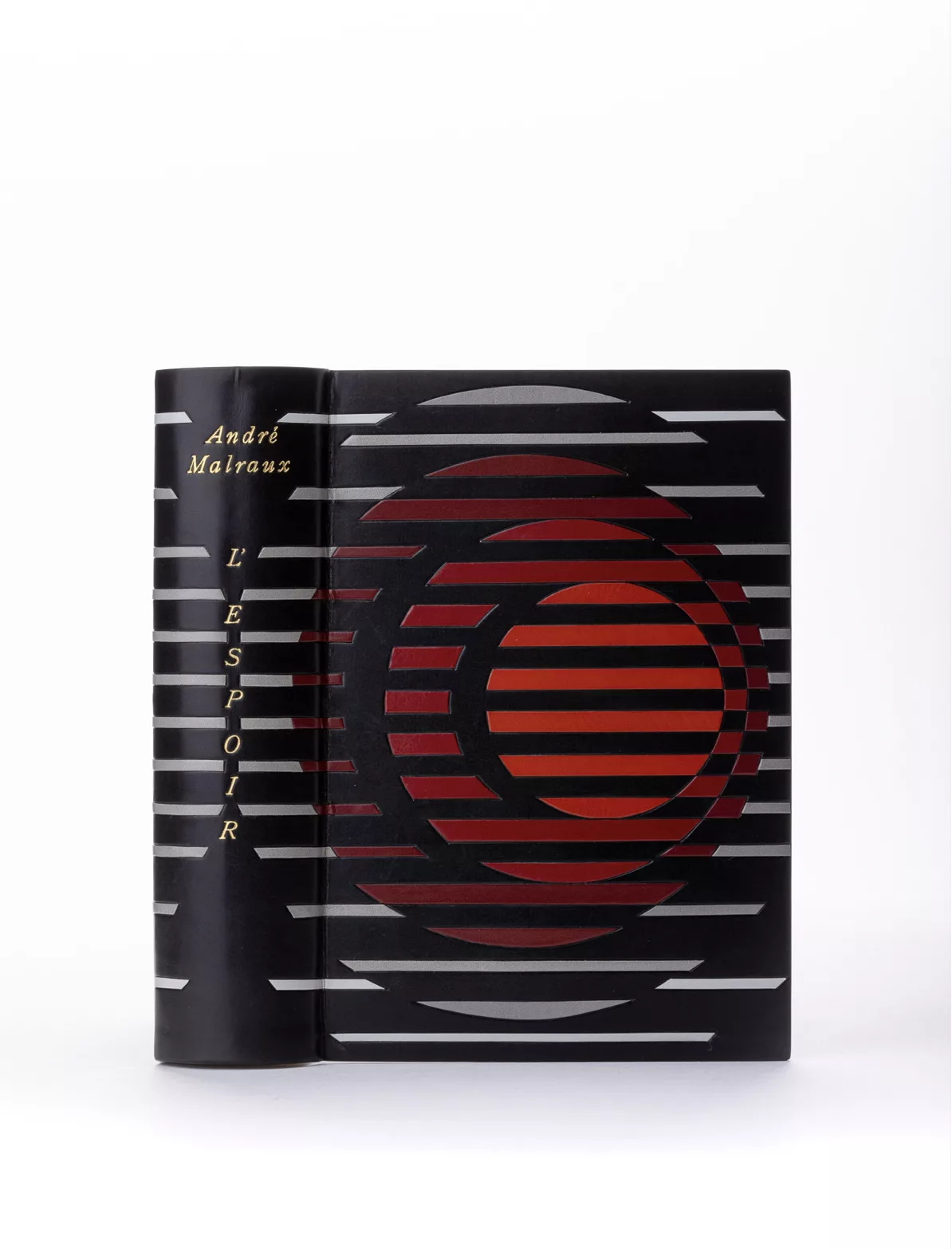
L’Espoir
One of 23 copies on white vélin de Hollande, this copy hors commerce (third paper).
It is with L’Espoir that Malraux most fully revealed himself, particularly through his reflection on the various motives behind political commitment. Like Ernest Hemingway, who had just published For Whom the Bell Tolls and by whom Malraux was influenced, he was in his mid-thirties when the Spanish Civil War broke out in the summer of 1936. Like Hemingway again, Malraux was a man of action who committed himself to the Republican left, opposing Franco’s Fascists as they attempted a coup with the support of much of the army. In 1936 and 1937, he traveled repeatedly between Madrid, Paris, Valencia and Barcelona, taking extensive notes — in notebooks, in books, on maps — which he later used to write L’Espoir, divided into three parts: “L’illusion lyrique,” “Le Manzanarès” and “L’Espoir.” He described it as an epic, in the sense of “a narrative in which the marvelous mingles with the true, legend with history, and whose purpose is to celebrate a hero or a great deed”: the great deed being the Spanish Civil War in general, and the España squadron in particular.
With the help of Pierre Cot, Air Minister in the Blum government, Malraux organized the delivery of aircraft to the Republicans and formed this squadron, initially composed of mercenaries, then disbanded and reconstituted with volunteers under the name Malraux Squadron. Holding the rank of colonel, he led bombing missions for six months, essential to the battle. Like George Orwell in Homage to Catalonia, who recalled the Republican fighters’ cruel lack of equipment, Malraux writes in a dialogue: “no collective courage can withstand airplanes and machine guns… The people are magnificent, Magnin, magnificent! says Vargas. But they are powerless.”
Malraux later made a film, Espoir: Sierra de Teruel, whose plot took up the story of a plane crashing in the mountains, one of the novel’s most iconic scenes — a story he told, never quite the same way twice, dozens of times in his speeches and writings. Malraux needed less than six months to write and publish his book, begun in February 1937, finished in September and published in December.
A very fine copy, beautifully bound by C. and J.-P. Miguet, one of their last creations. Perfect condition.