


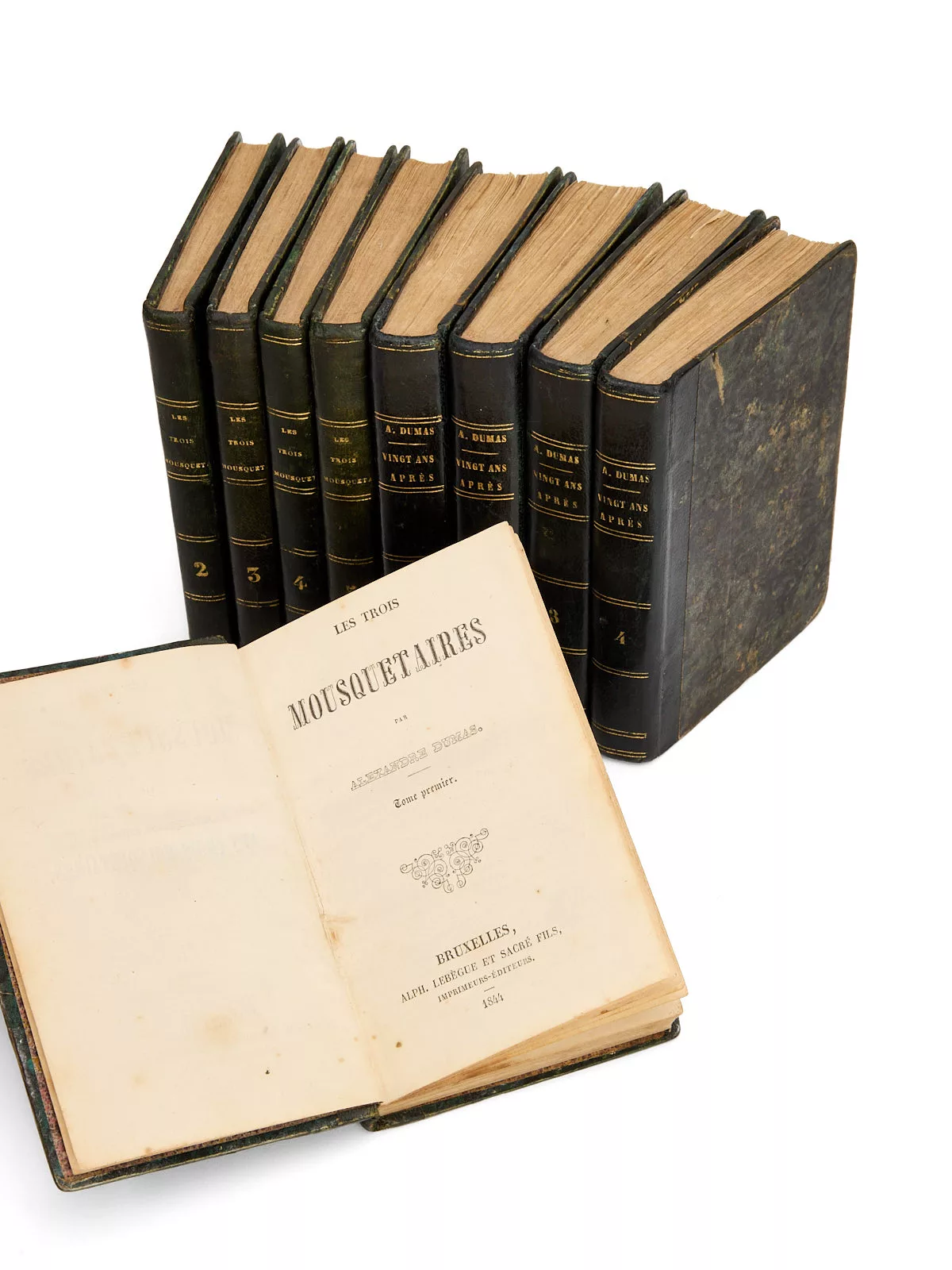
Les trois mousquetaires Vingt ans après (suite des Trois mousquetaires)
Both precede the Paris book editions published by Baudry.
The two series are complete with all title and half-title leaves, which are often missing.
On 14 March 1844, Le Siècle published the first instalment of a novel destined for universal fame: Les Trois Mousquetaires. Drawing on the tradition of the historical novel established by Walter Scott, Alexandre Dumas, with the assistance of Auguste Maquet, created a flamboyant, fraternal and immensely popular swashbuckling epic set during the reign of Louis XIII. Its impact was immediate: throughout France, readers eagerly awaited — or had read aloud to them — each day’s instalment.
The phenomenal success of the serial immediately attracted publishers. Even before the Paris book edition appeared from Baudry in the second half of 1844, no fewer than three unauthorized editions were issued in Brussels, then a major center of pirated publishing.
The edition published by Alphonse Lebègue and Sacré fils is both the earliest and the rarest. Douglas Munro identifies it as such in his standard bibliography, describing the Belgian issue as “The original edition in French.” The two subsequent Brussels editions were published by Société belge de librairie Hauman et Cie and Meline, Cans et Compagnie; further editions were then typeset for publication and distribution in Leipzig. All bear the date 1844, but have different title pages.
The reason for these “pirate” editions was straightforward: Les Trois Mousquetaires was not yet available in book form when Dumas auctioned the Paris publishing rights. Baudry secured them at considerable expense, but the Belgian edition was already in circulation, without authorization.
The text itself is of considerable importance. Since serial authors were paid by the line, the original version was longer and contained more dialogue than the text Dumas revised for Baudry’s Paris edition. The first edition in book form therefore differs from the authorized version “not only by small corrections, but also by more than two hundred major variants, often extending over entire paragraphs” (Munro).
Dumas was well aware of the practices of publishers and newspapers. The roman-feuilleton had become an unprecedented publishing phenomenon, transforming reading habits and the relationship between authors and the press. Eugène Sue, Paul Féval and Paul de Kock were among its masters, but Dumas reigned supreme. His serials brought newspapers new subscribers, generated translations throughout Europe, inspired theatrical adaptations and prompted countless new editions.
“All for one, one for all.”
The myth was born. D’Artagnan, the bold and loyal young Gascon, arrives in Paris and encounters Athos, Porthos and Aramis, with whom he forms an unbreakable friendship. Four contrasting characters became universal figures: the noble and melancholy Athos, the gigantic and vain Porthos, the worldly and clerical Aramis, and the impetuous, courageous D’Artagnan.
Dumas drew upon Courtilz de Sandras’s Mémoires de M. d’Artagnan (1700), but transformed his source through a dramatic and moral imagination entirely his own. To those who accused him of mistreating history, he famously replied: “What does it matter if one violates History, provided one gives her beautiful children?”
Victor Hugo enthusiastically praised Les Trois Mousquetaires as a work of gripping drama, passionate energy, vivid dialogue and sparkling style. The novel can be read at any age as a celebration of loyalty, friendship and panache.
Dumas produced its sequel almost immediately. Vingt ans après began appearing as a serial in January 1845 and was subsequently issued in book form by Baudry. Once again, the Lebègue edition published in Brussels preceded the Paris edition.
Twenty years have passed. Richelieu is dead and Mazarin has taken his place. France is shaken by the Fronde. The musketeers are older and scattered, their youthful certainties eroded by time. Dumas summons them once more and asks what remains of their former ideals. The novel becomes darker, more complex and more political: Cromwell replaces Buckingham, while Mordaunt takes up the legacy of Milady. The heroes remain brave, but death is closer and doubt has entered their world.
Meanwhile another great Dumas phenomenon was already under way: Le Comte de Monte-Cristo, serialized between 1844 and 1846.
The Belgian Trois Mousquetaires is an extraordinary witness to the speed with which Dumas’s success spread and to the importance of Brussels piracy in nineteenth-century publishing. Belgian publishers, beyond the reach of French copyright enforcement, could typeset successive chapters almost as soon as they appeared in the newspapers and place inexpensive book editions on the French market before the authorized Paris publisher had completed its own edition.
These unauthorized editions — for which Fernand Vandérem later coined the term “préfaçons” — became a major problem for the French book trade during the first half of the nineteenth century. Today, however, the earliest of them preserve the first appearance in book form of one of the most famous novels in world literature.
Munro, Alexandre Dumas Père, A Bibliography of Works Published in French 1825–1900, pp. 142–144 (Les Trois Mousquetaires: “the greatest of Dumas’ romances”); Vicaire, III, 359; Carteret, I, 235; Clouzot, 98; En français dans le texte, no. 263. For Vingt ans après: Vicaire, III, 368–369; Munro, 166.