

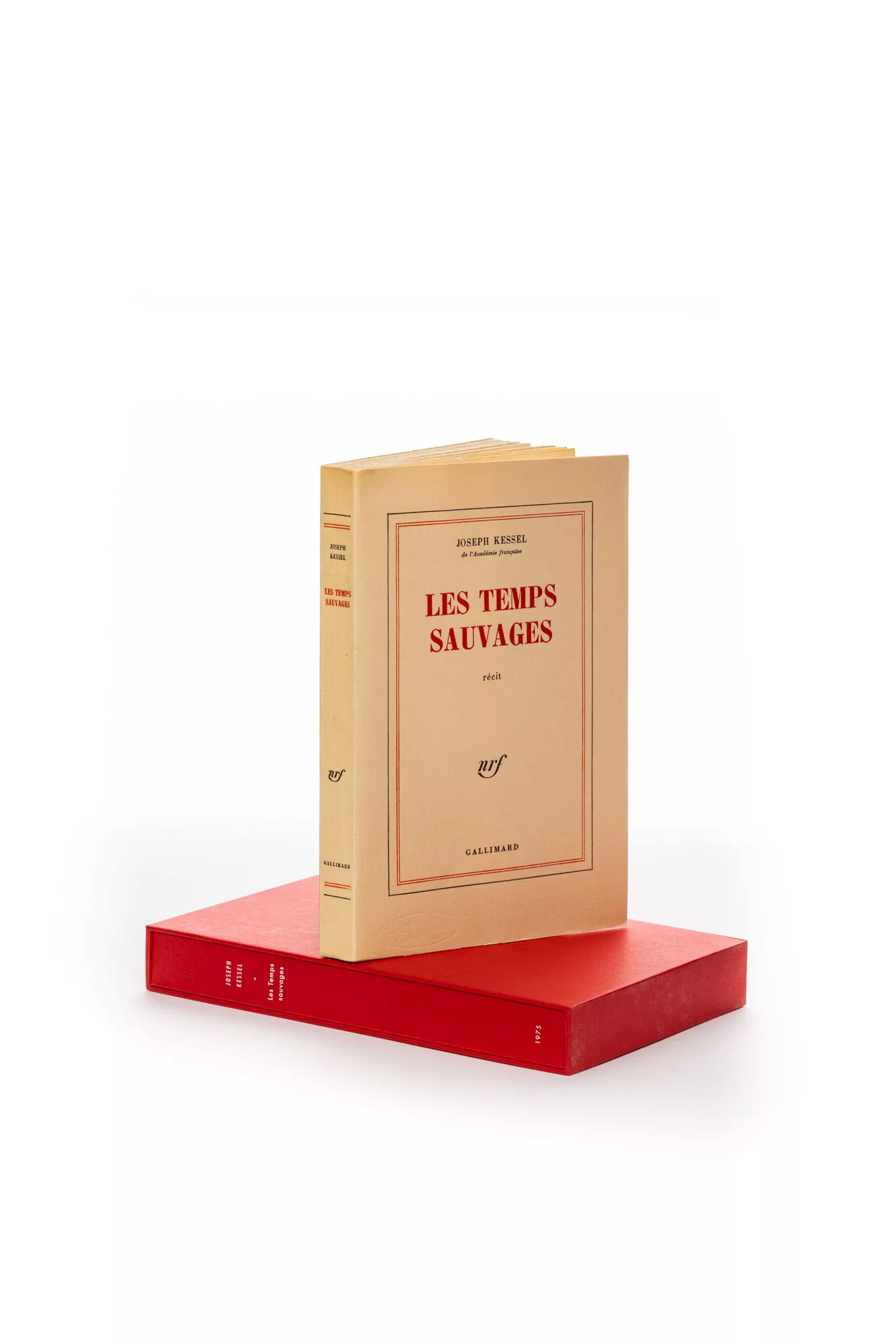
Les Temps sauvages
One of 32 copies on vergé de Hollande, this copy no. 2.
It was at Avernes, a small village some fifty kilometers northwest of Paris, in a long building poetically named “le Four à chaux de Marie Godard,” that the traveler-writer often withdrew to compose first Les Cavaliers, then Les Temps sauvages. He began writing it upon returning from a trip to Afghanistan with his wife.
For Kessel, the book was an occasion to revisit his early years. In October 1918, a unit of volunteer airmen was formed for Siberia. Kessel, a sub-lieutenant barely twenty years old, did not hesitate and sailed from Brest, bound for Vladivostok. What he found there was not war — he missed the fighting entirely — but the madness of a world upended by revolution: a city held by Cossacks, nightly apocalypse at the Aquarium cabaret, a former barracks housing six thousand prostitutes, a hysterical world accelerating toward disintegration, which Kessel recounts as though it were a war narrative.
“One had to master the savage within oneself, the brute, the animal,” he recalls of his time in Siberia in 1919, a young victor of the Great War, in the opening pages of the novel. In this he is close to Jack London and his philosophical, misanthropic vision: man is a wolf to man, though wolves do not devour one another. As a wild beast, man transforms and survives, for better or worse. “Only the males of the human species murder their mates,” Jack London wrote in The Call of the Wild.
Fine condition.