

Les Témoins
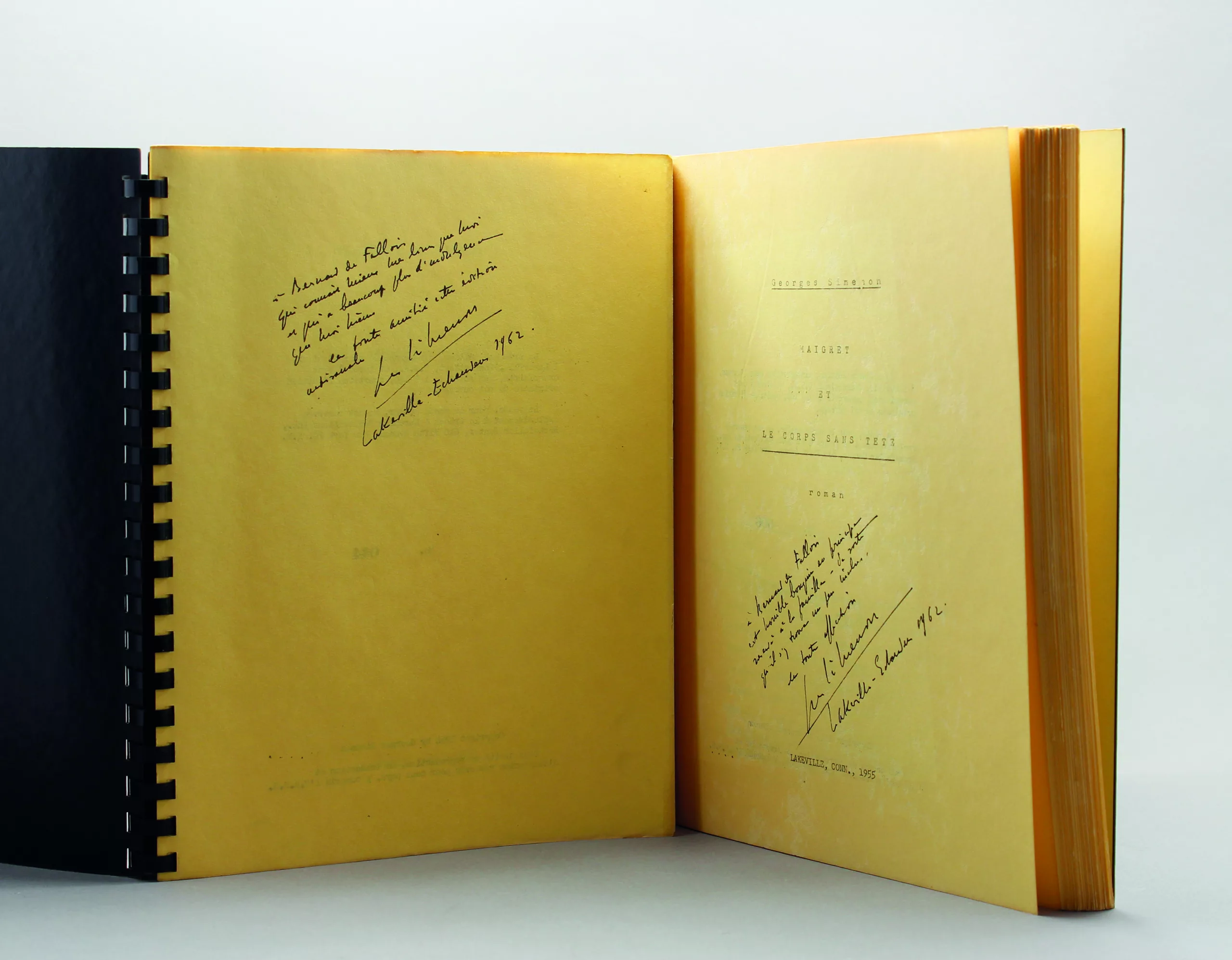
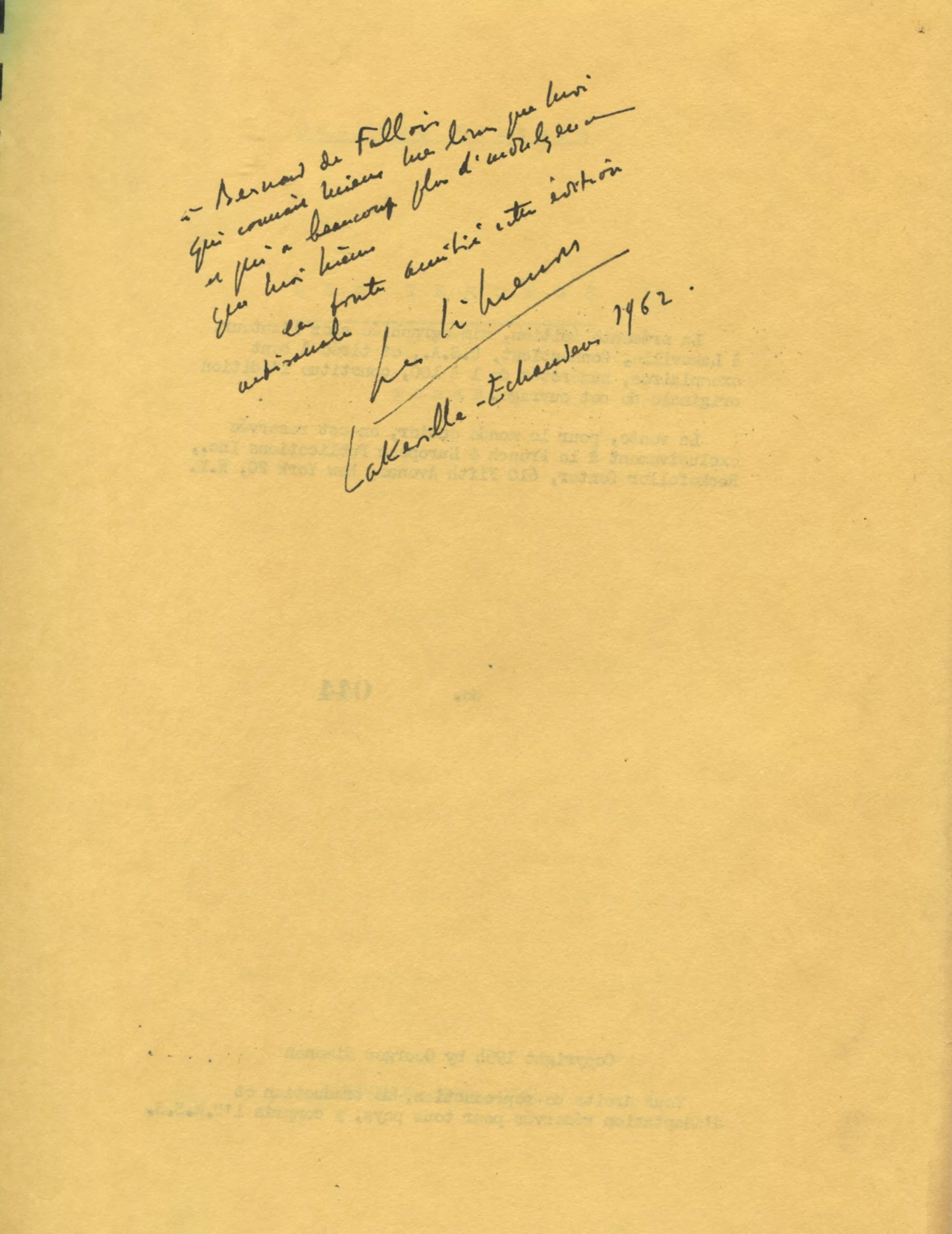
Presentation copy inscribed by Simenon to Bernard de Fallois: “à Bernard de Fallois qui connaît mieux mes livres que moi et qui a beaucoup plus d'indulgence que moi-même. En toute amitié cette édition artisanale. Georges Simenon, Lakeville-Echandens, 1962.”
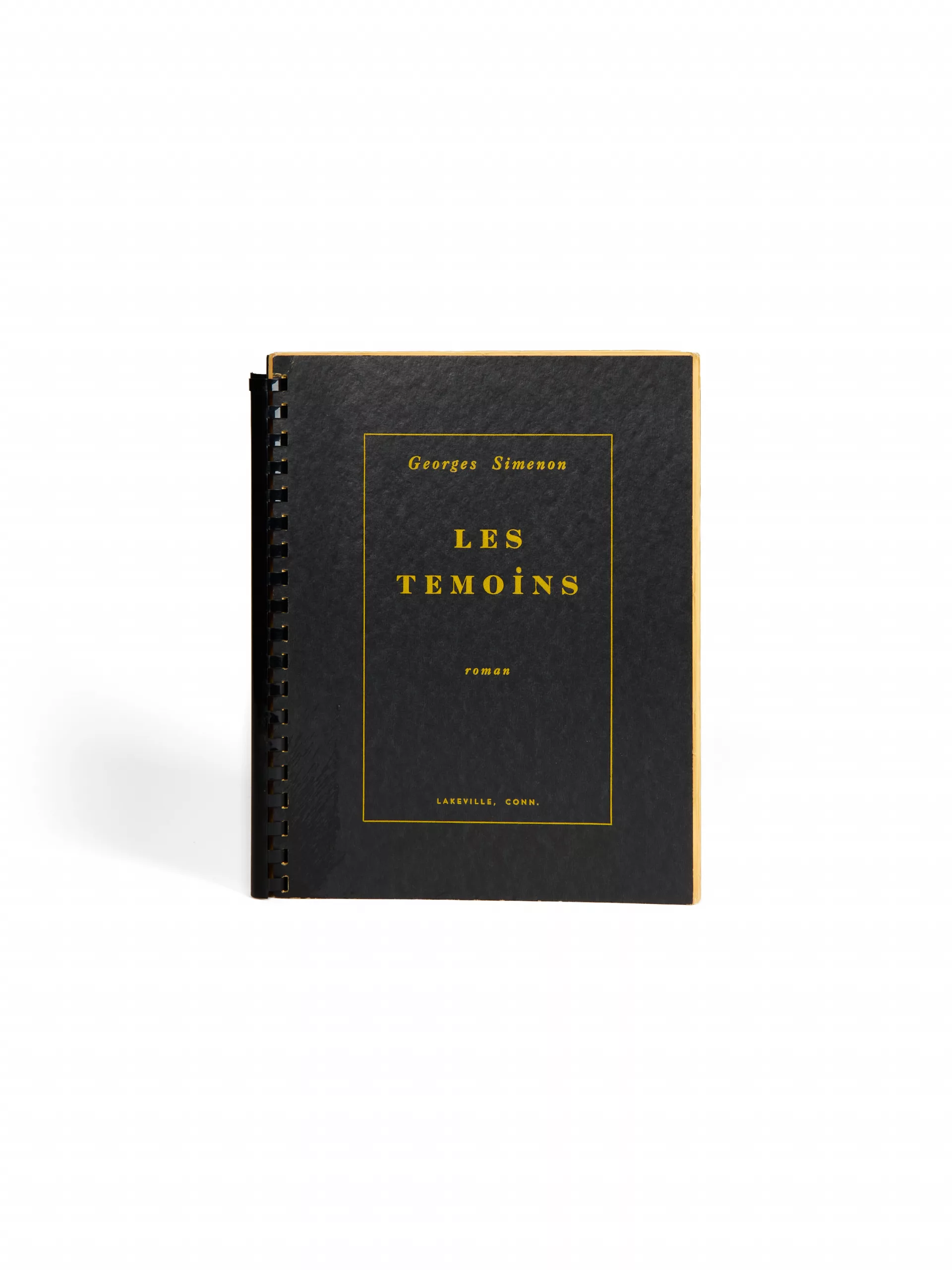
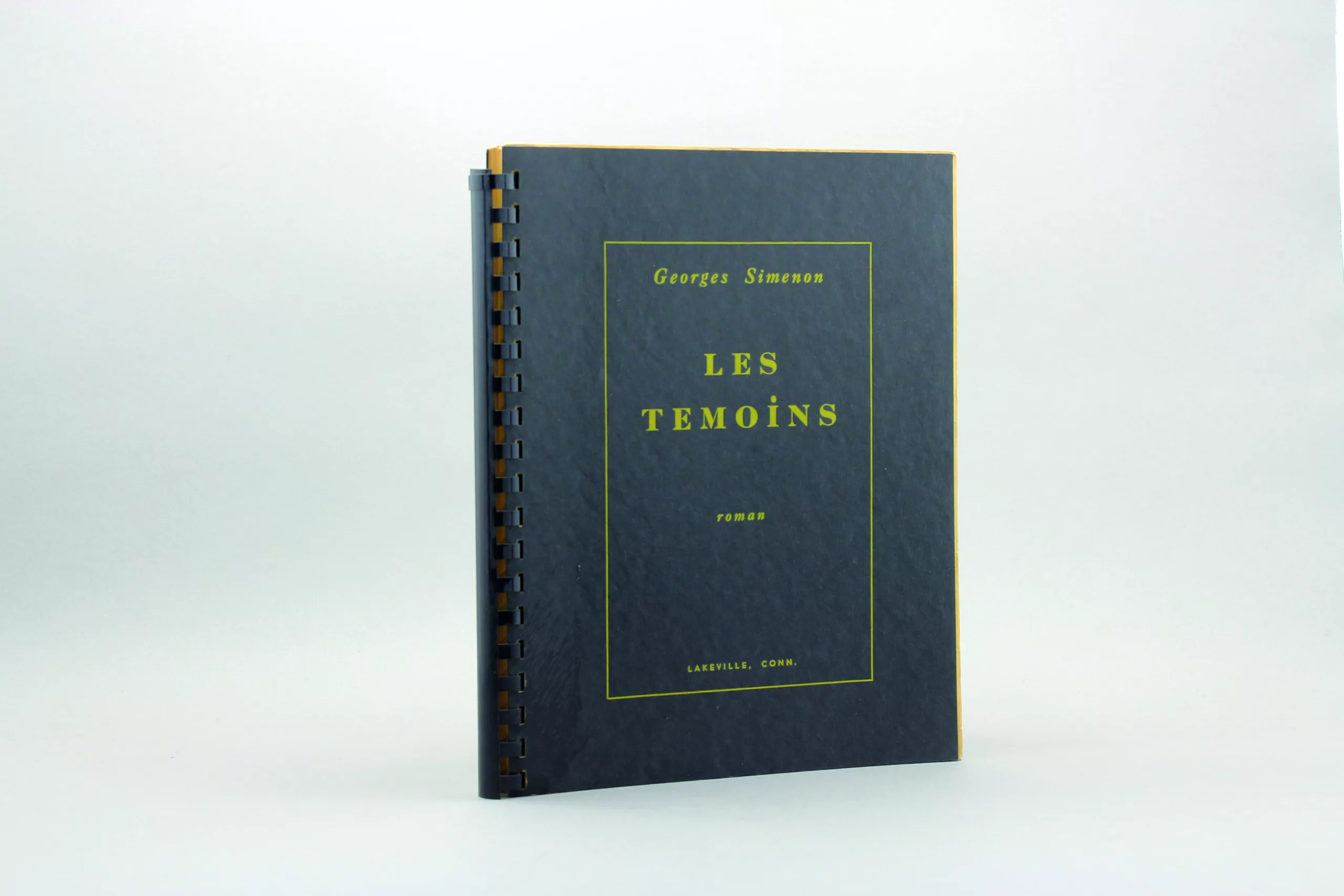
In 1950, shortly after his marriage to Denyse, Simenon settled in Lakeville, a small town in Connecticut, at Shadow Rock Farm. His novels followed one another there at an impressive pace, immediately published in France by Presses de la Cité. Three of them, however, received a special publication in the form of a limited mimeographed edition, distributed exclusively through French & European Publications at Rockefeller Center in New York: Maigret chez le Ministre, Maigret et le corps sans tête and this Témoins. “He kept only part of the print run, just enough to give away a few copies to his circle and please his visitors. Which explains why these first editions hardly circulate and are extremely rare on the market […].”
To date, we know of no copy numbered higher than 44: nos. 2, 4, 5, 6, 7, 9, 10, 11, 12, 14, 15, 16, 17, 22, 24, 25, 27, 29, 31, 34, 35 and 36, and no. 44, for this Témoins. An appeal to collectors who may own others, as a fuller census would be most valuable! As for signed presentation copies, six others are known: two for Maigret chez le Ministre, three for Maigret et le corps sans tête, and only one other for Les Témoins (that of his Parisian publisher Sven Nielsen).
The inscriptions are each addressed to close friends, in the years following publication (between 1956 and 1964). This one is no exception: Bernard de Fallois was a close friend of Georges Simenon and a discerning connoisseur of his work, having taken a passionate interest in it from the 1950s onward, publishing in 1961 an essay devoted to Simenon with Gallimard (in the “La Bibliothèque idéale” series edited by Robert Mallet).
He was the first to dare state the obvious: “the Maigrets should be regarded as novels in their own right, despite the reluctance of French taste to admit a body of fiction that belongs neither to a stylist nor to a writer of ideas. ‘He writes like the man in the street,’ Alexandre Vialatte once said of him, in a bad mood. To which another critic replied, not without humor: ‘What is curious, however, is that apart from Simenon nobody knows how to write like the man in the street.’”
It was Gaston Gallimard who asked Bernard de Fallois to write the volume for La Bibliothèque idéale, in 1961: “A few years earlier I had published Jean Santeuil and Contre Sainte-Beuve, and tried to explain the genesis of the Recherche. But by then it had come to be understood that Proust was the greatest writer of the century. Simenon, on the other hand, was not regarded as a great writer, the equal of Balzac or Dostoevsky. I wanted to speak of him in that way, without the reservations that were always attached to his name. I asked to meet him, to learn everything he had written before he first signed his own name. From then on we became close friends, and for more than twenty years I spent a week at his house every year.”
One of only two known copies with a presentation inscription.
Extremely rare.
Jean-Baptiste Baronian, La Bibliophilie, une sanction, Lausanne, L’Age d’Homme, 2006, p. 23, and Bulletin de l’Académie Royale de Langue et de Littérature Française, tome LVXXXIII, 2010; Menguy, 192, p. 103.